One for Sorrow – Mary Downing Hahn

This book begins with a run-on sentence. Prepare yourself for a rant, because there will be no prisoners taken, nor will I be using any spoiler warnings in this review…

https://pdpabst.files.wordpress.com/2017/07/one-for-sorrow-book.jpgTitle: One for Sorrow: A Ghost Story
Author: Mary Downing Hahn (1937-)
Original Publication Date: 2017
Edition: Scholastic Inc. (2018), 293 pages
Genre: Horror. Fantasy. Historical fiction.
Ages: 10?
First Sentence: Although I didn’t realize it, my troubles began when we moved to Portman Street, and I became a student in the Pearce Academy for Girls, the finest school in the town of Mount Pleasant, according to father.

It’s 1918 and the Spanish Flu is making the rounds of America. Shy Annie Browne is new in school and on her first day is immediately “befriended” by Elsie Schneider, a lying, controlling, destructive little psycho whom all the other girls despise. Annie is prevented from making any other friends until Elsie is absent from school, at which point Annie is finally brought into the popular circle – and takes part in their ceaseless bullying of Elsie. There’s no doubt that Elsie brings it on herself, but she’s grossly outnumbered and Annie feels bad about her part in it (not that it stops her). Eventually, Elsie gets the flu and dies, only to return as an angry ghost with a particular grudge against Rosie, the leader of the clique, and guilt-stricken Annie.

Okay, so the writing in this book is absolutely horrible, beginning with the most brutally short paragraphs this side of a Guardian article. Sentences are clipped, descriptive prose is fleeting and the vocabulary is limited and therefore numbingly repetitive. Is this the style of today? If so, it’s been streamlined of everything that could possibly make reading a “chore.”

Just as I finished my oatmeal, Jane knocked on the door.
When I ran to meet her, she gave me a big hug. “Oh, I’m so glad you’re well enough to come back to school, Annie. I’ve missed you so much.”
“I’ve missed you, too.”

https://d.gr-assets.com/books/1348400532l/200891.jpg
I’m just going to recommend better books in these spaces today.

The prose is continually stuck at the level of early chapter books – and not even challenging ones at that. You’ll find more detailed verbiage in American Girl, Chet Gecko and Beverly Cleary stories for younger readers and that’s a death blow for this entire book. The concept – a ghost story kicked off by the Spanish Influenza at the end of the First World War – has so much potential, but it can’t be harnessed because the setting is never given any focus or weight. Hahn is a veteran writer; she’s been doing this since the 1980s and once won the Scott O’Dell award for historical fiction, but there’s no evidence here for why that would have ever been the case. Aside from the games girls played, the books they read and some basic info on wakes and horse-drawn hearses, there’s just nothing here. Maryland in 1918 is a vague backdrop for the ghostly plot, nothing more.

As far as the plot goes, Elsie’s ghost doesn’t appear until over 100 pages in – before that, One for Sorrow is a story about bullying, which means it should be character driven. It isn’t. Aside from Elsie and Rosie, almost none of the characters merit any physical description or personality. The clique of mean girls are only distinguishable by their degrees of guilt, with the “nice” ones (Annie and Jane) feeling more guilt and the “mean” ones (Eunice and Lucy) feeling less, with Rosie somewhere in the middle. Never mind that this sets up the phony idea that guilt is somehow a virtue; it can lead to virtue but just as easily to self-destruction. As such, none of these girls have any positive traits whatsoever. They are nasty, ill-mannered liars without a complete spine between them. Rosie comes up with a plan (inspired by the true story of Hahn’s mother) to get free sweets by going to wakes and pretending to know the dead people there. “We won’t be doing anything wrong,” Rosie said. “We’ll tell people how sorry we are, we’ll talk about how nice the dead person was, we’ll make the mourners feel better. That’s not taking advantage, that’s not lying.” And Annie more than once compares this horrid specimen to Anne Shirley, who never told a lie. But since most kids won’t (or can’t?) read Anne of Green Gables, I guess they’ll never know that.

As for Annie, she’s a complete drip with no spirit at all. One could be forgiven for assuming that she must improve at some point, being the protagonist and all, but you would be wrong. To the end she thinks (paraphrasing): “oh, why did I let Elsie make me do those terrible things?” She makes no effort to defeat Elsie’s ghost. She goes along with every stupid and cruel idea Rosie ever has, even one which nearly gets her killed, and then feels bad afterwards. She does not grow or alter through the book and never comes clean. When she stumbles upon a retired ghost hunter called Mrs. Jameson, it is by accident, and she simply follows all of Mrs. Jameson’s instructions thereafter with no agency of her own.

https://i0.wp.com/d.gr-assets.com/books/1293762966l/596878.jpg
The second book about Tiffany Aching. Excellent, complex and creepy.

So much for the characters. The plot begins with children being mean (usually by shoving and screaming insults at one another) and once Elsie’s ghost appears it’s just round two of the same spiel for more tedious pages of screaming and shoving. Ghost Elsie is exactly the same as living Elsie, only with more power. This should be unnerving but it isn’t. For instance, Elsie possesses Annie and makes her do terrible things, but Annie doesn’t black out (which would heighten the suspense by adding mystery) or have enough personality to make the behavioral change feel horrifying (a la Tiffany Aching in A Hat Full of Sky). The writing continues to be frenetic and flat, and Elsie explains from the start what she intends to do to Annie, so there’s no chance for the situation to ever feel dreadful or uncanny: Alone except for Elsie, I found myself removing the flu mask from my bookbag and tucking it into Rosie’s. I didn’t want to do it, but I couldn’t stop. It was as if I were outside my own body, watching myself.

One for Sorrow is a ghost story that has no sense of the unearthly and no allowance for anything bigger than the individual. A Scooby-Doo hoax would feel more authentic to this novel’s worldview because while this is set in 1918, all of the characters are from 2017.

https://images.gr-assets.com/books/1361116236l/500660.jpg
By These Ten Bones, featuring werewolves in medieval Scotland. Good and evil, religious belief, horror and the highlands. Worth checking out.

In 1918 a girl’s first thought about ghosts would involve the state of the soul, salvation and damnation. Annie would pray to God for aid and she would go to church – if for no other reason than the hope that Elsie couldn’t follow her there. But Annie doesn’t even think of any of those things, because Annie is from 2017. That’s why she mishears the phrase “at peace with the Lord” as “at the beach with the Lord” – because she’s never heard it before. She’s shocked at the notion of corporeal punishment because her parents and teachers also belong in 2017 (Miss Harrison, faced with a sea of screaming pupils disgracing her school’s orderly reputation, disciplines them by ending recess early). Muddying the waters are a couple of references to hell and the devil, which means Hahn wants us to think of these characters as Christian, even though they obviously aren’t.

So let’s try to assume that Annie and her entire social circle are the very height of the 1918 progressive movement. But just as there’s no spiritual element to her problem, there’s no historical one either – because guess what? Annie loves to read, so it really should occur to her that Elsie can’t be the world’s first ghost. It has to have happened before and there should be records, yet she does no research on spiritualists and ghost-hunters, and no one reading this book would gain from it any sense of the antiquity of hauntings. When Annie’s bad behavior gets out of hand, she’s sent to a convalescent home and it just so happens there’s a retired ghost-hunter on the premises. Mrs. Jameson drops hints that she’s an expert on the matter, but even at this stage there’s nothing bigger than the ghosts – in fact, Mrs. Jameson can’t “help” Elsie until she dies and becomes one herself. In other words, when Elsie causes Mrs. Jameson to fall and break a hip, it’s actually a good thing.

Lastly, although Elsie is clearly psychotic – revelling in every drop of pain she causes and before her death probably headed to a future abducting and murdering children – it turns out that she can only be defeated by empathy.
https://vignette3.wikia.nocookie.net/bartimaeus/images/1/1d/Trilogy.jpg/revision/latest/scale-to-width-down/200?cb=20140528201030
Annie is basically a villain protagonist, but if that’s what you’re looking for, this is still the gold standard.

It’s not even genuine empathy. You know, the sort that would make this story less about the ghost and more about the life lessons the heroine learns about caring for others and standing up to bullies and whatnot. That would be corny but fairly typical. Instead, Mrs. Jameson flat-out instructs Annie to lie: “Be kind to her, earn her trust.” Annie loathes Elsie but pretends otherwise – and it’s the right thing to do. Elsie kills Mrs. Jameson – and it’s the right thing to do. Early on in the book, Elsie screams at Annie: “I’d give anything to have a mother like yours. It’s not fair that you have so much and I have nothing!” Herein lies the key to her defeat. She’s just an underprivileged child who wants her mommy and the whole book was a 200 page temper tantrum (culminating in the murder of a little old lady). It turns out that sympathizing with the motives of evil is what defeats it.

To be extra clear, Elsie does not show any mercy at the end of this book. She becomes “reachable” because she turns maudlin and self-pitying for a couple of minutes. She is not redeemed, but she gets everything she wanted, including a free ticket to the afterlife to reunite with her dead mother. She’s like Hannah in Thirteen Reasons Why, only she’s a literal ghost instead of tapes. She dies and is avenged. All of the adults feel sorry for her, all of the girls who wouldn’t be her friends are haunted by their actions and she never has to repent or live with any of her own choices.

The point of the Castle Project has always been to read as widely as possible in the field of children’s literature. I cannot proclaim the superiority of vintage options if I don’t read the modern alternatives. Well, here you go. On technical merits, One for Sorrow is abysmal. It is relentlessly unpleasant, philosophically poisonous and the bigger picture behind this book implies that speculative fiction in particular is on a steep decline. If there’s nothing bigger than our finite experience, if good and evil are relative based on the individual and if our entire history means nothing, we will be seeing more and more fantasies robbed of power and built on sand.

There was only one thing I appreciated about One for Sorrow and that was Hahn’s inclusion of many book titles which girls of the time would have read. After a while I began keeping a list, hoping that Hahn was sending some kind of message to her readers (she was born in the 1930s, so she has to be aware of what’s happened):

L.M. Montgomery – Anne of Green Gables; Anne’s House of Dreams
Johann D. Wyss – The Swiss Family Robinson
Wilkie Collins – The Moonstone; The Woman in White
Charles Dickens – The Pickwick Papers
Ouida – A Dog of Flanders
Zane Grey – Riders of the Purple Sage
Louisa May Alcott – Little Women
Booth Tarkington – Penrod; Seventeen; The Magnificent Ambersons
Henry Wadsworth Longfellow – ‘The Wreck of the Hesperus’
Victor Appleton – Tom Swift
Sir Walter Scott
Edgar Allan Poe
Nathaniel Hawthorne

Feast your eyes and think of what they call progress.

https://i0.wp.com/photo.goodreads.com/books/1177273274l/690609.jpg
Bonus points for including a cryptid – because people of the time believed in them, even if Rinaldi doesn’t.

See Also: The Coffin Quilt by Ann Rinaldi. Set during the Hatfield-McCoy feud, this books contains plenty of southern gothic atmosphere, morbid and murderous occurrences, actual historical detail and period-accurate belief systems.

Parental Guide, just for fun.

Violence: You’ve got your dead people, your rotting ghost, and your screaming, shoving, fat-shaming and throwing things (these bullies don’t have very original material). Without atmosphere or subtlety, the disturbing horror content ranges from merely annoying to unpleasant. Spookiness can be fun. This was neither.

Values: Be nice! Lying makes people feel better, so it’s good! Empathize at all costs, even with psychos – because if you’re only nice enough, they’ll totally leave you alone!

There’s also a dropped plotline in which the girls hate Elsie for being German, which sets up a commentary on xenophobia that is never utilized because that’s not really why they hate her. It’s just an extra way to insult her.

Role Models: Everyone is horrible. Oh and Annie gets a concussion from sledding. Headfirst. At night. In a cemetery. Just thought I’d mention it.

Educational Properties: If you or yours have already suffered through it, by all means hold a discussion on morality and the Spanish flu to try and make it worth your time. Otherwise, no.

End of Guide.

Mary Downing Hahn has written many ghost stories, and I can easily believe the ones from the 80s were better just because the trends in children’s publishing were healthier at the time. Judging an author from a single book is never entirely fair, but I have to admit that I’m sorely tempted to do so in this case.

Up Next: The vintage equivalent. An obscure Canadian choice from 1968 featuring another angry ghost girl. Let’s see how it stacks up, just as a nice note to go out on.

The Prince and the Pauper – Mark Twain

It derailed the Great American Novel and it was totally worth it.

https://postercrazed.com/wp-content/uploads/2017/05/The-Prince-and-the-Pauper-by-Mark-Twain-Art-Print.jpg
Not my edition, but importing photos has gotten rather difficult lately…

Title: The Prince and the Pauper
Author: Mark Twain (1835-1910)
Illustrator: Uncredited
Original Publication Date: 1881
Edition: Harper and Brothers Publishers (1909), 281 pages
Genre: Historical fiction. Adventure.
Ages: 10-14
First Sentence: In the ancient city of London on a certain autumn day in the second quarter of the sixteenth century, a boy was born to a poor family of the name of Canty, who did not want him.

As King Henry VIII’s health fails, a fateful meeting takes place between his son and heir, Edward VII, and a pauper named Tom Canty. The boys switch costume, marveling at their strangely identical appearance, but before they can change back, they are mistaken one for the other and Prince Edward is thrown from the palace on his ear while Tom is installed in his place. Edward must now venture through the underbelly of Tudor society, seeking someone to believe his claims, while Tom futilely insists that he is not the true heir to a court that can only maintain that the prince has gone mad. When King Henry dies, preparations for the coronation begin, but how will the prince ever regain his rightful place?

Mark Twain revolutionized American literature with Adventures of Huckleberry Finn and its groundbreaking use of wholly accurate and authentic vernacular. His characters spoke in slightly different dialects depending on their location, class and race. He took far greater pains with the writing than he did with the plot, and it shows in his lazy sequels, where the accent work turns plain and inconsistent. However, in every one of those books he had an advantage: he was an American who’d grown up and spent years traveling and working in the south. While he visited England, it was clearly not long enough to learn anything about the overwhelming variety of accents to be found there. Everyone in The Prince and the Pauper speaks an identical version of ye olde English. Here’s the prince begging the pauper’s villainous father to believe that he is not Tom Canty:

“Oh, art his father, truly? Sweet heaven grant it be so–then wilt thou fetch him away and restore me!”
“His father? I know not what thou mean’st; I but know I am thy father, as thou shalt soon have cause to–“
“Oh, jest not, palter not, delay not!–I am worn, I am wounded, I can bear no more. Take me to the king my father, and he will make thee rich beyond thy wildest dreams. Believe me, man, believe me!–I speak no lie, but only the truth!–put forth thy hand and save me! I am indeed the Prince of Wales!”

https://vignette.wikia.nocookie.net/onceuponatime8042/images/e/e0/InfoboxPrincePauper.jpg/revision/latest?cb=20130414052811
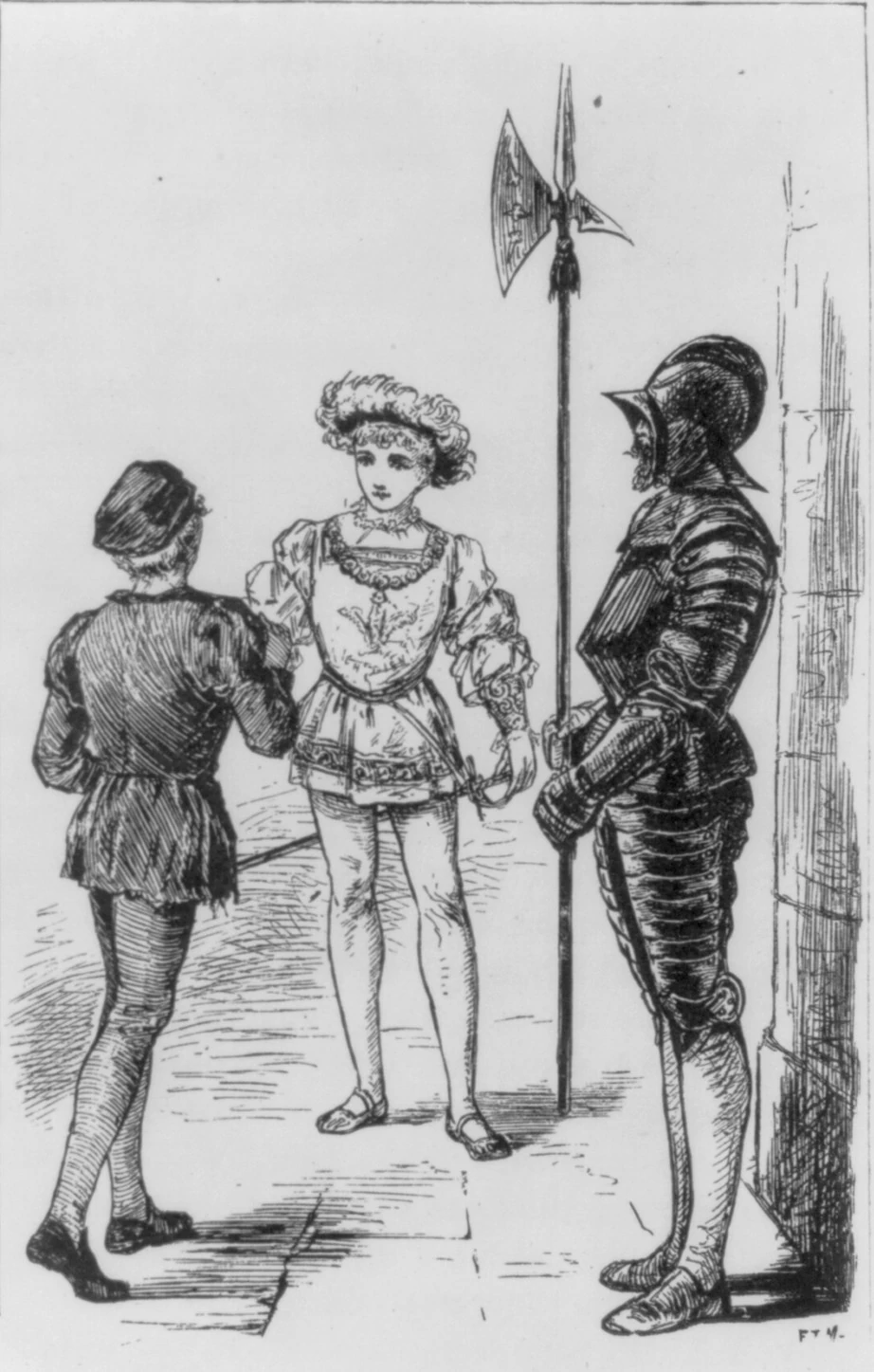
The illustrations from my edition, shamefully uncredited.

Neither of the titular characters indulge in a second’s worth of masquerade. They both stand by their true identities, and yet the boy from Offal Court with only his feet for transport and the sequestered son of the King of England apparently speak as identically as they look. No Englishman would have written this plot (or if he did, he would choose an “exotic” locale like Ruritania to set it in). Twain grounds his flight of fancy amidst real historical events, but I don’t even want to criticize him for this. The Tom Sawyer books were not exactly bastions of realism either, and The Prince and the Pauper departs altogether into the realms of the fairy tale – a style which Twain does a great job with.

As a fairy tale, it’s properly dark, suited for those children who’ve grown up with Grimm, Andersen and other storytellers of good cruelly set upon before it can triumph. Twain’s inspiration seems to have stemmed in part from a desire to draw attention to the excessive punishments of the Tudor era, and as such his prince finds himself lost amid beggars, thieves and vagrants. What’s odd is that, unlike in the Tom Sawyer series, Twain wears his heart on his sleeve here, appearing in genuine earnest upon his subject. He offers few bon mots, but some of his loveliest writing, as when the prince (now king) finds shelter in a barn and friendship with a calf.

The king was not only delighted to find that the creature was only a calf, but delighted to have the calf’s company; for he had been feeling so lonesome and friendless that the company and comradeship of even this humble animal was welcome. And he had been so buffeted, so rudely entreated by his own kind, that it was a real comfort to him to feel that he was at last in the soiciety of a fellow-creature that had at least a soft heart and a gentle spirit, whatever loftier attributes might be lacking. So he resolved to waive rank and make friends with the calf.

Pleasant thoughts came at once; life took on a cheerfuler seeming. He was free of the bonds of servitude and crime, free of the companionship of base and brutal outlaws; he was warm, he was sheltered; in a word, he was happy. The night wind was rising; it swept by in fitful gusts that made the old barn quake and rattle, then its forces died down at intervals, and went moaning and wailing around corners and projections–but it was all music to the king, now that he was snug and comfortable; let it blow and rage, let it batter and bang, let it moan and wail, he minded it not, he only enjoyed it. He merely snuggled the closer to his friend, in a luxury of warm contentment, and drifted blissfully out of consciousness into a deep and dreamless sleep that was full of serenity and peace. The distant dogs howled, the melancholy kine complained, and the winds went on raging, whilst furious sheets of rain drove along the roof; but the majesty of England slept on undisturbed, and the calf did the same, it being a simply creature and not easily troubled by storms or embarrassed by sleeping with a king
.

Twain uses an interesting tactic for the historical aspects included – where his interest in description flags, he simply excerpts from other chroniclers such as Leigh Hunt; educating his public while saving time. I guess that never caught on. It does disrupt the story a little bit, but it adds plenty of detail, especially of the resplendent pickle Tom Canty’s in.

Tom’s plotline is given less space, which is fitting since it’s considerably less dramatic. Unlike the Tom Sawyer books, whose plotting range from ramshackle to insane, The Prince and the Pauper is tightly woven. Tom Canty remains stationary, and the looming false coronation provides a natural venue for the finale, devoid of excessive coincidence.

https://christinawehner.files.wordpress.com/2015/09/527px-the_prince_and_the_pauper_12-134.jpg

Most of the secondary characters are only there to help or hinder the two boys, with the exception of Miles Hendon, a brave musketeer-styled nobleman who was wrongfully dispossessed and seeks restoration. Miles sees the good qualities in what he takes for a delusional beggar-boy, and so offers his protection. Although unconvinced by Edward’s assertions, Miles plays along, hoping to cure the boy of his madness and make him his ward. To this end, Miles becomes “a knight of the Kingdom of Dreams and Shadows” as the unlikely pair brave the mean streets of Tudor England together, and when separated, always find each other again.

The young prince does turn out to be every bit the equal of Miles for bravery. I had assumed going in that Edward would be the lesser of the two boys, stuck-up and ready for humbling, but he is so wholly principled and virtuous that Twain accidentally makes a case for monarchy through his example. Obviously, the plot couldn’t begin without the pair being rather dimwitted, but once the prince is cast into the streets things really get into gear. As Tom Canty’s abusive father and grandmother drag the prince “home” for a beating, the boy’s mother attempts to intervene and the prince’s mettle is revealed for the first time:

A sounding blow upon the prince’s shoulder from Canty’s broad palm sent him staggering into goodwife Canty’s arms, who clasped him to her breast, and sheltered him from a pelting rain of cuffs and slaps by interposing her own person.
The prince sprung away from Mrs. Canty, exclaiming:
“Thou shalt not suffer for me, madam. Let these swine do their will upon me alone.”
This speech infuriated the swine to such a degree that they set about their work without waste of time.

From this time forward, the prince shows loyalty to those as give him aid, compassion for the unjustly punished, contempt for the base and crooked, and obstinence in the face of disbelief. Trained in the art of the sword, he makes short work of boy thieves, and when captured by a gang of hoodlums, he refuses to improve his position by assisting in their plots to beg and steal.

Tom Canty is less sure of his moral compass. With less to lose, he finds himself going along with the masquerade he’s been forced into. He doesn’t like it but he adapts. Even here, the theme of justice asserts itself when Tom presides over a passing sheriff’s prisoners, bringing them into the palace to decide their fates. This culminates in some of the only comedic material in what is, for Twain, a thoroughly dramatic tale. Tom hears the accusation of witchcraft and storm-summoning levied against a mother and daughter:

“How wrought they, to bring the storm?”
“By pulling off their stockings, sire.”
This astonished Tom, and also fired his curiosity to fever heat. He said, eagerly:
“It is wonderful! Hath it always this dread effect?”
“Always, my liege–at least if the woman desire it, and utter the needful words, either in her mind or with her tongue.”
Tom turned to the woman, and said with impetuous zeal:
“Exert thy power–I would see a storm!”
There was a sudden paling of cheeks in the superstitious assemblage, and a general, though unexpressed, desire to get out of the place–all of which was lost upon Tom, who was dead to everything but the proposed cataclysm.

https://tobagostars.files.wordpress.com/2012/01/mark-twain.jpg

I could continue pulling quotes from this book all day, and I can well understand why Twain found this story more compelling than Huckleberry Finn. Throughout The Prince and the Pauper it seems as if he actually likes his characters – which I’m not sure can be said about any of his sequels to Tom Sawyer. Because it’s still written by Twain, there are occasional moments where his snideness gets the better of him, as when, after describing the engineering marvel of London Bridge and its remarkably self-sufficient community, he caps off with this statement: It was just the sort of population to be narrow and ignorant and self-conceited. However, that aspect of his writing is kept on a short leash here and not allowed to sprawl in every direction. The writing is wonderful, the plot is entertaining and though parts of it are very intense, that is compensated by the ever-present ideal of goodness. It is an undoubted children’s classic.

See Also: The Adventures of Tom Sawyer.

Parental Guide.

Violence: Beatings were a part and parcel of the era, and the prince sustains a few. Several of the vagabonds he falls in with have missing ears and there are descriptions of other medieval punishments, from whipping to getting boiled alive. However, these are mostly second-hand accounts. There are only two sequences which directly affect the prince, and both have a similar intensity to the famous murder in Tom Sawyer. One occurs when two women are burned at the stake, with their relatives forcibly restrained from throwing themselves on the pyre, and the prince looking away in horror. Twain focuses only on the reaction of the onlookers, not on what’s happening to the condemned women, but it’s still extremely dark.
The other notable sequence is an abrupt shift into full-fledged horror tropes, when the prince seeks shelter with a hermit. The hermit turns out to be a thoroughly deranged Catholic, who, upon discovering that he has King Henry’s son in his power, decides to truss him up while he sleeps. His methodical arrangements (and Twain’s choice language) make the whole scene that much more creepy.
The old man glided away, stooping, stealthily, catlike, and brought the low bench. He seated himself upon it, half his body in the dim and flickering light, and the other half in shadow; and so, with his craving eyes bent upon the slumbering boy, he kept his patient vigil there, heedless of the drift of time, and softly whetted his knife, and mumbled and chuckled; and in aspect and attitude he resembled nothing so much as a grizzly, monstrous spider, gloating over some hapless insect that lay bound and helpless in his web.

Values: Packed full, unusually for Twain. There’s a great deal of focus on noble characteristics, the quality of mercy and the value of education. This is also a precursor to A Connecticut Yankee in King Arthur’s Court, engaged at least in part around the cruel and unusual punishments of Tudor England, though here lacking the American alternative.

Role Models: Between Edward, Tom and Miles, practically every masculine virtue is exemplified, among them honor, honesty, strength, fidelity, principal, integrity, compassion, sacrifice and protectiveness. Twain dedicated the book to his own daughters, and it’s rather sweet to see this less jaundiced side of the man.

Educational Properties: This book furnishes a very detailed view of Tudor England and with so much focus on criminal law, social stratification, royal customs and historic London, it’s a great boon to homeschoolers, not even taking into account its highly advanced diction.

End of Guide.

And with this I have completed Mark Twain’s juvenile bibliography, ending on a high note indeed.

6 Reasons to Read L.M. Montgomery’s Anne Books in Publication Order

When I was a kid my mother sat down with my brother and I and read The Chronicles of Narnia out loud. She’d never read them growing up, and since our handy boxed set came already numbered we simply followed the reading order specified by the publisher, starting with The Magician’s Nephew and moving on from there. We loved them.

It was only later on that I learned we had read in the books in the chronological order, rather than the publication order which readers would have originally experienced, beginning with The Lion, the Witch and the Wardrobe. I then discovered that there were vast arguments on the internet regarding which one is the optimum way to experience C.S. Lewis’s classic series. This revelation got nothing but a shrug from me – reading the Chronicles in chronological order only meant that I saw Narnia itself as the main character of the series, rather than the Pevensies and their friends. The only problem I’d had with this experience was wondering why on earth The Lion, the Witch and the Wardrobe was the most famous of the series.

https://i0.wp.com/ecx.images-amazon.com/images/I/51OhjS4JpTL._SY282_BO1,204,203,200_.jpg

Moving ahead with this narrative, a couple of years ago I read Anne of Green Gables, and upon beginning this blog I went ahead and purchased the complete set of sequels to get the full experience. Once more, with no reason not to, I followed the publisher’s advice and read in numbered sequence, ending with Rilla of Ingleside. Naturally, I enjoyed some of the books more than others, and was not concerned about publication order until I was on chronological volume 6, Anne of Ingleside.

There were spoilers.

No one told me that there would be spoilers.

Having looked forward to that final book, Rilla of Ingleside (sixth in publication order), I was quite annoyed to suddenly have L.M. Montgomery herself telling me exactly what to expect for different characters in the upcoming war. I went looking for articles similar to the many I’d found on Narnia, passionately arguing for or against publication and chronological order.

I found crickets.

Having finished the Anne series, I truly wish I’d read an article like this before I ever began (or at least before I’d finished Anne of the Island, the last book before publication and chronological order split). Instead, I will be supplying the arguments myself in the hope that it will be of use to others.
Since I have only read them in chronological order, this defense of publication order will of course be somewhat theoretical in nature. And to make it easier to picture my forthcoming arguments, a list.

Publication order went like this:

Anne of Green Gables (1908)
Anne of Avonlea (1909)
Anne of the Island (1915)
Anne’s House of Dreams (1917)
Rainbow Valley (1919)
Rilla of Ingleside (1921)
Anne of Windy Poplars (1936)
Anne of Ingleside (1939)

Whereas the current order goes like this:

  1. Anne of Green Gables (1908)
  2. Anne of Avonlea (1909)
  3. Anne of the Island (1915)
  4. Anne of Windy Poplars (1936)
  5. Anne’s House of Dreams (1917)
  6. Anne of Ingleside (1939)
  7. Rainbow Valley (1919)
  8. Rilla of Ingleside (1921)

    If you haven’t read the books yet: You are who this article is meant for, so I will avoid heavy spoilers.

The six reasons

  1. You avoid major spoilers for Rilla of Ingleside.

    In the final chapter of Anne of Ingleside, Montgomery decided to remind her fans of the tragedies “yet in store” for the Blythes. Since every person reading this in 1939 had doubtless read Rilla, she did not feel the need for subtle foreshadowing.

    When reading a war novel, you expect some characters to die. Since Anne has three sons, hinting that one of them won’t make it isn’t that much of a spoiler. But Montgomery doesn’t hint. In fact, she gives the whole game away.

    Here is the offending paragraph with names removed:

    [Anne’s son] was smiling in his sleep as someone who knew a charming secret. The moon was shining on his pillow through the bars of the leaded window … casting the shadow of a clearly defined cross on the wall above his head. In long after years Anne was to remember that and wonder if it were an omen of [historical battlefield] … of a cross-marked grave “somewhere in [Europe].” But tonight it was only a shadow … nothing more.

    So if you don’t want to know exactly which of Anne’s sons dies and where, if you want to go into the final story with all the painful uncertainty intact, you should read these books in the order Montgomery actually wrote them. It is clear that’s how she intended them to be experienced.

  2. While Montgomery did not plan her series out in advance (as is the modern habit), the early books about Anne were still written in fairly quick succession. Anne of Avonlea followed after Green Gables by one year. There was a six year gap before she returned to that world and Anne’s college experiences in Anne of the Island, but from that point on she stuck with the series, bringing out a new story every other year until she reached a suitable conclusion with Rilla of Ingleside in 1921. After that? Fifteen years elapsed before Anne of Windy Poplars was published.

    What becomes apparent when looking at the original six compared to the final two installments is that Montgomery developed a very different mindset and even writing style between the two eras. There’s a thematic unity to the original set, with each of them featuring a centerpiece romance that offers a natural, optimistic conclusion to Montgomery’s episodic stories. Each book is an assemblage of subplots, with no single thread gaining precedence until reaching the end, where hope for the future is clearly embodied in these various successful courtships. This actually does feature in Anne of Green Gables (a coming-of-age story without any romance plot of its own), as the ending directly sets up Anne’s future love interest, who returns to feature heavily in Anne of the Island. In the surrounding novels, we are introduced to wistful spinsters, grieving widowers and tragic housewives, each of whom is granted a second chance at love – culminating with Anne’s own teenage daughter and the post-war future she won’t have to face alone.

    Are these stories predictable? Yes, but they’re also very hopeful and sweet, and when put in a row, they maintain a sense of internal logic, of renewal and resurgence. On the other hand, Windy Poplars and Ingleside have no standout love stories to tie everything together at the end, with the former’s crescendo arriving as Anne helps a little girl, and the latter lacking any overarching story whatsoever. They aren’t necessarily bad endings, but they don’t carry the same weight as previous books, and it’s noticeable – Windy Poplars especially feels like a set of short stories with too many characters to keep track of after the comparatively tight plotting of the first three. Put it aside until after Rilla and it will feel like something new.

  3. Since the final books were inserted later on, it stands to reason that nothing of any importance can happen in them. They read like filler because they ARE filler. It didn’t have to be that way – Montgomery could have chosen to go back and flesh out minor characters. But she didn’t care to do that, preferring to create new characters who would have absolutely no bearing (or existence) in the chronological sequels. This is less of a problem in Windy Poplars, as it takes place in the separate town of Summerside, but it’s quite noticeable in Ingleside, as the Blythe children are contractually obligated to not have any local friends when Rainbow Valley begins. Consequently, every single kid in their town of Glen St. Mary is a total brat. These are the two longest books, and with the status quo set in stone, nothing important or surprising occurs in either, meaning that new readers of the series will definitely struggle with loss of momentum here.

  4. Anne of Windy Poplars is commonly held as one of the weakest installments, but it might actually be improved by reinstatement as the 7th, rather than 4th, book. Anne visits Avonlea several times in this book, and these scenes are clearly meant to delight. However, glimpsing dear old Green Gables through the visits of Anne’s new friends feels rather humdrum in the 4th installment, because we’ve just gone there in every previous book. It’s only after this that the narrative moves to new locations permanently – which means that these happy visits are actually our last sight of classic Green Gables. This entire book is a nostalgic look back at young Anne with her life ahead of her, but because of its modern placement it feels more like Anne by numbers and, again, filler.

  5. The same improvement would be offered to both Anne of Ingleside and Rainbow Valley in this manner. These two books chart very similar themes – pre-war innocence as depicted through the lives and dreams of the generation who would grow up to fight in it. Realistically, this translates to two books in a row about precocious children bouncing through well-meaning mischief. While it is nice to get acquainted with the Blythes before the Merediths arrive in Rainbow Valley, it’s a pity that it happens in the longest book in the series – and the one with spoilers.

    On the other hand, Rainbow Valley is certainly the more refined in theme and construction, but it’s slow to start and it would be a pity to give it less attention than it deserves (many of the negative reviews on GoodReads can be boiled down to “cute kid overdose”). Indeed, I only noticed how good Rainbow Valley actually was when I was over halfway through, as I was also less than enamoured of the premise. If you switch Anne of Ingleside from 6th to its original 8th place, you free up both books to be judged on merit rather than forced into an unnecessary competition which only shows up the weaknesses in both.

  6. Anne of Ingleside was Montgomery’s final published novel. She suffered from depression for much of her life and this increased in severity towards the end (she died of a prescription drug overdose whose nature is debated). Whatever happened, there’s no doubt that she lost heart for Anne, and thus her late additions to the story are markedly different in tone. There’s a bitterness and exhaustion to them, with the communities of Ingleside and Summerside feeling heavy with scandals and sorrow – yet at the same time Montgomery’s trademark sentiment is overplayed, as if compensating for her own loss of convictions. Anne herself comes across like a different person, with sugar in her veins instead of her customary fire and dew. The lack of old characters dropping by indicates that Montgomery had no real interest in writing about them. Chapters aren’t even given names anymore (previously always a source for Montgomery’s sardonic wit, among other things). These are different stories, from another time, and they should be read as such.
https://upload.wikimedia.org/wikipedia/commons/thumb/0/00/Lucy_Maud_Montgomery.JPG/205px-Lucy_Maud_Montgomery.JPG

What it comes down to is that the original six belong together. Shoehorning the final books in where they don’t belong does the series no favours and only highlights individual shortcomings. So you should read this series exactly as Montgomery wrote them, no matter what your Bantam editions might be telling you. By this method you will avoid spoilers, repetition, seesawing character development and thematic disunity all in one fell swoop.

The Coffin Quilt – Ann Rinaldi

Southern Gothic for 12 year old girls.

https://i0.wp.com/photo.goodreads.com/books/1177273274l/690609.jpg

Title: The Coffin Quilt: The Feud Between the Hatfields and the McCoys
Author: Ann Rinaldi (1934-)
Original Publication Date: 1999
Edition: Harcourt (2001), 228 pages
Genre: Historical fiction.
Ages: 12-15
First Sentence: Today they hanged Ellison Mounts.

It’s the feud between the Hatfields and the McCoys! Madness, cruelty, death and despair all told from the viewpoint of youngest McCoy daughter Fanny, as she spends her childhood bearing witness to the conflict and finally realises that the only way forward is to walk away.

It shouldn’t surprise anyone that The Coffin Quilt is quite a dark book, even though Ann Rinaldi does her best to downplay the violence for her target audience of morbid young teens – a select readership of girls who like reading historical tragedies (like all those Dear America books about the Titanic and the Oregon trail). While the Hatfield-McCoy Feud fits the bill, the real story sprawled in so many directions that Ann Rinaldi had to find some way of containing it – thus, we follow events from the limited perspective of Fanny McCoy. She’s seven in 1880, when over half of the novel takes place, and she has no say in what happens as the domestic life of the family sours and shifts. The short chapters are packed with dread and woe, but daily life goes on even while the corpses accumulate. It’s less an action-packed western, more the eerie twin of Little House:

It was the old of the moon. A good time for timbering. A good time for cutting hay, too, which was where Pa and my brothers had gone at first light. They never cut on the new of the moon, because the sap was still in the hay and it’d take longer to dry.
My family planted and harvested by the signs. The rules for this are simple. You plant in the fruitful signs of Scorpio, Pisces, Taurus, or Cancer. You plow in Aries. You plant flowers in Libra when the moon is in the first quarter. It goes on like that and you dasn’t go against the rules or corn will hae small ears, potatoes will get numbs, and if you kill a hog in the growing parts of the moon the meat gets all puffy. Lots of town people just hoot about this, but it works for us so we keep doing it.

One of the surprises to The Coffin Quilt is Rinaldi’s willingness to think outside of the box. She not only figures that teen girls can read stories without any romance, and that they might be willing to read about a much younger character, but she also sidesteps the stereotypes about her chosen time period. It works for us so we keep doing it. No judgement. This is a great improvement on her first historical novel, Time Enough for Drums, whose cast and tone were far more predictable. The Hatfields and McCoys are dreadful people, but Rinaldi keeps them interesting by giving them some moments of sympathy, however brief. This makes Fanny’s loyalty understandable and highlights the grotesquerie and sheer waste of the feud. As Rinaldi points out in her author’s note, in the aftermath: Hatfields became respectable mine operators. McCoys went back to their lives, too, cultivating the land, raising ginseng, keeping bees, breeding cattle, hogs, and sheep, and displaying many of the traits and talents the people of these parts are famous for–the traits that mark the pioneer, the survivor, the breaker of the land, the raiser of the family, the churchgoer, the good neighbor. They may have been crazy but she still gives them their due.

https://www.history.com/.image/t_share/MTU3ODc4NjAzNTIzODkyOTU5/hith-hatfields-mccoy-174041967-2.jpg
Hatfields.

Likewise, Rinaldi also includes an honest-to-goodness cryptid in this story, a mystery creature called Yeller Thing, who always appears as a harbinger of evil tidings. The mountain folk reported such sightings, and so Rinaldi delivers a composite creature without trying to appeal to science for an explanation: I know what I saw. It was yeller. And big. Bigger than anything in these woods had a right to be, even a bear. It streaked by like a painter cat. And there was this eerie sound. Not a growl. It sounded like a Rebel yell, from what my pa told me about such yells. Or like a man about to die, which is maybe the same thing.
For a moment I stood stock-still. And then I heard the words Mama so often read from her Bible: “And it is appointed unto men once to die.”
Those words just came into my head. And I knew then that what was out there was nothing animal or human. The knowing flooded through me, and I ran.

https://www.legendsofamerica.com/wp-content/uploads/2018/10/RandolphMcCoy.jpg
Randolph “Ranel” McCoy.

The Coffin Quilt is dished up with almost no presentism or finger-wagging, even though there’s plenty of scope for it. Instead, the crux of the matter lies in what choice Fanny is going to make. It’s the story of her survival, as she grows up within failed institutions. Her family and neighbours are all participants in the feud, Hatfields and McCoys make up the bulk of local sheriffs and even the reverend starts meddling – once he becomes father-in-law to a McCoy. Love affairs, sibling rivalry, letters, gossip, and even quilting are all hazards, nothing but fuel to the fire. Only Mr. Cuzlin, the schoolteacher, unmarried and with no family in the area, has the wherewithal to stay out of the fray. Rinaldi says in her afterword that she interpreted this history as “a continuation of the war,” when the country was torn asunder and brutally stitched back together. There’s no sense to the killings and Rinaldi doesn’t try to find an explanation. The only moral is that it was a waste of human life.

There is a thread of hope, nonetheless. The Hatfields and McCoys are both very large families, and not every branch of either is actually involved in the feud. A different life is available mere miles “inland” from the Kentucky/West Virginia border. It just has to be chosen. Once the violence has reached its crescendo, this decision is all that remains for Fanny. She’s a survivor.

The Coffin Quilt gives its audience a chance to step into another era and answer the question of what it would be like to live through the most famous feud in American history. It’s a compelling recreation, and Rinaldi never skimps on the atmosphere or the angst, making her popularity among 90s teens easy to understand: I seized on the books and started reading. About other worlds and other people who had terrible heartache, who sweated blood for their dreams and cried in pain for their loves, and whose lives were all better than mine.

With simple but highly evocative writing and the habit of dramatizing memorable moments in US history with a series of (so far) sympathetic heroines, I’d say Rinaldi has a winning formula. I look forward to her take on the Salem Witch trials.

See Also: Time Enough for Drums was her first novel in the historical genre, a family drama with a side helping of romance and a lighter tone all around.

Parental Guide.

Violence: It permeates the whole book. There are shootings, hangings, knife fights and the climax of both feud and book is when the McCoy homestead gets set ablaze – with Fanny’s older sister Alifair shot for attempting to put it out. Alifair is also shown to be abusive towards Fanny.

In general, the violence arrives second or third hand as news of the day. One of the few incidents Fanny actually witnesses is the Election Day dancefloor fight between Tolbert McCoy and Lias Hatfield, soon joined by their various brothers. Knives come out, and Ellison Hatfield gets cut up like a hog on butchering day before being shot dead.

Another, and in this case wholly fictitious, event is when Fanny brings some food to a local prostitute only to find her hanging naked from the rafters, slowly choking to death. Fanny can’t reach up to free her so she runs to the schoolhouse and brings her teacher back to help. Life saved, the prostitute leaves town.

Fanny’s sister Roseanna runs off with Johnse Hatfield but they don’t get married. Johnse leaves her, she bears a child out of wedlock and the baby dies of pneumonia. Johnse takes up with another McCoy girl, and she leaves him when she figures out that he’s an abusive alcoholic who won’t protect her family from his. Fanny doesn’t actually witness any of this.

Values: Doubtless the easiest way to bring the Hatfield-McCoy Feud to a modern audience would be with a pat prescriptive for how the whole mess could have been avoided, along the lines of “violence is wrong.” But Rinaldi includes and highlights Ma McCoy’s obsessive pacifism, a trait she had which did hold the McCoy men back from retaliation several times – and which only ever made the situation worse.

Role Models: Fanny makes a sympathetic protagonist. She learns to make choices and live with them, and she has the strength to go on living rather than give up in despair. Her schoolteacher is the only completely supportive character but in general there’s some surprising element or nuance at play. For instance, Fanny’s quiet sister Trinvilla ends up giving her both the best and worst advice she receives.

Educational Properties: Rinaldi uses a fair amount of symbolism in this book, which is fitting for the southern gothic atmosphere. She did a lot of research into the traditional cooking, medicine and handicrafts of the area – doing some hands-on recreations could result in a highly practical education, and of course what teen doesn’t enjoy tales of cryptids? And that’s all incidental to the great variety of material available on the Hatfield-McCoy feud.

End of Guide.

So far I’m very pleased with Ann Rinaldi’s books and I wish I’d actually bothered to read her as a teen.

Rilla of Ingleside – L.M. Montgomery

A textbook case in how one single character can nearly ruin an entire novel.

https://lh5.googleusercontent.com/proxy/Y0W4Eq-BljNFpxjAgohlU_J9U4GCFWrJA-1m8qNQpvOHX5y-s-Dkhy_InYS32Q8cYzLu6m_aXbvFIT0LWDPsV75lrWcPufY=w1200-h630-p-k-no-nu

Title: Rilla of Ingleside (Anne Novels #8)
Author: L.M. Montgomery (1874-1942)
Original Publication Date: 1921
Edition: Bantam Books (1998), 277 pages
Genre: Historical Fiction. Romance.
Ages: 12-16
First Line: It was a warm, golden-cloudy, lovable afternoon.

Anne’s youngest child Rilla is now fifteen and excited at the prospect of the fun teenage years ahead of her. She’s completely unaware that a far off Balkan conflict is about to turn into a world war. Yet soon enough she watches as all three of her brothers are taken overseas, joining the military alongside all the other boys she’s grown up with – including handsome Kenneth Ford, Leslie’s only son. Carefree Rilla comes of age in the midst of historical and personal tragedy, raising a neighbour’s orphaned war baby and waiting for those who will make it home…

There’s been a romantic timelessness to the Anne series, but that ends once and for all here. From our perspective, Rilla of Ingleside is historical fiction but of all the books it was the closest to its author’s own day while writing. It’s a living document of the Great War, only a couple of years removed. Beginning on page one with the news report of the assassination of Archduke Franz Ferdinand, it has a panoramic quality as the Blythes follow the news and wait – for four patient, endless years. Because of this, Rilla has a very different perspective on the war than that of following generations, and it’s not exactly pleasant.

However, before I get into that, Rilla deserves praise for its main character. Rilla is quite a different protagonist from Anne – giddy, shallow and making no apologies for it. Her older sisters are the ones following in Anne’s footsteps by going to college, while Rilla has no great plans beyond having a good time and getting married. Her ungifted ordinariness thus makes her a much better lead for a wartime story than an Anne-type heroine, because she is being tested constantly and she has to rise to the occasion. She has pluck but no one ever realised it before, while Anne always wore hers confidently on her sleeve.

The accompanying love story is also a very simple affair – a war is not the time for the painfully slow courtships Montgomery normally depicts. Rilla fancies Kenneth Ford straight away, in the most shallow, appearance-led manner possible, and the feeling is mutual – yet Montgomery is actually able to wrestle meaning, poignancy and commitment out of this relationship, notable when Ken’s last evening before shipping out is interrupted by Rilla’s war-baby:

Kenneth sat very still and silent, looking at Rilla–at the delicate, girlish silhouette of her, her long lashes, her dented lip, her adorable chin. In the dim moonlight, as she sat with her head bent a little over Jims, the lamplight glinting on her pearls until they glistened like a slender nimbus, he thought she looked exactly like the Madonna that hung over his mother’s desk at home. He carried that picture of her in his heart to the horror of the battlefields of France. He had had a strong fancy for Rilla Blythe ever since the night of the Four Winds dance; but it was when he saw her there, with little Jims in her arms, that he loved her and realized it. And all the while, poor Rilla was sitting, disappointed and humiliated, feeling that her last evening with Ken was spoiled and wondering why things always had to go so contrarily outside of books. She felt too absurd to try to talk. Evidently Ken was completely disgusted, too, since he was sitting there in such stony silence.

The figure of little Jims brings a needed note of levity into what is certainly the darkest of the series. The early scene where Rilla goes collecting for the red cross and brings home this orphaned baby in a soup tureen is undoubtedly the most Dickensian moment in the series, and one where Montgomery pulls no punches setting her tableau. Rilla walks in on a scene straight out of Oliver Twist:

Through the open door of the small bedroom opposite her, Rilla saw Mrs. Anderson lying on the untidy bed; and Mrs. Anderson was dead. There was no doubt of that; neither was there any doubt that the big, frowzy, red-headed, red-faced, over-fat woman sitting near the door-way, smoking a pipe quite comfortably, was very much alive. She rocked idly back and forth amid her surroundings of squalid disorder, and paid no attention whatever to the piercing wails proceeding from a cradle in the middle of the room.
Rilla knew the woman by sight and reputation. Her name was Mrs. Conover; she lived down at the fishing village; she was a great-aunt of Mrs. Anderson; and she drank as well as smoked. Her first impulse was to turn and flee. But that would not do. Perhaps this woman, repulsive as she was, needed help–though she certainly did not look as if she were worrying over the lack of it.
“Come in,” said Mrs. Conover, removing her pipe and staring at Rilla with little, rat-like eyes.

https://www.virago.co.uk/wp-content/uploads/2019/01/hbg-title-9780349004501-9.jpg?fit=422%2C675

Rilla, who knows nothing about infants and has no liking for them, is left petrified that her little war-baby will expire and yet is resentfully determined to do her part. She would look after this detestable little animal if it killed her. This creates a handy yardstick to measure Rilla’s personal growth, as she diligently looks after Jims, giving over from resentment to pride as she slowly forms a bond with the boy.

Unfortunately, Rilla was just about the only thing I really liked in this book. Once again Montgomery ignores her sizable cast of characters built up over the series, cherrypicking a favored few to revisit – and one of them is Susan the housekeeper, a previously minor character who is now featured in almost every chapter. Her role is simple: Zealously follow the news, swallow every bit of war propaganda and maintain a steady stream of invective under pretense of “keeping spirits up.” Sometimes she makes Anne cry. Unforgivable. She hates the German (of course), but tries not to leave anyone out. “The Germans would never have got back Passchendaele if the Canadians had been left there; and it was bad business trusting to those Portuguese at the Lys River.” She hates Woodrow Wilson with deathless passion for staying out the war, but turns on a dime once he joins in and becomes a blind supporter of his every utterance. She frets if baby Jims has “pro-German” blood and even thinks the Blythes’ cat is pro-German.

At first I had hopes that she was a figure of satire – the most vociferous supporter of the war a childless old woman, baying for blood from the safety of her Canadian kitchen – but it is made very clear that she is meant to be admired for her unwavering patriotism. She was one of the women–courageous, unquailing, patient, heroic–who had made victory possible. In her, they all saluted the symbol for which their dearest had fought.

Meanwhile, there’s only one pacifist character and he is hated by the entire cast (and the author), such that whenever some indignity or misfortune befalls him the narrative halts so everyone can cheer. As the war drags on, the most moving material is given to Anne and Gilbert, watching their sons sign up and their daughters be robbed of youth, after having taken such care to give their six children the same opportunities and joys which they had experienced in peacetime. Yet these two beloved characters are kept almost entirely out of the way in favour of their housekeeper’s dozenth “kill the krauts!” rant.

Maybe Montgomery found it too painful to focus on the parents (the Blythes, Merediths, Fords and Wrights) whose children are taken, or are returned to them aged and injured. Later generations of writers could tell these stories from a distance, but I don’t think Montgomery felt capable of it. And this, this is what makes Rilla of Ingleside so heartbreaking to read. It’s a novel that shows us its author grasping at straws to justify what she and the world had just been through, holding on to hope that the old world had been destroyed so that something better could be built on the rubble. She has one soldier say in a letter home to take courage, for there will be a day “when the ‘red rain’ of Langemarck and Verdun shall have brought forth a golden harvest–not in a year or two, as some foolishly think, but a generation later, when the seed sown now shall have had time to germinate and grow.”

A generation later there was another world war.

Being completely honest, I found this book quite a bitter experience. It came so close to being among my favorites in the series – the cinematic sweep and Rilla’s character growth was so entertaining and moving, but between the war propaganda, several ghastly scenes (see the Violence category) and the existence of Susan my overall response was anger and sorrow. Not really what I’m looking for in a sequel to Anne of Green Gables…

And so it’s farewell to the Blythes and a long break from L.M. Montgomery. I still find it easy to recommend the full series to interested parties – uneven it may be, but even the weakest volumes have some standout material.

Parental Guide.

Violence: The pacifist character suffers a paralytic stroke on Armistice Day, which Susan takes as divine judgement and practically dances a jig for. One of Rilla’s brothers doesn’t make it.

However, the most ghastly moment in the entire series comes when the minister’s little boy relapses into pagan blood sacrifice to try and get the Blythes’ MIA son to return home. He takes his beloved kitten out and drowns him. “I thought if I sacrificed Stripey God would send [the Blythes’ son] back.” His parents don’t address his disturbing beliefs, Rilla finds his gesture “splendid–and sad–and beautiful,” and as he gets his wish I shudder to think what he’ll be “sacrificing” next year.

Values: The nobility of sacrifice. Patriotism, war fever, hatred of Germans and pacifists. Faith in the modern experiment.

Role Models: Everyone except for the pacifist and a female rival of Rilla’s are clearly intended for admiration.

Educational Properties: A wealth of immediate material which could be utilized alongside more recent information to gain both the long and short view of the war.

End of Guide.

Expect one last post on the subject of the Anne books sometime next week. Only five reviews remain to post.

A Stranger Came Ashore – Mollie Hunter

The cover makes this look fairly campy, but the actual story hearkens to North Sea folktales. Sign me up.

mollie hunter a stranger came ashoreTitle: A Stranger Came Ashore
Author: Mollie Hunter (1922-2012)
Original Publication Date: 1975
Edition: HarperTrophy (1995), 163 pages
Genre: Fantasy. Suspense.
Ages: 9-14
First Line: It was a while ago, in the days when they used to tell stories about creatures called the Selkie Folk.

It is a dark and stormy night on the Shetlands Islands when the Norwegian ship Bergen wrecks and a solitary man washes ashore in the isolated community of Black Ness. Calling himself Finn Learson, the good-looking young man secures shelter in the Henderson household, charming the family and their neighbours and quietly making himself indispensable while paying court to his hosts’ lovely daughter Elspeth. Only twelve year old Robbie Henderson finds it hard to trust the stranger. As omens appear in the funeral fire and Elspeth grows listless, Robbie begins to see something menacing behind Finn’s ready smile. Concerned for his sister, Robbie sets out to discover the truth about the stranger – and when he does, he will need to find help, or Elspeth will suffer a terrible fate…

https://thekelpiespearls.files.wordpress.com/2011/02/mollie_hunter2.jpg
Scottish author Maureen Mollie Hunter McIlwraith.

The first thing to understand about A Stranger Came Ashore is that it is deliberately written in the style of an oral folktale. Mollie Hunter was Scottish and she tried to recreate the feel of Shetland customs and concerns; as such, there is a distinct cadence to the writing, a pattern of speech rather than straight narrative. It makes the novel feel distinctly personal, as a tale told directly to you, yet it’s also distancing – this is a tale of a while ago and Hunter does not play up the drama. Even knowing what to expect, the effect is momentarily very strange and perhaps even a deal-breaker for those expecting the techniques of modern storytelling. However, once you grow accustomed to the style, it becomes both lilting and propulsive, such that I have more trouble deciding where to end my quotes than where to start.

So Robbie swithered and swayed in the opinion that was never asked, and meanwhile, Finn Learson was getting acquainted with all the rest of the people in Black Ness. Very easy he found this, too, for all that he was a man of few words, since there is nothing Shetlanders enjoy better than visiting back and forward in one another’s houses.
Sooner or later also, on such occasions, out will come the fiddle. All the young folk–and very often some of those that are not so young–will get up to have a dance; and the first evening that this was the way of things in the Hendersons’ house, Finn Learson showed the lightest, neatest foot in the whole company.
He was merry as a grig, too, clapping his hands in time to the fiddling, white teeth flashing all the time in a laugh, eyes glittering like two great dark fires in his handsome head. No amount of leaping and whirling seemed to tire him, either; and curiously looking on at this with Robbie and Janet, Old Da remarked,
“Well, there’s one stranger that knows how to make himself at home on the islands!”

Hunter laces this book with details of Shetland culture, including their holiday traditions, superstitions, social conventions, the tug of war between pagan and Christian customs, the threat of the press gang, and all the way down to floor plans and furniture: Old-fashioned beds for the islanders were made like a large box complete with a lid on top and a sliding door on one side. There were air-holes in the sliding doors, neatly pierced in the shapes of hearts and diamonds; the box beds themselves stood on legs that raised them above drafts… This gives A Stranger Came Ashore plenty of crossover appeal between kids who like the particular atmosphere of British fantasy and kids who enjoy historical fiction. In other words, I would have loved it growing up if I’d only known it existed.

https://i2.wp.com/dymusings.com/wp-content/uploads/2012/09/p1000277.jpg?resize=640%2C360
A Shetland box bed.

The fantasy elements of A Stranger came Ashore are built on ancient motifs. The Great Selkie is drawn ashore by the gold of a young girl’s hair – he has the power to charm the girl and her family, but is bound to speak only truth. This makes Finn Learson a trickster who nevertheless offers recompense to the families he hurts as he willingly takes on the work of the village, and further insists that the Hendersons accept an ancient gold coin, “for it may still cost you more than you think to have me here.” His sea-magic is powerful, but opposed by other elements and Robbie’s role in the story is to be the messenger and summon those other elements. It’s fairly mythic for such a quick read.

Unfortunately, Robbie does have a tendency to be outclassed and upstaged from his own story, as does Elspeth, the damsel in distress who never even realises she’s in danger. Finn Learson, with his charming facade and careful words, owns the book – at least until the final third when Yarl Corbie shows up.

Yarl is both the best and worst thing about A Stranger Came Ashore. He’s a bitter wizard who lost his love to the Great Selkie years ago, and now grinds along as the village schoolteacher, terrifying his pupils and inspiring wild rumours of ancient magic. It’s easy to understand why Robbie is so reluctant to approach such an intimidating and possibly crazy man – and this also forms a smart contrast with the smiling, seductive Finn, for Yarl Corbie acts like a villain but in truth plays the hero. From his first appearance this book is his:

https://th.bing.com/th/id/OIP.-UBQ0Oxy_L7qY1kr7NpO-wHaDF?pid=Api&rs=1
No idea why I thought of this guy…

To begin with, he had the nickname of Yarl Corbie, for that is the nickname the raven has in Shetland, and he looked like nothing so much as a huge raven.
His nose was big and beaky. His skin was swarthy. His eyes glittered in a sharp and knowing way. He was tall, but very thin and stooped, and he dressed always in black. Besides which, he always wore a tattered, black, schoolmaster’s gown that flapped from his shoulders like a raven’s wings. And like the raven, he was solitary in his habits.
There was yet another reason, however, for his nickname of Yarl Corbie. Long ago, it was said, in the days when this schoolmaster was still only an unchristened child, he had been fed on broth made from the bodies of two ravens. This, it was also said, had gifted him with all the powers of a wizard; and it was this, of course, which had given Robbie his idea.
Yet here was the snag of it all. Robbie was deadly afraid of Yarl Corbie; for Robbie, it has to be remembered, was twelve years old at that time, which was certainly not old enough for him to have lost his fear of wizards. It has to be remembered too, that Robbie was Shetland born and bred; which meant that deep, deep down in his blood and in his bones there lived the Shetlander’s ancient fear of the raven and its croaking cry of death.

The fact that this quote was pulled from page 98, over halfway into the novel, gives rise to the only significant problem I have with A Stranger Came Ashore. There is no earlier appearance by the schoolmaster, no brief cameo or reference to offer any hint that this man could hold a solution to Robbie’s problem. The lack of foreshadowing guarantees that his fortuitous knowledge of the Great Selkie feels like a deus ex machina rather than an organic part of the worldbuilding. He’s so cool that I didn’t really mind, but it’s a significant dramatic flaw that could have been cleared up with just one line, and I wish an editor had intervened on this point.

This is the only notable failing of the book and it’s not one likely to bother its intended young audience. Children who’ve enjoyed hearing folktales read to them will find here a longer fiction with the same feel, and Mollie Hunter’s style lends itself very well to reading aloud besides. There is menace and suspense, but it has none of the love for grotesquerie found in something like Coraline and is leisurely paced and intelligently written, like much of 70s middle grade. A fine addition to your family’s fantasy collection, especially if you prize a northern setting.

https://magdalenaperks.files.wordpress.com/2011/03/800px-crofthouse-shetland.jpg
Traditional homestead, looks like a postcard possibly.

See Also: Seven Tears Into the Sea for a defanged teen romance take on selkies. The Stones are Hatching for a nihilistic deconstruction of British folklore and boy heroes.

Parental Guide and spoilers for the ending.

Violence: Very mild. There are some eerie omens and a vision of Elspeth dressed for some deathly bridal. It is revealed that girls who go to the Great Selkie’s underwater palace eventually grow homesick and drown when they attempt to return to the land, which makes for some unsettling imagery.

One seaside brawl. Yarl Corbie has a knife he likes to wave around and he easily scares Robbie into keeping silent about his wizardry. In the end Yarl becomes a raven and blinds Finn in one eye, sending the Selkie back to the sea.

Values: Lots of Shetland folk traditions are included here, and given that it’s rather hard to find children’s books set on the Shetland Islands, that’s enough for a recommendation already. Although it’s not a retelling, it is a folktale by nature and so is pro family and tradition.

Role Models: Robbie is a good, imaginative boy but also timid and superstitious, and so the only way he can save his sister is to conquer his fears one by one – of the dark, the schoolmaster and the stranger. He rises to the challenge yet also feels compassion for his family’s defeated enemy at the last when he believes Yarl Corbie fully blinded the Great Selkie.

“But a selkie hunts with its eyes,” he exclaimed. “And so you might as well say you’ve doomed him to starve to death!”
“Would that be so bad?” Yarl Corbie asked.
“I don’t know,” Robbie admitted. “But it’s cruel, all the same.”
Yarl Corbie shrugged. “The thought does you credit, I suppose,” he said drily.

Educational Properties: It would springboard nicely into a research session on the Islands, whose history and culture is not well known, as well as selkie folklore.

End of Guide.

It will probably be a while before I come across any more of Hunter’s books – although a prolific writer, relatively few of hers have migrated to America and many appear out of print. However, she’s definitely on my list to watch out for.

Brown Sunshine of Sawdust Valley – Marguerite Henry

A sweet and simple swan song.

Brown Sunshine of Sawdust ValleyTitle: Brown Sunshine of Sawdust Valley
Author: Marguerite Henry
Illustrator: Bonnie Shields
Original Publication Date: 1996
Edition: Aladdin Paperbacks (1998), 100 pages
Genre: Animal Stories.
Ages: 6-9
First Line: September 1: Dear Diary, I get a sick feeling whenever I look at a person riding a horse and acting so smug and happy at being up there.

Molly is ecstatic when her parents decide to buy her a horse for her tenth birthday, and she goes to the auction with high hopes. Her father is continually outbid until the final horse is shown – an old, neglected mare called Lady Sue. Molly is crushed. But Lady Sue starts to grow on her and then one day surprises the whole family by giving birth to a baby mule. Brown Sunshine charms the neighbours, improves their fortunes and even has a chance of being crowned King Mule at the Tennessee Mule Day Parade…

Whatever went wrong with Misty’s Twilight, all is forgiven here and every problem is fixed. This is a gentle chapter book which sits very nicely alongside Misty of Chincoteague as an appealing item for young horse lovers. We are once more following a likable lead, as Molly’s parents are poor and she’s not a snob in the least – after all, she’s delighted by the prospect of raising her own mule, a long way from the legacy chasing that drove the cast of Misty’s Twilight.

Local colour is also back, with a sizable portion of this book centering around the contributions Lady Sue and Brown Sunshine can make to this poor Tennessee family’s cottage industries. They get into business plowing and planting for neighbours, while Molly’s mother takes advantage of a new way to sell her fruit preserves:

Mom is really in business now! She’s making twice as many jellies and jams as before. And Lady is pulling a cart full of tart-smelling currants and sweet red raspberries, and strawberry rhubarb preserves, apricots with almonds, blue plum, ginger marmalade, rose-geranium jelly, spiced grape jelly, and blueberry jam.
Mom’s even become adventurous; she’s made a new blend using five different fruits. This was the end result of two weeks of experimenting. Pops and I got used to seeing everything but the itchen sink simmering away on the stove. Acorns, nasturtium leaves, sassafras roots (that I had to dig up), and dandelion stems boiling away and sending their particular smells into the steamy kitchen. Only one new jam came of these long days of experimenting. Now orders come in daily for it. Mom calls it “Fabulous Five Fruit Medley.” I think helping with the household expenses makes Mom feel happier about everything.

This makes a much better way to update Henry’s family dynamic than was Maureen’s endless complaining and pitying Grandma Beebe’s life of drudgery in Stormy. A few other tweaks help bring Henry’s style into the 90s, although the plot is old-fashioned in every particular. The diary format was very popular at the time, so selections from Molly’s journal are sprinkled throughout. There is also the addition of obligatory rich brat Freddy Westover, a stock character also found in Thoroughbred and Saddle Club stories. Freddy is not static, however, and his character improves as Brown Sunshine attracts the attention of one-armed muleteer Mr. Covington, an old-timer whom Freddy respects. For a side character in a 100 page chapter book, that’s an impressive character arc.

IMG_20200515_111656
Brown Sunshine and Mr. Covington, illustration by Bonnie Shields.

The book’s brevity does mean that Brown Sunshine is less defined than Henry’s earlier equine characters, and a couple more chapters in the rather rushed middle of the story, when he was growing up, would have been more than welcome. However, for such an elderly lady to return so well to form in the last year of her life, we can hardly ask for more. Misty’s Twilight came perilously close to being her swan song, and even if Brown Sunshine of Sawdust Valley is a minor work, it’s a fine and graceful sendoff to Ms. Henry’s legacy.

Even before Molly had planted a kiss on Brown Sunshine’s forehead and left, Sunshine felt a new surge of life. He was home again … in his own paddock with his mother grazing nearby. He fell to his knees in the coolness of the grass, and then to his side. He was rubbed by the earth. He sniffed and rolled in contentment. Then he gave a full turn to his other side. He had never made a full turn before! Overhead he saw the deep blue sky holding a brilliant half-moon.

See Also: Misty of Chincoteague, Sea Star, Stormy, Misty’s Foal.

Parental Guide.

Violence: Since they don’t realise Lady Sue is pregnant, Molly’s mother assumes the mare has colic and will die, rushing off for the vet. This is the only dramatic scene in the book.

Values: Mules are a great gift to hardworking farmers. Not judging a book by its cover and making the best of something less than ideal are the manner by which Lady Sue is brought home. Molly’s family are religious, industrious and on good terms with their neighbours.

Role Models: Everyone is a darling once you get to know them.

Educational Properties: Molly reads up on the history of the American mule, which leads her to George Washington’s scientific farming interests and the import of a jack directly from the King of Spain. Since mules were an economic miracle of the time period, and the entire plot of the book centers on how much Brown Sunshine improves the family’s finances, this could actually be a springboard for a simple lesson in economics.

End of Guide.

Rainbow Valley – L.M. Montgomery

The key to Rainbow Valley lies in its dedication: “To the memory of Goldwin Lapp, Robert Brookes, and Morley Shier, who made the supreme sacrifice that the happy valleys of their home land might be kept sacred from the ravage of the invader.”

https://thewesterncornerofthecastle.home.blog/wp-content/uploads/2020/09/99508-rainbowvalley.jpg

Title: Rainbow Valley (Anne Novels #7)
Author: L.M. Montgomery (1874-1942)
Original Publication Date: 1919
Edition: Bantam Books (1998), 225 pages
Genre: Sentimental Fiction.
Ages: 12-15
First Line: It was a clear, apple-green evening in May, and Four Winds Harbour was mirroring back the clouds of the golden West between its softly dark shores.

In this spinoff to the regular Anne series, the four older Blythe children befriend the four children of the town’s new minister: Jerry, Faith, Una and Carl. The Meredith kids all mean well, but their father (a distracted scholar at the best of times) is a heartbroken widower with no time for them while the housekeeper is crotchety, half-blind Aunt Martha. The children are left to free-range most of the time and they do their best to bring themselves up, but as the minister’s sons and daughters, they are subjected to ferocious scrutiny – with tomboy Faith especially good at shocking the elders of the church. The Blythes may welcome them but it seems they will never be accepted by the rest of the community…

I began Rainbow Valley convinced that it was going to be one of the weakest installments in the series. The four Merediths and their abstracted father are pleasant enough, but total strangers who take away time from the established families of previous volumes. Adding runaway servant girl Mary Vance in chapter five doesn’t help matters – too many children, too few of them Blythes, and Mary incredibly obnoxious to boot. However, by the time I was done I realised that this is one of the most well-structured and meaningful of the Anne books.

Rainbow Valley is soaked in sunshine and cheer, returning the focus to youthful scrapes and hijinks for the first time since Anne of Green Gables, with Faith taking Anne’s long-vacated role as the wild innocent. Montgomery also addresses an early blind spot of her own – in Anne of Avonlea, trouble-making Davy was the center of attention, while quiet Dora was ignored both within text and without. Here again, Faith receives most of the attention from other characters, but Montgomery sets up shy Una as the only Meredith who understands how much the family suffers, who witnesses their father’s grief and had an uneasy consciousness that there was something askew in their way of living. She longed to put it right, but did not know how. Fittingly, it is she who ends up taking the necessary step to bring about a happy conclusion to the novel.

https://d1w7fb2mkkr3kw.cloudfront.net/assets/images/book/lrg/9780/3490/9780349009513.jpg

The treatment Montgomery affords the Merediths is rather peculiar and alienates many readers. The children are thoroughly neglected by their father and yet John Meredith is treated as a sympathetic character throughout. He dressed hurriedly and ate his supper less abstractedly than usual. It occurred to him that it was a poor meal. He looked at his children; they were rosy and healthy looking enough–except Una, and she had never been very strong even when her mother was alive. They were all laughing and talking–certainly they seemed happy. Carl was especially happy because he had two most beautiful spiders crawling around his supper plate. Their voices were pleasant, their manners did not seem bad, they were considerate of and gentle to one another. Yet Mrs. Davis had said their behaviour was the talk of the congregation. John Meredith is not proactive – he’s a broken man who has retreated entirely into his books and sermons while his children eat poor food, lose beloved pets and are looked down on by the neighbours, all with him rarely the wiser. Yet he’s depicted as a good father and given a sweet romance plot. So what is Montgomery’s purpose here?

The community of Glen St. Mary is driven by gossip. The elders of the Presbyterian church are not interested in trying to improve things or aid their new minister – they just want him to look good for their rivalry with the Methodists and make snide comments when he fails. No one offers sewing lessons to Una or sends over a meal (the Blythes excepted), even though they’re perfectly aware of how the family struggles. They simply judge and diminish. Since Montgomery married a minister and thus ended up in a very exposed community role, I wonder how much of the depiction in Rainbow Valley was actually based on personal experience. However, it’s not just one character who functions as a mean-spirited gossip – it’s practically the whole town. Indeed, that’s the point.

This is why there’s a sudden ensemble cast of children and why the emphasis is on these children raising themselves and holding to their own standards. This is Montgomery’s ode to the generation sacrificed. The four Meredith children are not intended for the reader to pity, they are not meant to be seen as neglected and in need of guidance, but rather as strong and self-sufficient. That’s why the plot reads so strangely at times. Anne barely features in this novel, and yet she’s given the pivotal scene where she defends the Merediths. Notably? She singles out the four children for their potential. The meaning could not be clearer.

“Gerald Meredith is the cleverest pupil in the Glen school, and Mr. Hazard says that he is destined to a brilliant career. He is a manly, honourable, truthful little fellow. Faith Meredith is a beauty, and as inspiring and original as she is beautiful. There is nothing commonplace about her. … Una Meredith is sweetness personified. She will make a most lovable woman. Carl Meredith, with his love for ants and frogs and spiders, will some day be a naturalist whom all Canada–nay, all the world, will delight to honouor.”

https://i0.wp.com/d28hgpri8am2if.cloudfront.net/book_images/onix/cvr9781442490178/rainbow-valley-9781442490178_hr.jpg

This is a refreshing glimpse of proper Anne spirit after the treatment she got in Ingleside, but the speech, as satisfying as it is, is also sad. Anne of Ingleside was certainly steeped in nostalgia for the pre-war years, but Montgomery had no real heart left for the series by that point. Rainbow Valley is a far more intense tribute to the young taken overseas, and Montgomery chooses the horrifying metaphor of the Pied Piper to drive this point home.

However haunted the book might be, it still features the Montgomery staple of a romance to provide a happy ending, in this case between John Meredith and a parishioner, whose first encounter is played up as pure medieval enchantment involving a woodland spring, starlight and a shared cup of water. To a large extent, the excellence of Montgomery’s work and its ability to live on lies in her ability to weave such spells in the middle of realistic stories. Her Prince Edward Island almost exists – certainly nothing occurs in any of her Anne novels that couldn’t happen in reality, and that allows the reader’s day to day life to be seen in a better light.

When I first learned that Montgomery suffered from depression all of her adult life, I felt betrayed by the seeming insincerity of it all. But what’s clear in reading these books is that Montgomery didn’t want to package her own pain and ship it out to her emotionally vulnerable audience of children and teenagers. Instead, she wrote stories that encouraged them to find strength, beauty and hope in the world, to pay attention to natural wonders and actual ideals. Life is hard enough and she was well aware of it, and so she wrote to counteract that pain. It was a noble effort and more than makes up for the occasional flaws.

Parental Guide

Violence: Walter Blythe defends Faith’s honour in a schoolyard brawl! I think this is the first proper action scene in an Anne book: There were no particular rules in the fights of the Glen school boys. It was catch-as-catch-can, and get your blows in anyhow. Walter fought with a savage fury and a joy in the struggle against which Dan could not hold his ground. It was all over very speedily. Walter had no clear consciousness of what he was doing until suddenly the red mist cleared from his sight and he found himself kneeling on the body of the prostrate Dan whoese nose–oh, horror!–was spouting blood.

There’s also a ghastly episode in which Aunt Martha kills Faith’s pet rooster for a guest’s dinner. Since their father is away when this happens, it turns Aunt Martha into a truly vile and underhanded guardian. Montgomery misses the opportunity to utilize this incident, as it could have been central to finding a good stepmother, but instead it’s treated as more or less a freak tragedy and Aunt Martha never gets any comeuppance.

Values: The Merediths create the Good Conduct Club, in which they collectively pass sentence on any member of the club who brings shame to their father, recognising the need for rules and order and being willing to self-impose them. Being children of a minister, religion forms a large part of their worldview, including their play. The takeaway of the entire book is that single parent families are broken and need the healing hand of a well-chosen stepparent to function properly.

Anne’s speech is a declaration that communities should defend their own people – the Presbyterians willingness to find fault in the new minister projects weakness to the rival Methodists, not strength. Subliminally, this speech also declares that war wastes the potential of an entire generation.

Role Models: The same as usual for these books, with the exception of Mary Vance, who is the poster child for ingrate.

Educational Properties: Same as usual for these books.

End of Guide

One to go. But first, an announcement. Owing to WordPress’s late upgrade to the Gutenberg Block editor, it is now extremely difficult for me to use this website the way I am accustomed, and I’m ready to call it quits. The program is slower, click-based and there’s even lagtime when I’m typing. I have a handful of nearly complete/complete reviews which I will be posting up in the next couple of weeks for the sake of feeling finished with it all. This project has been helping me get through a very tough time, but it’s time for me to move on to other things. Thank you to my readers.

Misty’s Twilight – Marguerite Henry

Whatever the case may be, I’m going to insist this was actually ghostwritten and so should you.

Misty's Twilight - Marguerite HenryTitle: Misty’s Twilight (Misty #4)
Author: Marguerite Henry (1902-1997)
Illustrator: Karen Haus Grandpré (????-)
Original Publication Date: 1992
Edition: Aladdin Paperbacks (1996), 142 pages
Genre: Animal Stories.
Ages: 8-12
First Line: On an early Saturday in spring, when dreams explode into reality, Dr. Sandy Price tiptoed about her home on Stolen Hours Farm.

This is the story of Twilight, Misty of Chincoteague’s great-great-grandfoal, whose mixed lineage of Chincoteague pony and thoroughbred makes her a potentially brilliant show horse, if only her owner Sandy Price could make up her mind what to do with her.

After 30 years, Marguerite Henry returned to Misty’s legacy in an irritating and completely skippable volume that, besides being graced with surprisingly pretty cover art, offers nothing to its intended child audience or to any grown fans of the earlier trilogy. Lacking Henry’s classic signatures of local colour and lovable characters, it falls far short of the normal standards which have made her a go-to for generations. Consider the rest of this review a set of variations on this statement.

Problem 1. Heavy doses of nostalgia for the original book and its legacy. This isn’t simply the story of a particularly gifted descendant of Misty. You will find herein full recaps and reenactments of scenes from Misty of Chincoteague, along with a protagonist whose whole life changed because she read the book as a twelve year old. It’s astonishing how self-congratulatory the whole thing feels. There are bland recreations of classic scenes, complete with stilted dialogue, most notably when Sandy’s two kids get upset over the foals and mares being split up on Pony Penning Day:

“Pam! Chris!” Sandy’s voice was firm. “Stop worrying! Don’t you remember in the book when Paul and Maureen were upset by this very sight, they went to see the fire chief, and he said, ‘Colts have got to grow up sometime. Their mothers can’t tell a colt in so many words to go rustle his own living. They just kick him away, gentle-like at first. But sometimes they have to get a bit rough, especially when they’ll be birthing a new foal in a few months.'”
Pam stopped crying. “I remember now,” she said, “how the fire chief puffed up in pride at his parting words to Paul and Maureen. ‘Separating the little ones from their mothers for only one night,’ he said, ‘why, that’s the kindest way we know how to wean ’em.'”
A gathering of parents and kids were listening in. Chris and Pam reddened in embarrassment at the attention.

Karen Haus Grandpre, Misty's Twilight
Sandy out shopping with the kids.

Problem 2. Sandy Price is an adult, sure, but it’s far more detrimental that she is not an underdog of any kind. Most kids who like horses don’t actually have any of their own, and reading about somebody lucky enough to live out that dream should be thrilling – provided the fictional proxy actually appreciates his or her good fortune in this matter. Sandy is introduced on her very own thoroughbred farm, but she ignores all of her unnamed horses to go chasing after her childhood dream of owning a Chincoteague pony. Regular thoroughbreds just aren’t enough. Her two kids act like horses are completely humdrum, so already in chapter one there’s nobody for the reader to root for. Sandy goes on to win three Chincoteague ponies at auction, but she still covets having a direct descendant of Misty (regular Chincoteague ponies just aren’t enough) and so she purchases Misty’s great-grandfoal Sunshine. Now she has four Chincoteague ponies, all of whom the book ignores as soon as Sunshine has a foal of her own.

Some readers might forgive Sandy if she at least formed an appropriate bond with newborn Twilight – like Paul and Maureen did with Misty. But it is soon apparent that Sandy has no meaningful interaction with any of her horses. She has a guy named Robert who works in the stable, while she goes to her day job as a skin doctor. She misses Twilight’s birth and she’s never shown training or tending her. Her kids are never shown playing with her. In other words, basically this entire book aimed at ages 8-12 is about a rich woman’s woes because she owns more equines than she has any time for.

Problem 3. Sandy is awful. She’s introduced announcing her decision to make her kids’ shared birthday the launch of a family road trip to Chincoteague – using their birthday to live her dream. She goes downhill from there. An idea was beginning to form in Sandy’s mind of taking one of Misty’s family home to set it free on Stolen Hours Farm. This impulse leads her to purchase Sunshine, a completely docile mare who loves attention, promising that she’ll “never know a bit or bridle.” Sandy appears to be quite bothered by the domestication of Misty’s descendants: What a contrast, these penned-up creatures, from the wild ponies of Assateague. Fame certainly had its price. A sadness came over Sandy that wouldn’t be pushed away. Yet given the chance, she gladly makes Twilight pay that price. What a fight she gave when first she felt the restriction of the rope! With a potential champion of cutting/jumping/dressage on her hands, Sandy gets over her scruples in a hurry. No pasture days for Sunshine’s spitfire daughter.

Grandpre, Misty's Twilight
Poor Twilight.

Sandy’s lack of horse sense then leads to the most horrible chapter of the book when she packs Twilight off to a horse trainer. She’s told Twilight will be ready to come home in three weeks, and during that time Sandy does not visit or supervise the trainer’s methods. When she comes to pick her up she finds out too late that poor Twilight has lost fifty pounds, trembles at the slightest touch and has a deep cut across her tongue to make her more sensitive to the bit. It would take weeks for Twi to learn all over again to trust those who had sent her away. Rather than engaging in a little self-criticism for her own part in her pony’s abuse, Sandy just directs all of her anger and blame at the trainer while she focuses on getting Twi registered. A little due diligence would have spared Twi’s ordeal but that never occurs to Sandy. Instead, she just quietly starts supervising the next trainer and remains impossible to like.

Problem 4. There are absolutely no developed or memorable human characters. Sandy’s story arc is a mess. First she wants a wild pony in pasture, then she wants a show champion, then she wants a wild pony in pasture again. Sandy’s kids are obnoxious at the beginning of the book, but then fifteen years go by and they’re suddenly understanding adults. Robert the horseman is a big guy. Andrew is from England. O’Quinn is Irish. Judy keeps house for Sandy but never features in a single scene. This is the same writer who gave us the Beebe family and their neighbours. Where are the character quirks? The warm humour? The brightness? The local colour? It’s so conspicuously absent that it’s hard to believe this is the same author.

Only one character is truly vibrant, enjoyable and Not a Problem – Twilight herself. Twilight was as unpredictable as a dangling electric wire. She liked to race along the fence rail, taunting the thoroughbreds on the other side, daring them to race. She had speed without question. She scared Sunshine and Sandy half to death as she skidded to the fence corners by sliding on her haunches and waiting until the last second to wheel out. Her poor mother tried to follow with frustrated whinnies, but she just couldn’t keep pace. None of the other Chincoteague ponies could. There was nothing tagalong about Twilight. She went far afield and returned only to nurse.
Unlike her mother, Twilight barely tolerated the bristles of the grooming brush and would pull away from a hand that longed to pet her. But in her frequent gallops she obviously enjoyed the cool fingers of the wind combing her coat.

Karen Grandpre, Misty's Twilight
Little Twilight at play.

Problem 5. Twilight is not the protagonist. She certainly should be, as it’s only when she’s being described that this begins to feel like a proper Marguerite Henry book. Twilight trains, travels and competes and we’re stuck witnessing it through Sandy’s eyes as she… waits at home and watches as ribbons get delivered to her door. She also answers the telephone and watches videos of Twi’s warm ups. Trust me, no child will be impressed with this.

Misty's Twilight, Karen Haus Grandpre
Twilight in her cutting career.

This lack of action does not extend to the illustrations, provided by Karen Haus Grandpre and also Not a Problem. Grandpre makes the most of Twilight’s athleticism, and her sketchy style suits the movement of show horses quite well. She captures Twi’s energy and her delicate build. It’s true that Grandpre lacks the humour and personality that Wesley Dennis always provided, but there’s so little of either to be found in the actual text that let’s be fair: I doubt if Dennis had lived to illustrate Misty’s Twilight that he’d have been able to inject any special life into it either. Let’s move on.

Problem 6. Marguerite Henry’s inability to maintain the natural connective tissue between her various sequels is still a problem. A cameo from fictional Paul or Maureen, grown and guarding Chincoteague’s legacy, would have been too much to expect. However, no acknowledgement of the Beebes or update on their existence is made at all; instead, Misty’s progeny are all owned by some guy called Merritt. Why does Henry insist upon reverting to the facts always after she’s come up with a lovely work of fiction? Here she refers to Stormy as “Misty’s third foal” even though in the novel Stormy, Misty’s Foal she was the fictional Misty’s firstborn, heightening the tension. Documentary facts or human interest drama: pick one and stop flip-flopping like this.

Problem 7. The faceplant ending. When Twi is twelve, Sandy suddenly starts having second thoughts. “Is it fair to work Twi daily and strenuously, to ship her across the ocean to enter the Olympics? Are we satisfying our belief in her … or is it our own vanity?” You’ve had your favorite pony on the ropes for ten years, woman, and you only think of this now? She then has the brilliant idea to make bred-in-captivity, over qualified, overly trained, registered champion Twilight some kind of wilderness ambassador. Okay then. Mercifully, the book finally concludes at this point.

I would not recommend Misty’s Twilight to any family at all. No matter how much you and yours love Marguerite Henry, just skip it and stick to her other books.

See Also: The Misty trilogy (Misty of Chincoteague, Sea Star, Stormy) are all worth it.

https://i2.wp.com/www.alternities.com/images/TX221_Anderson_Afraid.jpgI’d direct your attention to Afraid to Ride by C.W. Anderson as well – long out of print but a much better book. Twilight’s rehabilitation after being abused is completely glossed over, while Afraid to Ride is an entire story dedicated to bringing a traumatized show jumper back to her former glory, with a genuinely nice main character.

Quick Parental Guide.

Violence: The scene with freshly “broken” Twilight, ribs showing.

Values: Misty of Chincoteague is the best book in the world. Horses should be free (or they should be made to jump through every competitive hoop available to make a name for their owners themselves).

Role Models: Terrible. Sandy lacks any introspection – she never examines her own desires or even appears grateful for goals achieved, she just runs from want to want to want. Faceless Judy raises her kids, faceless Robert tends to her horses, and she just obsesses over how to send Twilight straight to the top in whatever category seems best at the moment.

Educational Properties: None, unless you’re really interested in equine sports, and then there are better books on the subject.

End of Guide.

Your family/library/homeschool/students all deserve better. Give it a miss.

Up Next: A spinoff Anne novel about her new neighbours that’s better than it sounds.

Wanted! – Caroline B. Cooney

Behold the phenomenon of the 90s teen thriller. Forget about forensics and just go with it.

https://d.gr-assets.com/books/1364015323l/21188.jpgTitle: Wanted!
Author: Caroline B. Cooney (1947-)
Original Publication Date: 1997
Edition: Scholastic Inc (1997), 230 pages
Genre: Thriller.
Ages: 11-14
First Sentence: “It’s Daddy, Alice.”

Alice gets a call from her father telling her to take one of his computer discs and its backup and drive his red Corvette to an ice cream place outside of town, hanging up before she can ask him whatever for. Alice doesn’t have her license yet, and before she can work up the nerve to leave the house a stranger with a voice she almost recognises comes looking for the disc. Alice hides beneath the Corvette until he’s gone. After the combined terror of this incident and of having to drive an overpowered muscle car to the rendezvous point, Alice waits for her father to arrive. He doesn’t. Instead, she hears on the radio that he has been found murdered in his house and that Alice sent an email to her mother confessing to the crime. Now in full panic mode, and thinking her own mother is against her, Alice goes on the run.

Wanted! is a beach read, a lightweight thriller dedicated to answering only one question: what would it be like to be a teenage girl on the run from the cops? Follow Alice from A to B to C as she attempts to do just that.

The book opens on dialogue, proceeds through a “hide from the creepy guy” scene and settles into a surprisingly accurate portrayal of a girl in shock. Alice takes off in an overpowered car without even adjusting the seat first, without calling the cops, because her father told her to meet her at the ice cream place and that’s all she can think to do. She responds like a scared child and the only thing unbelievable about this scenario is that it takes forever for a cop to notice her driving that badly in that car:

There was the turnoff, by a low-lying meadow with a narrow glimpse of the beautiful Salmon River. The turn came quicker than Alice expected, and she took her foot off the gas late, braked late, and knew immediately that the best decision was to quit making the turn. Skip the whole thing, keep going straight, turn around later and come back. Too late for that. Alice found herself in the turn with way too much velocity. The tires screamed as if she had run over squirrels and Alice screamed, too, imagining their flat, bloody bodies, but she hung onto the wheel and missed the picket fence of somebody’s yard and even got back onto her side of the road.

Maybe the lack of cell phones prolonged the plot.

https://th.bing.com/th/id/OIP.EQ6je0P1YpowSYBK6rCZnQHaFj?pid=Api&rs=1
I don’t get the appeal but I’d definitely notice it.

Provided you can get behind a protagonist who is running scared, lying and hiding with two days of practice while in constant panic mode, Alice is fairly easy to sympathize with – which is good, considering she occupies about 98% of the book by herself. Cooney manages this through extensive focus on Alice’s state of mind, her repetitive fears and random thoughts offering some sense of what her normal life was like as she figures out how to disappear. She ditches the flashy Corvette, she evades mall security, pretends to be a college student and wonders what to do as technology keeps getting in her way. Alice is running around with a disc that may have gotten her father killed and she can’t read what’s on it because every school and library computer lab requires passwords and ID cards.

Sadly for any readers attracted to the paranoia of the premise – girl on the run! trust no one! – this really isn’t Robert Ludlum for teens, more of a standard “spot the killer” narrative with a cast that’s slightly too small for good red herrings. Because of the focus on two day’s worth of action, there’s less tapestry for the mystery to be pinned against. Alice uncovers old secrets but it takes her way too long to figure out who the only incriminating figure truly is. On the other hand, it’s more excusable for her than it is for the police, who apparently don’t know how to talk down a scared fugitive girl. Also, forensic evidence would have put Alice in the clear so quickly that there would have been no story at all if she’d only understood that a “typed confession” meant diddly squat by comparison.

https://i0.wp.com/s.fixquotes.com/files/author/caroline-b-cooney_77UFH.jpg
Caroline B Cooney.

But Wanted! is geared for a younger audience and it’s clear that Cooney didn’t win their support with cold hard logic. Underneath the thrills, Alice’s actions are actually driven by a very simple emotional hook – her love for her parents and her sense of betrayal at their divorce. Alice flees because the divorce left a gap in Mom’s character which allows her to fear the worst – that her own mother will not believe her innocence. Does that make any sense logically? Nope, but any girl whose parents ever let her down this way will get it. There’s no 21st Century Henkesian resignation here – Cooney taps this vein of teen angst for all its worth:

Alice was pretty close friends with Cindy, who had been through divorce twice with each parent, a horror so enormous that Alice could not even think of it as real life, but as a soap opera taking over.

How could Mom stand the presence of any man but Dad? Couldn’t Mom see that these men did not measure up? How could Mom giggle and put on perfume and buy a new wardrobe and experiment with expensive makeup as if she, too, were fifteen and learning how to flirt?

Similar to Betsy Byars (with some obvious literary differences), Cooney understands that a character doesn’t need to be in on the action to have an affect on the protagonist. It’s a little unexpected to find such primal resentment threaded within this one-day escapist beach read, but it works to give Wanted! a little emotional backbone (and prolong the plot).

https://cdn1.theyoungfolks.com/wp-content/uploads/2018/09/02200142/Sadie_FINAL-cover-image.jpg
A Booklist Top Ten YA Books for Adult Readers. I’d call that missing the point.

One thing which is very obvious about Wanted! is that it will only appeal to younger and less jaded teens. This is not a criticism, although today it will be seen as one because YA has been aging up for a while. A quick scan of the recent YA Edgar Award list makes it clear that the industry has been busy taking advantage of “crossover appeal” with the adult market (which already made up at least 55% of YA readers back in 2012). The 2019 Edgar winner was a novel called Sadie, which comes replete with trigger warnings for pedophilia/sexual abuse and is about a teenage girl hunting down the man who killed her little sister. All of the (adult) reviewers love it, and applaud its maturity (because YA needs to “grow”). The marketplace has changed vastly since Cooney’s heyday and I expect the “dark sophistication” of YA books to only increase while (by coincidence, I’m sure) teen readership continues its decline.

Is there any audience for Wanted! left? Like most potboilers, it has an obvious expiration date and that has long since passed. Of course, some kids do enjoy reading vintage books, whether for the novelty factor or from content sensitivity, and if my prediction pans out I expect we will be seeing a revival of vintage YA at some point. Cooney’s Face on the Milk Carton series has remained in print, so it’s clearly possible. I suspect that Wanted! is not the best that she has to offer, but it’s not a bad way to spend an afternoon.

Parental Guide.

Violence: Nothing visceral. The plot hinges on a pair of murders (Alice’s Dad and another person long ago), but neither incident is witnessed by Alice and little description is ever offered. The killer puts Alice in vaguely specified danger.

Values: Spoilers if you actually plan to read this.

Everything is tied up with a bow at the end. Alice was never without a safety net after all. If she had only trusted her mother, her school friends or the cops, she would have been safe from the very start.

Also, don’t run from the police.

End of Spoilers.

Role Models: Alice has many scruples about her newfound career as a fugitive. She burns with shame when she has to steal a little kid’s backpack. She ditches the Corvette but can’t bring herself to steal another car and flee – because then she’d have truly broken the law. In the end, she goes to a friend of her Dad’s, and since he’s away, she steals his old beater – little is made of this act afterward, perhaps because she knows who to return it to and figures he might forgive her given the circumstances.

Educational Properties: … … What exactly do you expect me to say here?

End of Guide.

Cooney wrote a wide array of novels, including a retelling of Macbeth, a retelling of the Trojan War, a reimagining of The Snow Queen as a paranormal horror story, a romantic time travel quartet, a non-romantic vampire trilogy, and a thriller that got “banned” in school libraries for its anti-Islamic content. I might continue to sample her work when I’ve got an afternoon to kill. It sounds quite eclectic.

Up Next: Late period Marguerite Henry.