The Midnight Fox – Betsy Byars

It turns out that my first choice for Betsy Byars was her own favorite among her many books. For those who are also wondering where to begin with Byars, this is quite a good choice.

Putting the finishing touches on this review, I discovered that both she and her illustrator have passed away this year – a clear loss to children’s literature.

midnight fox cover, byarsTitle: The Midnight Fox
Author: Betsy Byars (1928-2020)
Illustrator: Ann Grifalconi (1929-2020)
Original Publication Date: 1968
Edition: Puffin Books (1981), 159 pages
Genre: Realistic Fiction. Animal stories.
Ages: 8-12
First Line: Sometimes at night when the rain is beating against the windows of my room, I think about that summer on the farm.

The summer before Tom turns ten, his parents send him to stay with his Aunt Millie, Uncle Fred and cousin Hazeline for a couple of months while they embark on a cycling tour of Europe. Tom is dismayed – as a comfortable city boy he’s sure to be miserable on Fred and Millie’s farm. He’s scared of animals and he misses his best friend Petie Burkis every day. Things change for the better when he catches a glimpse of an elusive black fox, but foxes are not welcome animals on a farm…

The Midnight Fox lacks a shiny award sticker on the cover and so I figured the fox’s chance of living to the end of the book was actually fairly high, although Byars got me second-guessing myself several times before it was finished – if your main concern in animal stories is whether the headlining critter lives or dies, please skip to the Violence section of the Parental Guide below.

While the fox plotline creates drama and suspense, the bulk of The Midnight Fox is a quiet and introspective portrait of a lonely nine year old boy on a depressing vacation – comparisons to my previous Castle read, Junonia (a quiet and introspective portrait of a lonely nine year old girl on a depressing vacation), are inevitable. So how does the vintage choice stand up?

Two of the most notable differences between Betsy Byars and Kevin Henkes are that Byars makes use of humour throughout her book and she allows her child protagonist to have actual interests. Henkes focused completely on the emotions of his heroine Alice, while her life back home, friends or any hobbies outside of shell collecting were barely acknowledged. She got “books” for her birthday; Tom actually reads:

Tom and Petie
Tom and Petie.

I would go over to Petie’s and he would be sitting on the porch reading. He would be so interested in the book that he wouldn’t even look up to see who I was.
“What are you reading, Petie?”
He would lift the book so I could see the title and it would be something like Mystery of the Deep.
“Can I read it when you’re through?”
He would nod.
“How much more you got?”
Still without missing a word, he would flip the remaining pages.
“Well, hurry up, will you?”
He would nod again, but Petie Burkis had never hurried through a book in his life. So I would wait. And wait. And finally, when I was ready to go out and get the book out of the library myself, then he would come over and give it to me.

Tom has an endearing range of hobbies besides, whether inventing games with Petie, building models, daydreaming or watching the kind of movies that show on “Chiller Theater.” He has a quirky and boyish view of the world which buoys up what would otherwise be a fairly dour and strait-laced narrative. He certainly has a melancholic disposition, but he isn’t depressed. Of course, faulting Henkes for depicting pre-teen depression would be unfair – it was all but unknown in the 60s, and seems to be everywhere today. So in spite of their many similarities, The Midnight Fox and Junonia are closer to apples and oranges than they appear. After all, realistic fiction is framed by the limits of reality – if reality is that pre-teen depression is skyrocketing and many kids are hemmed in by loneliness, anxiety and obsessively structured playtime, novels like The Midnight Fox aren’t going to be written anymore. However, this ensures that Byars is by far the more entertaining choice in this instance.

fox sighting
Ann Grifalconi gives a distinctive look to the story.

One of her best tricks within this novel is to keep Tom’s best friend Petie a presence throughout the book, mentioned with great frequency – true friendships matter even if they have no bearing on the plot. Much of the novel’s accompanying humour comes from Tom’s anecdotes of Petie, alongside his self-deprecating image of what a ridiculous figure he makes on the farm:

I continued to walk until I came out of the forest, right by the pasture where the cows were grazing. They were all together in the shade of the trees, and they turned in a body and looked at me.
I had thought, when I first saw these cows from a distance, that if I ever had to do a circus act, I would get about six cows like these and train them. They would be called The Cow Family Dancers, and I would come out in an Alpine suit with an accordion, and as I would start to play, the cows would come dancing out into the circus arena, not trotting like horses, but doing peasant steps, turning and clicking their heels and tossing their heads.
Now that I saw the cows at close range I abandoned this idea for all time and began to walk slowly past them. “Cows do not attack people. Cows do not attack people. Cows do not attack people,” I said to myself as I passed, and then, completely against my will, I found myself making up a Petie Burkis news story:
COW ATTACKS BOY–SCIENTISTS BAFFLED
Scientists in Clinton County were baffled today by the report that a cow attacked a young boy. The young boy, who was passing the cow in a respectful manner, was able to give no reason for the attack. “She just came at me,” he managed to whisper before he was driven to the hospital. No one has been able to reach the parents of the young boy, as they are having a vacation in Europe.

fox and kit
Grifalconi’s stylized foxes.

A positive change comes over Tom after he catches a glimpse of the black fox, hunting for her sole surviving kit. At first he’s certain that he only dreamed it, not knowing that foxes could even come in black, and afterwards he takes an interest in fox habitat and hunting patterns, forging a link through this new rural hobby with nature, gaining the ability to hold still and really look at the world around him. His terror of domestic animals is replaced by a fascination with wildlife, and he becomes calmer and braver because of it. This is a fairly standard character progression in children’s literature, probably because of how true it is, and it works very well here:

I had found a hornets’ nest like a huge gray shield in a tree. I had found a bird’s nest, low in a bush, with five pale-blue eggs and no mother to hatch them. I had found seven places where chipmunks lived. I had found a brown owl who never moved from one certain limb of one certain tree. I had heard a tree, split by lightning years ago, suddenly topple and crash to the ground, and I ran and got there in time to see a disgruntled possum run down the broken tree and into the woods. But I did not find the place where the black fox lived.

Byars has an enjoyable writing style, a bit rambling but oddly graceful. Her writing advice was to always read your own prose out loud and that pays dividends here. The Midnight Fox does not suffer from any dry prose and it is personal and character-driven while still being amusing. The story is sure to please nature-loving kids, especially if they’ve already enjoyed other vintage options.

See Also: Junonia by Kevin Henkes. Same issues, different generation.

Parental Guide has only one important spoiler. Does the fox live?

Violence: Tom’s cousin Hazeline reluctantly talks about a recent incident with a farmer, a poultry farm and a family of foxes:

“…underneath the moss was an open trap, and that very night the fox came by and he saw the raw chicken and he put his foot right on that moss and sprung the trap. Bingo!”
“Oh.”
“End of fox,” she said. “That was about two weeks ago, and then he found the den and went and got a stick of dynamite and blew it up and that was the end of the baby foxes.”
“Oh.” It was one of those stories that you’re sorry afterward that you made somebody tell you.

There is some real pathos to the separation of the foxes, with the mother fox trying to bring food to the cage her kit is kept in. Animal lovers will be relieved that they survive.

fox hunting
Uncle Fred fox hunting.

Values: Hunting is not shown in a positive light, although Byars never turns this into a polemic. Tom does not attack or condemn his uncle, nor does he judge his aunt for wanting her poultry protected – he just doesn’t want the foxes to die and so he makes a stand.

Role Models: Tom is a worrier from the start, but he’s well-behaved and tries to keep his petulance under wraps. He’s creative and observant, self-contained and self-aware. In the end, he gets the classic coming-of-age moment of conquering his fears to save something that matters to him.

Tom’s finds his relatives very hard to relate to, but they aren’t villains. Uncle Fred’s understated response to Tom’s defiance is quite heartwarming, the more so since this is not a sentimental story.

Educational Properties: Certainly there’s a fair amount of discussion on the life cycle of the fox, which would tie this to a nature study. With its extremely small cast and limited setting, The Midnight Fox would also be a good choice for mapping out a novel.

End of Guide.

This was an unexpectedly enjoyable book and I shall certainly be keeping an eye out for more Betsy Byars. She went on from this to win a Newbery, an Edgar and the National Book Award and her books regularly appear in used bookstores (or they did before 2020 happened, anyway).

Up Next: Returning to the ongoing saga of Misty of Chincoteague.


Junonia – Kevin Henkes

Diagnostic.

https://kevinhenkes.com/wp-content/uploads/Junonia.jpgTitle: Junonia
Author: Kevin Henkes
Illustrator: Kevin Henkes
Original Publication Date: 2011
Edition: Greenwillow Books/HarperCollins (2011), 176 pages
Genre: Realistic Fiction.
Ages: 8-10
First Line: When Alice Rice and her parents were halfway across the bridge, Alice felt strange.

Alice is an only child. She has no grandparents, aunts, uncles or cousins. Every year she and her parents go on a seaside vacation to Sanibel Island in Florida, where Alice celebrates her birthday and hunts for seashells, including the rare junonia – which she hopes to finally find this year, for her tenth birthday. Alice has created an extended family out of the other yearly vacationers who share neighboring cottages, but this year several of them aren’t coming and her “aunt” Kate is bringing a new boyfriend and his six year old daughter Mallory, who is in anguish over her mother leaving her to go live in France. Alice watches her make-believe family turn into strangers while her birthday is overshadowed by Mallory’s misery and subsequent bad behaviour. Will everything still turn out alright?

Junonia bird, Kevin Henkes
One of Junonia’s seaside vignettes.

Junonia has an eye catching cover and pretty blue ink illustrations heading every chapter, giving it an endearing appearance of vintage charm. It’s written by Caldecott winner (and 2020 recipient of the Award Formerly Known as the Laura Ingalls Wilder Award) Kevin Henkes, a beloved author/illustrator of picture books. He has also won Newbery Honors for two of his middle grade novels. Junonia has an idyllic setting, thoughtful pace and great perception, giving voice to the emotional life of a lonely and imaginative little girl. It suffers from none of the grittiness and gimmickry that bog down many modern books for pre-teens, and its retro vibe will appeal to cautious parents – but in spite of the sweetly vintage packaging, Junonia carries a hefty dose of spiritual malaise which seeps into every corner of this melancholic little book.

Let’s start with Alice, who is about to turn ten and is depressed. I’m really not sure what else to call this: Being low in the kayak made the water seem so vast and deep, the sky so far and wide. Alice felt like a dust mite compared to all of it. She whispered, “It’s so big.”
Her mother turned her head partway and nodded.
Alice wanted to ask her: Do you ever feel too small to matter? But she didn’t.

Junonia flower
Gladiolus.

Her previous summer vacations were always magical, but this year isn’t and she senses that right from the moment they arrive. Although plenty of nice things do happen this year, the happiness she’d felt was as thin as an eggshell, and as easily broken. She feels resentment toward even the smallest changes, she struggles with body image and awkwardness, and she’s waiting for something wonderful to happen (symbolized by the junonia) which fails to materialize. She is incredibly lonely: Kate was the closest thing Alice had to a relative. It would be different this year. Every other year, Kate had stayed with Alice’s family in their pink cottage, sleeping on the sofa in the living room. Every other year, Alice had had Kate to herself; she hadn’t had to share her with anyone except her parents. Her parents are older, non-religious, they don’t appear to have any pets waiting back home, Alice had given up wanting a brother or sister, and it’s nearly the end of the book before a best friend Libby is even mentioned. She’s never been allowed to walk down to the beach alone. Her parents are financially well off, however, and so she has everything that she really needs – like a Florida vacation and stacks of birthday presents.

Alice is a well-drawn and believable character whose constantly fluctuating inner life is related very clearly. Henkes is renowned for his ability to convey the inner life of children and several GoodReads reviewers referred to this book as Mrs. Dalloway for ten year olds. Aside from the question of whether ten year olds really need their own Mrs. Dalloway, I had no trouble believing in Alice as a real person and I felt great sympathy for her immediately. Henkes uses small details which accumulate into a portrait – not only for Alice, but also the smaller role of Mallory.

Mallory introduces herself by introducing her doll and we (and Alice) can immediately tell that something has gone wrong in the little girl’s life. “Munchkey’s mother went to sea in a pot, and she’s been missing for weeks,” Mallory said, her voice high and thin. “She might never come back.” The little girl proceeds to annoy and trouble Alice, and they never quite become friends. Alice doesn’t seem to have much experience with younger kids (wonder why) and she struggles not to be resentful, while Mallory grasps at any little thing that makes her happy, whether it belongs to her or not. Alice is capable of being patient and compassionate but finds it difficult, especially as Mallory has several breakdowns that spoil everyone’s vacation fun. Many reviewers have expressed annoyance towards both girls for being sullen, but in all honesty they were the only two characters in Junonia that I could stand. Why should they be expected to cavort through their summer vacation like the Bobbsey Twins when the adults in their lives have utterly failed to provide them any of the things those children could rely on?

https://i0.wp.com/i.ebayimg.com/images/i/110723678806-0-1/s-l1000.jpg

Henkes depicts the pain, confusion and despondency these girls are dealing with expertly, informing every small moment (and Junonia is nothing but a book of small moments). However, in contrast to books from even the 80s and 90s, neither he nor any of his characters treat the divorce of Mallory’s parents as something unusual – because these days it isn’t. It’s simply a part of life, and of course it hurts kids but they just don’t realize how complicated the situation is. Alice felt as if she had only a dim understanding of adult life. That’s all we are given of her inner thoughts when “aunt” Kate decides to bail. Kate, who chose to start a relationship with a single father, acts sensitive about it but in the end she blames Mallory for ruining everyone’s day. “Next year,” said Kate. “Next year will be better.” She came forward for hugs. “Maybe I’ll be alone.” No accountability.

All of this is incredibly realistic. It’s not uplifting or pretty, but it can’t be said that Henkes puts a foot wrong in depicting this world. His prose is simple and efficient, filled with small details that ring true; however, I did not find it to be as graceful or poetic as I’d heard it described. In fact, I was driven slightly insane by Henkes’s love of similes, which seem to be his go-to literary flourish:

Within minutes Alice was asleep … her hands curled at her chin like unusual, smooth pink seashells.

Banks of clouds sat on the western horizon like great cottony hedgerows with deep lilac shadows.

At the horizon, clouds crammed the sky like rolls of cotton smashed against glass. But up above, the sky was a bright blue bowl.

Seconds earlier, Alice had been thinking that the surface of the water was like glossy, peaked blue-green icing sprinkled with truckloads of sugar.

She watched the endless procession of long waves rolling toward the shore. The crests were white and foamy. The hollows between the crests were deep, like trenches scooped out by a huge shovel. After a while, she saw the crests as strips of lace laid out on folds of steel blue cloth.

Junonia seascape, Henkes
These similes are less effective than his art.

Junonia is a sad little book. This effect owes much to the realism of the story, as Henkes never cheats, never offers a scenario that is even remotely unlikely – everything here can happen, does happen. There’s a subtle and omnipresent depression going on. Lonely and introspective preteen girls might have an easier time relating to Alice than to the Railway Children or the Melendys, but maybe those older books would introduce or inspire a different value system, something more sustaining than Junonia, which simply reflects back to its young readers, honestly and accurately, the rising tide of pre-teen depression, for which “adopting” a sea turtle just isn’t much of a consolation prize.

See Also: The Hundred Dresses, another melancholy realistic story, only with better writing and a greater degree of hope.

Parental Guide.

Violence: None. Not even any bad language outside of one use of “bloody hell.”

Values: Life is disappointing and its best to accept that with grace. Loneliness and disillusionment are a part of life. Change is inevitable. It’s good to be understanding of others. It’s important to see yourself in a positive light, because everyone is pretty in their own way.

Junonia is almost aggressively secular at points, with Alice inventing a sea goddess called Junonia after deciding out of the blue that God wasn’t an old man in flowing robes with a white beard and a temper to beware of. An old man who didn’t come to the rescue during wars or when kids got picked on at school. Her new and improved perfect, personal god is then discarded like a disappointing toy when things go wrong. …it was a silly waste of time to think about a god named Junonia. Obviously she, Junonia, didn’t exist. She hadn’t saved Alice’s party from being spoiled, and she hadn’t stopped Mallory from becoming a thief. When it turns out that Mallory didn’t steal anything, Alice doesn’t reflect back on this dismissal.

Also of note is the final passage of the book, which put me so much in mind of the ending of Little House in the Big Woods that I immediately got out my copy and compared, only to notice a significant difference.

Little House: She thought to herself, “This is now.”
She was glad that the cosy house, and Pa and Ma and the firelight and the music, were now. They could not be forgotten, she thought, because now is now. It can never be a long time ago.

Henkes: Suddenly she felt as if she were the center of everything, like the sun. She was thinking: Here I am. I have my parents. We’re alone together. I will never be old. I will never die. It’s right now. I’m ten.

Laura falls into the stillness of the present because she cannot believe it will ever be forgotten. Alice falls into the stillness of the present because she’s gone from looking forward to turning ten, to no longer wanting to grow up. What’s the opposite of coming-of-age?

Role Models: Alice is a good kid trying to navigate life with few resources at her disposal. The same goes for Mallory times ten. The ghost of an ideal family is still felt, but it’s treated as something unreasonable to expect. The entire cast of vacationers and absentees are well-off, and small families are an unquestioned norm. Alice’s parents are well-meaning and still together, but their idea of a fun birthday surprise is to “give” their daughter a sea turtle, so they can show how much they love the environment together or something.

Junonia shells

Educational Properties: There’s a lot of talk throughout the book of sea shells and Henkes provides a hand drawn chart of them that was very helpful and appreciated. The text includes almost no scientific info on the local flora and fauna though, because Alice just isn’t much of a nerd. This is also reflected in the sea goddess subplot; Alice could have chosen to invest in any of a dozen mythological sea gods and goddesses, which would at least have offered her some cultural backbone, yet she conjured up a New Age alternative. In fact, the phrase Alice got books pretty much sums up what you won’t find here, as Henkes puts all his investment in Alice’s emotions rather than her interests.

Junonia is a successful example of a book that actually could be used to teach some empathy, due to its absolute commitment to realism. Lonely middle-class white kids whose parents take them on vacation and shower them with creature comforts are not high on the prescribed list of “people to feel sorry for,” yet a girl with siblings might take them less for granted after reading about Alice’s imaginary family. It might make a reasonable mother/daughter book choice, although there are many better options out there.

End of Guide.

Fans of modern realistic fiction would undoubtedly be the best fit for Junonia. Those who prefer a real vintage style and outlook will be disappointed. I don’t see much harm in the book when taken by itself, but if Junonia is indicative of the themes in modern middle-grade stories – loneliness, depression, dysfunction, disillusion – then well-adjusted children are really being left out in the cold.

I wasn’t a fan of Henkes’s writing in this book, but I admired his honesty and maintain a policy of never judging authors by just one work – especially when, like Junonia, it’s one of their minor endeavors. Henkes won two Newbery Honors and I won’t make any further pronouncements on his writing style until I’ve tried them both out.

Up Next: The vintage equivalent with a novel by Betsy Byars.

Anne’s House of Dreams – L.M. Montgomery

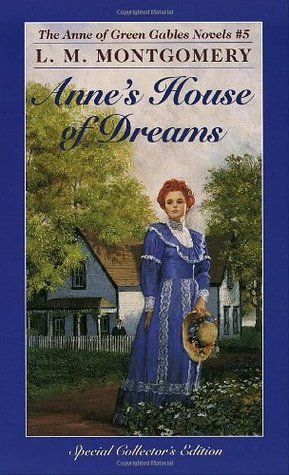
Even though Anne has apparently forgotten how to dress thanks to one of the worst covers in the whole series, this is definitely my favorite of the sequels thus far.

https://images.gr-assets.com/books/1442471048l/77394.jpgTitle: Anne’s House of Dreams (Anne Novels #5)
Author: L.M. Montgomery (1874-1942)
Original Publication Date: 1917
Edition: Bantam Books (1998), 227 pages
Genre: Sentimental Fiction. Romance.
Ages: 12-17
First Line: “Thanks be, I’m done with geometry, learning or teaching it,” said Anne Shirley, a trifle vindictively, as she thumped a somewhat battered volume of Euclid into a big chest of books, banged the lid in triumph, and sat down upon it, looking at Diana Wright across the Green Gables garret, with gray eyes that were like a morning sky.

Anne is married at last and is moving to a dear little cottage at Four Winds Harbor, where her charmed life will be marred by tragedy. Our beloved heroine must face up to the difficulties of life when she meets her neighbor Leslie Moore, who is trapped in a marriage from which Anne’s customary meddling has no hope of freeing her – but she also forms some of her closest and most genuine friendships in this isolated place.

https://i.pinimg.com/236x/73/90/fb/7390fb8a4a1b5ce428be639846aa19f9.jpg
This publisher commissioned a better idea.

After a series of opening chapters detailing Anne’s longed-for Green Gables wedding in all of its dreamy perfection, the sentimental guff Anne fans are accustomed to is jettisoned to make way for Montgomery’s darkest work yet. Written during the First World War, Anne’s House of Dreams is remarkably somber, thoughtful and honest. It utilizes a smaller cast of characters (mostly Anne, Gilbert and their three nearest neighbors) and develops them beyond the usual comedic figures that have featured in other stories of Anne as an adult.

The cast we meet upon Anne’s arrival at Four Winds are the sentimental lighthouse-keeper Captain Jim, with his stories of the sea; man-hating, fervent Presbyterian Miss Cornelia Bryant; and fair heroine Leslie Moore. Anne’s House of Dreams plays to one of Montgomery’s hidden strengths, as she usually packs her novels with so many ancillaries that they crowd each other out; here, every character has a sense of depth and development missing from those such as Anne’s dorm buddies. This deliberate downscaling makes Anne’s House of Dreams the most tightly plotted of the series so far, abandoning much of the episodic structure in favor of Anne’s continuous attempt to unravel the mystery of Leslie Moore and befriend her.

https://i0.wp.com/images2.fanpop.com/images/photos/4100000/The-Goose-Girl-grimms-fairy-tales-4125926-345-500.jpg
Arthur Rackham’s Goose Girl.

Leslie is one of Montgomery’s best creations, introduced as a modern Goose Girl: Anne saw a girl who was driving a flock of snow-white geese along the crest of a velvety green hill on the right. … The girl was tall and wore a dress of pale blue print. … But it was the girl’s beauty which made Anne give a little gasp–a beauty so marked that it must have attracted attention anywhere. She was hatless, but heavy braids of burnished hair, the hue of ripe wheat, were twined about her head like a coronet; her eyes were blue and star-like; her figure, in its plain print gown, was magnificent; and her lips were as crimson as the bunch of blood-red poppies she wore at her belt. Anne’s friendship with Leslie is fascinating because it is fraught with tension, not blithe and carefree as in books past. Grave in aspect, embittered from the many tragedies in her life, Leslie feels pain and envy just being near Anne, and Anne in turn is unsure if her cold new neighbour even likes her. This is much more convincing than the Katherine plotline from Windy Poplars (which was very much recycled from this story), as Anne cannot cure Leslie’s woes by her mere star-like presence this time. Instead, the author relies on some of Dickens’ techniques to bring about the necessary happy ending.

Meanwhile, the change of scenery reinvigorates Montgomery’s prose. The ocean is this novel’s muse, and Four Winds is no sleepy hamlet: There was a certain tang of romance and adventure in the atmosphere of their new home which Anne had never found in Avonlea. There, although she had lived in sight of the sea, it had not entered intimately into her life. In Four Winds it surrounded her and called to her constantly. From every window of her new home she saw some varying aspect of it. Its haunting murmur was ever in her ears. Vessels sailed up the harbour every day to the wharf at the Glen, or sailed out again through the sunset, bound for ports that might be half way round the globe. Fishing boats went white-winged down the channel in the mornings, and returned laden in the evenings.

Montgomery’s reliable humour takes on a new shade as well, in compliment of the book’s changeable atmosphere. Miss Cornelia, the latest in her trademark line of comical spinsters, has an acerbic tongue unmatched even by Marilla Cuthbert. “He’s noted for his beautiful pigs. He’s a heap prouder of his pigs than of his children. But then, to be sure, his pigs are the best pigs possible, while his children don’t amount to much.” While claiming to hate only men, Miss Cornelia offers scathing indictment of her entire community, while still sitting down to the job of making baby clothes for expectant mothers. “I s’pose I’m a fool, to be putting hand embroidery on this dress for an eighth baby. But, Lord, Mrs. Blythe, dearie, it isn’t to blame for being the eighth, and I kind of wished it to have one real pretty dress, just as if it was wanted.”

https://thewesterncornerofthecastle.home.blog/wp-content/uploads/2020/07/3e8c4-lucymaudmontgomery.jpg
Lucy Maud Montgomery.

I went into Anne’s House of Dreams with rather low expectations, after many reviews made it sound like this is where Anne first becomes a Mary Sue, yet my fears were unfounded. She still has her rich inner life, her after-dark strolls, her fancies about ghost ships in the fog and her strong belief system. What she doesn’t do anymore is write, and that choice has driven legions of Anne fans berserk. Montgomery must have anticipated this, as she has Gilbert say, “some people might think that a Redmond B.A., whom editors were beginning to honour, was ‘wasted’ as the wife of a struggling country doctor.” Anne does not set her dreams of literary greatness aside from lack of support, though; rather, it is by honest self-evaluation. “I know what I can do. I can write pretty, fanciful little sketches that children love and editors send welcome cheques for. But I can do nothing big.” Anne chooses to get married instead and readers lament the waste of her talent, ambition and education, as if none of that will be utilized raising children.

I would not be commenting on this point, were it not for how many of these reviewers seem to take that choice as almost a personal affront, as if they secretly wanted Anne to embrace a future as an old maid. Perhaps it’s a testament to the personal impact of the Anne books – this series charts more years of a single life than most children’s literature ever attempts, and as she grows up with so many paths to pick from it’s only natural that we would all want to see Anne choose the road that affirms our own life choices and dreams, to prove once and for all that she truly is a kindred spirit. Every girl who yearns for marriage and motherhood will be rewarded, but for a lot of others it’s clear that Anne becomes a stranger to them.

https://i0.wp.com/ecx.images-amazon.com/images/I/51wrG5wav3L._SL500_.jpg
This Little House spinoff went the other way, and inspired an equal and opposite backlash because you can’t please everyone.

All the signs pointed this way, of course – for her to become a career girl after three volumes in which she longed for and sacrificed for family (and finally realised how she felt about Gilbert) would have been disingenuous and contradictory. Those who dislike the idea of her embracing the domestic might prefer to just stop with Anne of Windy Poplars, which is the apex of her career plot – but you’d be missing out.

Anne’s House of Dreams is a very heartfelt book, and it delves fairly deeply into big themes, notably an ambiguous look at predestination and the question of evil. There is the tragedy that befalls Anne at what should be the pinnacle of her happiness, causing her to question providence for the first time. This is echoed in the regretful spinsterdom of Anne’s new cook Susan, and brought to a head when Gilbert’s medical ethics come into conflict with Anne’s concern for Leslie’s welfare. Captain Jim and Miss Cornelia each take a side in the ensuing argument, with the latter angrily crying, “I don’t believe the doctor has any business to tamper with the visitations of God.” Montgomery gives weight to the human conundrums of life, death, truth and promises, and allows every character in this tiny drama to have their say. It’s certainly the most grown-up of the Anne books, perhaps less likely to be appreciated by a teenage girl than the comic early adventures or the Austenian plot of Anne of the Island, but its focused themes and touching drama make it essential to the complete story.

See Also: I have reviewed the entire series so far, starting with Anne of Green Gables. Warmly recommended.

Parental Guide, with major Spoilers in the Violence section below.

Violence: Leslie’s past is an unending misery, as related to Anne by Miss Cornelia.

At twelve, Leslie witnessed her little brother get crushed beneath a cart and two years later found her father hanging in the parlour, “his face as black as a coal.” She was emotionally blackmailed by her mother into a loveless marriage with wealthy Dick Moore, who it’s strongly hinted was an abusive drunk. He soon went to Havana, got into a bar fight, suffered brain damage and came home mentally disabled, trapping Leslie as his caregiver for eleven long years.

Aside from this backstory, there’s also the tragedy of Anne’s first child, a daughter who dies within hours of birth (a reason is never given, which was common practice in those days). At the close of the novel, Captain Jim also passes away, though that was heavily foreshadowed.

Values: To live a good and happy life irrespective of fame or fortune. The acceptance that all things must pass, as Anne and Gilbert must leave their happy little house at the end of the book for the sake of Gilbert’s work and the many children to come. The cherished value of the smallest things. The capacity to overcome grief and, in Leslie’s case, to rise above bitterness and not be defined by misfortune. The hand of providence in second chances. The idea that the truth will set you free – rather literally in this case. And of course, the necessity of love and friendship in life.

Role Models: Anne and Gilbert model a happy, supportive marriage. The Blythes, Leslie, Miss Cornelia and Captain Jim are all good neighbours.

Educational Properties: I stick to my usual recommendation for this series, although if you’re participating in a book club (family or otherwise) the ethical quandaries make this one of the more suitable Anne novels for debate.

End of Guide.

The next Anne novel is the very last one Montgomery wrote and I can’t help wonder if it will simply retread the failures of Windy Poplars. Is Anne the meddlesome Mary Sue, adored by all and incapable of mistakes, due for one more appearance? I’ll find out next month.

Up Next: A book from the 2010s at last! Let’s see how Kevin Henkes measures up to what came before.

Sea Star: Orphan of Chincoteague – Marguerite Henry

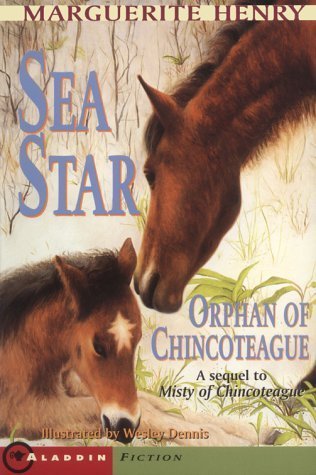
Way to betray the entire premise of your original classic, Ms. Henry.

https://i.gr-assets.com/images/S/compressed.photo.goodreads.com/books/1452289973l/1351766.jpgTitle: Sea Star: Orphan of Chincoteague
Author: Marguerite Henry
Illustrator: Wesley Dennis
Original Publication Date: 1949
Edition: Aladdin Paperbacks (1991), 172 pages
Genre: Animal Stories.
Ages: 8-11
First Line: Paul was separating each silver hair in Misty’s tail.

I’ll begin with a quote from Misty of Chincoteague to explain my frustration with this book: Now when a buyer came to look at the colts, Maureen did not run to her room as she used to do, pressing her face in the feather bed to stifle her sobs. Nor did Paul swing up on one of Grandpa’s ponies and gallop down the hard point of land to keep from crying. Now they actually led the colts out to the buyers to show how gentle they were. They even helped load them onto waiting trucks. All the while they kept thinking that soon they would have a pony of their own, never to be sold. Not for any price.

Well, that didn’t age well.

It’s a bright July day when a silver airplane lands at Pony Ranch. Movie men have come to film the annual Pony Penning, and they want to purchase Misty for the film and subsequent tour. Paul and Maureen are guilt-tripped into selling Misty in order to put their uncle through college, and are afterwards thankful to discover an orphaned colt on Assateague. Little Sea Star helps to distract them from their loss but the colt is frail and refuses to eat – it’s up to the whole Beebe family to find some way to save the poor thing.

https://missmollys-inn.com/wp-content/uploads//2012/12/Marguerite-Henry-misty-of-chincoteague.jpeg
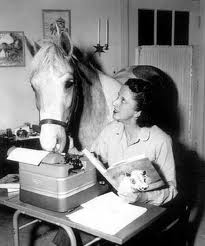
Marguerite and Misty.

Marguerite Henry had no plans to write a sequel to Misty of Chincoteague – having taken great liberties with the true story, she thought it stood well enough on its own, at least until she heard about little Sea Star. In this follow-up novel she tried to bring the plot more in line with reality. The real Misty had actually been sold to Marguerite Henry herself, and she did bring Misty to book signings to delight children. One important difference is that the real Misty was purchased before she’d even been weaned – while Clarence Beebe had not been planning to sell her, the little foal was not a beloved family pet, hard won from the wilds of Assateague and saved up for over a hard summer’s work by the Beebe children. Misty of Chincoteague was pure poetic license, delivered in gratitude to the Beebes for agreeing to sell such a wonderful pony. The characters by the end of the book were in a different place than they’d ever been in the real world, so the follow-up act of selling Misty was impossible to replicate naturally – instead, Marguerite Henry had to devote a portion of Sea Star‘s dialogue to a series of justifications for the decision. Unfortunately, none of them are very convincing.

Now it’s worth pointing out that the novel’s dialogues are only the connective tissue between the A and B plots. With the exception of the scene where Misty is crated for the plane trip, all of the horse material is entertaining for kids – the first half details the excitement of Pony Penning Day and the last third is all about saving Sea Star. Any child who loved Misty will easily pick this sequel out in a bookstore and they will probably like most of it – while it was my least favorite of the original trilogy as a kid, I still read it multiple times. Children might not agree with the decision to sell Misty, but it’s not likely to be a total deal-breaker and they certainly aren’t going to care about the mathematics of commerce or possible communistic overtones. That being said…

So the two men from New York arrive and, upon learning that the Beebe grandparents are both out, immediately start horse-trading with the kids. First they offer the tempting good news – a movie! how exciting! – and afterwards explain that they’d have to purchase Misty to make the film happen. They also want to take her to schools, libraries and movie theaters, and start guilting Paul and Maureen:

Mr. Van Meter said, “We had a feeling you might want to share Misty with boys and girls everywhere.”
“Boys and girls who have never seen a real pony,” Mr. Jacobs continued.
It was Mr. Van Meter’s turn now. “Sometimes when I hear children in New York talk about Misty, it seems she no longer belongs to a boy and girl on an island, but to boys and girls everywhere.”
The words kept flying, back and forth, higher and higher. “Misty has grown bigger than you know,” Mr. Jacobs said. “She isn’t just a pony. She’s a heroine in a book!”

Apart from the interesting metafictional element going on here (Misty of Chincoteague is a book within the sequel to the book) this is some appalling behaviour by two grown men, and Grandpa Beebe is rightly disgusted on his return. Also, no, Misty does not “belong” to all children everywhere, the book does. But the kids fall in line and even parrot some of this back at Grandma to shore up their decision to sell. “When they told how much Misty meant to poor little city children,” says Maureen. Well, as a former “poor little city child” who dreamt of riding lessons which my parents could never afford, I would not have wanted a girl in the countryside to give up her pony so that I could spend five minutes petting it. Not to mention the cold business decision to make thousands of children momentarily happy at the expense of making two extremely sad. As Grandpa says, “livin’ out here on this lonely marshland, why, Misty’s the nighest to a friend these childern got.” Are they undeserving of the pony they worked so hard for, just because she’s famous now?

Misty sold
Wesley Dennis does a great job with a sad scene.

The picture men’s arguments fail to entirely sway the family and Grandpa gladly sends them packing. However, shortly afterwards Grandma Beebe shows up with the woeful news that Clarence Lee, Paul and Maureen’s young uncle, can’t afford the college tuition of 300 dollars to study for the ministry. The children must now nobly sacrifice their beloved pony for the greater good of the family… No, hang on, that argument is also flawed.

First of all, it hinges on a character we never get to meet. Saintly Clarence Lee does not feature in a single scene in any of the three Misty books, so it is very difficult to care about his hopes and dreams. This is a failure in terms of dramatic impact, but it would still be an understandable decision for the characters in an era when college could have a great positive impact on an entire family’s prospects – until you do the math and realise that Grandpa Beebe is being taken for a fool.

The movie men explain that their company was young and struggling and could afford to pay only two hundred and fifty dollars for Misty. So she’s a famous pony and they’re trying to get her on the cheap. Grandpa agrees to this arrangement because, after a sale he was making fell through, he’s only got 50 dollars to his name. Combined, that makes up the entire tuition fee in one fell swoop. Problem is, the deal Grandpa had lost involved selling a “whole flock” of ponies – the buyer he had lined up decided to buy used trucks instead. So Grandpa has a “whole flock” of unsold ponies, and the going rate of wild ponies back in Misty of Chincoteague was 100 dollars. In that novel it was also made clear that gentled ponies could be sold for higher price. They’re sitting on a number of ponies that could easily turn a profit and instead they sell their famous Misty for beneath her value? How has Pony Ranch stayed in business?

Also, since when is college a one-time deal? Why can’t Clarence Lee wait a year and reapply? Grandma even says he’s recovering from pneumonia, which is why he can’t be expected to earn the money for himself. If he’s that physically frail, maybe it’s not the best time to embark on a grueling course of study? Selling out a beloved family pet to be hauled from place to place (which is bound to be stressful for a pony who has never traveled before), and giving her into the care of people who see a financial meal ticket decades before the film industry enforced an animal welfare code, all because college is worth any price? This has not aged well. Attempts to parallel them putting Misty in a sale crate with Paul releasing the Phantom back into the wilds also miss the mark because the Phantom was not happy at Pony Ranch while Misty clearly is.

happy misty
Behold happy Misty.

And so Misty is sold. They don’t even write up a formal contract, just a vague promise that Misty will be sent home after the tour is over. Luckily, Henry was inspired to write a third book in the series in the 1960s, assuring new generations of children that Misty did indeed come back to Paul and Maureen – unless those children got the Aladdin Horseshoe Library box set, which went ahead and listed the books in the wrong order so that Sea Star appeared to be the conclusion to the series after all.

https://d20eq91zdmkqd.cloudfront.net/assets/images/book/large/9780/6897/9780689716249.jpg
No, I’m not bitter.
Sea Star rescued, wesley dennis
Sea Star rescued.

Within hours of Misty’s departure, Paul and Maureen find little Sea Star in a cove on Assateague, and the whole family is delighted and relieved. Once this plot is finally under way, the novel does a 180 and becomes classic Marguerite Henry – the story of an orphaned colt wasting away in sorrow, and of an injured mare pining for her own lost foal and how they are brought together to grow strong and heal the sorrows of an entire family with the help of a lot of myrtle leaves. Sea Star, with his toothpick legs and wondering expression, is adorable and Wesley Dennis’s illustrations are a wonderful accompaniment once more. There are no dubious motivations amongst the native Chincoteaguers – nope, real salt of the earth types one and all. Scrumptious food descriptions are back and there’s even some humour. The first half of the book is all but forgotten, and yet…

I don’t like giving a negative review of a Marguerite Henry book. However, since Misty worked perfectly well as a standalone, I have to say that Henry’s first instinct was right. I will say in its favour that, while I can nitpick its value system, Sea Star would actually make a tremendous vehicle for discussion with even a young child and the writing remains on the same strong read-aloud level of Misty. It’s not essential, but as I said at the start, children will still enjoy the majority of the story.

See Also: Misty of Chincoteague.

Parental Guide, with mild spoilers.

Violence: Sea Star is found beside his mother’s body, but that is hardly described. Both Sea Star and the injured mare are implied to be well on the road to recovery by the end of the book.

Values: College is worth any price. If you love something, let it go. Share your greatest treasure with the impoverished world. Love is a healing force that helps us overcome our sorrows.

Role Models: Obviously the whole plot is meant to make the Beebes look virtuous and self-sacrificing, and it’s obvious what I think about that.

Educational Properties: If it’s used as a read aloud, it could spark some strong feelings and interesting discussion. Always a good thing.

End of Guide.

I’m now halfway through the series, with one more sequel and a final spinoff volume to go.

Up Next: Back to the Anne novels.