One for Sorrow – Mary Downing Hahn

This book begins with a run-on sentence. Prepare yourself for a rant, because there will be no prisoners taken, nor will I be using any spoiler warnings in this review…

https://pdpabst.files.wordpress.com/2017/07/one-for-sorrow-book.jpgTitle: One for Sorrow: A Ghost Story
Author: Mary Downing Hahn (1937-)
Original Publication Date: 2017
Edition: Scholastic Inc. (2018), 293 pages
Genre: Horror. Fantasy. Historical fiction.
Ages: 10?
First Sentence: Although I didn’t realize it, my troubles began when we moved to Portman Street, and I became a student in the Pearce Academy for Girls, the finest school in the town of Mount Pleasant, according to father.

It’s 1918 and the Spanish Flu is making the rounds of America. Shy Annie Browne is new in school and on her first day is immediately “befriended” by Elsie Schneider, a lying, controlling, destructive little psycho whom all the other girls despise. Annie is prevented from making any other friends until Elsie is absent from school, at which point Annie is finally brought into the popular circle – and takes part in their ceaseless bullying of Elsie. There’s no doubt that Elsie brings it on herself, but she’s grossly outnumbered and Annie feels bad about her part in it (not that it stops her). Eventually, Elsie gets the flu and dies, only to return as an angry ghost with a particular grudge against Rosie, the leader of the clique, and guilt-stricken Annie.

Okay, so the writing in this book is absolutely horrible, beginning with the most brutally short paragraphs this side of a Guardian article. Sentences are clipped, descriptive prose is fleeting and the vocabulary is limited and therefore numbingly repetitive. Is this the style of today? If so, it’s been streamlined of everything that could possibly make reading a “chore.”

Just as I finished my oatmeal, Jane knocked on the door.
When I ran to meet her, she gave me a big hug. “Oh, I’m so glad you’re well enough to come back to school, Annie. I’ve missed you so much.”
“I’ve missed you, too.”

https://d.gr-assets.com/books/1348400532l/200891.jpg
I’m just going to recommend better books in these spaces today.

The prose is continually stuck at the level of early chapter books – and not even challenging ones at that. You’ll find more detailed verbiage in American Girl, Chet Gecko and Beverly Cleary stories for younger readers and that’s a death blow for this entire book. The concept – a ghost story kicked off by the Spanish Influenza at the end of the First World War – has so much potential, but it can’t be harnessed because the setting is never given any focus or weight. Hahn is a veteran writer; she’s been doing this since the 1980s and once won the Scott O’Dell award for historical fiction, but there’s no evidence here for why that would have ever been the case. Aside from the games girls played, the books they read and some basic info on wakes and horse-drawn hearses, there’s just nothing here. Maryland in 1918 is a vague backdrop for the ghostly plot, nothing more.

As far as the plot goes, Elsie’s ghost doesn’t appear until over 100 pages in – before that, One for Sorrow is a story about bullying, which means it should be character driven. It isn’t. Aside from Elsie and Rosie, almost none of the characters merit any physical description or personality. The clique of mean girls are only distinguishable by their degrees of guilt, with the “nice” ones (Annie and Jane) feeling more guilt and the “mean” ones (Eunice and Lucy) feeling less, with Rosie somewhere in the middle. Never mind that this sets up the phony idea that guilt is somehow a virtue; it can lead to virtue but just as easily to self-destruction. As such, none of these girls have any positive traits whatsoever. They are nasty, ill-mannered liars without a complete spine between them. Rosie comes up with a plan (inspired by the true story of Hahn’s mother) to get free sweets by going to wakes and pretending to know the dead people there. “We won’t be doing anything wrong,” Rosie said. “We’ll tell people how sorry we are, we’ll talk about how nice the dead person was, we’ll make the mourners feel better. That’s not taking advantage, that’s not lying.” And Annie more than once compares this horrid specimen to Anne Shirley, who never told a lie. But since most kids won’t (or can’t?) read Anne of Green Gables, I guess they’ll never know that.

As for Annie, she’s a complete drip with no spirit at all. One could be forgiven for assuming that she must improve at some point, being the protagonist and all, but you would be wrong. To the end she thinks (paraphrasing): “oh, why did I let Elsie make me do those terrible things?” She makes no effort to defeat Elsie’s ghost. She goes along with every stupid and cruel idea Rosie ever has, even one which nearly gets her killed, and then feels bad afterwards. She does not grow or alter through the book and never comes clean. When she stumbles upon a retired ghost hunter called Mrs. Jameson, it is by accident, and she simply follows all of Mrs. Jameson’s instructions thereafter with no agency of her own.

https://i0.wp.com/d.gr-assets.com/books/1293762966l/596878.jpg
The second book about Tiffany Aching. Excellent, complex and creepy.

So much for the characters. The plot begins with children being mean (usually by shoving and screaming insults at one another) and once Elsie’s ghost appears it’s just round two of the same spiel for more tedious pages of screaming and shoving. Ghost Elsie is exactly the same as living Elsie, only with more power. This should be unnerving but it isn’t. For instance, Elsie possesses Annie and makes her do terrible things, but Annie doesn’t black out (which would heighten the suspense by adding mystery) or have enough personality to make the behavioral change feel horrifying (a la Tiffany Aching in A Hat Full of Sky). The writing continues to be frenetic and flat, and Elsie explains from the start what she intends to do to Annie, so there’s no chance for the situation to ever feel dreadful or uncanny: Alone except for Elsie, I found myself removing the flu mask from my bookbag and tucking it into Rosie’s. I didn’t want to do it, but I couldn’t stop. It was as if I were outside my own body, watching myself.

One for Sorrow is a ghost story that has no sense of the unearthly and no allowance for anything bigger than the individual. A Scooby-Doo hoax would feel more authentic to this novel’s worldview because while this is set in 1918, all of the characters are from 2017.

https://images.gr-assets.com/books/1361116236l/500660.jpg
By These Ten Bones, featuring werewolves in medieval Scotland. Good and evil, religious belief, horror and the highlands. Worth checking out.

In 1918 a girl’s first thought about ghosts would involve the state of the soul, salvation and damnation. Annie would pray to God for aid and she would go to church – if for no other reason than the hope that Elsie couldn’t follow her there. But Annie doesn’t even think of any of those things, because Annie is from 2017. That’s why she mishears the phrase “at peace with the Lord” as “at the beach with the Lord” – because she’s never heard it before. She’s shocked at the notion of corporeal punishment because her parents and teachers also belong in 2017 (Miss Harrison, faced with a sea of screaming pupils disgracing her school’s orderly reputation, disciplines them by ending recess early). Muddying the waters are a couple of references to hell and the devil, which means Hahn wants us to think of these characters as Christian, even though they obviously aren’t.

So let’s try to assume that Annie and her entire social circle are the very height of the 1918 progressive movement. But just as there’s no spiritual element to her problem, there’s no historical one either – because guess what? Annie loves to read, so it really should occur to her that Elsie can’t be the world’s first ghost. It has to have happened before and there should be records, yet she does no research on spiritualists and ghost-hunters, and no one reading this book would gain from it any sense of the antiquity of hauntings. When Annie’s bad behavior gets out of hand, she’s sent to a convalescent home and it just so happens there’s a retired ghost-hunter on the premises. Mrs. Jameson drops hints that she’s an expert on the matter, but even at this stage there’s nothing bigger than the ghosts – in fact, Mrs. Jameson can’t “help” Elsie until she dies and becomes one herself. In other words, when Elsie causes Mrs. Jameson to fall and break a hip, it’s actually a good thing.

Lastly, although Elsie is clearly psychotic – revelling in every drop of pain she causes and before her death probably headed to a future abducting and murdering children – it turns out that she can only be defeated by empathy.
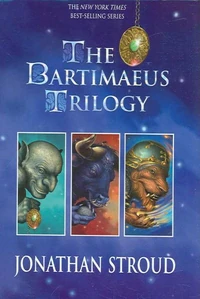
https://vignette3.wikia.nocookie.net/bartimaeus/images/1/1d/Trilogy.jpg/revision/latest/scale-to-width-down/200?cb=20140528201030
Annie is basically a villain protagonist, but if that’s what you’re looking for, this is still the gold standard.

It’s not even genuine empathy. You know, the sort that would make this story less about the ghost and more about the life lessons the heroine learns about caring for others and standing up to bullies and whatnot. That would be corny but fairly typical. Instead, Mrs. Jameson flat-out instructs Annie to lie: “Be kind to her, earn her trust.” Annie loathes Elsie but pretends otherwise – and it’s the right thing to do. Elsie kills Mrs. Jameson – and it’s the right thing to do. Early on in the book, Elsie screams at Annie: “I’d give anything to have a mother like yours. It’s not fair that you have so much and I have nothing!” Herein lies the key to her defeat. She’s just an underprivileged child who wants her mommy and the whole book was a 200 page temper tantrum (culminating in the murder of a little old lady). It turns out that sympathizing with the motives of evil is what defeats it.

To be extra clear, Elsie does not show any mercy at the end of this book. She becomes “reachable” because she turns maudlin and self-pitying for a couple of minutes. She is not redeemed, but she gets everything she wanted, including a free ticket to the afterlife to reunite with her dead mother. She’s like Hannah in Thirteen Reasons Why, only she’s a literal ghost instead of tapes. She dies and is avenged. All of the adults feel sorry for her, all of the girls who wouldn’t be her friends are haunted by their actions and she never has to repent or live with any of her own choices.

The point of the Castle Project has always been to read as widely as possible in the field of children’s literature. I cannot proclaim the superiority of vintage options if I don’t read the modern alternatives. Well, here you go. On technical merits, One for Sorrow is abysmal. It is relentlessly unpleasant, philosophically poisonous and the bigger picture behind this book implies that speculative fiction in particular is on a steep decline. If there’s nothing bigger than our finite experience, if good and evil are relative based on the individual and if our entire history means nothing, we will be seeing more and more fantasies robbed of power and built on sand.

There was only one thing I appreciated about One for Sorrow and that was Hahn’s inclusion of many book titles which girls of the time would have read. After a while I began keeping a list, hoping that Hahn was sending some kind of message to her readers (she was born in the 1930s, so she has to be aware of what’s happened):

L.M. Montgomery – Anne of Green Gables; Anne’s House of Dreams
Johann D. Wyss – The Swiss Family Robinson
Wilkie Collins – The Moonstone; The Woman in White
Charles Dickens – The Pickwick Papers
Ouida – A Dog of Flanders
Zane Grey – Riders of the Purple Sage
Louisa May Alcott – Little Women
Booth Tarkington – Penrod; Seventeen; The Magnificent Ambersons
Henry Wadsworth Longfellow – ‘The Wreck of the Hesperus’
Victor Appleton – Tom Swift
Sir Walter Scott
Edgar Allan Poe
Nathaniel Hawthorne

Feast your eyes and think of what they call progress.

https://i0.wp.com/photo.goodreads.com/books/1177273274l/690609.jpg
Bonus points for including a cryptid – because people of the time believed in them, even if Rinaldi doesn’t.

See Also: The Coffin Quilt by Ann Rinaldi. Set during the Hatfield-McCoy feud, this books contains plenty of southern gothic atmosphere, morbid and murderous occurrences, actual historical detail and period-accurate belief systems.

Parental Guide, just for fun.

Violence: You’ve got your dead people, your rotting ghost, and your screaming, shoving, fat-shaming and throwing things (these bullies don’t have very original material). Without atmosphere or subtlety, the disturbing horror content ranges from merely annoying to unpleasant. Spookiness can be fun. This was neither.

Values: Be nice! Lying makes people feel better, so it’s good! Empathize at all costs, even with psychos – because if you’re only nice enough, they’ll totally leave you alone!

There’s also a dropped plotline in which the girls hate Elsie for being German, which sets up a commentary on xenophobia that is never utilized because that’s not really why they hate her. It’s just an extra way to insult her.

Role Models: Everyone is horrible. Oh and Annie gets a concussion from sledding. Headfirst. At night. In a cemetery. Just thought I’d mention it.

Educational Properties: If you or yours have already suffered through it, by all means hold a discussion on morality and the Spanish flu to try and make it worth your time. Otherwise, no.

End of Guide.

Mary Downing Hahn has written many ghost stories, and I can easily believe the ones from the 80s were better just because the trends in children’s publishing were healthier at the time. Judging an author from a single book is never entirely fair, but I have to admit that I’m sorely tempted to do so in this case.

Up Next: The vintage equivalent. An obscure Canadian choice from 1968 featuring another angry ghost girl. Let’s see how it stacks up, just as a nice note to go out on.

The Prince and the Pauper – Mark Twain

It derailed the Great American Novel and it was totally worth it.

https://postercrazed.com/wp-content/uploads/2017/05/The-Prince-and-the-Pauper-by-Mark-Twain-Art-Print.jpg
Not my edition, but importing photos has gotten rather difficult lately…

Title: The Prince and the Pauper
Author: Mark Twain (1835-1910)
Illustrator: Uncredited
Original Publication Date: 1881
Edition: Harper and Brothers Publishers (1909), 281 pages
Genre: Historical fiction. Adventure.
Ages: 10-14
First Sentence: In the ancient city of London on a certain autumn day in the second quarter of the sixteenth century, a boy was born to a poor family of the name of Canty, who did not want him.

As King Henry VIII’s health fails, a fateful meeting takes place between his son and heir, Edward VII, and a pauper named Tom Canty. The boys switch costume, marveling at their strangely identical appearance, but before they can change back, they are mistaken one for the other and Prince Edward is thrown from the palace on his ear while Tom is installed in his place. Edward must now venture through the underbelly of Tudor society, seeking someone to believe his claims, while Tom futilely insists that he is not the true heir to a court that can only maintain that the prince has gone mad. When King Henry dies, preparations for the coronation begin, but how will the prince ever regain his rightful place?

Mark Twain revolutionized American literature with Adventures of Huckleberry Finn and its groundbreaking use of wholly accurate and authentic vernacular. His characters spoke in slightly different dialects depending on their location, class and race. He took far greater pains with the writing than he did with the plot, and it shows in his lazy sequels, where the accent work turns plain and inconsistent. However, in every one of those books he had an advantage: he was an American who’d grown up and spent years traveling and working in the south. While he visited England, it was clearly not long enough to learn anything about the overwhelming variety of accents to be found there. Everyone in The Prince and the Pauper speaks an identical version of ye olde English. Here’s the prince begging the pauper’s villainous father to believe that he is not Tom Canty:

“Oh, art his father, truly? Sweet heaven grant it be so–then wilt thou fetch him away and restore me!”
“His father? I know not what thou mean’st; I but know I am thy father, as thou shalt soon have cause to–“
“Oh, jest not, palter not, delay not!–I am worn, I am wounded, I can bear no more. Take me to the king my father, and he will make thee rich beyond thy wildest dreams. Believe me, man, believe me!–I speak no lie, but only the truth!–put forth thy hand and save me! I am indeed the Prince of Wales!”

https://vignette.wikia.nocookie.net/onceuponatime8042/images/e/e0/InfoboxPrincePauper.jpg/revision/latest?cb=20130414052811
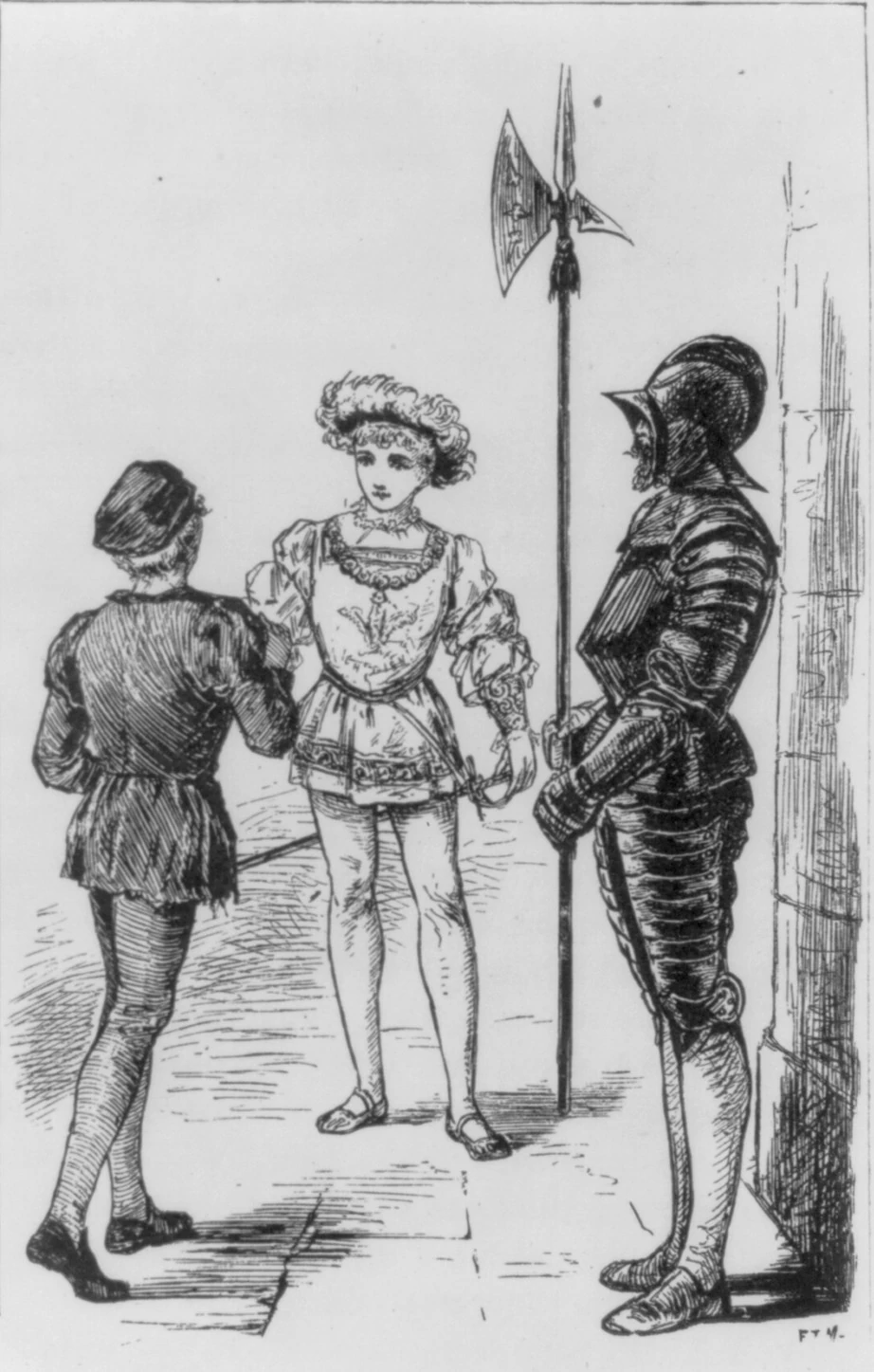
The illustrations from my edition, shamefully uncredited.

Neither of the titular characters indulge in a second’s worth of masquerade. They both stand by their true identities, and yet the boy from Offal Court with only his feet for transport and the sequestered son of the King of England apparently speak as identically as they look. No Englishman would have written this plot (or if he did, he would choose an “exotic” locale like Ruritania to set it in). Twain grounds his flight of fancy amidst real historical events, but I don’t even want to criticize him for this. The Tom Sawyer books were not exactly bastions of realism either, and The Prince and the Pauper departs altogether into the realms of the fairy tale – a style which Twain does a great job with.

As a fairy tale, it’s properly dark, suited for those children who’ve grown up with Grimm, Andersen and other storytellers of good cruelly set upon before it can triumph. Twain’s inspiration seems to have stemmed in part from a desire to draw attention to the excessive punishments of the Tudor era, and as such his prince finds himself lost amid beggars, thieves and vagrants. What’s odd is that, unlike in the Tom Sawyer series, Twain wears his heart on his sleeve here, appearing in genuine earnest upon his subject. He offers few bon mots, but some of his loveliest writing, as when the prince (now king) finds shelter in a barn and friendship with a calf.

The king was not only delighted to find that the creature was only a calf, but delighted to have the calf’s company; for he had been feeling so lonesome and friendless that the company and comradeship of even this humble animal was welcome. And he had been so buffeted, so rudely entreated by his own kind, that it was a real comfort to him to feel that he was at last in the soiciety of a fellow-creature that had at least a soft heart and a gentle spirit, whatever loftier attributes might be lacking. So he resolved to waive rank and make friends with the calf.

Pleasant thoughts came at once; life took on a cheerfuler seeming. He was free of the bonds of servitude and crime, free of the companionship of base and brutal outlaws; he was warm, he was sheltered; in a word, he was happy. The night wind was rising; it swept by in fitful gusts that made the old barn quake and rattle, then its forces died down at intervals, and went moaning and wailing around corners and projections–but it was all music to the king, now that he was snug and comfortable; let it blow and rage, let it batter and bang, let it moan and wail, he minded it not, he only enjoyed it. He merely snuggled the closer to his friend, in a luxury of warm contentment, and drifted blissfully out of consciousness into a deep and dreamless sleep that was full of serenity and peace. The distant dogs howled, the melancholy kine complained, and the winds went on raging, whilst furious sheets of rain drove along the roof; but the majesty of England slept on undisturbed, and the calf did the same, it being a simply creature and not easily troubled by storms or embarrassed by sleeping with a king
.

Twain uses an interesting tactic for the historical aspects included – where his interest in description flags, he simply excerpts from other chroniclers such as Leigh Hunt; educating his public while saving time. I guess that never caught on. It does disrupt the story a little bit, but it adds plenty of detail, especially of the resplendent pickle Tom Canty’s in.

Tom’s plotline is given less space, which is fitting since it’s considerably less dramatic. Unlike the Tom Sawyer books, whose plotting range from ramshackle to insane, The Prince and the Pauper is tightly woven. Tom Canty remains stationary, and the looming false coronation provides a natural venue for the finale, devoid of excessive coincidence.

https://christinawehner.files.wordpress.com/2015/09/527px-the_prince_and_the_pauper_12-134.jpg

Most of the secondary characters are only there to help or hinder the two boys, with the exception of Miles Hendon, a brave musketeer-styled nobleman who was wrongfully dispossessed and seeks restoration. Miles sees the good qualities in what he takes for a delusional beggar-boy, and so offers his protection. Although unconvinced by Edward’s assertions, Miles plays along, hoping to cure the boy of his madness and make him his ward. To this end, Miles becomes “a knight of the Kingdom of Dreams and Shadows” as the unlikely pair brave the mean streets of Tudor England together, and when separated, always find each other again.

The young prince does turn out to be every bit the equal of Miles for bravery. I had assumed going in that Edward would be the lesser of the two boys, stuck-up and ready for humbling, but he is so wholly principled and virtuous that Twain accidentally makes a case for monarchy through his example. Obviously, the plot couldn’t begin without the pair being rather dimwitted, but once the prince is cast into the streets things really get into gear. As Tom Canty’s abusive father and grandmother drag the prince “home” for a beating, the boy’s mother attempts to intervene and the prince’s mettle is revealed for the first time:

A sounding blow upon the prince’s shoulder from Canty’s broad palm sent him staggering into goodwife Canty’s arms, who clasped him to her breast, and sheltered him from a pelting rain of cuffs and slaps by interposing her own person.
The prince sprung away from Mrs. Canty, exclaiming:
“Thou shalt not suffer for me, madam. Let these swine do their will upon me alone.”
This speech infuriated the swine to such a degree that they set about their work without waste of time.

From this time forward, the prince shows loyalty to those as give him aid, compassion for the unjustly punished, contempt for the base and crooked, and obstinence in the face of disbelief. Trained in the art of the sword, he makes short work of boy thieves, and when captured by a gang of hoodlums, he refuses to improve his position by assisting in their plots to beg and steal.

Tom Canty is less sure of his moral compass. With less to lose, he finds himself going along with the masquerade he’s been forced into. He doesn’t like it but he adapts. Even here, the theme of justice asserts itself when Tom presides over a passing sheriff’s prisoners, bringing them into the palace to decide their fates. This culminates in some of the only comedic material in what is, for Twain, a thoroughly dramatic tale. Tom hears the accusation of witchcraft and storm-summoning levied against a mother and daughter:

“How wrought they, to bring the storm?”
“By pulling off their stockings, sire.”
This astonished Tom, and also fired his curiosity to fever heat. He said, eagerly:
“It is wonderful! Hath it always this dread effect?”
“Always, my liege–at least if the woman desire it, and utter the needful words, either in her mind or with her tongue.”
Tom turned to the woman, and said with impetuous zeal:
“Exert thy power–I would see a storm!”
There was a sudden paling of cheeks in the superstitious assemblage, and a general, though unexpressed, desire to get out of the place–all of which was lost upon Tom, who was dead to everything but the proposed cataclysm.

https://tobagostars.files.wordpress.com/2012/01/mark-twain.jpg

I could continue pulling quotes from this book all day, and I can well understand why Twain found this story more compelling than Huckleberry Finn. Throughout The Prince and the Pauper it seems as if he actually likes his characters – which I’m not sure can be said about any of his sequels to Tom Sawyer. Because it’s still written by Twain, there are occasional moments where his snideness gets the better of him, as when, after describing the engineering marvel of London Bridge and its remarkably self-sufficient community, he caps off with this statement: It was just the sort of population to be narrow and ignorant and self-conceited. However, that aspect of his writing is kept on a short leash here and not allowed to sprawl in every direction. The writing is wonderful, the plot is entertaining and though parts of it are very intense, that is compensated by the ever-present ideal of goodness. It is an undoubted children’s classic.

See Also: The Adventures of Tom Sawyer.

Parental Guide.

Violence: Beatings were a part and parcel of the era, and the prince sustains a few. Several of the vagabonds he falls in with have missing ears and there are descriptions of other medieval punishments, from whipping to getting boiled alive. However, these are mostly second-hand accounts. There are only two sequences which directly affect the prince, and both have a similar intensity to the famous murder in Tom Sawyer. One occurs when two women are burned at the stake, with their relatives forcibly restrained from throwing themselves on the pyre, and the prince looking away in horror. Twain focuses only on the reaction of the onlookers, not on what’s happening to the condemned women, but it’s still extremely dark.
The other notable sequence is an abrupt shift into full-fledged horror tropes, when the prince seeks shelter with a hermit. The hermit turns out to be a thoroughly deranged Catholic, who, upon discovering that he has King Henry’s son in his power, decides to truss him up while he sleeps. His methodical arrangements (and Twain’s choice language) make the whole scene that much more creepy.
The old man glided away, stooping, stealthily, catlike, and brought the low bench. He seated himself upon it, half his body in the dim and flickering light, and the other half in shadow; and so, with his craving eyes bent upon the slumbering boy, he kept his patient vigil there, heedless of the drift of time, and softly whetted his knife, and mumbled and chuckled; and in aspect and attitude he resembled nothing so much as a grizzly, monstrous spider, gloating over some hapless insect that lay bound and helpless in his web.

Values: Packed full, unusually for Twain. There’s a great deal of focus on noble characteristics, the quality of mercy and the value of education. This is also a precursor to A Connecticut Yankee in King Arthur’s Court, engaged at least in part around the cruel and unusual punishments of Tudor England, though here lacking the American alternative.

Role Models: Between Edward, Tom and Miles, practically every masculine virtue is exemplified, among them honor, honesty, strength, fidelity, principal, integrity, compassion, sacrifice and protectiveness. Twain dedicated the book to his own daughters, and it’s rather sweet to see this less jaundiced side of the man.

Educational Properties: This book furnishes a very detailed view of Tudor England and with so much focus on criminal law, social stratification, royal customs and historic London, it’s a great boon to homeschoolers, not even taking into account its highly advanced diction.

End of Guide.

And with this I have completed Mark Twain’s juvenile bibliography, ending on a high note indeed.

The Coffin Quilt – Ann Rinaldi

Southern Gothic for 12 year old girls.

https://i0.wp.com/photo.goodreads.com/books/1177273274l/690609.jpg

Title: The Coffin Quilt: The Feud Between the Hatfields and the McCoys
Author: Ann Rinaldi (1934-)
Original Publication Date: 1999
Edition: Harcourt (2001), 228 pages
Genre: Historical fiction.
Ages: 12-15
First Sentence: Today they hanged Ellison Mounts.

It’s the feud between the Hatfields and the McCoys! Madness, cruelty, death and despair all told from the viewpoint of youngest McCoy daughter Fanny, as she spends her childhood bearing witness to the conflict and finally realises that the only way forward is to walk away.

It shouldn’t surprise anyone that The Coffin Quilt is quite a dark book, even though Ann Rinaldi does her best to downplay the violence for her target audience of morbid young teens – a select readership of girls who like reading historical tragedies (like all those Dear America books about the Titanic and the Oregon trail). While the Hatfield-McCoy Feud fits the bill, the real story sprawled in so many directions that Ann Rinaldi had to find some way of containing it – thus, we follow events from the limited perspective of Fanny McCoy. She’s seven in 1880, when over half of the novel takes place, and she has no say in what happens as the domestic life of the family sours and shifts. The short chapters are packed with dread and woe, but daily life goes on even while the corpses accumulate. It’s less an action-packed western, more the eerie twin of Little House:

It was the old of the moon. A good time for timbering. A good time for cutting hay, too, which was where Pa and my brothers had gone at first light. They never cut on the new of the moon, because the sap was still in the hay and it’d take longer to dry.
My family planted and harvested by the signs. The rules for this are simple. You plant in the fruitful signs of Scorpio, Pisces, Taurus, or Cancer. You plow in Aries. You plant flowers in Libra when the moon is in the first quarter. It goes on like that and you dasn’t go against the rules or corn will hae small ears, potatoes will get numbs, and if you kill a hog in the growing parts of the moon the meat gets all puffy. Lots of town people just hoot about this, but it works for us so we keep doing it.

One of the surprises to The Coffin Quilt is Rinaldi’s willingness to think outside of the box. She not only figures that teen girls can read stories without any romance, and that they might be willing to read about a much younger character, but she also sidesteps the stereotypes about her chosen time period. It works for us so we keep doing it. No judgement. This is a great improvement on her first historical novel, Time Enough for Drums, whose cast and tone were far more predictable. The Hatfields and McCoys are dreadful people, but Rinaldi keeps them interesting by giving them some moments of sympathy, however brief. This makes Fanny’s loyalty understandable and highlights the grotesquerie and sheer waste of the feud. As Rinaldi points out in her author’s note, in the aftermath: Hatfields became respectable mine operators. McCoys went back to their lives, too, cultivating the land, raising ginseng, keeping bees, breeding cattle, hogs, and sheep, and displaying many of the traits and talents the people of these parts are famous for–the traits that mark the pioneer, the survivor, the breaker of the land, the raiser of the family, the churchgoer, the good neighbor. They may have been crazy but she still gives them their due.

https://www.history.com/.image/t_share/MTU3ODc4NjAzNTIzODkyOTU5/hith-hatfields-mccoy-174041967-2.jpg
Hatfields.

Likewise, Rinaldi also includes an honest-to-goodness cryptid in this story, a mystery creature called Yeller Thing, who always appears as a harbinger of evil tidings. The mountain folk reported such sightings, and so Rinaldi delivers a composite creature without trying to appeal to science for an explanation: I know what I saw. It was yeller. And big. Bigger than anything in these woods had a right to be, even a bear. It streaked by like a painter cat. And there was this eerie sound. Not a growl. It sounded like a Rebel yell, from what my pa told me about such yells. Or like a man about to die, which is maybe the same thing.
For a moment I stood stock-still. And then I heard the words Mama so often read from her Bible: “And it is appointed unto men once to die.”
Those words just came into my head. And I knew then that what was out there was nothing animal or human. The knowing flooded through me, and I ran.

https://www.legendsofamerica.com/wp-content/uploads/2018/10/RandolphMcCoy.jpg
Randolph “Ranel” McCoy.

The Coffin Quilt is dished up with almost no presentism or finger-wagging, even though there’s plenty of scope for it. Instead, the crux of the matter lies in what choice Fanny is going to make. It’s the story of her survival, as she grows up within failed institutions. Her family and neighbours are all participants in the feud, Hatfields and McCoys make up the bulk of local sheriffs and even the reverend starts meddling – once he becomes father-in-law to a McCoy. Love affairs, sibling rivalry, letters, gossip, and even quilting are all hazards, nothing but fuel to the fire. Only Mr. Cuzlin, the schoolteacher, unmarried and with no family in the area, has the wherewithal to stay out of the fray. Rinaldi says in her afterword that she interpreted this history as “a continuation of the war,” when the country was torn asunder and brutally stitched back together. There’s no sense to the killings and Rinaldi doesn’t try to find an explanation. The only moral is that it was a waste of human life.

There is a thread of hope, nonetheless. The Hatfields and McCoys are both very large families, and not every branch of either is actually involved in the feud. A different life is available mere miles “inland” from the Kentucky/West Virginia border. It just has to be chosen. Once the violence has reached its crescendo, this decision is all that remains for Fanny. She’s a survivor.

The Coffin Quilt gives its audience a chance to step into another era and answer the question of what it would be like to live through the most famous feud in American history. It’s a compelling recreation, and Rinaldi never skimps on the atmosphere or the angst, making her popularity among 90s teens easy to understand: I seized on the books and started reading. About other worlds and other people who had terrible heartache, who sweated blood for their dreams and cried in pain for their loves, and whose lives were all better than mine.

With simple but highly evocative writing and the habit of dramatizing memorable moments in US history with a series of (so far) sympathetic heroines, I’d say Rinaldi has a winning formula. I look forward to her take on the Salem Witch trials.

See Also: Time Enough for Drums was her first novel in the historical genre, a family drama with a side helping of romance and a lighter tone all around.

Parental Guide.

Violence: It permeates the whole book. There are shootings, hangings, knife fights and the climax of both feud and book is when the McCoy homestead gets set ablaze – with Fanny’s older sister Alifair shot for attempting to put it out. Alifair is also shown to be abusive towards Fanny.

In general, the violence arrives second or third hand as news of the day. One of the few incidents Fanny actually witnesses is the Election Day dancefloor fight between Tolbert McCoy and Lias Hatfield, soon joined by their various brothers. Knives come out, and Ellison Hatfield gets cut up like a hog on butchering day before being shot dead.

Another, and in this case wholly fictitious, event is when Fanny brings some food to a local prostitute only to find her hanging naked from the rafters, slowly choking to death. Fanny can’t reach up to free her so she runs to the schoolhouse and brings her teacher back to help. Life saved, the prostitute leaves town.

Fanny’s sister Roseanna runs off with Johnse Hatfield but they don’t get married. Johnse leaves her, she bears a child out of wedlock and the baby dies of pneumonia. Johnse takes up with another McCoy girl, and she leaves him when she figures out that he’s an abusive alcoholic who won’t protect her family from his. Fanny doesn’t actually witness any of this.

Values: Doubtless the easiest way to bring the Hatfield-McCoy Feud to a modern audience would be with a pat prescriptive for how the whole mess could have been avoided, along the lines of “violence is wrong.” But Rinaldi includes and highlights Ma McCoy’s obsessive pacifism, a trait she had which did hold the McCoy men back from retaliation several times – and which only ever made the situation worse.

Role Models: Fanny makes a sympathetic protagonist. She learns to make choices and live with them, and she has the strength to go on living rather than give up in despair. Her schoolteacher is the only completely supportive character but in general there’s some surprising element or nuance at play. For instance, Fanny’s quiet sister Trinvilla ends up giving her both the best and worst advice she receives.

Educational Properties: Rinaldi uses a fair amount of symbolism in this book, which is fitting for the southern gothic atmosphere. She did a lot of research into the traditional cooking, medicine and handicrafts of the area – doing some hands-on recreations could result in a highly practical education, and of course what teen doesn’t enjoy tales of cryptids? And that’s all incidental to the great variety of material available on the Hatfield-McCoy feud.

End of Guide.

So far I’m very pleased with Ann Rinaldi’s books and I wish I’d actually bothered to read her as a teen.

Brown Sunshine of Sawdust Valley – Marguerite Henry

A sweet and simple swan song.

Brown Sunshine of Sawdust ValleyTitle: Brown Sunshine of Sawdust Valley
Author: Marguerite Henry
Illustrator: Bonnie Shields
Original Publication Date: 1996
Edition: Aladdin Paperbacks (1998), 100 pages
Genre: Animal Stories.
Ages: 6-9
First Line: September 1: Dear Diary, I get a sick feeling whenever I look at a person riding a horse and acting so smug and happy at being up there.

Molly is ecstatic when her parents decide to buy her a horse for her tenth birthday, and she goes to the auction with high hopes. Her father is continually outbid until the final horse is shown – an old, neglected mare called Lady Sue. Molly is crushed. But Lady Sue starts to grow on her and then one day surprises the whole family by giving birth to a baby mule. Brown Sunshine charms the neighbours, improves their fortunes and even has a chance of being crowned King Mule at the Tennessee Mule Day Parade…

Whatever went wrong with Misty’s Twilight, all is forgiven here and every problem is fixed. This is a gentle chapter book which sits very nicely alongside Misty of Chincoteague as an appealing item for young horse lovers. We are once more following a likable lead, as Molly’s parents are poor and she’s not a snob in the least – after all, she’s delighted by the prospect of raising her own mule, a long way from the legacy chasing that drove the cast of Misty’s Twilight.

Local colour is also back, with a sizable portion of this book centering around the contributions Lady Sue and Brown Sunshine can make to this poor Tennessee family’s cottage industries. They get into business plowing and planting for neighbours, while Molly’s mother takes advantage of a new way to sell her fruit preserves:

Mom is really in business now! She’s making twice as many jellies and jams as before. And Lady is pulling a cart full of tart-smelling currants and sweet red raspberries, and strawberry rhubarb preserves, apricots with almonds, blue plum, ginger marmalade, rose-geranium jelly, spiced grape jelly, and blueberry jam.
Mom’s even become adventurous; she’s made a new blend using five different fruits. This was the end result of two weeks of experimenting. Pops and I got used to seeing everything but the itchen sink simmering away on the stove. Acorns, nasturtium leaves, sassafras roots (that I had to dig up), and dandelion stems boiling away and sending their particular smells into the steamy kitchen. Only one new jam came of these long days of experimenting. Now orders come in daily for it. Mom calls it “Fabulous Five Fruit Medley.” I think helping with the household expenses makes Mom feel happier about everything.

This makes a much better way to update Henry’s family dynamic than was Maureen’s endless complaining and pitying Grandma Beebe’s life of drudgery in Stormy. A few other tweaks help bring Henry’s style into the 90s, although the plot is old-fashioned in every particular. The diary format was very popular at the time, so selections from Molly’s journal are sprinkled throughout. There is also the addition of obligatory rich brat Freddy Westover, a stock character also found in Thoroughbred and Saddle Club stories. Freddy is not static, however, and his character improves as Brown Sunshine attracts the attention of one-armed muleteer Mr. Covington, an old-timer whom Freddy respects. For a side character in a 100 page chapter book, that’s an impressive character arc.

IMG_20200515_111656
Brown Sunshine and Mr. Covington, illustration by Bonnie Shields.

The book’s brevity does mean that Brown Sunshine is less defined than Henry’s earlier equine characters, and a couple more chapters in the rather rushed middle of the story, when he was growing up, would have been more than welcome. However, for such an elderly lady to return so well to form in the last year of her life, we can hardly ask for more. Misty’s Twilight came perilously close to being her swan song, and even if Brown Sunshine of Sawdust Valley is a minor work, it’s a fine and graceful sendoff to Ms. Henry’s legacy.

Even before Molly had planted a kiss on Brown Sunshine’s forehead and left, Sunshine felt a new surge of life. He was home again … in his own paddock with his mother grazing nearby. He fell to his knees in the coolness of the grass, and then to his side. He was rubbed by the earth. He sniffed and rolled in contentment. Then he gave a full turn to his other side. He had never made a full turn before! Overhead he saw the deep blue sky holding a brilliant half-moon.

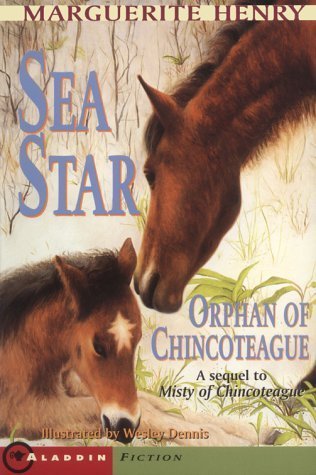
See Also: Misty of Chincoteague, Sea Star, Stormy, Misty’s Foal.

Parental Guide.

Violence: Since they don’t realise Lady Sue is pregnant, Molly’s mother assumes the mare has colic and will die, rushing off for the vet. This is the only dramatic scene in the book.

Values: Mules are a great gift to hardworking farmers. Not judging a book by its cover and making the best of something less than ideal are the manner by which Lady Sue is brought home. Molly’s family are religious, industrious and on good terms with their neighbours.

Role Models: Everyone is a darling once you get to know them.

Educational Properties: Molly reads up on the history of the American mule, which leads her to George Washington’s scientific farming interests and the import of a jack directly from the King of Spain. Since mules were an economic miracle of the time period, and the entire plot of the book centers on how much Brown Sunshine improves the family’s finances, this could actually be a springboard for a simple lesson in economics.

End of Guide.

Wanted! – Caroline B. Cooney

Behold the phenomenon of the 90s teen thriller. Forget about forensics and just go with it.

https://d.gr-assets.com/books/1364015323l/21188.jpgTitle: Wanted!
Author: Caroline B. Cooney (1947-)
Original Publication Date: 1997
Edition: Scholastic Inc (1997), 230 pages
Genre: Thriller.
Ages: 11-14
First Sentence: “It’s Daddy, Alice.”

Alice gets a call from her father telling her to take one of his computer discs and its backup and drive his red Corvette to an ice cream place outside of town, hanging up before she can ask him whatever for. Alice doesn’t have her license yet, and before she can work up the nerve to leave the house a stranger with a voice she almost recognises comes looking for the disc. Alice hides beneath the Corvette until he’s gone. After the combined terror of this incident and of having to drive an overpowered muscle car to the rendezvous point, Alice waits for her father to arrive. He doesn’t. Instead, she hears on the radio that he has been found murdered in his house and that Alice sent an email to her mother confessing to the crime. Now in full panic mode, and thinking her own mother is against her, Alice goes on the run.

Wanted! is a beach read, a lightweight thriller dedicated to answering only one question: what would it be like to be a teenage girl on the run from the cops? Follow Alice from A to B to C as she attempts to do just that.

The book opens on dialogue, proceeds through a “hide from the creepy guy” scene and settles into a surprisingly accurate portrayal of a girl in shock. Alice takes off in an overpowered car without even adjusting the seat first, without calling the cops, because her father told her to meet her at the ice cream place and that’s all she can think to do. She responds like a scared child and the only thing unbelievable about this scenario is that it takes forever for a cop to notice her driving that badly in that car:

There was the turnoff, by a low-lying meadow with a narrow glimpse of the beautiful Salmon River. The turn came quicker than Alice expected, and she took her foot off the gas late, braked late, and knew immediately that the best decision was to quit making the turn. Skip the whole thing, keep going straight, turn around later and come back. Too late for that. Alice found herself in the turn with way too much velocity. The tires screamed as if she had run over squirrels and Alice screamed, too, imagining their flat, bloody bodies, but she hung onto the wheel and missed the picket fence of somebody’s yard and even got back onto her side of the road.

Maybe the lack of cell phones prolonged the plot.

https://th.bing.com/th/id/OIP.EQ6je0P1YpowSYBK6rCZnQHaFj?pid=Api&rs=1
I don’t get the appeal but I’d definitely notice it.

Provided you can get behind a protagonist who is running scared, lying and hiding with two days of practice while in constant panic mode, Alice is fairly easy to sympathize with – which is good, considering she occupies about 98% of the book by herself. Cooney manages this through extensive focus on Alice’s state of mind, her repetitive fears and random thoughts offering some sense of what her normal life was like as she figures out how to disappear. She ditches the flashy Corvette, she evades mall security, pretends to be a college student and wonders what to do as technology keeps getting in her way. Alice is running around with a disc that may have gotten her father killed and she can’t read what’s on it because every school and library computer lab requires passwords and ID cards.

Sadly for any readers attracted to the paranoia of the premise – girl on the run! trust no one! – this really isn’t Robert Ludlum for teens, more of a standard “spot the killer” narrative with a cast that’s slightly too small for good red herrings. Because of the focus on two day’s worth of action, there’s less tapestry for the mystery to be pinned against. Alice uncovers old secrets but it takes her way too long to figure out who the only incriminating figure truly is. On the other hand, it’s more excusable for her than it is for the police, who apparently don’t know how to talk down a scared fugitive girl. Also, forensic evidence would have put Alice in the clear so quickly that there would have been no story at all if she’d only understood that a “typed confession” meant diddly squat by comparison.

https://i0.wp.com/s.fixquotes.com/files/author/caroline-b-cooney_77UFH.jpg
Caroline B Cooney.

But Wanted! is geared for a younger audience and it’s clear that Cooney didn’t win their support with cold hard logic. Underneath the thrills, Alice’s actions are actually driven by a very simple emotional hook – her love for her parents and her sense of betrayal at their divorce. Alice flees because the divorce left a gap in Mom’s character which allows her to fear the worst – that her own mother will not believe her innocence. Does that make any sense logically? Nope, but any girl whose parents ever let her down this way will get it. There’s no 21st Century Henkesian resignation here – Cooney taps this vein of teen angst for all its worth:

Alice was pretty close friends with Cindy, who had been through divorce twice with each parent, a horror so enormous that Alice could not even think of it as real life, but as a soap opera taking over.

How could Mom stand the presence of any man but Dad? Couldn’t Mom see that these men did not measure up? How could Mom giggle and put on perfume and buy a new wardrobe and experiment with expensive makeup as if she, too, were fifteen and learning how to flirt?

Similar to Betsy Byars (with some obvious literary differences), Cooney understands that a character doesn’t need to be in on the action to have an affect on the protagonist. It’s a little unexpected to find such primal resentment threaded within this one-day escapist beach read, but it works to give Wanted! a little emotional backbone (and prolong the plot).

https://cdn1.theyoungfolks.com/wp-content/uploads/2018/09/02200142/Sadie_FINAL-cover-image.jpg
A Booklist Top Ten YA Books for Adult Readers. I’d call that missing the point.

One thing which is very obvious about Wanted! is that it will only appeal to younger and less jaded teens. This is not a criticism, although today it will be seen as one because YA has been aging up for a while. A quick scan of the recent YA Edgar Award list makes it clear that the industry has been busy taking advantage of “crossover appeal” with the adult market (which already made up at least 55% of YA readers back in 2012). The 2019 Edgar winner was a novel called Sadie, which comes replete with trigger warnings for pedophilia/sexual abuse and is about a teenage girl hunting down the man who killed her little sister. All of the (adult) reviewers love it, and applaud its maturity (because YA needs to “grow”). The marketplace has changed vastly since Cooney’s heyday and I expect the “dark sophistication” of YA books to only increase while (by coincidence, I’m sure) teen readership continues its decline.

Is there any audience for Wanted! left? Like most potboilers, it has an obvious expiration date and that has long since passed. Of course, some kids do enjoy reading vintage books, whether for the novelty factor or from content sensitivity, and if my prediction pans out I expect we will be seeing a revival of vintage YA at some point. Cooney’s Face on the Milk Carton series has remained in print, so it’s clearly possible. I suspect that Wanted! is not the best that she has to offer, but it’s not a bad way to spend an afternoon.

Parental Guide.

Violence: Nothing visceral. The plot hinges on a pair of murders (Alice’s Dad and another person long ago), but neither incident is witnessed by Alice and little description is ever offered. The killer puts Alice in vaguely specified danger.

Values: Spoilers if you actually plan to read this.

Everything is tied up with a bow at the end. Alice was never without a safety net after all. If she had only trusted her mother, her school friends or the cops, she would have been safe from the very start.

Also, don’t run from the police.

End of Spoilers.

Role Models: Alice has many scruples about her newfound career as a fugitive. She burns with shame when she has to steal a little kid’s backpack. She ditches the Corvette but can’t bring herself to steal another car and flee – because then she’d have truly broken the law. In the end, she goes to a friend of her Dad’s, and since he’s away, she steals his old beater – little is made of this act afterward, perhaps because she knows who to return it to and figures he might forgive her given the circumstances.

Educational Properties: … … What exactly do you expect me to say here?

End of Guide.

Cooney wrote a wide array of novels, including a retelling of Macbeth, a retelling of the Trojan War, a reimagining of The Snow Queen as a paranormal horror story, a romantic time travel quartet, a non-romantic vampire trilogy, and a thriller that got “banned” in school libraries for its anti-Islamic content. I might continue to sample her work when I’ve got an afternoon to kill. It sounds quite eclectic.

Up Next: Late period Marguerite Henry.

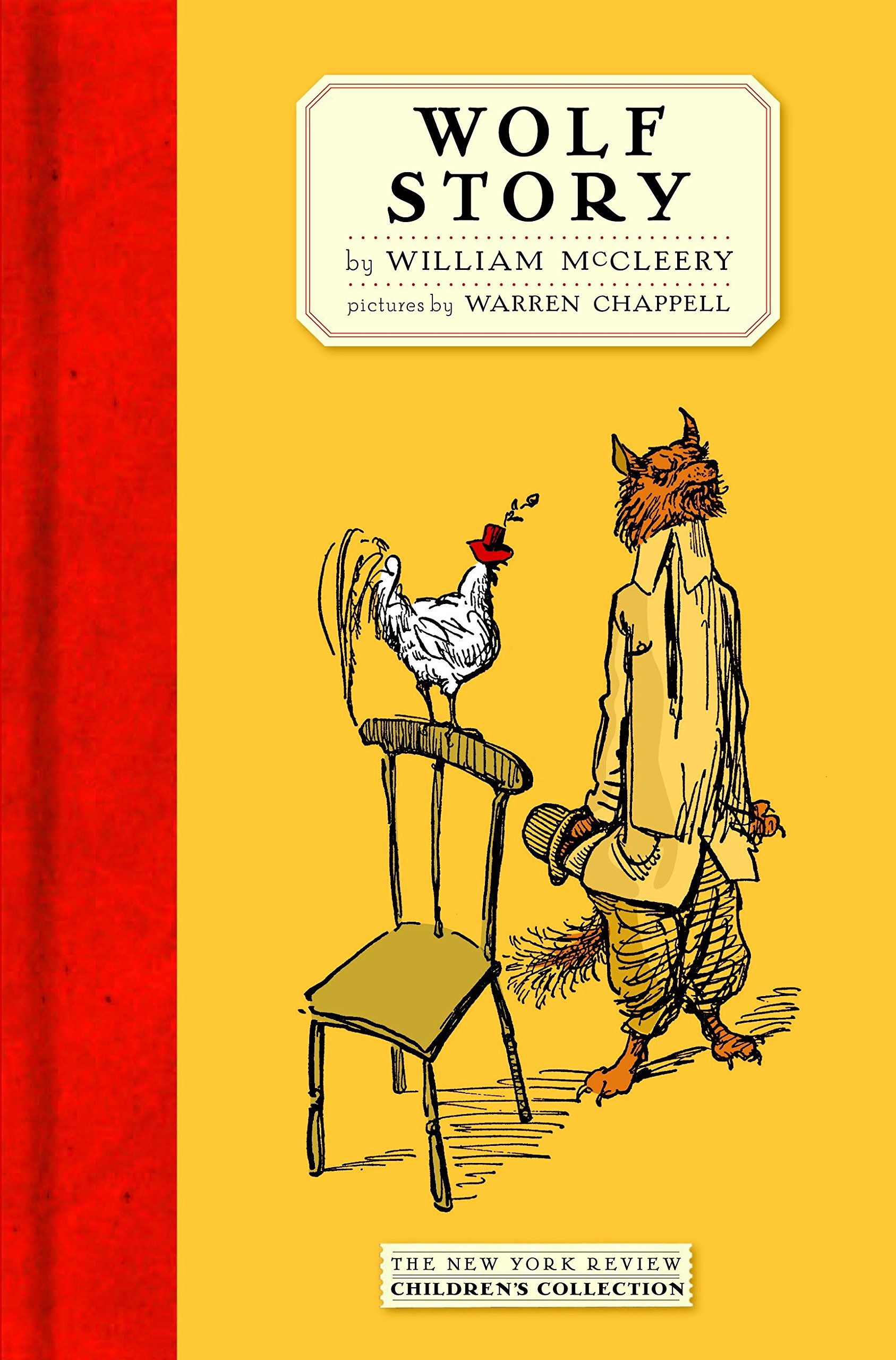
Wolf Story – William McCleery

A mildly meta curio spoiled by an ill-thought moral at the end. Not recommended.

https://images-na.ssl-images-amazon.com/images/I/81JS1tk45RL.jpgTitle: Wolf Story
Author: William McCleery (1911-2000)
Illustrator: Warren Chappell (1904-1991)
Original Publication Date: 1947
Edition: NYRB Children’s Collection (2012), 82 pages
Genre: Humor.
Ages: 4-6
First Sentence: Once upon a time a man was putting his five-year-old son Michael to bed and the boy asked for a story.

A father tucks his son into bed and the son naturally wants a story. After rejecting Goldilocks, Michael requests a new story and is soon “helping” his father make it more exciting by adding a fierce wolf called Waldo to the mix. On subsequent outings with Michael and his best friend Stefan the wolf story continues, despite the father’s boredom, until they reach a mutually satisfying conclusion.

Okay, so this book is nowhere near as meta as it probably sounds. The first two chapters do work quite well in that regard, as the story is constructed while the father and son’s relationship is being sketched out – mostly through the use of dialogue. It’s cozy and endearing, while also forming a humorous commentary on storytelling conventions:

And the man continued: “Once upon a time there was a hen. She was called Rainbow because her feathers were of many different colors: red and pink and purple and lavender and magenta–” The boy yawned. “–and violet and yellow and orange…”
“That will be enough colors,” said the boy.
“And green and dark green and light green…”
“Daddy! Stop!” cried the boy. “Stop saying so many colors. You’re putting me to sleep!”
“Why not?” said the man. “This is bed-time.”
“But I want some story first!” said the boy. “Not just colors.”
“All right, all right,” said the man. “Well, Rainbow lived with many other hens in a house on a farm at the edge of a deep dark forest and in the deep dark forest lived a guess what.”
“A wolf,” said the boy, sitting up in bed.
“No, sir!” cried the man.
“Make it that a wolf lived in the deep dark forest,” said the boy.
“Please,” said the man. “Anything but a wolf. A weasel, a ferret, a lion, an elephant…”
“A wolf,” said the boy.

wolfs hen and boy
Jimmy Tractorwheel the farmer’s son, and Rainbow the hen.

The rapport between father and son creates a pleasantly homey vibe, so nostalgic that it seems pulled directly from McCleery’s own experiences telling bedtime stories to his son. However, the novel proceeds to take on a slightly different tone, as subsequent chapters take place on various Sunday outings, accompanied by Michael’s best friend Stefan – from then on it’s two against one as the boys hijack and control the story, reducing the early delightful tug of war. The wolf story is then continuously interrupted by forays into the wider world of 1940s New York:

“Do you mind if we have lunch in the park?” said the boy’s father to the boy’s mother. “Would you mind not having to fix lunch for us?”
“Oh, that would be terrible,” said the boy’s mother. “If I don’t have to fix lunch for you I will be forced to go back to bed and read the Sunday paper!”
Soon the man and the two boys were driving along the West Side Highway toward Fort Tryon Park. The boys could see freighters, tankers, ferry boats and other craft in the Hudson River. “Enemy battleships!” the boys cried, and raked them with fire from their wooden rifles. Sometimes the man had to speak sternly to the boys, saying, “Boys! Sit down! Stop waving those rifles around. Do you want to knock my front teeth out?”
The boys were very well behaved, and every time the man spoke sternly to them they would stop waving the rifles around, for a few seconds anyway.

As you can tell, McCleery has a fairly repetitive style and prefers to avoid using names or descriptions for his characters. The story is completely trivial and its lack of suspense probably works in favor of a young audience – the wolf story is constantly being treated as a game by the boys, cutting any build-up of suspense with interruptions. It’s packed with dialogue, onomatopoeia and exclamation points, and supposedly makes an enjoyable read-aloud (although I have some caveats in the Parental Guide). McCleery wrote plays for television and Broadway, which explains a lot about his style.

wolf bestiary
Cute.

I would say that Wolf Story‘s greatest asset is its illustrator, Warren Chappell. Leaving the family wholly anonymous, he only illustrates the tale within the tale. Chappell takes McCleery’s dim-witted wolf and makes him hulking and villainous, yet absurd, while Rainbow the hen looks like she wandered in from Greenwich Village, sporting a debonair hat. Most charming of all are his medieval letters at the start of every chapter, with the wolf lurking behind them (it’s a pity the 10 chapters only opened with 5 individual letters).

Wolf Story is a very short book. It’s nicely packaged by NYRB and it seems to be well-received by modern parents – however, it doesn’t strike me as a lost children’s classic and I’m a little surprised it was chosen out of the sea of out-of-print stories waiting for a new lease on life. The plot is slight and gains little development, characters are thinly sketched, the glimpses of 1940s New York are all too brief and the writing is on the flat side. Also, the ending is a huge problem – the wolf story is based around a folktale motif, but if you enjoy the hard-headed sensibilities of classic folktales (where evil, selfishness and stupidity are punished in the end), you will probably find Wolf Story as much a letdown as I did. It looks good at the start but it wouldn’t make my list of vintage gems.

See Also: Stuart Little, another evocation of New York in the 40s, directed to the same basic age group (though the writing has way more style) and with eccentricities all its own…

And now a long Parental Guide for a short novel. Big spoilers for how the book ends.

Language: Quick heads up that there is one appearance of the word “damn,” which the father tries to dissuade his son from using, offering “darn” as a substitute – this book gets called a perfect read-aloud a lot, but I know there are parents who would prefer curse-free books for their six year olds.

wolf attacked
Big five year old or small wolf?

Violence: It’s about as serious as a Road Runner cartoon. Five year old Jimmy Tractorwheel, the farmer’s son, wallops Waldo the Wolf with a baseball bat and all that’s missing from the scene are the circling birdies. Lots of threats of eating the hen or shooting the wolf but no one actually dies, leading to…

Values: …the father inserting an asinine moral when the farmer’s family finally capture Waldo. Jimmy Tractorwheel decides to try and reform Waldo after the wolf whines about how: “I never had no opportunities. I ain’t even been to school.” He’s still a wolf, but that’s forgotten about and social experimentation follows, which the father insists is absolutely successful: “So Waldo was locked up and every day Jimmy would come and ask him questions about how a wolf is treated by his parents and what makes him so fierce. The more Waldo talked about his fierceness the gentler he grew, until finally he was allowed out of the cage on a leash. Jimmy and Waldo wrote a book about wolves which was read by the farmers and the wolves in that part of the country and helped them to understand each other. They all became quite friendly and some wolves even worked on the farms, as sheepdogs.” 

Michael actually tries to have Waldo revert to type and repay the farmer by stealing Rainbow again, but the father won’t have it and ends the story, which put me in mind of the quote by G.K. Chesterton: “For children are innocent and love justice, while most of us are wicked and naturally prefer mercy.”

wolf in prison
Hmm.

Role Models: The father clearly intends Jimmy to be such. Since both the father and Jimmy literally advocate letting a fox wolf guard the hen house, they obviously aren’t very smart. The wolf himself has no redeeming qualities – he is murderous, doltish and cowardly – yet he gets off scot-free.

Educational Properties: Since this is a static novel about the joys of telling a dynamic  story out of thin air, it could be used as an example of meta fiction for the young. You might also discuss the ending and explain that A: wolves are not tameable and B: pop psychology is not a panacea (and that’s just for starters). There are already too many people out there who think they live in a Disney movie. This is not helpful.

End of Guide.

This was William McCleery’s only work for young people, which means I have now completed his bibliography and I’m honestly relieved. Imagine what he’d have done with The Little Red Hen…

Up Next: Back to the story of Anne Shirley.

Stormy, Misty’s Foal – Marguerite Henry

This second sequel is a great improvement on Sea Star and makes so little reference to the events of that book that it could even be read as the first sequel to Misty – which nine year old me believed it to be, thanks to the Aladdin boxset.

stormyTitle: Stormy, Misty’s Foal (Misty #3)
Author: Marguerite Henry
Illustrator: Wesley Dennis
Original Publication Date: 1963
Edition: Aladdin Paperbacks (1991), 223 pages
Genre: Animal Stories. Survival stories.
Ages: 8-12
First Line: In the gigantic Atlantic Ocean, just off the coast of Virginia, a sliver of land lies exposed to the smile of the sun and the fury of wind and tide.

Misty has been home with the Beebes for an indeterminate amount of time and is now ready to have her first foal. Paul and Maureen are excited and impatient, but a violent storm strikes the islands, causing massive tidal flooding and forcing the locals to evacuate. Animals can’t come on the helicopters, so the Beebes have to move Misty into their kitchen and hope for the best. Will Misty and her colt survive? Will the Beebes have a home to return to? And how can the islands ever recover from such terrible devastation?

Stormy, Misty’s Foal is a much darker novel than Misty or Sea Star, death-riddled from the sixth chapter (when a neighbor reports on two thousand drowned baby chicks), onward through the storm and into its aftermath, in which Paul and Grandpa Beebe are enlisted to scour the islands and place markers wherever dead ponies are found. It’s a sequel meant for older kids, with a greater suspense and dread, and it stands on its own identity rather than the laurels of what came before.

cat and dog, wesley dennis
Happy dog, less happy cat.

Being considerably longer than the first two Beebe books, Marguerite Henry is able to place more focus on the location, with Pony Ranch clearly defined as a going concern. There are more details surrounding such things as church visits and the contents of the Beebe’s smokehouse, along with a family cat and dog. Misty is referred to as a “movie star,” and she’s obviously made the family prosperous, but there’s no indication in the text that she was ever gone, which makes it feel like Sea Star never happened.

Again, Henry contradicts a passage in her earlier work, preventing the three books from coming together as an integral whole. From Sea Star: “Look at me, Sea Star,” [Paul] said. “When Misty comes back home, you and she can be a team. Misty and Star. Sound pretty to you? And you can run like birds together and you can raise up foals of your own, and Maureen and I can race you both and we won’t care which wins.” It’s a pretty passage and was a high point of that book, yet Sea Star doesn’t appear or get mentioned here. The reason is probably that the true story had an unhappy ending – orphan foals are hard to keep alive, and the Beebe’s efforts were in vain – but after writing such a positive tale, Henry disappoints any children hoping to see Misty and Star together by silently sticking to the facts.

Grandpa Beebe, wesley dennis
Grandpa Beebe worries over his life’s work.

There are a host of positives that come with this third story, though. Chiefly among them is a real sense of the Beebe family as an ensemble cast. Therefore, Paul is no longer the only really proactive character; everyone has a job to do when the disaster strikes, and they each have their own fears to quell. Grandpa Beebe is particularly changed by this process into a man in his own right rather than the wise authority figure of previous books.

Misty spends much of her time separated from the Beebes, as their symbol of home, history and everything they wish to return to (with Stormy embodying hope for the future). Given this is based off of the Ash Wednesday storm of 1962, it’s clear that Henry is again playing loose with the facts – the real Clarence and Paul Beebe had both sadly died in the intervening decade and a different branch of the family was living at Pony Ranch and caring for Misty during this time. However, the extensive credits at the end of the book make it clear that Henry was determined to do right by the islanders and what they endured. She consulted everyone from the family to the mayor to the coast guard, giving Stormy‘s evacuation and cleanup scenes clarity and definition.

A street sign veered by, narrowly missing the horses’ knees. 98th Street, it said. Grandpa turned around to make sure he had read it aright. “My soul and body!” he boomed. “It scun clear down from Ocean City! That’s thirty mile away!”

In front of Barrett’s Grocery two red gas pumps were being used as mooring posts for skiffs and smacks and trawlers. A Coast Guard DUKW, called a “duck,” and looking like a cross between a jeep and a boat, came churning up alongside Grandpa and Paul.

As they turned onto Main Street, which runs along the very shore of the bay, Paul was stunned. Yesterday the wide street with its white houses and stores and oyster-shucking sheds had been neat and prime, like a Grandma Moses picture. Today boats were on the loose, bashing into houses. A forty-footer had rammed right through one house, its bow sticking out the back door, its stern out the front.
Nothing was sacred to the sea. It swept into the cemetery, lifted up coffins, cast them into peoples’ front yards.

flood destruction, wesley dennis
Flood destruction.

Stormy works just as well as the earlier volumes for reading aloud, and in this case parents might actually find the plot more gripping than their children, who would most likely focus on the ponies and the missing dog while parents would immediately grasp the larger nature of the disaster.

Of course, it isn’t all grim – there’s a great deal of focus on the community supporting one another and on the brave men in the Coast Guard and local volunteers setting forth into the floodlands, by boat and helicopter, providing aid and rescue. Also, the various book covers don’t exactly keep you in suspense about whether Misty safely delivers her foal or not.

Spoilers for the final chapters below.

Misty and Stormy end up on tour, raising money to restore the depleted herds of Assateague. Because we’ve seen the devastation close up, this tour to help the ecology and economy of Chincoteague comes across as truly heartwarming (unlike the previous college-for-Clarence plot), and it does help a lot that the Beebes don’t sell her off this time.

End of Spoilers.

One bit of advice I’d give is that no matter how many of the Misty books you decide to add to your library, avoid the Aladdin editions pictured at the top of these reviews. The Aladdin books are clearly cheap reprints and Wesley Dennis’s marvelous illustrations lose a great deal of definition in the process.

See Also: Misty of Chincoteague and Sea Star.

Parental Guide!

surviving ponies, wesley dennis
Surviving ponies.

Violence: A great deal. Many animals die in the flood, either drowned or exposed to the elements. Much of the time this is only mentioned in passing, but when Paul and Grandpa finally make it out to their ponies’ winter pasture they find an entire herd dead, and proceed to make a grim search for survivors. The heart-breaking work went on. They came upon snakes floating, and rabbits and rats. And they found more stallions dead, with their mares and colts nearby. And they found lone stragglers caught and tethered fast by twining vines. Grandpa is hit especially hard by this loss.

However, none of the main animal characters die and there are no human casualties at all, so depending on what your own child has already read, this might be very easy to handle. I remember finding it extremely disturbing when I first read it, but a year or so later this became my favorite Misty book.

Values: Faith, hope and charity all get their due, along with love of home and family, some grassroots philanthropy and community pulling together in hard times. The civic emphasis of the previous volumes (obey your elders and sacrifice for college) is replaced by civil disobedience. The Mayor has trouble with the mainland government after the storm:

“The government has approved sending ‘copters to take fresh water to the ponies still alive on Assateague, but they have no orders yet to take out the dead ones.”
Grandpa exploded. “Mayor! The live ones has got water. There’s allus water in the high-up pools in the White Hills. Them ponies know it.”
“You and I know it too, Clarence. But sometimes outside people get sentimental in the wrong places.”

This theme continues when the government refuses to allow women and children to return to Chincoteague, with Grandpa deciding to just smuggle his family home.

Perception of government isn’t the only thing that changed between the 40s and 60s. The role of women had too, and Grandma, a positive and respected figure before, is now singled out for pity at various points for having to always be at home or supporting the Ladies’ Auxiliary. As for Maureen…

Role Models: Maureen is now actively complaining about being a girl. As Maureen and Grandma heaped the trays and carried them back, Maureen’s lip quivered. “Oh, Grandma, Paul didn’t even ask what I did today. He doesn’t even know I was at Doctor Finney’s, riding a famous trotter. Oh, Grandma, why was I born a girl?” This is right after Paul and Grandpa come back from scouting for dead ponies, both so stricken by the sight that they can’t even talk about it, and she’s whining because she was spared all that and got to play with living ponies instead. She spends much of this book bursting into tears. “Oh, Grandma, being a girl is horrible. Paul always gets to have the most excitement.”

She’s acting as if trawling the death-choked waters is fun and games, and that’s not to mention that Paul only gets to accompany his grandfather on these forays back to the islands because he’s getting near full-grown, and the Coast Guard needs able-bodied men to do these jobs. Maureen is a pre-teen girl. She comes off far worse here than she ever did back in the 40s, precisely because Henry is trying to make her more outspoken – chafing at restrictions while ignoring that those restrictions are perfectly logical in this situation. The author never has any of her characters sit down and talk to Maureen about her attitude, and the girl is now a terrible role model, even though the others all remain admirable.

Educational Properties: Storms and flooding are serious concerns in coastal communities, and Stormy covers many aspects of such crises, from the creation of tidal storms to which citizens are most vulnerable when the power goes out (there’s a subplot involving a man who lives in an “electric cradle”). The details of evacuation, clean up and recovery mean that a lot of research and discussion could take place around this book, whether or not such a scenario could happen where you live. Obviously, massive amounts of natural science could also be tied in with Stormy, and there are also some random bonuses – like the reference to Grandma Moses and a world news report on the radio which is a time capsule in and of itself.

End of Guide.

I highly recommend Stormy, Misty’s Foal. It could foster some great conversations, and it’s full of drama without feeling lopsided the way Sea Star did. At this point, it seemed that Marguerite Henry had said all she needed to about Misty’s life, but Misty had three foals in all and Henry kept tabs on the descendants of her former pet and muse, eventually resulting in one final book about an especially gifted descendant: Misty’s Twilight. Expect my review next month.

Up Next: An odd little book by William McCleery, brought back in print by the NYRB Children’s Collection.

The Midnight Fox – Betsy Byars

It turns out that my first choice for Betsy Byars was her own favorite among her many books. For those who are also wondering where to begin with Byars, this is quite a good choice.

Putting the finishing touches on this review, I discovered that both she and her illustrator have passed away this year – a clear loss to children’s literature.

midnight fox cover, byarsTitle: The Midnight Fox
Author: Betsy Byars (1928-2020)
Illustrator: Ann Grifalconi (1929-2020)
Original Publication Date: 1968
Edition: Puffin Books (1981), 159 pages
Genre: Realistic Fiction. Animal stories.
Ages: 8-12
First Line: Sometimes at night when the rain is beating against the windows of my room, I think about that summer on the farm.

The summer before Tom turns ten, his parents send him to stay with his Aunt Millie, Uncle Fred and cousin Hazeline for a couple of months while they embark on a cycling tour of Europe. Tom is dismayed – as a comfortable city boy he’s sure to be miserable on Fred and Millie’s farm. He’s scared of animals and he misses his best friend Petie Burkis every day. Things change for the better when he catches a glimpse of an elusive black fox, but foxes are not welcome animals on a farm…

The Midnight Fox lacks a shiny award sticker on the cover and so I figured the fox’s chance of living to the end of the book was actually fairly high, although Byars got me second-guessing myself several times before it was finished – if your main concern in animal stories is whether the headlining critter lives or dies, please skip to the Violence section of the Parental Guide below.

While the fox plotline creates drama and suspense, the bulk of The Midnight Fox is a quiet and introspective portrait of a lonely nine year old boy on a depressing vacation – comparisons to my previous Castle read, Junonia (a quiet and introspective portrait of a lonely nine year old girl on a depressing vacation), are inevitable. So how does the vintage choice stand up?

Two of the most notable differences between Betsy Byars and Kevin Henkes are that Byars makes use of humour throughout her book and she allows her child protagonist to have actual interests. Henkes focused completely on the emotions of his heroine Alice, while her life back home, friends or any hobbies outside of shell collecting were barely acknowledged. She got “books” for her birthday; Tom actually reads:

Tom and Petie
Tom and Petie.

I would go over to Petie’s and he would be sitting on the porch reading. He would be so interested in the book that he wouldn’t even look up to see who I was.
“What are you reading, Petie?”
He would lift the book so I could see the title and it would be something like Mystery of the Deep.
“Can I read it when you’re through?”
He would nod.
“How much more you got?”
Still without missing a word, he would flip the remaining pages.
“Well, hurry up, will you?”
He would nod again, but Petie Burkis had never hurried through a book in his life. So I would wait. And wait. And finally, when I was ready to go out and get the book out of the library myself, then he would come over and give it to me.

Tom has an endearing range of hobbies besides, whether inventing games with Petie, building models, daydreaming or watching the kind of movies that show on “Chiller Theater.” He has a quirky and boyish view of the world which buoys up what would otherwise be a fairly dour and strait-laced narrative. He certainly has a melancholic disposition, but he isn’t depressed. Of course, faulting Henkes for depicting pre-teen depression would be unfair – it was all but unknown in the 60s, and seems to be everywhere today. So in spite of their many similarities, The Midnight Fox and Junonia are closer to apples and oranges than they appear. After all, realistic fiction is framed by the limits of reality – if reality is that pre-teen depression is skyrocketing and many kids are hemmed in by loneliness, anxiety and obsessively structured playtime, novels like The Midnight Fox aren’t going to be written anymore. However, this ensures that Byars is by far the more entertaining choice in this instance.

fox sighting
Ann Grifalconi gives a distinctive look to the story.

One of her best tricks within this novel is to keep Tom’s best friend Petie a presence throughout the book, mentioned with great frequency – true friendships matter even if they have no bearing on the plot. Much of the novel’s accompanying humour comes from Tom’s anecdotes of Petie, alongside his self-deprecating image of what a ridiculous figure he makes on the farm:

I continued to walk until I came out of the forest, right by the pasture where the cows were grazing. They were all together in the shade of the trees, and they turned in a body and looked at me.
I had thought, when I first saw these cows from a distance, that if I ever had to do a circus act, I would get about six cows like these and train them. They would be called The Cow Family Dancers, and I would come out in an Alpine suit with an accordion, and as I would start to play, the cows would come dancing out into the circus arena, not trotting like horses, but doing peasant steps, turning and clicking their heels and tossing their heads.
Now that I saw the cows at close range I abandoned this idea for all time and began to walk slowly past them. “Cows do not attack people. Cows do not attack people. Cows do not attack people,” I said to myself as I passed, and then, completely against my will, I found myself making up a Petie Burkis news story:
COW ATTACKS BOY–SCIENTISTS BAFFLED
Scientists in Clinton County were baffled today by the report that a cow attacked a young boy. The young boy, who was passing the cow in a respectful manner, was able to give no reason for the attack. “She just came at me,” he managed to whisper before he was driven to the hospital. No one has been able to reach the parents of the young boy, as they are having a vacation in Europe.

fox and kit
Grifalconi’s stylized foxes.

A positive change comes over Tom after he catches a glimpse of the black fox, hunting for her sole surviving kit. At first he’s certain that he only dreamed it, not knowing that foxes could even come in black, and afterwards he takes an interest in fox habitat and hunting patterns, forging a link through this new rural hobby with nature, gaining the ability to hold still and really look at the world around him. His terror of domestic animals is replaced by a fascination with wildlife, and he becomes calmer and braver because of it. This is a fairly standard character progression in children’s literature, probably because of how true it is, and it works very well here:

I had found a hornets’ nest like a huge gray shield in a tree. I had found a bird’s nest, low in a bush, with five pale-blue eggs and no mother to hatch them. I had found seven places where chipmunks lived. I had found a brown owl who never moved from one certain limb of one certain tree. I had heard a tree, split by lightning years ago, suddenly topple and crash to the ground, and I ran and got there in time to see a disgruntled possum run down the broken tree and into the woods. But I did not find the place where the black fox lived.

Byars has an enjoyable writing style, a bit rambling but oddly graceful. Her writing advice was to always read your own prose out loud and that pays dividends here. The Midnight Fox does not suffer from any dry prose and it is personal and character-driven while still being amusing. The story is sure to please nature-loving kids, especially if they’ve already enjoyed other vintage options.

See Also: Junonia by Kevin Henkes. Same issues, different generation.

Parental Guide has only one important spoiler. Does the fox live?

Violence: Tom’s cousin Hazeline reluctantly talks about a recent incident with a farmer, a poultry farm and a family of foxes:

“…underneath the moss was an open trap, and that very night the fox came by and he saw the raw chicken and he put his foot right on that moss and sprung the trap. Bingo!”
“Oh.”
“End of fox,” she said. “That was about two weeks ago, and then he found the den and went and got a stick of dynamite and blew it up and that was the end of the baby foxes.”
“Oh.” It was one of those stories that you’re sorry afterward that you made somebody tell you.

There is some real pathos to the separation of the foxes, with the mother fox trying to bring food to the cage her kit is kept in. Animal lovers will be relieved that they survive.

fox hunting
Uncle Fred fox hunting.

Values: Hunting is not shown in a positive light, although Byars never turns this into a polemic. Tom does not attack or condemn his uncle, nor does he judge his aunt for wanting her poultry protected – he just doesn’t want the foxes to die and so he makes a stand.

Role Models: Tom is a worrier from the start, but he’s well-behaved and tries to keep his petulance under wraps. He’s creative and observant, self-contained and self-aware. In the end, he gets the classic coming-of-age moment of conquering his fears to save something that matters to him.

Tom’s finds his relatives very hard to relate to, but they aren’t villains. Uncle Fred’s understated response to Tom’s defiance is quite heartwarming, the more so since this is not a sentimental story.

Educational Properties: Certainly there’s a fair amount of discussion on the life cycle of the fox, which would tie this to a nature study. With its extremely small cast and limited setting, The Midnight Fox would also be a good choice for mapping out a novel.

End of Guide.

This was an unexpectedly enjoyable book and I shall certainly be keeping an eye out for more Betsy Byars. She went on from this to win a Newbery, an Edgar and the National Book Award and her books regularly appear in used bookstores (or they did before 2020 happened, anyway).

Up Next: Returning to the ongoing saga of Misty of Chincoteague.


Junonia – Kevin Henkes

Diagnostic.

https://kevinhenkes.com/wp-content/uploads/Junonia.jpgTitle: Junonia
Author: Kevin Henkes
Illustrator: Kevin Henkes
Original Publication Date: 2011
Edition: Greenwillow Books/HarperCollins (2011), 176 pages
Genre: Realistic Fiction.
Ages: 8-10
First Line: When Alice Rice and her parents were halfway across the bridge, Alice felt strange.

Alice is an only child. She has no grandparents, aunts, uncles or cousins. Every year she and her parents go on a seaside vacation to Sanibel Island in Florida, where Alice celebrates her birthday and hunts for seashells, including the rare junonia – which she hopes to finally find this year, for her tenth birthday. Alice has created an extended family out of the other yearly vacationers who share neighboring cottages, but this year several of them aren’t coming and her “aunt” Kate is bringing a new boyfriend and his six year old daughter Mallory, who is in anguish over her mother leaving her to go live in France. Alice watches her make-believe family turn into strangers while her birthday is overshadowed by Mallory’s misery and subsequent bad behaviour. Will everything still turn out alright?

Junonia bird, Kevin Henkes
One of Junonia’s seaside vignettes.

Junonia has an eye catching cover and pretty blue ink illustrations heading every chapter, giving it an endearing appearance of vintage charm. It’s written by Caldecott winner (and 2020 recipient of the Award Formerly Known as the Laura Ingalls Wilder Award) Kevin Henkes, a beloved author/illustrator of picture books. He has also won Newbery Honors for two of his middle grade novels. Junonia has an idyllic setting, thoughtful pace and great perception, giving voice to the emotional life of a lonely and imaginative little girl. It suffers from none of the grittiness and gimmickry that bog down many modern books for pre-teens, and its retro vibe will appeal to cautious parents – but in spite of the sweetly vintage packaging, Junonia carries a hefty dose of spiritual malaise which seeps into every corner of this melancholic little book.

Let’s start with Alice, who is about to turn ten and is depressed. I’m really not sure what else to call this: Being low in the kayak made the water seem so vast and deep, the sky so far and wide. Alice felt like a dust mite compared to all of it. She whispered, “It’s so big.”
Her mother turned her head partway and nodded.
Alice wanted to ask her: Do you ever feel too small to matter? But she didn’t.

Junonia flower
Gladiolus.

Her previous summer vacations were always magical, but this year isn’t and she senses that right from the moment they arrive. Although plenty of nice things do happen this year, the happiness she’d felt was as thin as an eggshell, and as easily broken. She feels resentment toward even the smallest changes, she struggles with body image and awkwardness, and she’s waiting for something wonderful to happen (symbolized by the junonia) which fails to materialize. She is incredibly lonely: Kate was the closest thing Alice had to a relative. It would be different this year. Every other year, Kate had stayed with Alice’s family in their pink cottage, sleeping on the sofa in the living room. Every other year, Alice had had Kate to herself; she hadn’t had to share her with anyone except her parents. Her parents are older, non-religious, they don’t appear to have any pets waiting back home, Alice had given up wanting a brother or sister, and it’s nearly the end of the book before a best friend Libby is even mentioned. She’s never been allowed to walk down to the beach alone. Her parents are financially well off, however, and so she has everything that she really needs – like a Florida vacation and stacks of birthday presents.

Alice is a well-drawn and believable character whose constantly fluctuating inner life is related very clearly. Henkes is renowned for his ability to convey the inner life of children and several GoodReads reviewers referred to this book as Mrs. Dalloway for ten year olds. Aside from the question of whether ten year olds really need their own Mrs. Dalloway, I had no trouble believing in Alice as a real person and I felt great sympathy for her immediately. Henkes uses small details which accumulate into a portrait – not only for Alice, but also the smaller role of Mallory.

Mallory introduces herself by introducing her doll and we (and Alice) can immediately tell that something has gone wrong in the little girl’s life. “Munchkey’s mother went to sea in a pot, and she’s been missing for weeks,” Mallory said, her voice high and thin. “She might never come back.” The little girl proceeds to annoy and trouble Alice, and they never quite become friends. Alice doesn’t seem to have much experience with younger kids (wonder why) and she struggles not to be resentful, while Mallory grasps at any little thing that makes her happy, whether it belongs to her or not. Alice is capable of being patient and compassionate but finds it difficult, especially as Mallory has several breakdowns that spoil everyone’s vacation fun. Many reviewers have expressed annoyance towards both girls for being sullen, but in all honesty they were the only two characters in Junonia that I could stand. Why should they be expected to cavort through their summer vacation like the Bobbsey Twins when the adults in their lives have utterly failed to provide them any of the things those children could rely on?

https://i0.wp.com/i.ebayimg.com/images/i/110723678806-0-1/s-l1000.jpg

Henkes depicts the pain, confusion and despondency these girls are dealing with expertly, informing every small moment (and Junonia is nothing but a book of small moments). However, in contrast to books from even the 80s and 90s, neither he nor any of his characters treat the divorce of Mallory’s parents as something unusual – because these days it isn’t. It’s simply a part of life, and of course it hurts kids but they just don’t realize how complicated the situation is. Alice felt as if she had only a dim understanding of adult life. That’s all we are given of her inner thoughts when “aunt” Kate decides to bail. Kate, who chose to start a relationship with a single father, acts sensitive about it but in the end she blames Mallory for ruining everyone’s day. “Next year,” said Kate. “Next year will be better.” She came forward for hugs. “Maybe I’ll be alone.” No accountability.

All of this is incredibly realistic. It’s not uplifting or pretty, but it can’t be said that Henkes puts a foot wrong in depicting this world. His prose is simple and efficient, filled with small details that ring true; however, I did not find it to be as graceful or poetic as I’d heard it described. In fact, I was driven slightly insane by Henkes’s love of similes, which seem to be his go-to literary flourish:

Within minutes Alice was asleep … her hands curled at her chin like unusual, smooth pink seashells.

Banks of clouds sat on the western horizon like great cottony hedgerows with deep lilac shadows.

At the horizon, clouds crammed the sky like rolls of cotton smashed against glass. But up above, the sky was a bright blue bowl.

Seconds earlier, Alice had been thinking that the surface of the water was like glossy, peaked blue-green icing sprinkled with truckloads of sugar.

She watched the endless procession of long waves rolling toward the shore. The crests were white and foamy. The hollows between the crests were deep, like trenches scooped out by a huge shovel. After a while, she saw the crests as strips of lace laid out on folds of steel blue cloth.

Junonia seascape, Henkes
These similes are less effective than his art.

Junonia is a sad little book. This effect owes much to the realism of the story, as Henkes never cheats, never offers a scenario that is even remotely unlikely – everything here can happen, does happen. There’s a subtle and omnipresent depression going on. Lonely and introspective preteen girls might have an easier time relating to Alice than to the Railway Children or the Melendys, but maybe those older books would introduce or inspire a different value system, something more sustaining than Junonia, which simply reflects back to its young readers, honestly and accurately, the rising tide of pre-teen depression, for which “adopting” a sea turtle just isn’t much of a consolation prize.

See Also: The Hundred Dresses, another melancholy realistic story, only with better writing and a greater degree of hope.

Parental Guide.

Violence: None. Not even any bad language outside of one use of “bloody hell.”

Values: Life is disappointing and its best to accept that with grace. Loneliness and disillusionment are a part of life. Change is inevitable. It’s good to be understanding of others. It’s important to see yourself in a positive light, because everyone is pretty in their own way.

Junonia is almost aggressively secular at points, with Alice inventing a sea goddess called Junonia after deciding out of the blue that God wasn’t an old man in flowing robes with a white beard and a temper to beware of. An old man who didn’t come to the rescue during wars or when kids got picked on at school. Her new and improved perfect, personal god is then discarded like a disappointing toy when things go wrong. …it was a silly waste of time to think about a god named Junonia. Obviously she, Junonia, didn’t exist. She hadn’t saved Alice’s party from being spoiled, and she hadn’t stopped Mallory from becoming a thief. When it turns out that Mallory didn’t steal anything, Alice doesn’t reflect back on this dismissal.

Also of note is the final passage of the book, which put me so much in mind of the ending of Little House in the Big Woods that I immediately got out my copy and compared, only to notice a significant difference.

Little House: She thought to herself, “This is now.”
She was glad that the cosy house, and Pa and Ma and the firelight and the music, were now. They could not be forgotten, she thought, because now is now. It can never be a long time ago.

Henkes: Suddenly she felt as if she were the center of everything, like the sun. She was thinking: Here I am. I have my parents. We’re alone together. I will never be old. I will never die. It’s right now. I’m ten.

Laura falls into the stillness of the present because she cannot believe it will ever be forgotten. Alice falls into the stillness of the present because she’s gone from looking forward to turning ten, to no longer wanting to grow up. What’s the opposite of coming-of-age?

Role Models: Alice is a good kid trying to navigate life with few resources at her disposal. The same goes for Mallory times ten. The ghost of an ideal family is still felt, but it’s treated as something unreasonable to expect. The entire cast of vacationers and absentees are well-off, and small families are an unquestioned norm. Alice’s parents are well-meaning and still together, but their idea of a fun birthday surprise is to “give” their daughter a sea turtle, so they can show how much they love the environment together or something.

Junonia shells

Educational Properties: There’s a lot of talk throughout the book of sea shells and Henkes provides a hand drawn chart of them that was very helpful and appreciated. The text includes almost no scientific info on the local flora and fauna though, because Alice just isn’t much of a nerd. This is also reflected in the sea goddess subplot; Alice could have chosen to invest in any of a dozen mythological sea gods and goddesses, which would at least have offered her some cultural backbone, yet she conjured up a New Age alternative. In fact, the phrase Alice got books pretty much sums up what you won’t find here, as Henkes puts all his investment in Alice’s emotions rather than her interests.

Junonia is a successful example of a book that actually could be used to teach some empathy, due to its absolute commitment to realism. Lonely middle-class white kids whose parents take them on vacation and shower them with creature comforts are not high on the prescribed list of “people to feel sorry for,” yet a girl with siblings might take them less for granted after reading about Alice’s imaginary family. It might make a reasonable mother/daughter book choice, although there are many better options out there.

End of Guide.

Fans of modern realistic fiction would undoubtedly be the best fit for Junonia. Those who prefer a real vintage style and outlook will be disappointed. I don’t see much harm in the book when taken by itself, but if Junonia is indicative of the themes in modern middle-grade stories – loneliness, depression, dysfunction, disillusion – then well-adjusted children are really being left out in the cold.

I wasn’t a fan of Henkes’s writing in this book, but I admired his honesty and maintain a policy of never judging authors by just one work – especially when, like Junonia, it’s one of their minor endeavors. Henkes won two Newbery Honors and I won’t make any further pronouncements on his writing style until I’ve tried them both out.

Up Next: The vintage equivalent with a novel by Betsy Byars.

Sea Star: Orphan of Chincoteague – Marguerite Henry

Way to betray the entire premise of your original classic, Ms. Henry.

https://i.gr-assets.com/images/S/compressed.photo.goodreads.com/books/1452289973l/1351766.jpgTitle: Sea Star: Orphan of Chincoteague
Author: Marguerite Henry
Illustrator: Wesley Dennis
Original Publication Date: 1949
Edition: Aladdin Paperbacks (1991), 172 pages
Genre: Animal Stories.
Ages: 8-11
First Line: Paul was separating each silver hair in Misty’s tail.

I’ll begin with a quote from Misty of Chincoteague to explain my frustration with this book: Now when a buyer came to look at the colts, Maureen did not run to her room as she used to do, pressing her face in the feather bed to stifle her sobs. Nor did Paul swing up on one of Grandpa’s ponies and gallop down the hard point of land to keep from crying. Now they actually led the colts out to the buyers to show how gentle they were. They even helped load them onto waiting trucks. All the while they kept thinking that soon they would have a pony of their own, never to be sold. Not for any price.

Well, that didn’t age well.

It’s a bright July day when a silver airplane lands at Pony Ranch. Movie men have come to film the annual Pony Penning, and they want to purchase Misty for the film and subsequent tour. Paul and Maureen are guilt-tripped into selling Misty in order to put their uncle through college, and are afterwards thankful to discover an orphaned colt on Assateague. Little Sea Star helps to distract them from their loss but the colt is frail and refuses to eat – it’s up to the whole Beebe family to find some way to save the poor thing.

https://missmollys-inn.com/wp-content/uploads//2012/12/Marguerite-Henry-misty-of-chincoteague.jpeg
Marguerite and Misty.

Marguerite Henry had no plans to write a sequel to Misty of Chincoteague – having taken great liberties with the true story, she thought it stood well enough on its own, at least until she heard about little Sea Star. In this follow-up novel she tried to bring the plot more in line with reality. The real Misty had actually been sold to Marguerite Henry herself, and she did bring Misty to book signings to delight children. One important difference is that the real Misty was purchased before she’d even been weaned – while Clarence Beebe had not been planning to sell her, the little foal was not a beloved family pet, hard won from the wilds of Assateague and saved up for over a hard summer’s work by the Beebe children. Misty of Chincoteague was pure poetic license, delivered in gratitude to the Beebes for agreeing to sell such a wonderful pony. The characters by the end of the book were in a different place than they’d ever been in the real world, so the follow-up act of selling Misty was impossible to replicate naturally – instead, Marguerite Henry had to devote a portion of Sea Star‘s dialogue to a series of justifications for the decision. Unfortunately, none of them are very convincing.

Now it’s worth pointing out that the novel’s dialogues are only the connective tissue between the A and B plots. With the exception of the scene where Misty is crated for the plane trip, all of the horse material is entertaining for kids – the first half details the excitement of Pony Penning Day and the last third is all about saving Sea Star. Any child who loved Misty will easily pick this sequel out in a bookstore and they will probably like most of it – while it was my least favorite of the original trilogy as a kid, I still read it multiple times. Children might not agree with the decision to sell Misty, but it’s not likely to be a total deal-breaker and they certainly aren’t going to care about the mathematics of commerce or possible communistic overtones. That being said…

So the two men from New York arrive and, upon learning that the Beebe grandparents are both out, immediately start horse-trading with the kids. First they offer the tempting good news – a movie! how exciting! – and afterwards explain that they’d have to purchase Misty to make the film happen. They also want to take her to schools, libraries and movie theaters, and start guilting Paul and Maureen:

Mr. Van Meter said, “We had a feeling you might want to share Misty with boys and girls everywhere.”
“Boys and girls who have never seen a real pony,” Mr. Jacobs continued.
It was Mr. Van Meter’s turn now. “Sometimes when I hear children in New York talk about Misty, it seems she no longer belongs to a boy and girl on an island, but to boys and girls everywhere.”
The words kept flying, back and forth, higher and higher. “Misty has grown bigger than you know,” Mr. Jacobs said. “She isn’t just a pony. She’s a heroine in a book!”

Apart from the interesting metafictional element going on here (Misty of Chincoteague is a book within the sequel to the book) this is some appalling behaviour by two grown men, and Grandpa Beebe is rightly disgusted on his return. Also, no, Misty does not “belong” to all children everywhere, the book does. But the kids fall in line and even parrot some of this back at Grandma to shore up their decision to sell. “When they told how much Misty meant to poor little city children,” says Maureen. Well, as a former “poor little city child” who dreamt of riding lessons which my parents could never afford, I would not have wanted a girl in the countryside to give up her pony so that I could spend five minutes petting it. Not to mention the cold business decision to make thousands of children momentarily happy at the expense of making two extremely sad. As Grandpa says, “livin’ out here on this lonely marshland, why, Misty’s the nighest to a friend these childern got.” Are they undeserving of the pony they worked so hard for, just because she’s famous now?

Misty sold
Wesley Dennis does a great job with a sad scene.

The picture men’s arguments fail to entirely sway the family and Grandpa gladly sends them packing. However, shortly afterwards Grandma Beebe shows up with the woeful news that Clarence Lee, Paul and Maureen’s young uncle, can’t afford the college tuition of 300 dollars to study for the ministry. The children must now nobly sacrifice their beloved pony for the greater good of the family… No, hang on, that argument is also flawed.

First of all, it hinges on a character we never get to meet. Saintly Clarence Lee does not feature in a single scene in any of the three Misty books, so it is very difficult to care about his hopes and dreams. This is a failure in terms of dramatic impact, but it would still be an understandable decision for the characters in an era when college could have a great positive impact on an entire family’s prospects – until you do the math and realise that Grandpa Beebe is being taken for a fool.

The movie men explain that their company was young and struggling and could afford to pay only two hundred and fifty dollars for Misty. So she’s a famous pony and they’re trying to get her on the cheap. Grandpa agrees to this arrangement because, after a sale he was making fell through, he’s only got 50 dollars to his name. Combined, that makes up the entire tuition fee in one fell swoop. Problem is, the deal Grandpa had lost involved selling a “whole flock” of ponies – the buyer he had lined up decided to buy used trucks instead. So Grandpa has a “whole flock” of unsold ponies, and the going rate of wild ponies back in Misty of Chincoteague was 100 dollars. In that novel it was also made clear that gentled ponies could be sold for higher price. They’re sitting on a number of ponies that could easily turn a profit and instead they sell their famous Misty for beneath her value? How has Pony Ranch stayed in business?

Also, since when is college a one-time deal? Why can’t Clarence Lee wait a year and reapply? Grandma even says he’s recovering from pneumonia, which is why he can’t be expected to earn the money for himself. If he’s that physically frail, maybe it’s not the best time to embark on a grueling course of study? Selling out a beloved family pet to be hauled from place to place (which is bound to be stressful for a pony who has never traveled before), and giving her into the care of people who see a financial meal ticket decades before the film industry enforced an animal welfare code, all because college is worth any price? This has not aged well. Attempts to parallel them putting Misty in a sale crate with Paul releasing the Phantom back into the wilds also miss the mark because the Phantom was not happy at Pony Ranch while Misty clearly is.

happy misty
Behold happy Misty.

And so Misty is sold. They don’t even write up a formal contract, just a vague promise that Misty will be sent home after the tour is over. Luckily, Henry was inspired to write a third book in the series in the 1960s, assuring new generations of children that Misty did indeed come back to Paul and Maureen – unless those children got the Aladdin Horseshoe Library box set, which went ahead and listed the books in the wrong order so that Sea Star appeared to be the conclusion to the series after all.

https://d20eq91zdmkqd.cloudfront.net/assets/images/book/large/9780/6897/9780689716249.jpg
No, I’m not bitter.

Sea Star rescued, wesley dennis
Sea Star rescued.

Within hours of Misty’s departure, Paul and Maureen find little Sea Star in a cove on Assateague, and the whole family is delighted and relieved. Once this plot is finally under way, the novel does a 180 and becomes classic Marguerite Henry – the story of an orphaned colt wasting away in sorrow, and of an injured mare pining for her own lost foal and how they are brought together to grow strong and heal the sorrows of an entire family with the help of a lot of myrtle leaves. Sea Star, with his toothpick legs and wondering expression, is adorable and Wesley Dennis’s illustrations are a wonderful accompaniment once more. There are no dubious motivations amongst the native Chincoteaguers – nope, real salt of the earth types one and all. Scrumptious food descriptions are back and there’s even some humour. The first half of the book is all but forgotten, and yet…

I don’t like giving a negative review of a Marguerite Henry book. However, since Misty worked perfectly well as a standalone, I have to say that Henry’s first instinct was right. I will say in its favour that, while I can nitpick its value system, Sea Star would actually make a tremendous vehicle for discussion with even a young child and the writing remains on the same strong read-aloud level of Misty. It’s not essential, but as I said at the start, children will still enjoy the majority of the story.

See Also: Misty of Chincoteague.

Parental Guide, with mild spoilers.

Violence: Sea Star is found beside his mother’s body, but that is hardly described. Both Sea Star and the injured mare are implied to be well on the road to recovery by the end of the book.

Values: College is worth any price. If you love something, let it go. Share your greatest treasure with the impoverished world. Love is a healing force that helps us overcome our sorrows.

Role Models: Obviously the whole plot is meant to make the Beebes look virtuous and self-sacrificing, and it’s obvious what I think about that.

Educational Properties: If it’s used as a read aloud, it could spark some strong feelings and interesting discussion. Always a good thing.

End of Guide.

I’m now halfway through the series, with one more sequel and a final spinoff volume to go.

Up Next: Back to the Anne novels.