A mildly meta curio spoiled by an ill-thought moral at the end. Not recommended.
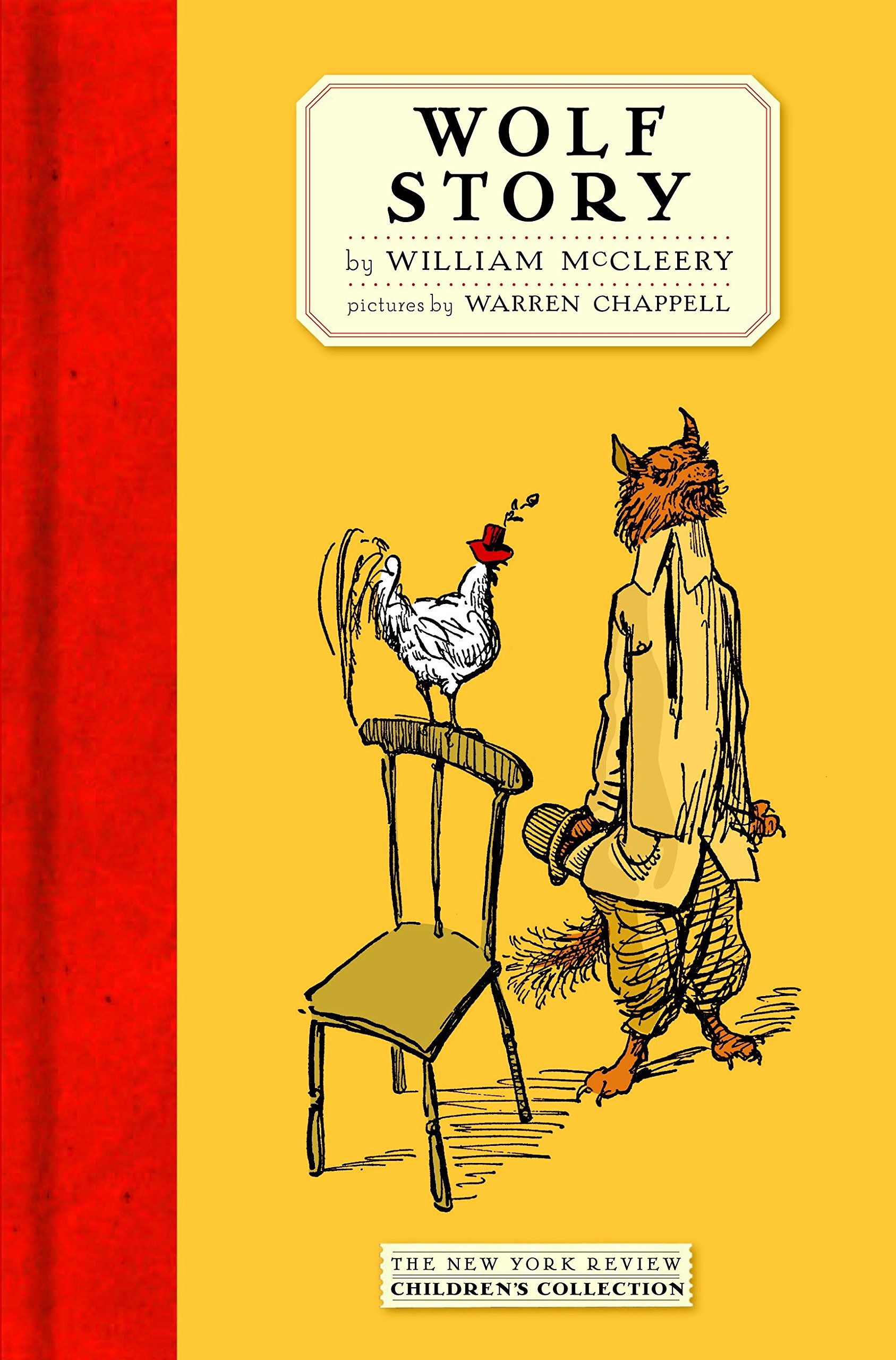
Title: Wolf Story
Author: William McCleery (1911-2000)
Illustrator: Warren Chappell (1904-1991)
Original Publication Date: 1947
Edition: NYRB Children’s Collection (2012), 82 pages
Genre: Humor.
Ages: 4-6
First Sentence: Once upon a time a man was putting his five-year-old son Michael to bed and the boy asked for a story.
A father tucks his son into bed and the son naturally wants a story. After rejecting Goldilocks, Michael requests a new story and is soon “helping” his father make it more exciting by adding a fierce wolf called Waldo to the mix. On subsequent outings with Michael and his best friend Stefan the wolf story continues, despite the father’s boredom, until they reach a mutually satisfying conclusion.
Okay, so this book is nowhere near as meta as it probably sounds. The first two chapters do work quite well in that regard, as the story is constructed while the father and son’s relationship is being sketched out – mostly through the use of dialogue. It’s cozy and endearing, while also forming a humorous commentary on storytelling conventions:
And the man continued: “Once upon a time there was a hen. She was called Rainbow because her feathers were of many different colors: red and pink and purple and lavender and magenta–” The boy yawned. “–and violet and yellow and orange…” “That will be enough colors,” said the boy. “And green and dark green and light green…” “Daddy! Stop!” cried the boy. “Stop saying so many colors. You’re putting me to sleep!” “Why not?” said the man. “This is bed-time.” “But I want some story first!” said the boy. “Not just colors.” “All right, all right,” said the man. “Well, Rainbow lived with many other hens in a house on a farm at the edge of a deep dark forest and in the deep dark forest lived a guess what.” “A wolf,” said the boy, sitting up in bed. “No, sir!” cried the man. “Make it that a wolf lived in the deep dark forest,” said the boy. “Please,” said the man. “Anything but a wolf. A weasel, a ferret, a lion, an elephant…” “A wolf,” said the boy.
Jimmy Tractorwheel the farmer’s son, and Rainbow the hen.
The rapport between father and son creates a pleasantly homey vibe, so nostalgic that it seems pulled directly from McCleery’s own experiences telling bedtime stories to his son. However, the novel proceeds to take on a slightly different tone, as subsequent chapters take place on various Sunday outings, accompanied by Michael’s best friend Stefan – from then on it’s two against one as the boys hijack and control the story, reducing the early delightful tug of war. The wolf story is then continuously interrupted by forays into the wider world of 1940s New York:
“Do you mind if we have lunch in the park?” said the boy’s father to the boy’s mother. “Would you mind not having to fix lunch for us?” “Oh, that would be terrible,” said the boy’s mother. “If I don’t have to fix lunch for you I will be forced to go back to bed and read the Sunday paper!” Soon the man and the two boys were driving along the West Side Highway toward Fort Tryon Park. The boys could see freighters, tankers, ferry boats and other craft in the Hudson River. “Enemy battleships!” the boys cried, and raked them with fire from their wooden rifles. Sometimes the man had to speak sternly to the boys, saying, “Boys! Sit down! Stop waving those rifles around. Do you want to knock my front teeth out?” The boys were very well behaved, and every time the man spoke sternly to them they would stop waving the rifles around, for a few seconds anyway.
As you can tell, McCleery has a fairly repetitive style and prefers to avoid using names or descriptions for his characters. The story is completely trivial and its lack of suspense probably works in favor of a young audience – the wolf story is constantly being treated as a game by the boys, cutting any build-up of suspense with interruptions. It’s packed with dialogue, onomatopoeia and exclamation points, and supposedly makes an enjoyable read-aloud (although I have some caveats in the Parental Guide). McCleery wrote plays for television and Broadway, which explains a lot about his style.
Cute.
I would say that Wolf Story‘s greatest asset is its illustrator, Warren Chappell. Leaving the family wholly anonymous, he only illustrates the tale within the tale. Chappell takes McCleery’s dim-witted wolf and makes him hulking and villainous, yet absurd, while Rainbow the hen looks like she wandered in from Greenwich Village, sporting a debonair hat. Most charming of all are his medieval letters at the start of every chapter, with the wolf lurking behind them (it’s a pity the 10 chapters only opened with 5 individual letters).
Wolf Story is a very short book. It’s nicely packaged by NYRB and it seems to be well-received by modern parents – however, it doesn’t strike me as a lost children’s classic and I’m a little surprised it was chosen out of the sea of out-of-print stories waiting for a new lease on life. The plot is slight and gains little development, characters are thinly sketched, the glimpses of 1940s New York are all too brief and the writing is on the flat side. Also, the ending is a huge problem – the wolf story is based around a folktale motif, but if you enjoy the hard-headed sensibilities of classic folktales (where evil, selfishness and stupidity are punished in the end), you will probably find Wolf Story as much a letdown as I did. It looks good at the start but it wouldn’t make my list of vintage gems.
See Also:Stuart Little, another evocation of New York in the 40s, directed to the same basic age group (though the writing has way more style) and with eccentricities all its own…
And now a long Parental Guide for a short novel. Big spoilers for how the book ends.
Language: Quick heads up that there is one appearance of the word “damn,” which the father tries to dissuade his son from using, offering “darn” as a substitute – this book gets called a perfect read-aloud a lot, but I know there are parents who would prefer curse-free books for their six year olds.
Big five year old or small wolf?
Violence: It’s about as serious as a Road Runner cartoon. Five year old Jimmy Tractorwheel, the farmer’s son, wallops Waldo the Wolf with a baseball bat and all that’s missing from the scene are the circling birdies. Lots of threats of eating the hen or shooting the wolf but no one actually dies, leading to…
Values: …the father inserting an asinine moral when the farmer’s family finally capture Waldo. Jimmy Tractorwheel decides to try and reform Waldo after the wolf whines about how: “I never had no opportunities. I ain’t even been to school.” He’s still a wolf, but that’s forgotten about and social experimentation follows, which the father insists is absolutely successful: “So Waldo was locked up and every day Jimmy would come and ask him questions about how a wolf is treated by his parents and what makes him so fierce. The more Waldo talked about his fierceness the gentler he grew, until finally he was allowed out of the cage on a leash. Jimmy and Waldo wrote a book about wolves which was read by the farmers and the wolves in that part of the country and helped them to understand each other. They all became quite friendly and some wolves even worked on the farms, as sheepdogs.”
Michael actually tries to have Waldo revert to type and repay the farmer by stealing Rainbow again, but the father won’t have it and ends the story, which put me in mind of the quote by G.K. Chesterton: “For children are innocent and love justice, while most of us are wicked and naturally prefer mercy.”
Hmm.
Role Models: The father clearly intends Jimmy to be such. Since both the father and Jimmy literally advocate letting a fox wolf guard the hen house, they obviously aren’t very smart. The wolf himself has no redeeming qualities – he is murderous, doltish and cowardly – yet he gets off scot-free.
Educational Properties: Since this is a static novel about the joys of telling a dynamic story out of thin air, it could be used as an example of meta fiction for the young. You might also discuss the ending and explain that A: wolves are not tameable and B: pop psychology is not a panacea (and that’s just for starters). There are already too many people out there who think they live in a Disney movie. This is not helpful.
End of Guide.
This was William McCleery’s only work for young people, which means I have now completed his bibliography and I’m honestly relieved. Imagine what he’d have done with The Little Red Hen…
Although written by Mark Twain, this particular Tom Sawyer adventure feels more like an unauthorized fanfiction, complete with random sci-fi insert and artificially tampering with established character traits… Oh wait…
Title: Tom Sawyer Abroad
Author: Mark Twain (1835-1910)
Original Publication Date: 1894
Edition: The Complete Adventures of Tom Sawyer, Borders Classics (2006), 193 to 277 (85) of 337 pages
Genre: Adventure. Humour. Science Fiction.
Ages: 10-12
First Sentence: Do you reckon Tom Sawyer was satisfied after all them adventures?
Mark Twain had many talents but character continuity was not among them. The scene opens upon a grandstanding Tom Sawyer, a last gift from the hard swerve his character took during Adventures of Huckleberry Finn, thirsting for new adventures as the townsfolk slowly lose interest in his previous folly. Hearing of a mad inventor about to set sail in a balloon of his own invention, Tom decides to go see the launch, with Huck and Jim accompanying him. Why is Jim still hanging with them? Does he have a job? What about his family, still enslaved? Is he working to free them? Not a word about any of it, and the trio are off to St. Louis, where they see the strange balloon, which has wings and fans and all sorts of things, and wasn’t like any balloon you see in pictures, according to Huck. I just ended up picturing a miniature zeppelin – it was easier. The trio get abducted in a haphazard fashion and soon find themselves hundreds of miles across the ocean and on their way to London when their lunatic pilot plunges to his death and they are swept off course to the Sahara Desert…
It’s very difficult to recommend Tom Sawyer Abroad, as even the most enthusiastic Twain fans are dismissive of it. It is laced with problems, starting with the age group it’s written for. It’s clearly aimed at a younger audience than Adventures of Huckleberry Finn, and most kids who’ve successfully navigated that American hellscape would probably find Abroad somewhat juvenile. On the other hand, younger readers who just love Tom and want more of his adventures would probably have to skip Huckleberry Finn, rendering the beginning of this volume (and Jim’s inclusion) even more nonsensical than it already is. The third book in most series has a ready-made audience – this one, not so much.
The writing is also subpar on this outing; although narrated by Huck, the use of vernacular is looser and simplified, showing the speed at which Twain churned this one out, having entered financial ruin by this point in his life. Whatever organic interest he might have felt in this Verneian escapade dried up fairly quickly, judging by the slapdash “and then we all went home” ending. Oh yes, and then there’s the matter of the plot…
It doesn’t have one.
Camel train in the Sahara.
Tom Tom Sawyer Abroad is usually called a Jules Verne parody. Granted, I’ve only read one of Verne’s Extraordinary Voyages at this stage, but the statement doesn’t seem particularly accurate toward the meat of this short novel. It would be more telling to call it a predictor of Samuel Beckett, given that the bulk of the text is given over to dimwitted people embroiled in arguments while they and the audience wait for something to happen. There are a few vistas and scattered dramatic incidents but they mostly serve as triggers for the arguments Tom has with Huck and Jim, whether the topic be mirages, the speed a flea can travel at or the reason the Sahara has so much sand. In a curious about-face from the previous installment, Tom has regained his good traits and is once more capable of understanding the books he reads. He’s the one who figures out how to operate the balloon, he has memorized and retells portions of the Arabian Nights for their evening’s entertainments and he’s got the hopeless task of trying to argue the scientific facts of mirages and the earth’s rotation with the pair of nimrods he’s traveling with.
While Tom has regained his wits, it’s safe to say that Huck and Jim have utterly lost theirs to compensate. Huck’s characteristic street smarts are long gone by this point, while Jim’s main contribution to the crew is a tendency toward superstition and panic. I expect fans of Adventures of Huckleberry Finn would be just as insulted by this depiction as I was by Tom’s in the previous. Sure, I might personally appreciate Tom’s disgusted remark that as for people like me and Jim, he’d just as soon have intellectual intercourse with a catfish, but it doesn’t change the fact that Twain treats his core characters very cheaply. Aunt Polly is more consistent over these three novels than any of the leads.
Way to go, Aunt Polly.
The thing is, with all of these caveats, I actually somewhat liked Tom Sawyer Abroad. Maybe I’ve just gotten used to Twain’s storytelling slip-ups but I found much of this little book vaguely entertaining rather than massively irritating. As dumb as the slapstick sequences are, the arguments Tom struggles to win have a certain obstreperous intent that I found endearing. After Jim maintains that the sun is (obviously) moving around the earth:
Tom turned on me, then, and says– “What do you say–is the sun standing still?” “Tom Sawyer, what’s the use to ask such a jackass question? Anybody that ain’t blind can see it don’t stand still.” “Well,” he says, “I’m lost in the sky with no company but a parsel of low-down animals that don’t know no more than the head boss of a university did three or four hundred years ago. Why, blame it, Huck Finn, there was Popes, in them days, that knowed as much as you do.” It warn’t fair play, and I let him know it. I says– “Throwin’ mud ain’t arguin’, Tom Sawyer.” “Who’s throwin’ mud?” “You done it.” “I never. It ain’t no disgrace, I reckon, to compare a backwoods Missouri muggings like you to a Pope, even the orneriest one that ever set on the throne. Why, it’s an honor to you, you tadpole, the Pope’s the one that’s hit hard, not you…”
Tom Sawyer, hero to every kid who’s ever felt superior for knowing about centrifugal force, the Fibonacci Sequence, Charles Martel, The Iliad or [insert your own nerd credential here]. The poor lad even has to deconstruct his insults for them. I suppose there is a chance that some juvenile readers would relate to Tom’s mindset here, provided they could look past the surrounding deficiencies of plot.
The African lion (Panthera leo) has never made its home in the Sahara, preferring savannahs and riverlands.
On that front, as silly as it is to read about “lions and tigers” in the Sahara (to say nothing of the repeated gag in which Huck is left stranded at the bottom of the balloon’s rope ladder sweeping along like a giant cat toy with the “lions and tigers” in pursuit while Tom looks for a safe place to deposit him), there is some throwaway imagery here deserving of a more well-crafted tome:
We were watching the shadder of the balloon slide along the ground, and now and then gazing off across the Desert to see if anything was stirring, and then down on the shadder again, when all of a sudden almost right under us we see a lot of men and camels laying scattered about, perfectly quiet, like they was asleep. We shut off the power, and backed up and stood over them, and then we see that they was all dead. It give us the cold shivers. And it made us hush down, too, and talk low, like people at a funeral. We dropped down slow and stopped, and me and Tom clumb down and went amongst them. There was men, and women, and children. They was dried by the sun and dark and shriveled and leathery, like the pictures of mummies you see in books. And yet they looked just as human, you wouldn’t a believed it; just like they was asleep, some laying on their backs, with their arms spread on the sand, some on their sides, some on their faces, just as natural, though the teeth showed more than usual. Two or three was setting up. One was a woman, with her head bent over, and a child was laying across her lap. A man was setting with his hands locked around his knees, staring out of his dead eyes at a young girl that was stretched out before him. He looked so mournful, it was pitiful to see.
Mark Twain.
It seems unlikely that Twain had a developed plot in mind for Tom Sawyer Abroad, as after a series of random encounters, extensive arguments and occasional soapboxing, he wraps the whole thing up and deposits the adventurers back home with Aunt Polly in the space of one page. However, the feeling I’m left with in this particular entry in the haphazard tales of Tom Sawyer (hardly a series as we would consider it today) is of disappointment for what this could have been, rather than frustration at what it was. After all, Tom Sawyer is in the public domain, and I could picture a really fantastic adventure being spun from this premise, packed with historical details and steampunk flourishes, with all three leads in character at once and all manner of exciting incidents and clever shout-outs to Twain, Verne and Beckett. Sadly, that book does not exist, nor does this unloved volume have the cult status likely to inspire it.
All theories for improvement aside, this is another superfluous sequel to The Adventures of Tom Sawyer, giving only a few hints at what sort of man Tom might grow up to be while breaking almost all continuity with that classic. If you’re a mad fan of Mark Twain, or enjoy collecting peculiar children’s books, this might be of interest.
See Also:The Adventures of Tom Sawyer, the classic that started this whole crazy train of rafting and ballooning adventures, with marvelous writing and delightful comedic (and dramatic) sequences.
Adventures of Huckleberry Finn, the literary juggernaut meant for older readers, full of satiric darkness and incredibly stupid decisions made by all of the main characters.
Around the World in Eighty Days by Jules Verne, an enchanting adventure for Victorian enthusiasts of all ages. Contains no balloon in spite of what your memories might be telling you.
Parental Guide, always a tricky thing for Mark Twain’s books.
Violence: There are occasional beduin attacks, but there’s never any dread on the part of the characters and usually they just pull their balloon up and watch the skirmish from a safe height. The encounter with the mummified dead, and a later sandstorm which buries a peaceful group of beduin without trace, are exceptions – Tom and company are shaken and these eerie sequences are standouts as a result.
Twain in Nikola Tesla’s lab remains one of the coolest historical photos of all time.
The mad inventor plummets to his death in a storm, with his demise being lit by the flashes of midnight lightning in a prediction of classic horror movies to come – and given that he fell while trying to push Tom out instead, it’s understandable that he is not then missed.
Values: Twain doesn’t seem to like Jules Verne much. Or the Crusades. Or the newspapers. As usual, it’s hard to tell what he actually does like. Tom’s education/intelligence seems to be slowly driving a wedge between him and Huck, such that it’s hard to picture them still being friends as adults, but I can’t tell if that was deliberate commentary or not.
Role Models: Huck and Jim are a total wash in this area. Granted they weren’t the most proactive pair before, but it’s still noticeable how little dignity either one now possesses. Tom is now a miniature man of action, still utterly indifferent to any worry he might be putting Aunt Polly to, but he’s moved on from being a prankster to a know-it-all.
Educational Properties: Most Victorian children’s books, whatever other failings they might have, would help your child to read at a higher level. This is one of the weaker offerings in that regard.
The best role this book could take in a homeschool setting would probably be to parse out the arguments as a demonstration of sophistry, strawmanning, logical fallacy, devil’s advocacy and other fun aspects of rhetoric.
There’s not enough detail to match this novel with a study on the Sahara, but assigning kids to design the balloon might lead to some artistic engineering attempts.
End of Guide.
One more to go and I’m done with the strange saga of Tom Sawyer. Expect the final volume in November. If anyone has ever read this book, please leave a comment with your opinion. I liked it better than it probably deserved but, in all fairness to Twain, at least he tried new things every time rather than rubber-stamping each new adventure with the same old form. Doubtless I shall look back on these with fondness when I’m embroiled in the 18 sequels to The Boxcar Children.
Up Next: An extended hiatus for family reasons. I shall return in November, probably with the next Anne novel. We shall see.
Title: The Trumpet of the Swan
Author: E.B. White (1899-1985)
Illustrator: Edward Frascino (????-)
Original Publication Date: 1970
Edition: Harper and Row (1973), 210 pages.
Genre: Anthropomorphic fantasy.
Ages: 5-8
First Sentence: Walking back to camp through the swamp, Sam wondered whether to tell his father what he had seen.
The gorgeous trumpeter swan (Cygnus buccinator).
The scene opens on a pond in the vast Canadian wilderness. Two swans have settled there to build a nest and raise their young. Sam Beaver, a boy from Montana, quietly observes them before returning to his father’s camp. The cygnets hatch and a peaceful, thoughtful nature documentary on the life cycle of a trumpeter swan seems about to unfold – except that one of the new cygnets is mute. So Louis, as the unfortunate is called (and that should be given the French pronunciation like Armstrong, or a later joke will fall flat), goes looking for Sam Beaver in Montana, finds him surprisingly quickly, and requests his assistance. Sam takes him to school, where he learns to write, but since swans can’t read, a full-grown Louis must learn to play trumpet to win the beautiful swan of his dreams. His father, the old cob, has to steal a trumpet to secure his son’s future (swans having no purchasing power), and Louis must then go forth across America and seek employment as everything from camp bugler to nightclub musician, all in quest of enough money to pay damages to the music shop in Billings and restore his father’s honour.
E.B. White took a break of nearly two decades between Charlotte’s Web and this, his longest novel, in which he lets loose all restraint and delivers a tale so wholly absurd that it makes Stuart Little look positively staid in comparison – in fact, had there been a cameo from Stuart, all the way to Montana and still looking for his bird, it would have fit the general tone rather perfectly. Many people say this is White’s funniest book and I suppose it is, although I found the constant unremarked absurdity and crazyquilt plotting to be a trifle wearying after a while.
The old cob’s daring heist.
The Trumpet of the Swan is best described as a peculiar mix of ingredients. First there is the riotous comedy of a swan playing trumpet, overnighting at the Ritz and attacking zookeepers. This is tempered by an obsession with “realistic” detail, such as swans being unable to read because they don’t go to school (of course that would be the case) and Louis needing an operation on his webbed foot to be able to use the valves on his new trumpet. Then there is the nature program aspect, detailing nesting habits, natural predators and man-made hazards in the life of the trumpeter swan. Meanwhile, the serious subtext of the novel is that of disability overcome and the final effect is (somehow) of a sweeping fairy tale romance – this in spite of the fact that Louis’s true love, Serena, is barely a character at all. Your individual enjoyment of the book will depend a lot on how successfully you think these elements are handled and how willing you are to see them meshed together in the first place.
What I actually found most refreshing about this novel had to do with the change in illustrator: Edward Frascino won the commission to illustrate because he could allegedly work faster than Garth Williams, and White insisted upon a spring publication date for financial reasons. Williams’ illustrations would undoubtedly have been warm and endearing as always, but I actually found Frascino’s style a far better match to the novel: As White muses on the subjects of freedom, romance and nature conservation, Frascino supplies regal swans and landscapes that are sweeping and full of wonder. There’s a grace implicit to even the silliest images that shows the New Yorker cartoonist had hidden depths. Unlike with Williams, Frascino has never been enshrined as integral to White’s work, and the special 2000 edition of The Trumpet of the Swan replaced his illustrations with those of Fred Marcellino. I have not had a chance to compare them yet other than to note that Marcellino’s swans are far more anthropomorphized than Frascino’s.
Marcellino’s sad Louis, rejected by an illiterate Serena……and Frascino’s triumphant Louis, serenading Serena.
As for the actual text, the biggest disappointment to be found this time around is actually in White’s writing style, which has become a good deal plainer than it was before – perhaps because he was hurrying himself as well as his illustrator. The sentences are shorter on average and less suited to reading aloud, as in this scene where Louis rescues a drowning boy at summer camp: Cheers came from the people on the shore and in the boats. Applegate clung to Louis’s neck. He had been saved in the nick of time. Another minute and he would have gone to the bottom. Water would have filled his lungs. He would have been a goner.
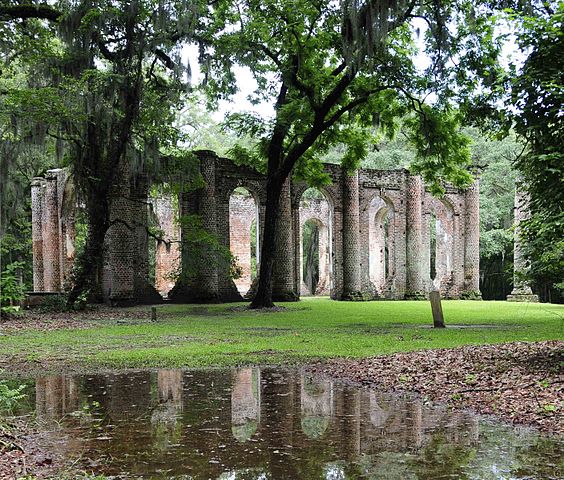
The South Carolina town of Yemassee is famous for the Old Sheldon Church Ruins, dating from the 1700s. Lots of cool pictures and history in the link to the right.
While this loss of underlying melody is certainly sad, such stiff passages are broken up by measured lines of classic White, with delicate sensibility and a love for the North American landscape (including a shout out to Yemassee, SC, which led me to this cool page). They flew south across Maryland and Virginia. They flew south across the Carolinas. They spent a night in Yemassee and saw huge oak trees with moss hanging from their branches. They visited the great swamps of Georgia and saw the alligator and listened to the mockingbird. They flew across Florida and spent a few days in a bayou where doves moaned in the cedars and little lizards crawled in the sun. They turned west into Louisiana. Then they turned north toward their home in Upper Red Rock Lake.
Louis has wings, allowing him to be a far greater traveller than tiny Stuart in his automobile or sedentary Wilbur, and thus White has him traverse the country, from Canada to Montana to Boston and Philadelphia. This freedom is tremendously important to Louis – it’s truly the classic American saga of the young man going out into the world to make a name for himself, bring prestige to the family, earn a living and win his true love… the archetypal young man is just a swan in this case. With no overhead. So it lacks real drama, making it quite perfect for little kids. Worth noting that Louis is on his own a lot of the time, meaning that one of White’s greatest skills – that of the ensemble cast which made Charlotte’s Web and the first half of Stuart Little so engaging – is almost completely absent last time around.
From the title page.
The most memorable character here is not even Louis; it’s his father, the old cob, who is prone to long speeches on his own gracefulness and his duty to uphold the swan image of elegance at all times. Yet he is willing to sacrifice that honour so that his mute son will have a future. He is at once both comic and noble, a figure of fun for being overly dignified, rather than a bumbling dad. In these moments The Trumpet of the Swan becomes a true companion for Charlotte’s Web – a story of a father’s love that is quite moving for a parent and comforting to a small child:
“I have robbed a store”, he said to himself. “I have become a thief. What a miserable fate for a bird of my excellent character and high ideals! Why did I do this? What led me to commit this awful crime? My past life has been blameless–a model of good behavior and correct conduct. I am by nature law-abiding. Why, oh, why did I do this?” Then the answer came to him, as he flew steadily on through the evening sky. “I did it to help my son. I did it for love of my son Louis.”
In spite of my own preference for a less whimsical White, The Trumpet of the Swan is extremely easy to quote from and ends on a truly graceful note. While I never quite warmed to it, it does share the unique charms of Stuart Little and Charlotte’s Web and has its own moments of beauty alongside its wilder eccentricities.
Violence: Male swans have powerful wings and are accustomed to beating up those who cross them, with Louis attacking two zookeepers attempting to corner Serena, and cuffing a little duck who stole his trumpet. The old cob is shot trying to repay the music store he’d previously burgled, but any sense of danger is soon negated as the old cob continues his elegant monologue regardless of the pain, saying “I must die gracefully, as only a swan can” before fainting. He’s soon patched up and on his way again.
Values: In addition to a love for the American landscape and an encouragement for nature preservation, White also writes an ode to freedom, with Louis and Serena choosing to take their chances in the wild rather than remain in the zoo forever. However, in a twist that weirds a lot of people out, they barter for their freedom by promising the zoo an occasional cygnet of theirs in exchange. Louis keeps this promise, as Sam Beaver points out that there’s always a runt in any brood that could benefit from mankind’s protection.
Louis is a swan navigating human society and White does bring up the problem of prejudice, primarily to spoof it. While Louis works as camp bugler, he meets a boy called Applegate who insists he doesn’t like birds. The camp leader says he is “entitled to his likes and dislikes and to his prejudices” but must still treat Louis with the respect accorded a camp bugler. After Louis saves the boy from a watery grave, the camp leader then puts Applegate on the spot, coaxing him toward a “and what have we learned today?” life lesson. Applegate thought hard for a moment. “Well,” he said, “I’m grateful to Louis for saving my life. But I still don’t like birds.” The camp leader is nonplussed and has to leave it at that.
Role Models: Everyone in this book is quite nice and fairly high-minded. Louis works hard, pays his father’s debt and always tips the waiter. His original sense of self-pity is overcome alongside his disability. The old cob does as he promised, and risks life and limb first to steal and then to pay back for the crime. Sam Beaver is kind to animals and is willing to cross the country to help his friend out of a jam. Only Serena lacks positive attributes, seeming to fall for Louis just because he carries so many material goods around and serenades her on the water.
Educational Properties: Easy tie-in to a music appreciation lesson if you have similar taste as White, who supplies a mixture of American standards (‘Summertime,’ ‘There’s a Small Hotel’ and ‘Beautiful Dreamer’ among those featured) and classical pieces (Brahms’ ‘Cradle Song’ mentioned by name, also Bach, Beethoven and Mozart) for Louis’s set list. A playlist drawn from and inspired by the book could very easily be created. The Trumpet of the Swan was also adapted for symphony in 2011 by Marsha Norman and received very positive reviews – if I ever expand into adaptations, that is certainly one I would like to try.
End of Guide.
With The Trumpet of the Swan I conclude the youth bibliography of Elwyn Brooks White. There is nowhere to go from here and that’s a very satisfying feeling all by itself, the more so given how effortless and enjoyable I found these three short, strange children’s classics to be. My advice for parents would be to gather up all three, start with Charlotte’s Web and see what order your own family would rank them in. I consider The Trumpet of the Swan as the weakest of the three but I also understand why so many other readers are completely charmed by it.
Up Next: Please note that I am changing the posting schedule from Saturday to Monday, owing to recent changes in my life. So next Monday expect a fantasy novel from two-time Carnegie winner Geraldine McCaughrean – finally a British author!
If you loved The Adventures of Tom Sawyer for its prose or its characters or even its brand of humour, then I have some bad news for you. Adventures of Huckleberry Finn (whose loss of the definite article has always been a pet peeve of mine) is not a true sequel or even a companion volume to that first installment – rather, it is a wholly separate entity piggybacking on The Adventures of Tom Sawyer to that novel’s and its own detriment. Bear with me as I wrestle my sprawling notes into form, as this will be almost twice as long as my regular reviews…
Title: Adventures of Huckleberry Finn
Author: Mark Twain (1835-1910)
Illustrator: Edward Winsor Kemble (1861-1933)
Original Publication Date: 1884
Edition: New Riverside Editions (2000), pages 69 to 320 of 392 pages.
Genre: Adventure. Humour. Historical Fiction.
Ages: 14-17
First Sentence: You don’t know about me, without you have read a book by the name of “The Adventures of Tom Sawyer,” but that ain’t no matter.
I owe a great deal of the following information to the contextual material included in the New Riverside Edition, specifically ‘The Composition of Adventures of Huckleberry Finn‘ by Victor A. Doyno and ‘Introduction to Adventures of Huckleberry Finn (1958)’ by Henry Nash Smith. Smith incidentally cautions against what I am about to do when he says “a book so clearly great, yet with such evident defects, poses a difficult critical problem. There is little profit in making a mere checklist of faults and beauties. We must try to see the book integrally.” There are apparently rules to reading Huckleberry Finn. I didn’t know this and it is now considerably too late for me to start playing by them.
Mark Twain.
So to really understand the artistic debacle that is this novel, we have to start with a recap not of the plot, but of its very creation. Mark Twain began work on it in 1876, upon completing Tom Sawyer and got the plot well underway before losing steam and setting the manuscript aside for several years. In the meantime he went to Europe, got irritated at the aristocracy and wrote The Prince and the Pauper. Between 1879 and 1880 he returned to Huckleberry Finn and wrote the middle portion of the work, filled with feuds, charlatans and angry mobs. He also added a ‘Snicket Warning Label’ to the front of the book (more on that in a moment), presumably not willing to spend the extra time reworking part one to match up with his new interests and themes in part two. Then he lost interest and put the manuscript aside for another three years. Twain finally finished it up from 1883 to 1885, tagging on the ending – which is famously reviled even by those who in the same breath call Adventures of Huckleberry Finn the Great American Novel. To be fair, he also went back into the early portion and added the eerie sequence set on the wreck of the Walter Scott, which provides a window into what the whole book could have been had he pursued further revisions. Instead, he sent it to print and made some quick cash.
Now, about that warning label. NOTICE: Persons attempting to find a motive in this narrative will be prosecuted; persons attempting to find a moral in it will be banished; persons attempting to find a plot in it will be shot. Does ironic self-criticism ward off or negate external criticism? It certainly seems to have worked for Twain, at least as far as the plot warning goes.
The plot I’m not supposed to look for begins in a very straightforward manner: Huck flees from his abusive father, runs into escaped slave Jim and they decide to drift down the Mississippi on a raft to the mouth of the Ohio River. Jim will then be able to make his way north to freedom, Huck will be safe from his father finding him and there’s just one problem: Mark Twain didn’t know about the Ohio, he knew about the lower Mississippi and that’s what he wanted to write about. His solution to this problem of plot versus intention was for Huck and Jim to travel in a fog, overshoot the Ohio and have to find a canoe to get back up the river. Fair enough, but Twain then ceased to care about his original story at all. For a large portion of the book they have acquired a canoe and yet they just keep drifting down the Mississippi against all logic because Twain was unwilling to go back and rework his early material to fit his new direction. He had also conceived an antipathy to The Adventures of Tom Sawyer at some point in all this, which perhaps explains his slow work on the follow-up and certainly explains the new and improved Tom Sawyer we get in the finished product.
Tom Sawyer from the first edition frontispiece.
If you really loved Tom in his book, there is pretty much nothing for you here. The clever and admirable boy is completely gone and his superstitions and make-believe have now transformed into an inability to tell the difference between fantasy and reality. The problem is very obvious if you read the two novels close together: Tom explains quite cogently what “ransom” means at the end of The Adventures of Tom Sawyer, while in the opening chapters of Huckleberry Finn he is suddenly clueless about the word, saying “per’aps if we keep them till they’re ransomed, it means that we keep them till they’re dead.” I read the scene carefully to see if maybe Tom was pranking his friends in some way, but no, it’s just a lengthy and not terribly funny joke on Twain’s part. Tom is now just as ignorant as his peers and can’t even comprehend the stories he so avidly devours. His pranks are cruel and actively dangerous. The boy who testified to save an innocent man from execution, delaying to the last moment from fear, now makes revelations for “dramatic effect.” His code, his better qualities, are all gone.
On the other hand, if you really thought Tom was just a brat in his book, but loved The Adventures of Tom Sawyer for the writing, there is still little for you here. Twain trades in the larger-than-life narration that was a big part of Tom Sawyer‘s charm and turns to the first-person American vernacular. This is a historic moment in American literature and I’m certainly not saying it’s a bad decision or the wrong choice to make – it just further distances the two volumes from each other. Many people read Huckleberry Finn first, or never get around to Tom Sawyer because “it’s just a kid’s book,” and I suppose doing so would negate several of my criticisms. Huckleberry Finn breaks so thoroughly away from its predecessor in form, character and content that being a sequel actually does it a disservice. Here’s a taste of Twain’s excellent use of the vernacular, from Huck’s time spent abducted and living up in the woods with his father:
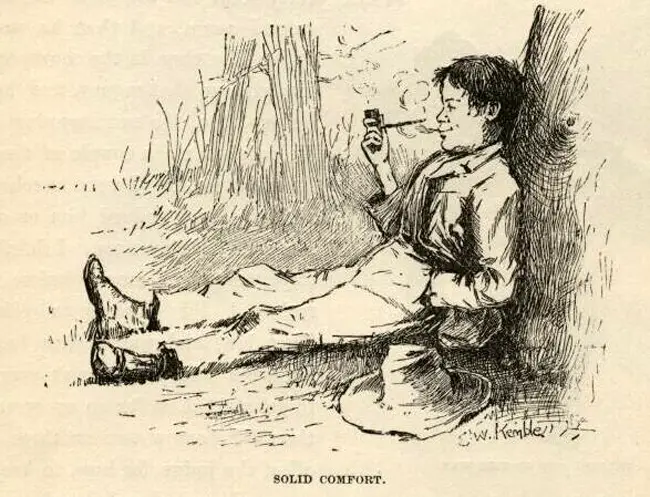
He kept me with him all the time, and I never got a chance to run off. We lived in that old cabin, and he always locked the door and put the key under his head, nights. He had a gun which he had stole, I reckon, and we fished and hunted, and that was what we lived on. Every little while he locked me in and went down to the store, three miles, to the ferry, and traded fish and game for whiskey and fetched it home and got drunk and had a good time, and licked me. The widow she found out where I was, by-and-by, and she sent a man over to try to get hold of me, but pap drove him off with the gun, and it warn’t long after that till I was used to being where I was, and liked it, all but the cowhide part. It was kind of lazy and jolly, laying off comfortable all day, smoking and fishing, and no books nor study. Two months or more run along, and my clothes got to be all rags and dirt, and I didn’t see how I’d ever got to like it so well at the widow’s, where you had to wash, and eat on a plate, and comb up, and go to bed and get up regular, and be forever bothering over a book and have old Miss Watson pecking at you all the time. I didn’t want to go back no more. … It was pretty good times up in the woods there, take it all around.
Huck having a good time, E.W. Kemble illustration.
After Huck escapes down the river with Jim he revels in his new freedom – a freedom that looks almost identical to the above passage, the ability to loll about and do nothing all day rather than build a new life for himself. Always moving but never going anywhere, and that’s before the raft gets hijacked by the so-called King and the Duke, a pair of charlatans that Huck and Jim put up with while they go from town to town playing a variety of con games. At this point in the novel, Huck and Jim have a canoe, they could easily give the charlatans the slip and make a getaway and they don’t because it’s too much trouble. If I never learnt nothing else out of pap, I learnt that the best way to get along with his kind of people is to let them have their own way. So they continue to clock in the miles down to Arkansas.
My opinion of this novel would actually be fairly high if I could believe that this was the point. After all, being worthlessly free on a raft and going south to go north have merit for satire, but none of this seems to have been Twain’s intention. I can’t find any critics taking up the idea that Huck and Jim are meant to be comic figures of incompetent fun. Twain doesn’t spend very much of his time mocking the two of them – they are the good guys in this story, society’s outcasts, and Twain clearly despises society. His Mississippi feels more like the River Styx a lot of the time. Twain’s disgust is very genuine – this is the man who expressed approval for both French and nascent Russian revolutions in the last years of his life – and this explains his treatment of Tom Sawyer as well. Tom can get along with society and succeed in it, which seemingly makes him part of the problem in Twain’s eyes.
The moral conviction of the book does have the desired effect at points. The Grangerford-Shepherdson feud is one of the best portions, with Huck arriving amongst the well-to-do Grangerford family and, with sincere admiration in his heart, accidentally ridiculing their lifestyle, including the Mortuary School of poetry, in the obituary verse and paintings left behind by a deceased daughter of the family. Huck pores over them and concludes: Everybody was sorry she died, because she had laid out a lot more of these pictures to do, and a body could see by what she had done what they had lost. But I reckoned, that with her disposition, she was having a better time in the graveyard. When the Grangerfords are wiped out in a day, Huck watching in horror from a nearby tree, it matters to the reader because it mattered to Huck. I ain’t agoing to tell all that happened–it would make me sick again if I was to do that. I wished I hadn’t ever come ashore that night, to see such things. Emotional impact is similarly gained during the charlatans’ lengthy con of the Wilks’ daughters, because Huck cares for virtuous Mary Jane Wilks and hates to watch the game go down. This adds some tension to the tale, especially when he becomes proactive for her sake. There are things that are good about this book, but they are overshadowed more and more heavily by flaws as the plot progresses to its insane conclusion.
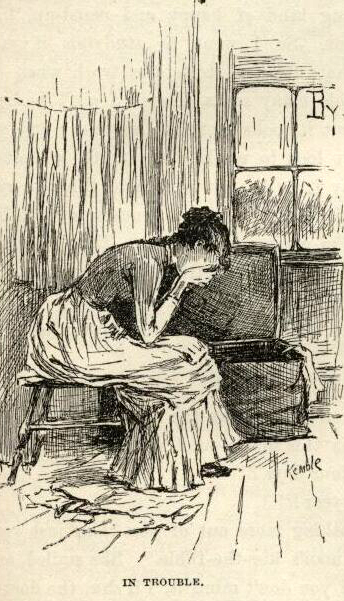
Poor Mary Jane gets put through the wringer.
Regarding the King and the Duke, Twain’s wholehearted commitment to satire on this outing damages one of the most successful features of Tom Sawyer, namely a credible villain. Injun Joe was a terrifying psychopath and far scarier than anything Twain serves up in this technically darker work, because now every evil is dished up with a load of vaudeville humour alongside. Pap is one of the worst fathers in literature, and Huck’s situation with him is grim and alarming, but pap is not that frightening because Twain is clearly showing him up as a slack-jawed moron the whole time. The charlatans are even worse, one introducing himself as “the rightful Duke of Bridgewater” and the other following up with saying he’s the “rightful King of France” and then he said it often made him feel easier and better for a while if people treated him according to his rights, and got down on one knee to speak to him, and always called him “Your Majesty,” and waited on him first at meals, and didn’t set down in his presence till he asked them. So Jim and me set to majestying him, and doing this and that and t’other for him, and standing up till he told us we might set down. This done him heaps of good, and so he got cheerful and comfortable. Twain’s humour in the previous volume relied mostly on verbal wit which was sophisticated enough to sail over kids’ heads much of the time. Huckleberry Finn features far more broad comedy, both backwoods humour and slapstick. If you like that better, you’re in luck, but from my point of view it’s not an improvement.
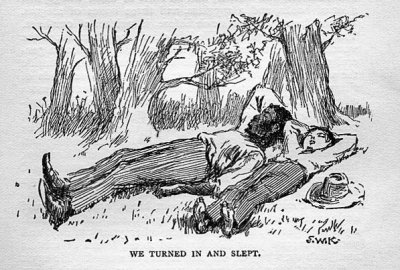
Huck and Jim asleep after a hard night’s drifting.
There is one single element of Adventures of Huckleberry Finn that works perfectly: the evolving friendship of Huck and Jim, and Huck’s changed attitude regarding Jim’s status as a slave. Yes, Huck’s battle with his conscience is riveting and tremendously realistic. His famous decision to “go to hell” and commit to the crime of stealing a slave is a great moment in American literature. It’s also only two pages long. Alas, alack, the Huck and Jim relationship is a subplot. Everyone talks about it and I was going to pitch in with my praise but since I’ve broken the other rules of reading Huck Finn I might as well break this one too.
However, at least reading the book has finally cleared up one mystery for me. It is now very clear why the ALA continues to defend Adventures of Huckleberry Finn with such energy, when no other old children’s book qualifies; no, I do not consider a negative defense a real one. The story of Huck Finn is a blueprint for many of the young adult (and now middle grade) themes the ALA loves to champion: Huck is from a broken home, he must make his own way and pointedly notlearn from his elders who are all morally compromised and/or bankrupt. Instead, he joins forces with an outsider in society, who is a far better role model in every way. Huck’s most important character trait is compassion (I would have said lying, but if the Jim story is the most important part of the book, Huck’s lies are incidental to his changed view of Jim) and being caring is today’s cardinal virtue, rather than being courageous, strong, intelligent, honest, hard-working or decisive. Meanwhile, white society is a rotten structure with racism just the cherry on top – unlike Tom Sawyer or Little House or other old books the ALA mostly ignores these days, where an independently reading child might not even noticethe racism and prefer to admire the good qualities being shown instead. This is indeed remarkably modern.
Last things last, we come to the artist’s solution to his problem of plot. Keep in mind it took him eight years to come up with this. Spoilers beyond.
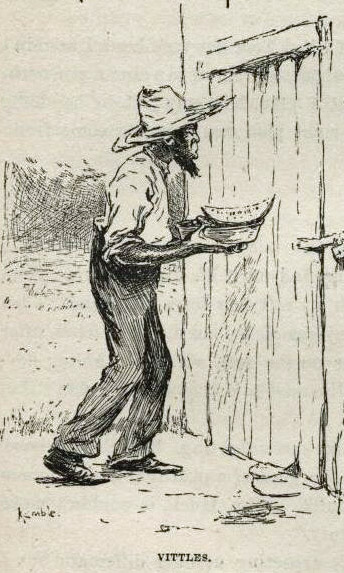
The shed Jim gets stuck in for roughly a quarter of the novel.
Huck and Jim have drifted eleven hundred miles away from St. Petersburg, Missouri when the charlatans have a streak of bad luck and do the natural thing: hand over Jim for the “reward money” from an invented flybill. Huck has his final crisis of conscience and commits to saving Jim, tracking him to a little one-horse cotton plantation owned by one Silas Phelps. Then, in the most outrageous Dickensian twist I think I’ve ever read, this man turns out to be Tom Sawyer’s uncle and Huck gets mistaken for Tom, who just so happens to be expected down for a visit. Huck ropes in Tom to help free Jim and the infamously stupid jailbreak plot ensues – basically, to reenact the great escapes from The Count of Monte Cristo and the like. This is justly criticized; however, nobody ever gives Tom’s plan credit for at least being lightyears ahead of Huck’s proposal. The following paragraph is legitimately the funniest part of this whole book and I’ve bolded the important bits:
“My plan is this,” I says. “We can easy find out if it’s Jim in there. Then get up my canoe to-morrow night, and fetch my raft over from the island. Then the first dark night that comes, steal the key out of the old man’s britches, after he goes to bed, and shove off down the river on the raft, with Jim, hiding daytimes and running nights, the way me and Jim used to do before. Wouldn’t that plan work?“
I almost laughed till I cried. To think I complained about Tom’s drop in intelligence when Huckleberry Finn now has the collective I.Q. of a ham sandwich and a jar of mayonnaise.
Please stop.
It would have been so, so easy for Mark Twain to fix this if he even pretended to care. JUST GET RID OF THE CANOE. Seriously, this book is supposed to be loaded with metaphorical significance, and what better than for the one thing that should be common along the river, the key to the north and freedom, to be so elusive that they are forced to drift south, sustained by the hope that today there’ll be an unguarded or drifting canoe that will turn everything around for them. This is the laziest fix possible – I can see why he might not have wanted to overhaul the whole thing by having Jim part with Huck at the Ohio, or turn the whole book on its head by starting down at Phelps’s plantation and going up the river, but he could have done something. Why are you asking me to accept this plot as the work of a genius? Oh right, because I’m not supposed to talk about the plot, I’m supposed to talk about Jim.
Golly gee, the little sociopath sure knows how to enjoy himself.
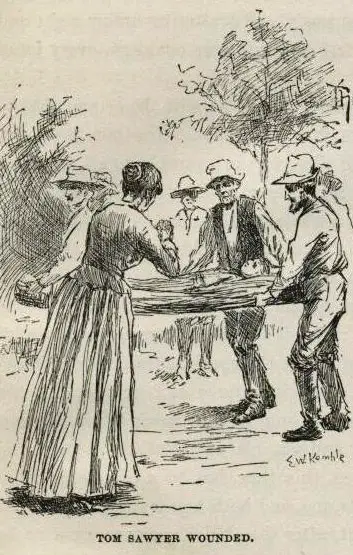
Anyway, Twain wasn’t done with his masterpiece yet. After Tom’s ludicrous escape plan is ruined, he gets shot in the leg and Jim gets recaptured. Tom then reveals that Jim’s been freed this whole time – his owner had a crisis of conscience on her deathbed – and Tom set the whole escape plan up just to have some fun.
Well, at least someone is.
But why limit yourself to one twist, or even just two, when you could really knock em down with a third whole plot twist? On the last actual page of this lunatic book, Jim reveals to Huck that his evil pap is dead– the body they found in an early night on the river, which Jim didn’t let Huck get a look at, was pap all along, and Huck could have gone home anytime after that. Who cares if the likelihood of stumbling over Huck’s dead dad was fairly minute? I mean, does probability even matter after the convergence of Tom, Huck, Jim and Uncle Silas on a patch of land in Arkansas? Who cares if this reduces Huck’s entire journey and the traumas he’s endured to a shaggy dog story? Who cares if this turns Jim, previously a caring father-figure to Huck, into a selfish manipulator of a poor child? Or maybe this was just Twain’s way of saying that there truly is nothing good in American society after all? What a twist!
End Spoilers.
It’s possible I would have a more favorable opinion of Adventures of Huckleberry Finn if I hadn’t already read Pudd’nhead Wilson, another of his late works where he did the exact same thing – started one story, lost interest, switched focus (this time completely) and instead of going back and starting over, he rushed his comedy-turned-tragedy-turned-detective-story to print for fast revenue. I am well aware that Mark Twain had financial difficulties. So did a lot of great writers, yet they somehow stuck to their artistry – often at the expense of family and friends, though some of them even had day jobs. Twain’s talent and innovation are here placed at the service of rank commercialism, for why else would he persist in a sequel to a work he had lost interest in? Because The Adventures of Tom Sawyer had become a popular novel, so much that he later knocked out two more short sequels starring these beloved characters, sequels which everyone agrees were pure commercial product.
The iconic first edition.
My personal response to this novel was so strongly negative that I find it impossible to fairly judge it as part of the Castle Project. I do not know what kind of a reaction it would get from young readers, beyond pointing out that many, many people do love this book and seem to find it a gripping story. The only thing I can state for certain is that it is a superfluous sequel in that outside of Huck himself, the second book offers no real continuation of the material in the first and is not necessary to complete the experience. If you stick to The Adventures of Tom Sawyer as a stand-alone, it’s not going to hurt anything.
Parental Guide, which I will keep brief.
Violence: Drunken abuse from pap, a family feud ending in massacre, a ghost story about a dead baby, a man shot down in the street, a couple of angry mobs forming, an incident of tarring and feathering, gold being hidden with a corpse in a coffin, casual references made to animal cruelty, murder, drownings, cruel pranks and crueller cons, much talk of slavery and copious quantities of the word “nigger.” I might be forgetting something. All is told in a tone of mixed humour and disgust not generally associated with youth literature until fairly recently.
Values: Black people are human beings and should no more be slaves than anyone else. Society is a disease. Human beings can be awful cruel to one another, as Huck thinks late in the book.
Role Models: Huck lies, steals and passively watches the King and the Duke rip off town after town before becoming proactive for the sake of Mary Jane. Jim briefly becomes the best character in the book right after the charlatans sell him, when he quite logically pays them back by spreading word about their con game, leading to them finally getting the tar and feathering they so richly deserve. Given that they betrayed a guy who could squeal on them and didn’t even have sense to blow town afterward, it’s extra satisfying. And yes, Huck and Jim together on the raft in harmony is truly a lesson to us all – though given how things literally go south for them I’m not sure I want to unpack that metaphor.
Educational Properties: Most people use this to discuss race relations in America but I expect you know by now what I’d suggest: a structural autopsy.
End of Guide.
There are two more (thankfully short) books in the Tom Sawyer series and I do already own them. Since the third volume, Tom Sawyer Abroad, gives me some Jules Verne vibes, I’m scheduling Around the World in Eighty Days for next month. This will hopefully give me some time to recover myself and gain some at least morbid curiosity for the remainder. I am genuinely shocked by just how much I hated this book, given how rewarding I found Tom Sawyer.
Up Next: I’m leapfrogging right over the 20th Century and into the 21st at last, with a work of historical fiction by Janet Taylor Lisle.
This classic holds the dubious distinction of being the first book I ever read that left me feeling cheated of a justly-deserved ending, and I suspect this milestone applies to a lot of other children as well. Yet in hindsight this might even be the thing I appreciate most about the book…
Title: Stuart Little
Author: E.B. White (1899-1985)
Illustrator: Garth Williams (1912-1996)
Original Publication Date: 1945
Edition: Scholastic Inc. (1987), 131 pages
Genre: Anthropomorphic fantasy.
Ages: 5-8
First Sentence: When Mrs. Frederick C. Little’s second son arrived, everybody noticed that he was not much bigger than a mouse.
Stuart Little is a mouse born into a human family, an unexpected event that the Littles (and the world) accept with enviable equanimity. Small as he is, any number of misadventures can befall Stuart around the house, but he, his parents and older brother George muddle through, until the arrival of the bird Margalo – a sweet-tempered creature that Stuart quickly falls for. Snowbell, the family cat, is not so pleased, and puts out a hit on the bird, courtesy of a femme fatale feline known only as the Angora (if you haven’t read this book, please be aware I am dramatizing a little here). Margalo gets wind of the plot and flees without saying goodbye to the Littles. Stuart, distraught, decides to head out after her.
Illustration by Garth Williams.
Stuart Little is like two books in one. The first half, consisting of Stuart’s home life, is as perfect a children’s tale as you’re likely to find, effortlessly appealing to the imaginations of those still young enough to be preoccupied with truly important matters – such as what it would be like to be about two inches tall and have to make your way across the house. The second half contains almost nothing which would appeal to the same child at the same age. Instead, Stuart leaves home without a goodbye, takes a job pontificating to a bunch of schoolchildren, gets a date with a human girl who’s just his size, makes a complete mess out of it and gets back on the road, still looking for his bird and without the slightest proof that he’ll ever find her. I find that the only way this complete collapse of momentum and humour makes any sense (and I have no proof of this theory) is if E.B. White took a break and, when he came back, decided to send-up The Great American Novel that a hundred Thomas Wolfe wannabes were busy flooding the market with. This is the only way that Stuart Little’s prosey travelogue of impractical politics and girl troubles can be explained to my satisfaction, anyway. Let me know your theory.
This might be a fatal flaw in a lesser novel, rendering it nothing but a historical curio, but Stuart Little has so much to offer in the first half that it remains a children’s classic to this day. What sets it apart from other mouse tales is White’s wonderful style, which is balanced perfectly between the simplicity that would allow a child to handle it on his own and a verve that makes it a comfortable read-aloud for a parent. White’s manner is warm, wry and elegant, even when the hero is in imminent danger of an undignified death:
One day when he was seven years old, Stuart was in the kitchen watching his mother make tapioca pudding. He was feeling hungry, and when Mrs. Little opened the door of the electric refrigerator to get something, Stuart slipped inside to see if he could find a piece of cheese. He supposed, of course, his mother had seen him, and when the door swung shut and he realized he was locked in, it surprised him greatly. “Help!” he called. “It’s dark in here! It’s cold in this refrigerator. Help! Let me out! I’m getting colder by the minute.” But his voice was not strong enough to penetrate the thick wall. In the darkness he stumbled and fell into a saucer of prunes. The juice was cold. Stuart shivered, and his teeth chattered together. It wasn’t until half an hour later that Mrs. Little again opened the door and found him standing on a butter plate, beating his arms together to try to keep warm, and blowing on his hands, and hopping up and down.
Waiting for rescue.
Stuart is a dapper mouse, with a complete dignity of dress and manner that allows him to feel bigger than his ridiculous circumstances. His request for a “nip of brandy” at the close of the fridge episode cements him as yet another adult protagonist in a story for children. However, I do wonder if the weakness of the second half might not be due to an absence of the other Littles, a flustered chorus to his misadventures and a loving family – even if they never do have the sense to board up the mousehole in the pantry. An example of their interplay from when they mistakenly believe Stuart has gone down it:
George was in favor of ripping up the pantry floor. He ran and got his hammer, his screw driver, and an ice pick. “I’ll have this old floor up in double-quick time,” he said, inserting his screw driver under the edge of the first board and giving a good vigorous pry. “We will not rip up this floor till we have had a good search,” announced Mr. Little. “That’s final, George! You can put that hammer away where you got it.” “Oh, all right,” said George. “I see that nobody in this house cares anything about Stuart but me.” Mrs. Little began to cry. “My poor dear little son!” she said. “I know he’ll get wedged somewhere.” “Just because you can’t travel comfortably in a mousehole doesn’t mean that it isn’t a perfectly suitable place for Stuart,” said Mr. Little. “Just don’t get yourself all worked up.”
A pretty little bird.
All together, including Snowbell, the Littles are a treat. It’s a perfect tale – a little strange, but humanoid mice are a strange concept when you think of it – until Margalo arrives and Stuart falls in love with a bird. Maybe this entire plot is purely to facilitate a pun – a “bird” is a girl, therefore a girl is a bird. However, it starts to feel more and more made up as it goes along. Stuart is too small to carry actual coin, so how does he pay for gasoline? Why does he have to chop down a dandelion for greens, yet is able to travel around with a mouse-sized tin of ham? Also, even as a child, it made no sense that Stuart, going on foot, would be able to find Margalo. Supposing she comes back while he’s out looking for her? I figured the likeliest way they’d meet again is if Margalo heard he was missing, and went looking for him.
The whole second half has a melancholy air. Stuart wrecks his new toy automobile in a sad and improbable bit of slapstick. He’s the world’s most boring substitute teacher, talking about being “Chairman of the World,” claiming that “rats are underprivileged,” and coming up with impracticable laws against being mean (this is the longest chapter in the whole book and has no pertinence on anything else). Meanwhile, the sudden appearance of Thumbelina Miss Ames is just bizarre, and Stuart behaves terribly the whole time he’s with her. Stuart, if you’re lonely for companionship, maybe try locating New York’s mouse population, who probably left you as a changeling in a human hospital to start with (this was always my theory anyway).
Elwyn Brooks White in the office.
This isn’t to say that the second half of Stuart Little has nothing to offer. White’s writing is consistent, there’s a wealth of local colour regarding 1940s New York, Garth Williams was already a quintessential children’s book illustrator on his very first try, and the non-ending is strangely inspired – especially since E.B. White is a rare example of a children’s author who did not weaken and knock out an inferior sequel when strapped for cash. It just ends. It is a messy novel meant for an age group that collects “practice” books which emphasize rigorous, multi-volume predictability, a la The Boxcar Children series. It is highly recommendable and artistically excellent, even if it does have the inescapable sense of a failed experiment. Just make sure your son or daughter gets Charlotte’s Web first, because Stuart Little is not necessarily the best introduction to E.B. White. Indeed, despite revisiting this (okay, the first half) often enough while growing up, I never trusted White enough to read a second one.
Parental Guide. Stuart’s letter to Miss Ames raised my eyebrows as I read it for this project. Quite frankly, he’s every parents’ nightmare: …my purpose in writing this brief note is to suggest that we meet. I realize that your parents may object to the suddenness and directness of my proposal, as well as to my somewhat mouselike appearance, so I think probably it might be a good idea if you just didn’t mention the matter to them. What they don’t won’t hurt them. He does promise to leave this matter to her own good judgement, and I suppose looked at from the Ames’ point of view the whole “afternoon on the river” sequence is a G rated cautionary tale about going on blind dates with hirsute strangers from out-of-town but it still feels tremendously out of place. Of course, Thumbelina herself was also courted by several wildly inappropriate suitors before finding her fairy prince, so maybe that’s what White was actually referring to here.
Stuart and Miss Harriet Ames.
Violence: Stuart gets into several close shaves, among them getting swept into a garbage truck and nearly drowned in the ocean. Snowbell and the Angora both threaten to eat Margalo, and Stuart defends her with a bow and arrow one night in a very Arthurian way. He destroys his toy car, though it’s fixed up again good as new.
Values: Chief among the values displayed here is actually stoicism. When Stuart boasts or brags he gets into trouble, first with the windowshade and then Miss Ames. When he does something truly noble, such as winning the boat race or saving Margalo, he is far too modest to tell anyone and the feat passes by unsung.
The Littles invent all manner of aids to help Stuart get about and enjoy life, while the dentist tinkers with model boats and cars. Stuart enjoys being useful to others and always has proper attire for every possible occasion. E.B. White also briefly morphs into his Elements of Style self, and has Stuart-as-teacher say “a misspelled word is an abomination in the sight of everyone. I consider it a very fine thing to spell words correctly and I strongly urge every one of you to buy a Webster’s Collegiate Dictionary and consult it whenever you are in the slightest doubt.”
You could tryto read Stuart Little as a metaphor for a handicapped or adopted child, but I would advise against this search for deeper meaning, as Stuart never really fits in, although his parents love him very much. Indeed, life with the Littles is portrayed as far more of a struggle than his subsequent independent voyage, of which he is a fairly successful navigator. He also leaves home without a word – so as far as families in classic children’s books go, this one is more on the dysfunctional side.
Role Models: Stuart actually regresses over the course of his story, from a gallant young mouse to a petulant one. I think White intended the Miss Ames date to demonstrate the problem of letting a perfect day dream interfere with having an imperfectly good day, but it’s the penultimate chapter and leaves Stuart on a very downcast and immature note.
Garth Williams.
Everyone, even the devious cats, are fully likable characters and most of them strive to be helpful at some point or other.
Educational Properties: Plenty of thought exercises and physics lessons. Random questions like “why doesn’t the story end? What do you think happened next? If a toy car is driving, is it still a mile?” spring to mind.
End of Guide.
Expect my review of Charlotte’s Web in August and The Trumpet of the Swan in September. E.B. White is going to be the first author on the Western Corner of the Castle whose bibliography I will be completing and I have absolutely no idea what to expect after this one. What are your thoughts on Stuart Little?
Up Next: One of the 1945 Newbery Honor books, so we’re almost staying in the year.

 Title: Wolf Story


 Title: Tom Sawyer Abroad


 Title: The Trumpet of the Swan



 Educational Properties: Easy tie-in to a music appreciation lesson if you have similar taste as White, who supplies a mixture of American standards (‘Summertime,’ ‘There’s a Small Hotel’ and ‘Beautiful Dreamer’ among those featured) and classical pieces (Brahms’ ‘Cradle Song’ mentioned by name, also Bach, Beethoven and Mozart) for Louis’s set list. A playlist drawn from and inspired by the book could very easily be created. The Trumpet of the Swan was also adapted for symphony in 2011 by Marsha Norman and received very positive reviews – if I ever expand into adaptations, that is certainly one I would like to try.
 Title: Adventures of Huckleberry Finn



 Title: Stuart Little


 The Western Corner of the Castle