One for Sorrow – Mary Downing Hahn

This book begins with a run-on sentence. Prepare yourself for a rant, because there will be no prisoners taken, nor will I be using any spoiler warnings in this review…

https://pdpabst.files.wordpress.com/2017/07/one-for-sorrow-book.jpgTitle: One for Sorrow: A Ghost Story
Author: Mary Downing Hahn (1937-)
Original Publication Date: 2017
Edition: Scholastic Inc. (2018), 293 pages
Genre: Horror. Fantasy. Historical fiction.
Ages: 10?
First Sentence: Although I didn’t realize it, my troubles began when we moved to Portman Street, and I became a student in the Pearce Academy for Girls, the finest school in the town of Mount Pleasant, according to father.

It’s 1918 and the Spanish Flu is making the rounds of America. Shy Annie Browne is new in school and on her first day is immediately “befriended” by Elsie Schneider, a lying, controlling, destructive little psycho whom all the other girls despise. Annie is prevented from making any other friends until Elsie is absent from school, at which point Annie is finally brought into the popular circle – and takes part in their ceaseless bullying of Elsie. There’s no doubt that Elsie brings it on herself, but she’s grossly outnumbered and Annie feels bad about her part in it (not that it stops her). Eventually, Elsie gets the flu and dies, only to return as an angry ghost with a particular grudge against Rosie, the leader of the clique, and guilt-stricken Annie.

Okay, so the writing in this book is absolutely horrible, beginning with the most brutally short paragraphs this side of a Guardian article. Sentences are clipped, descriptive prose is fleeting and the vocabulary is limited and therefore numbingly repetitive. Is this the style of today? If so, it’s been streamlined of everything that could possibly make reading a “chore.”

Just as I finished my oatmeal, Jane knocked on the door.
When I ran to meet her, she gave me a big hug. “Oh, I’m so glad you’re well enough to come back to school, Annie. I’ve missed you so much.”
“I’ve missed you, too.”

https://d.gr-assets.com/books/1348400532l/200891.jpg
I’m just going to recommend better books in these spaces today.

The prose is continually stuck at the level of early chapter books – and not even challenging ones at that. You’ll find more detailed verbiage in American Girl, Chet Gecko and Beverly Cleary stories for younger readers and that’s a death blow for this entire book. The concept – a ghost story kicked off by the Spanish Influenza at the end of the First World War – has so much potential, but it can’t be harnessed because the setting is never given any focus or weight. Hahn is a veteran writer; she’s been doing this since the 1980s and once won the Scott O’Dell award for historical fiction, but there’s no evidence here for why that would have ever been the case. Aside from the games girls played, the books they read and some basic info on wakes and horse-drawn hearses, there’s just nothing here. Maryland in 1918 is a vague backdrop for the ghostly plot, nothing more.

As far as the plot goes, Elsie’s ghost doesn’t appear until over 100 pages in – before that, One for Sorrow is a story about bullying, which means it should be character driven. It isn’t. Aside from Elsie and Rosie, almost none of the characters merit any physical description or personality. The clique of mean girls are only distinguishable by their degrees of guilt, with the “nice” ones (Annie and Jane) feeling more guilt and the “mean” ones (Eunice and Lucy) feeling less, with Rosie somewhere in the middle. Never mind that this sets up the phony idea that guilt is somehow a virtue; it can lead to virtue but just as easily to self-destruction. As such, none of these girls have any positive traits whatsoever. They are nasty, ill-mannered liars without a complete spine between them. Rosie comes up with a plan (inspired by the true story of Hahn’s mother) to get free sweets by going to wakes and pretending to know the dead people there. “We won’t be doing anything wrong,” Rosie said. “We’ll tell people how sorry we are, we’ll talk about how nice the dead person was, we’ll make the mourners feel better. That’s not taking advantage, that’s not lying.” And Annie more than once compares this horrid specimen to Anne Shirley, who never told a lie. But since most kids won’t (or can’t?) read Anne of Green Gables, I guess they’ll never know that.

As for Annie, she’s a complete drip with no spirit at all. One could be forgiven for assuming that she must improve at some point, being the protagonist and all, but you would be wrong. To the end she thinks (paraphrasing): “oh, why did I let Elsie make me do those terrible things?” She makes no effort to defeat Elsie’s ghost. She goes along with every stupid and cruel idea Rosie ever has, even one which nearly gets her killed, and then feels bad afterwards. She does not grow or alter through the book and never comes clean. When she stumbles upon a retired ghost hunter called Mrs. Jameson, it is by accident, and she simply follows all of Mrs. Jameson’s instructions thereafter with no agency of her own.

https://i0.wp.com/d.gr-assets.com/books/1293762966l/596878.jpg
The second book about Tiffany Aching. Excellent, complex and creepy.

So much for the characters. The plot begins with children being mean (usually by shoving and screaming insults at one another) and once Elsie’s ghost appears it’s just round two of the same spiel for more tedious pages of screaming and shoving. Ghost Elsie is exactly the same as living Elsie, only with more power. This should be unnerving but it isn’t. For instance, Elsie possesses Annie and makes her do terrible things, but Annie doesn’t black out (which would heighten the suspense by adding mystery) or have enough personality to make the behavioral change feel horrifying (a la Tiffany Aching in A Hat Full of Sky). The writing continues to be frenetic and flat, and Elsie explains from the start what she intends to do to Annie, so there’s no chance for the situation to ever feel dreadful or uncanny: Alone except for Elsie, I found myself removing the flu mask from my bookbag and tucking it into Rosie’s. I didn’t want to do it, but I couldn’t stop. It was as if I were outside my own body, watching myself.

One for Sorrow is a ghost story that has no sense of the unearthly and no allowance for anything bigger than the individual. A Scooby-Doo hoax would feel more authentic to this novel’s worldview because while this is set in 1918, all of the characters are from 2017.

https://images.gr-assets.com/books/1361116236l/500660.jpg
By These Ten Bones, featuring werewolves in medieval Scotland. Good and evil, religious belief, horror and the highlands. Worth checking out.

In 1918 a girl’s first thought about ghosts would involve the state of the soul, salvation and damnation. Annie would pray to God for aid and she would go to church – if for no other reason than the hope that Elsie couldn’t follow her there. But Annie doesn’t even think of any of those things, because Annie is from 2017. That’s why she mishears the phrase “at peace with the Lord” as “at the beach with the Lord” – because she’s never heard it before. She’s shocked at the notion of corporeal punishment because her parents and teachers also belong in 2017 (Miss Harrison, faced with a sea of screaming pupils disgracing her school’s orderly reputation, disciplines them by ending recess early). Muddying the waters are a couple of references to hell and the devil, which means Hahn wants us to think of these characters as Christian, even though they obviously aren’t.

So let’s try to assume that Annie and her entire social circle are the very height of the 1918 progressive movement. But just as there’s no spiritual element to her problem, there’s no historical one either – because guess what? Annie loves to read, so it really should occur to her that Elsie can’t be the world’s first ghost. It has to have happened before and there should be records, yet she does no research on spiritualists and ghost-hunters, and no one reading this book would gain from it any sense of the antiquity of hauntings. When Annie’s bad behavior gets out of hand, she’s sent to a convalescent home and it just so happens there’s a retired ghost-hunter on the premises. Mrs. Jameson drops hints that she’s an expert on the matter, but even at this stage there’s nothing bigger than the ghosts – in fact, Mrs. Jameson can’t “help” Elsie until she dies and becomes one herself. In other words, when Elsie causes Mrs. Jameson to fall and break a hip, it’s actually a good thing.

Lastly, although Elsie is clearly psychotic – revelling in every drop of pain she causes and before her death probably headed to a future abducting and murdering children – it turns out that she can only be defeated by empathy.
https://vignette3.wikia.nocookie.net/bartimaeus/images/1/1d/Trilogy.jpg/revision/latest/scale-to-width-down/200?cb=20140528201030
Annie is basically a villain protagonist, but if that’s what you’re looking for, this is still the gold standard.

It’s not even genuine empathy. You know, the sort that would make this story less about the ghost and more about the life lessons the heroine learns about caring for others and standing up to bullies and whatnot. That would be corny but fairly typical. Instead, Mrs. Jameson flat-out instructs Annie to lie: “Be kind to her, earn her trust.” Annie loathes Elsie but pretends otherwise – and it’s the right thing to do. Elsie kills Mrs. Jameson – and it’s the right thing to do. Early on in the book, Elsie screams at Annie: “I’d give anything to have a mother like yours. It’s not fair that you have so much and I have nothing!” Herein lies the key to her defeat. She’s just an underprivileged child who wants her mommy and the whole book was a 200 page temper tantrum (culminating in the murder of a little old lady). It turns out that sympathizing with the motives of evil is what defeats it.

To be extra clear, Elsie does not show any mercy at the end of this book. She becomes “reachable” because she turns maudlin and self-pitying for a couple of minutes. She is not redeemed, but she gets everything she wanted, including a free ticket to the afterlife to reunite with her dead mother. She’s like Hannah in Thirteen Reasons Why, only she’s a literal ghost instead of tapes. She dies and is avenged. All of the adults feel sorry for her, all of the girls who wouldn’t be her friends are haunted by their actions and she never has to repent or live with any of her own choices.

The point of the Castle Project has always been to read as widely as possible in the field of children’s literature. I cannot proclaim the superiority of vintage options if I don’t read the modern alternatives. Well, here you go. On technical merits, One for Sorrow is abysmal. It is relentlessly unpleasant, philosophically poisonous and the bigger picture behind this book implies that speculative fiction in particular is on a steep decline. If there’s nothing bigger than our finite experience, if good and evil are relative based on the individual and if our entire history means nothing, we will be seeing more and more fantasies robbed of power and built on sand.

There was only one thing I appreciated about One for Sorrow and that was Hahn’s inclusion of many book titles which girls of the time would have read. After a while I began keeping a list, hoping that Hahn was sending some kind of message to her readers (she was born in the 1930s, so she has to be aware of what’s happened):

L.M. Montgomery – Anne of Green Gables; Anne’s House of Dreams
Johann D. Wyss – The Swiss Family Robinson
Wilkie Collins – The Moonstone; The Woman in White
Charles Dickens – The Pickwick Papers
Ouida – A Dog of Flanders
Zane Grey – Riders of the Purple Sage
Louisa May Alcott – Little Women
Booth Tarkington – Penrod; Seventeen; The Magnificent Ambersons
Henry Wadsworth Longfellow – ‘The Wreck of the Hesperus’
Victor Appleton – Tom Swift
Sir Walter Scott
Edgar Allan Poe
Nathaniel Hawthorne

Feast your eyes and think of what they call progress.

https://i0.wp.com/photo.goodreads.com/books/1177273274l/690609.jpg
Bonus points for including a cryptid – because people of the time believed in them, even if Rinaldi doesn’t.

See Also: The Coffin Quilt by Ann Rinaldi. Set during the Hatfield-McCoy feud, this books contains plenty of southern gothic atmosphere, morbid and murderous occurrences, actual historical detail and period-accurate belief systems.

Parental Guide, just for fun.

Violence: You’ve got your dead people, your rotting ghost, and your screaming, shoving, fat-shaming and throwing things (these bullies don’t have very original material). Without atmosphere or subtlety, the disturbing horror content ranges from merely annoying to unpleasant. Spookiness can be fun. This was neither.

Values: Be nice! Lying makes people feel better, so it’s good! Empathize at all costs, even with psychos – because if you’re only nice enough, they’ll totally leave you alone!

There’s also a dropped plotline in which the girls hate Elsie for being German, which sets up a commentary on xenophobia that is never utilized because that’s not really why they hate her. It’s just an extra way to insult her.

Role Models: Everyone is horrible. Oh and Annie gets a concussion from sledding. Headfirst. At night. In a cemetery. Just thought I’d mention it.

Educational Properties: If you or yours have already suffered through it, by all means hold a discussion on morality and the Spanish flu to try and make it worth your time. Otherwise, no.

End of Guide.

Mary Downing Hahn has written many ghost stories, and I can easily believe the ones from the 80s were better just because the trends in children’s publishing were healthier at the time. Judging an author from a single book is never entirely fair, but I have to admit that I’m sorely tempted to do so in this case.

Up Next: The vintage equivalent. An obscure Canadian choice from 1968 featuring another angry ghost girl. Let’s see how it stacks up, just as a nice note to go out on.

Fantasy: The Stones are Hatching

Nine pages from the end and the whole magnificent edifice comes crashing down into the sea… Hey, do you remember classic Twin Peaks? “How’s Annie?” It’s kind of like that, only, you know, for kids.

https://i.ebayimg.com/images/g/SLIAAOSwGJlZOGeg/s-l500.jpgTitle: The Stones are Hatching
Author: Geraldine McCaughrean (1951-)
Original Publication Date: 1999
Edition: HarperCollins (2000), 230 pages
Genre: Fantasy. Horror.
Ages: 15-17
First Sentence: Phelim had always thought there must be more to magic than rabbits or handkerchiefs–that if it existed at all, it would be too large to palm or to hide up your sleeve.

The constant hammer of the guns of World War One has caused the Stoor Worm, a monster meant to sleep for centuries, to stir. Its harbingers are the Hatchlings, creatures forgotten in British folklore now spreading across the unsuspecting countryside, for the old ways are no longer practiced and people are helpless before the onslaught of merrows, corn wives, ushteys and other creatures too terrible to contemplate. Eleven year old Phelim is thrown out of his own house by strange invaders who insist that he is Jack o’ Green, the only one who can save Britain and slay the Worm. Scared and miserable, with his sister’s mocking voice ever echoing in his head, he sets out with a Fool, a Maiden and a Horse to the place where the Stoor Worm lies…

Discussing The Stones are Hatching without the ending is very difficult, as without those final pages this is an excellent dark fantasy novel for teens, rooted in history and folklore, with horrible monsters roaming across beautiful landscapes. Think of the film Princess Mononoke and you have an idea of what to expect. Geraldine McCaughrean has immense talent at her disposal, and she’s not afraid to make use of it. I first became interested in her oeuvre when she used her 2018 Carnegie acceptance speech to draw the world’s attention to the fact that publishers now set limits on what words authors can use in books for little kids, nixing any material considered too demanding and setting off a domino effect into the upper reading levels:

https://lemonwire-lthfr4usl8x.netdna-ssl.com/wp-content/uploads/2018/06/geraldine-mccaughrean-wins-carnegie-childrens-book-prize.jpg
Geraldine McCaughrean.

“The only way to make books – and knowledge – accessible is to give children the necessary words. And how has that always been done? By adult conversation and reading. Since when has one generation EVER doubted and pitied the next so much that it decides not to burden them with the full package of the English language but to feed them only a restricted diet, like invalids, of simple words…
Worst and most wicked outcome of all would be that we deliberately and wantonly create an underclass of citizens with a small but functional vocabulary: easy to manipulate and lacking in the means to reason their way out of subjugation, because you need words to be able to think for yourself.”

This won me over to her right away, even though I don’t agree with all of her opinions in that speech (subjects for another time!) and unboxing my copy of The Stones are Hatching rapidly convinced me that she is one of the finest stylists currently contributing to the field of children’s literature. By itself, this makes me want to recommend this book, as her descriptive skills enliven a classic hero’s journey, one that is rendered darker than average by returning the tale to its unbowdlerized roots in Celtic folklore. Seven pages in and Phelim is faced with his first creature of nightmare:

He pictured an Alsatian outside, broken loose from its kennel, maltreated perhaps and starving. He thought of the police, but they were ten miles away in Somerton. The dog’s breath rasped in its throat like a hacksaw; its claws scrabbled paint off the door in crackling sheets. When it barked, the glass of the wall lights shook. Five, six, seven times it hurled itself against the door and then, when the bolts held, fell back and prowled around the house, slavering over the spilled dustbin, setting small plant pots rolling, clawing at the brittle tarpaper covering the cellar door. Phelim felt his own shanks shaking, his feet and palms melting like butter…

Phelim knew he had to move. He knew he had to do more than wait for the dog to scratch or climb its way into the house and come ravening down the stairs. He rushed up the staircase on hands and feet, sobbing with the exertion, and threw open both bedroom doors to check that the windows were shut tight. He went over and pressed his face against the dirty glass, trying to catch a squinnying glimpse of the dog below–the hound besieging his sister’s cottage. Good thing she was away; Prudence was not fond of animals at the best of times.
But Phelim could not see; the dog was too close in against the house, clawing at the brickwork. All he could see was the overturned chicken house crushed into splintery shards, the chickens lying about like torn-off scarlet dahlia heads.

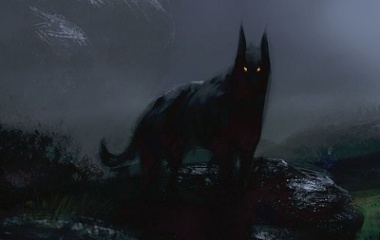
https://mythology.net/wp-content/uploads/2017/04/Black-Dog-Ghost-380x240.jpg
Artist’s impression of Black Dog.

No good or even ambiguous creatures hatch from the Stoor Worm’s eggs; they are all vile monsters, repelled by commonplace items – from marigolds to spilled blood to hot cross buns – but otherwise pitiless and unstoppable. Nightmare fuel is a constant throughout the book as the apocalyptic scenario unfolds. It’s one of the finest examples I’ve come across of fantasy as social metaphor (something often poorly executed), as World War One was essentially an apocalypse, with lasting social and psychological damage to this very day, and making it trigger a literal end of the world is fitting and powerful. The shadows of the dead men hang over everything, from Mad Sweeney’s twisted nursery rhymes to Phelim’s run-in with the Washer at the Ford, washing the shirts of the dead and the soon-to-die, Phelim’s own among them. Knowing what it means makes Phelim’s journey that much harder:

Alexia was pinning her hopes on him. If Jack o’ Green died, seemingly nothing could save humankind from the Stoor Worm’s brood of Hatchlings. And the more he thought about that, the more he despaired. After all, he already knew their journey was futile. He was going to get killed. He was traveling toward his own death. And yet he kept on going. Why? It must have been like that for the soldiers in the trenches, he thought. Plain common sense and logic told them they would die if they went one more time into no-man’s-land. And yet they knew they would go. The only taboo was to speak of it, to admit to the fear.

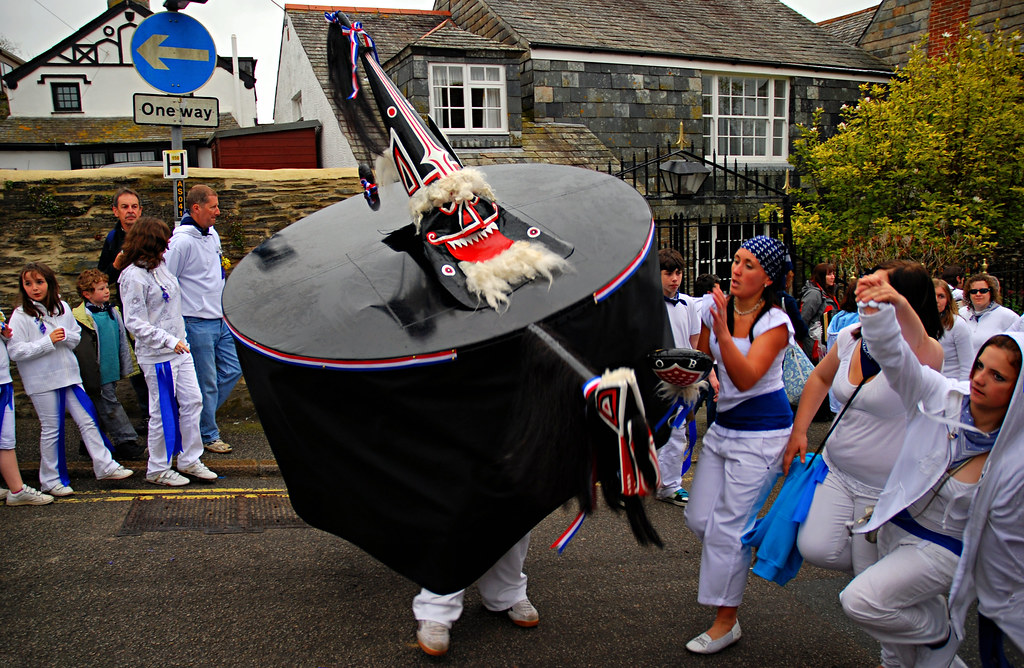
https://c2.staticflickr.com/4/3575/3493445311_ae005a0bb5_b.jpg
Phelim is accompanied by the Obby Oss, seen here in the traditional Obby Oss Festival in Padstow, Cornwall.

The darkness of The Stones are Hatching is very consistent and (eventually) rings hollow. Having an eleven year old British boy drawn into a hidden fantasy realm makes a Harry Potter comparison inevitable, although this book was clearly meant for an older audience from the start. Magic is unpleasant here and there is no logic, charm or comfort to be had in learning about it. Nor is Phelim’s role in saving the world explained to him beyond a bare outline. The stakes are high from the start, Phelim doesn’t know what to do and his bound companions are strange and off-putting – the Maiden thinks he’s an idiot, the Fool is a madman, and the Horse is what you see above. He can’t just shake off the years of psychological abuse from his only relative either, and he is unsurprisingly sullen and scared, with a continuously bad attitude – yet he does the work regardless. In spite of the treatment he’s received from his sister Prudence, the poor boy retains good instincts and is protective of Alexia (and indeed all the women of Britain when the time comes). When the big moments arrive, he steps up and does the right thing and is on a steady road to improvement, to true heroism – beginning when he recognises what a hero does:


“[Hatchlings] could be bought off, they could,” said the Oss in its soft Cornish burr. “Folks could hold they off with bribes; a child, spilled blood, a drowning. … But folks have forgot. Forgot the price. Forgot how to pay it…”
“They shouldn’t pay! … Not with blood and children and suchlike! It’s vile! It’s blackmail!” retorted Phelim hotly. “It’s giving in to blackmail. Like sending twelve men and maidens to feed the Minotaur. Theseus didn’t. Theseus refused. Theseus went and fought the Minotaur and killed it rather than go on paying the tribute.”

All of this positive character growth is then chucked off a cliff nine pages from the end. It doesn’t come entirely out of nowhere though – I simply discounted the warning signs from a desire to trust McCaughrean. The biggest clue of what’s coming is how she continuously falls back on the tired horror trope of “anyone can turn on you.” Phelim and his companions are off to save the world, yet the people within that world are constantly shown as not worth saving, even if they’re blood kin. The flashbacks even hold this view, with Alexia’s parents shipping her off to a school for the dark arts (in the most traditional “deal with the devil” fashion) while Mad Sweeney fought in the Napoleonic Wars and almost got executed by his own side for cowardice. In the present, ordinary humans are as much of a danger as the Hatchlings are – worse, because Phelim constantly misplaces his trust in them. Even in the early scene with soon-to-perish reapers (nice working-class blokes, mostly schoolboys and old men) who are as close to good folk as McCaughrean gets, she still inserts a line of schoolmarmish scolding to cheapen their innate worth – when Phelim explains he’s been locked out of his own house by strangers, “that’ll be Gypsies,” said the driver bigotedly. Nice use of the adjective for a man who’s about to die horribly. The poetic detriment done by this treatment of humanity is considerable.

https://www.metmuseum.org/toah/images/h5/h5_50.130.14.jpg
Reapers Resting in a Wheat Field, 1885 oil-on-canvas by American artist John Singer Sargent (1856-1925).

A related problem involves the way McCaughrean bypasses Christianity, or indeed any spiritual element at all – in a book where Old Scratch has a cameo and hot cross buns can ward off hidden enemies. The question just sits unanswered, all the while Phelim’s name means “Ever-good” and legends are told of the ancient hero Assipattle who first vanquished the Worm. There are no positive influences or allies to be found as Phelim and his companions travel toward the end game – which is not the case in any old folktales, whether of the Pagan or Christian era. For instance, McCaughrean includes the horrifying nuckelavee but ignores the Orcadian legend it is a part of, in which the monster is confined in the summer months by the good Sea Mither, a feminine spirit locked in constant struggle with her masculine counterpart Teran, who represents the storms of winter. I did not even know about this legend until I’d read The Stones are Hatching and was doing my research, but I did feel that the novel had a slightly hollow ring to it even before reaching the finish line.

Now I have to discuss the ending. If you think the book sounds like something you really want to read for yourself, you should stop here and come back later.

Massive spoilers ahead!

Phelim saves Britain. To do so he has to kill the Stoor Worm in its sleep, which effectively genocides its Hatchlings. That they would have done the same to humanity doesn’t matter to Phelim – he feels soiled. Throughout the book, Phelim’s mysterious magic has been tied to his “goodness” and he tries in the aftermath to explain to Alexia that he is no longer “ever-good” and that his name is now false. However, his magic has not faded, so by the rules of the Old Ways he is clearly in the right for what he did.

He then returns home to his sister, who reveals that when Phelim was little she had his father (the real Jack o’ Green) committed to an asylum for seeing things, for being a drunkard and a pacifist. Phelim responds by using his magic to summon up an ushtey (a water-horse), which he helps his sister to mount. She is then swept off to be drowned and he is relieved to be no longer burdened by goodness, magic or heroism. Ever-good Green had committed his first act of wickedness, and his magic was guttering out like a spent candle.

Punchline is, the boy tracks down his father and it turns out Jack o’ Green didn’t even mind being in the asylum all this time because he really is a lazy good-for-nothing, twirling his green thumbs while his pint-sized son had to save the world in his place. The hero’s journey is upended in a world never shown worth saving, all for some cheap attempt at moral equivalency. Phelim’s hatred and anger went with [the water-horse], sucked out of him like the nests out of the hedgerow. He was left with the same kind of emptiness as after killing the Worm. Oh right, no difference there.

So that’s what McCaughrean spent her considerable talents on in 1999. I neither see the point of The Stones are Hatching as a meaningful story nor do I have any idea who its intended audience is. Kids who actually like straight-up nihilistic horror fiction can doubtless find far bloodier books for their entertainment. Kids who enjoy fantasy – even dark fantasy – are unlikely to be entertained by this, because fantasy is an ancient and idealistic genre at heart, where big concepts like good and evil still manage to matter. There is of course an appreciable purpose to writing characters that deconstruct heroism, such as Special Agent Dale Cooper and Ned Stark, but the stories of these fallible men are A: intended for adults and B: do not peddle moral relativism like it’s some kind of revelation about humanity.

https://i0.wp.com/images4.fanpop.com/image/photos/17200000/Ashitaka-princess-mononoke-17253113-853-480.jpg
Ashitaka, from Princess Mononoke (1997), directed by Hayao Miyazaki.

It’s a real shame. My advice is to skip The Stones are Hatching and go watch Princess Mononoke instead – that has beauty alongside the ugliness and its hero Ashitaka (who also desires to find a peaceful solution to conflict between an ancient natural order and modernizing humans) doesn’t just throw in the towel and embrace evil when things don’t go his way.


Spoilers continue into the Parental Guide.

Violence: A constant. Gruesome imagery abounds, from skinless demons to Alexia’s bones being used to make a witch’s ladder after she’s been killed. Monsters are described in a visceral manner, as when Phelim discovers the corn wives in the wheat field:

Then the curve of the blade clanged against something hollow and metallic and black.
A woman’s rib cage.
No white-clothed beauty, this. At close quarters he could see the rust-red eyes, the adze-shaped chin, the nose as curved as a billhook. Her long, black skirt was pale with dust, but not the shiny black of her iron upper body. Her long, flue-black, iron breasts had blunted countless sickle blades as she stood amid the wheat, waiting for her victims to blunder into her. She held a long-handled scythe, but she and her sisters had not come to harvest wheat.
Only the reapers.

Many of the old myths gave monsters sexual characteristics and this is not bowdlerized. It’s even a plot point when the faeries choose to invade Britain with the sole intent of stealing its women now that most of the men are dead. Phelim doesn’t seem to feel bad about wiping out their invading fleet, either; possibly because they are sentient, whereas most of the Hatchlings are beasts.

Values: Obviously not heroism, which is deconstructed in a most neurotic fashion. In fighting [the Worm], he could only become what she was: malevolent, destructive. … Phelim thought of Assipattle slicing and slashing with his sword, and it was not so much the preposterousness of the myth that struck him (one man fighting this subcontinent of a beast) as the violence, the kill-or-be-killed pettishness of it all. So the boy rejects heroism because being one means killing the enemies of those you are a hero to defend.

Family isn’t worth anything at all in this book either – family members are simply in a more advantageous position to betray both Phelim and Alexia. I think the end appearance of Phelim’s absent father is meant to be a positive moment, but it feels decidedly hollow given how cheerfully inactive the old man has been this whole time.

While modernity, as represented by Prudence and the Great War, is certainly not shown in a positive light, the Old Ways are nothing to miss, given that the people who hearken back to them turn into frenzied mobs looking for human sacrifices. Christian ministers don’t come to the aid of the people, but the one guy who takes up the pagan ways ends up causing Alexia’s death for no reason. Even the hokiest modern values like “just believe in yourself” come to nothing. By subverting the heroism of Phelim, this entire book is washed of all meaning, other than a possible anti-war sentiment if you squint.

Role Models: As if. “I couldn’t bring myself to die on the moral high ground, sparing thousands of monsters bent on eviscerating mankind, so I’m going to murder my sister. That’ll show em’.”

Educational Properties: A parent-child fantasy bookclub discussing the rich soup of symbolism, folklore, metaphor and poisonous philosophy within the novel is really your only hope in this regard. It could even be time well spent depending on how much research you want to do, but there really are much better choices for British fantasy out there.

End of Guide.

At least I can console myself that this weird artistic misfire wasn’t a trilogy. It turns out that The Stones are Hatching is the real reason I started this blogging project, because almost none of the reviews I’ve found discuss the ending or the themes, so I hope I’ve helped someone by this holistic method. Sadly, my early enthusiasm for McCaughrean’s oeuvre is now significantly tarnished, although that won’t stop me from her giving her another try down the road.

Up Next: Let’s just go back to Tom Sawyer and Mark Twain’s continued bids to make money off him. As long as Tom doesn’t murder Aunt Polly, I’m up for anything.