Historical Fiction: Black Duck

All authors of historical fiction should make proper scholarly use of the Author’s Note – no matter what age group they’re writing for. Aside from that, this is an entertaining novel that only took me a day and a half to read.

https://thewesterncornerofthecastle.home.blog/wp-content/uploads/2019/08/29adf-blackduckjacketfront.jpgTitle: Black Duck
Author: Janet Taylor Lisle (1947-)
Original Publication Date: 2006
Edition: Philomel Books/Sleuth (2006), 252 pages
Genre: Historical Fiction. Mystery.
Ages: 10-12
First Sentence: Newport Daily Journal, December 30, 1929: COAST GUARDS KILL THREE SUSPECTED RUM RUNNERS.

It’s 1929, Rhode Island, and rum running is in full swing, with every local family forced to pick a side – easy money on the wrong side of the law, or ratting out the neighbours to what could be the crooked side of the law. Teenagers Ruben and Jeddy are best friends but Jeddy’s father is the local police chief while Ruben’s father is slowly getting ensnared in the bootlegging industry, despite his efforts to remain neutral. One day, Ruben and Jeddy find a dead man in an evening suit washed up on the beach, but by the time they’ve returned with a cop the body’s vanished. Ruben made the mistake of searching the body and soon finds himself plunged into the dangerous underworld of the rum runners, who think he’s taken something valuable from the corpse. Isolated from Jeddy as well as his own father, Ruben gains a new ally in the dashing captain of the Black Duck, the most elusive of the smugglers, but one whose tiny local outfit is threatened by the encroaching big-city operations. Ruben, in way over his head in a world of warring criminal factions and shifting loyalties, becomes the only witness to a terrible night on the water…

https://www.janettaylorlisle.com/images/photos/jtl_sunroom_300dpi_bw.jpg
Janet Taylor Lisle.

This middle-grade novel by Janet Taylor Lisle (who won a Newbery Honor in 1990 for Afternoon of the Elves) is based on the true story of the Black Duck, the fastest rum running vessel on the Rhode Island coast, which was caught by the Coast Guard on the 29th of December in a dense fog. The Coast Guard opened fire on the cabin and three of the four man crew died, while the captain lost a thumb and later insisted that no warning had been given before the authorities opened fire. Given they were ambushed in a fog right after a pick-up of liquor, it seems fairly likely that someone tipped off the authorities to the Black Duck’s whereabouts, but in the end nothing was ever proven and, despite local outrage, the Coast Guard was cleared of all wrongdoing in the incident. Lisle changed this story in a few significant ways, and there will be more information on that in the Parental Guide.

Obviously there is plenty here to hang a novel on, and Lisle makes use of an interview framing device to help propel the plot and its mystery, as a teenager interviews elderly Ruben about the events in his youth, interspersed with (fictional) newspaper clippings about the Black Duck, raising new questions as Ruben answers the old. Lisle knows how to use a hook of the old-fashioned kind when she ends her chapters: There were probably ten perfectly legal reasons why Police Chief Ralph McKenzie would be up late counting out stacks of money at his supper table. I just couldn’t right then think of what they might be. The plot thickens constantly and involves multiple factions beyond a simple cops vs. criminals outlook, with small local outfits, big time operators muscling in, crooked cops on the take, and civilians trying and often failing to stay clear of the whole mess. It’s a rich soup of conflicts, secrets and betrayals. The rum running world is shown in perfectly comprehensible detail – anything that won’t fit organically into Ruben’s story gets brought up in the interview sections – with the governing laws and nighttime operations easy to understand.

https://i0.wp.com/www.traveltourismblog.com/images/Rhode-Island-Mohegan-bluffs-coast.jpg
A rocky stretch of Rhode Island coast.

I’d never been on the beach at Brown’s, though I’d passed it going upriver on the Fall River boat a couple of times. It was a natural cove sheltered by a dip in the coast, a good place for a hidden landing. When I rode up, about twenty men were already there and a bunch of skiffs were pulled up on the beach, oars set and ready. The place was lit up bright as day with oil lanterns planted on the beach and car headlights shining across the sand. When I looked across the water, I was astonished to see a freighter looming like a gigantic cliff just outside the blaze of lights. It was in the process of dropping anchor. I soon found out that she was the Lucy M., a Canadian vessel that usually moored outside the twelve-mile U.S. territorial limit of the coast to avoid arrest.
The way the Prohibition law was written, the Coast Guard couldn’t touch an outside rig, since it was in international waters. So ships from Canada and the West Indies, Europe and Great Britain would lie off there, sell their liquor cargos and unload them onto rum-running speedboats like the Black Duck to carry into shore. Sometimes as many as ten or fifteen ocean-going vessels would be moored at sea, waiting to make contact with the right runner. “Rum row,” these groups of ships were called. You couldn’t see them from land, but you knew they were out there lying in wait over the horizon. It gave you an eerie feeling, as if some pirate ship from the last century was ghosting around our coast.
I couldn’t believe the Lucy M.‘s captain would be so bold as to bring her into Brown’s, where any Coast Guard cutter in the area could breeze up and put the pinch on her. Nobody at Brown’s seemed worried about it, though, and unloading operations soon commenced.

Lisle’s writing is very straightforward and plain, lacking the richer textures and colours of great historical fiction, but she’s good at telling an exciting story and she doesn’t pack Black Duck out with a load of extra gritty details – no foul language, graphic violence or nasty medical conditions – to artificially propel her middle grade story into the reach of the larger young adult market.


One drawback to the novel is a lack of emotional weight. By rights, the story should be perfect for it, with death and betrayal centered around the broken friendship of two boys. However, Jeddy retreats into the background halfway through the book and is barely glimpsed after that, mitigating the impact of subsequent events. It’s a pity, as their relationship is well-drawn, with a tense mixture of small lies and family loyalties pulling them apart. Once that happens, though, Ruben is left fairly isolated save for his visits to the local hermit, Tom, and his interactions with Jeddy’s older sister Marina, whom Ruben is besotted with.

Marina is referred to on the dust jacket as “strong willed,” but I found it refreshing that Lisle did not make use of her as a cynical back door invite to girl readers – you know, “look, there’s a girl helping the boy protagonist and she’s just as important to the story, so please buy this book because boys don’t read enough anymore…” Marina’s role in Black Duck is closer to that of the good girls in old noir films than to a modern “strong female character.” In other words, Marina is not dressing as a boy and moonlighting with the Black Duck crew.

Ruben’s own character development proceeds along the classic path – he starts the story naive, seeking excitement and resenting the steady job he has waiting in his future, feeling unappreciated by his father and jumping at the offer of twenty bucks no matter the source. However, following the fate of the Black Duck’s daredevil crew, well…
A sadder and a wiser man
He rose the morrow morn.

https://englishromanticism.files.wordpress.com/2013/03/the-rime-of-the-ancient-mariner-by-gustave-dorc3a9-jonnard-engraver-plate-2-the-wedding-guest.jpg?w=750
The Ancient Mariner and the Wedding Guest, from the wood-engravings by French artist Gustave Dore.

My final thoughts on Black Duck could best be summed up by calling it decent. This sounds like a terribly low bar, but it’s an important one in these days of constant envelope-pushing. Lisle’s book is entirely suitable light reading, mixing an intriguing time period with a mystery format. It’s perfect for kids who enjoy the historical genre. However, it lacks staying power, and I would strongly recommend making it a buddy read with Farley Mowat’s The Black Joke, which looks at the rum running business from the Canadian side of things. Together the two books would offer a neat crash course in the coastal landscape of Prohibition for homeschooling families, and with that I offer a new category in my reviews:

See Also: The Black Joke by Farley Mowat, set in the early 30s off the coast of Newfoundland, considerably better written yet also far more boat-centric.

Onwards to the Parental Guide, packed with spoilers and historical links today.

Violence: The original corpse in the water is thusly described: Above it, swathed in a shawl of brown seaweed, a rubbery-looking shoulder peeked out, white as a girl’s. Above that, a bloated face the color of slate; two sightless eyes, open. And there in his neck, what was that? I saw a small dark-rimmed hole. … I went forward and felt around, trying not to brush up against the corpse’s skin. It had a cold, blubbery feel that turned my stomach. The murderers come back later, toting machine guns and killing Tom’s old dog because they tripped over her. The boys, hiding further down the beach and thinking that Tom’s been killed, come upon the scene after the gangsters leave.
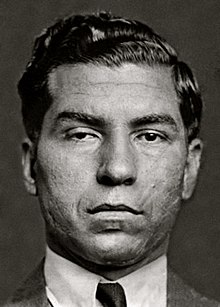
https://upload.wikimedia.org/wikipedia/commons/thumb/1/1b/LuckyLucianoSmaller.jpeg/220px-LuckyLucianoSmaller.jpeg
Italian gangster Lucky Luciano has a brief cameo.

Ruben gets kidnapped by the villains later, and then re-abducted by a bigger New York crew, who toss him into the back of the getaway car so roughly that he strikes his head on something and spends a considerable amount of time bleeding all over the place. After being rescued, he becomes the fictional fifth member of the Black Duck, who shelters in the tarp-covered lifeboat while listening to the gunfire above.

Lastly, Marina is a pretty girl. Ruben’s crush is obvious but never vulgarly described. A crooked cop takes an interest in Marina, and gives her a ride in his car under false pretenses. When he pulls over, she exits the vehicle immediately and flags down another driver to get home. Marina keeps this a secret, with the takeaway being she doesn’t think anyone would believe her side of the story. This whole sequence feels somewhat shoehorned into the plot, but it’s nowhere near as disturbing as Julie of the Wolves.

Values: Lip service is paid to good cops, but every single one in this story is crooked in some way or other, including Jeddy and his dad.

There’s some family dysfunction on display, though it’s fairly mild for modern youth literature and Ruben actually gets over his resentment of his straight-laced father. In fact, there’s a parallel between Ruben and his young present-day interviewer David, as they both chafe against working in the family business. Ruben came to accept it, and it’s shown how the friendship that develops over the interviews appears to have a good influence on young David.

The Black Duck crew is heavily romanticized and fictionalized, becoming an outlaw crew with Robin Hood allure: They were local men from local families with a need to make ends meet during hard times, different altogether from the big-city syndicates that were beginning to bully their way into the business at that time. Many folks quietly cheered them on around their supper tables, proud that one of their own could outsmart both the government and the gangsters. Their status as good guys makes their fate more impactful, but it’s also a questionable interpretation of events. More on that under Ed. Properties.

Role Models: This whole novel is about murky ethical dilemmas that the young teens at the heart of the story aren’t sure how to navigate. This is apparently a recurring theme in Lisle’s fiction. In consequence, Ruben, Jeddy and Marina flail around and never really come up with any answers to their questions. Jeddy clings with absolute loyalty to his father, ignoring all evidence against him. Marina falls in love with the Black Duck’s captain and says “if you have to make a choice, you do what’s best for the people you love,” but finds out that isn’t really an applicable rule when those “people you love” are in conflict. Ruben decides to move on with a civilian life while trying to forgive everyone involved in the Black Duck incident. Ruben’s got some old-school pluck, but his naievety and trusting nature get pretty frustrating after a while, coming across as willful blindness (like Jeddy’s) that he really can’t afford. It’s actually quite realistic.

Educational Properties: Okay, Lisle changed all the names of the crew of the Black Duck. Her captain is a fellow named Billy Brady, a daring and enterprising young man with a grassroots operation. It’s no wonder Marina’s in love with him. The real Black Duck was owned by a guy called Charlie Travers. Interesting switch takes place here – Charlie was the sole survivor of the shooting, whereas Lisle’s Billy is killed and a minor character survives instead, doubtless to increase the emotional factor.

https://i0.wp.com/www.newenglandhistoricalsociety.com/wp-content/uploads/2015/01/solomon-solomon.jpg
Russian-Jewish gangster Charles Solomon.

Charlie Travers does appear to have started out as a hotshot kid, reworking the Black Duck’s engine to get up to 32 knots and proving nearly impossible to catch. However, he was a shady figure, becoming the partner of Max Fox, one of Charles ‘King’ Solomon’s lieutenants. Solomon was Boston’s answer to Lucky Luciano, being heavily involved in narcotics and bootlegging, gambling, prostitution and witness intimidation. When he died, Max Fox was one of the men who acquired his divvied-up territory. So if this Charlie Travers person was independent and local, he didn’t stay that way for long. Since Lisle changed all the names (except of the boat itself), this might not seem like important information, but I do feel that Lisle should have clarified her changes in the Author’s Note at the end, Ann Rinaldi style, given that this novel is inspired by real accounts. When Lisle has Marina say of the Black Duck’s crew “they kept clear of the syndicates and they didn’t carry guns,” she’s referring to the fictional Billy Brady, but what reader would know that without looking up the original newspaper clippings?

Therefore, in addition to Black Duck‘s excellent use in a study on Prohibition, I think it could also work as a demonstration of how stories can be retold and repackaged with opposing facts – historical references to machine guns and “King Solomon” become fictional references to unarmed men avoiding the syndicates. It’s kind of like Island of the Blue Dolphins (and oh, suddenly I can’t wait to unpack that “true story”).

End of Guide.

Lisle has a fair number of books out and I would be quite content to try a few more as I see them. I was surprised to find that Black Duck is her most popular work on GoodReads, but like I said, it’s both entertaining and decent, and post-millennium, decency is the first hurdle that any youth literature has to clear, at least on the Western Corner of the Castle…

Up Next: Teenage paranormal romance. Set on the west coast. Published in 2005. No, it’s not Twilight.
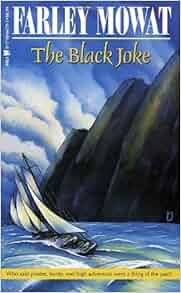
Adventure Novels: The Black Joke

When your tagline reads ” Who said pirates, booty, and high adventure were a thing of the past?” and the reader flips the book over and reads “The time: the 1930s” – you did, pal. This has been an episode of How to Lose Your Argument. I suspect this will not be the last time I take issue with the cover copy on these things.

https://images-na.ssl-images-amazon.com/images/I/510BNIo188L._SY291_BO1,204,203,200_QL40_.jpgTitle: The Black Joke
Author: Farley Mowat (1921-2014)
Illustrator: Victor Mays (1927-)
Original Publication Date: 1962
Edition: McClelland & Stewart Ltd. (2004), 218 pages
Genre: Adventure. Historical.
Ages: 9-12
First Sentence: One wind-whipped summer day in the year 1735, a black-hulled ship came storming in from seaward toward the mountain walls which guard the southern coast of Newfoundland.

The Black Joke has a slightly perplexing title until you realise it’s the name of a ship, a ship which stood out from her sisters as a ballerina would stand out in a crowd of folk dancers. Her slim, black-painted hull had a grace and delicacy which was unique amongst the rough-built, hard-working fishing ships. The Black Joke is owned by Jonathan Spence, a Newfoundland fisherman with a scrupulous work ethic, independent streak and strong will to avoid debt. His adversary, local merchant Simon Barnes, resents Spence and fears he’ll set a precedent for the local community. Unluckily for Spence, it’s the early 1930s and American Prohibition has created a thriving business for east coast rum-runners, all of whom are looking for fast yet innocuous vessels to smuggle liquor into the United States and in them Simon Barnes sees a way to turn a profit and rid himself of Spence. Framed and separated from his ship, Spence devises a plan to get her back but an accident intervenes and it falls to his young son Peter and his nephew Kye to rescue Black Joke before she sails for America.

Farley Mowat, Victor Mays - boat
An example of the illustrations by Victor Mays.

Most reviews of this little book make it sound like a fairly standard boys’ adventure novel, but I want to emphasize that for over half the duration, Jonathan Spence is the de facto protagonist, with Farley Mowat’s omniscient third person narrator hopping between ancillaries as needed. Children’s books with adults as main characters are pretty much a thing of the past but used to be quite common and The Black Joke is generally a serious story of a man falsely accused and the friends who come to his aid; Peter and Kye don’t get the chance to go rogue until the final quarter. While it is definitely an adventure tale, it’s not quite The Hardy Boys. Everything is kept very real, very plausible.

Take note that this is indeed a boating book. If Jack London’s Cruise of the Dazzler was essentially a human interest story that happened to go to sea, The Black Joke is all about the ship and the setting, with little leftover for the humans involved. I’m lucky to have a nautically knowledgeable friend and a few sea stories behind me but if you present this book to an unversed kid who has no one to discuss it with, he may not make it to the exciting parts, as the first chapters do have a strongly documentary feel.

As an American child, I had little exposure to any books set in Newfoundland. The only one I ever came across was Star in the Storm by Joan Hiatt Harlow, so I was especially interested in The Black Joke‘s setting and Mowat did not disappoint:

 By this time it was full daylight, with the sun just showing to the east. The cliffs no longer looked quite so formidable and, seen from the bottom, they were not absolutely sheer. The many ledges were thick-covered with deep moss which was riddled by the burrows of rats and puffins.
 Having started the two boys up the cliff, Jonathan remained behind to scuff a small avalanche of moss down over the dory, effectively concealing it from any but the closest inspection. Then he too shouldered a pack and began climbing upward.
 Peter led the way, scrambling from ledge to ledge, pausing now and again to search for the best route, but gradually gaining height. A hundred feet up he found a narrow ravine that slanted sideways up the cliff, so that the going became easier. All the same, it took half an hour of hard climbing before the three of them were at the top.

farley mowat, victor mays - boys
On top of Colombier.

The Black Joke leaves Newfoundland and the Spence’s are forced to island-hop from St. Pierre to Colombier to Miquelon and each location is distinctive. Mowat does equally well with weather patterns, which can be as big of an obstacle as the human villains, and also accents. Not only do his characters’ accents vary by ethnicity (Irish, French, Basque) and location (Newfoundland, New Jersey), he even modulates between generations. Pierre the Basque fisherman has a French accent you could cut with a knife but he married a Newfoundlander and their son Jacques speaks English in a stiff and formal, learned-lesson way. Meanwhile, when Pierre is talking to another Basque in private his accent vanishes, our clue that the two are conversing in French. I thought it worked quite well.

The story is very entertaining and the pace picks up as soon as they approach St. Pierre. Mowat strings out the plot, packing a lot of incident into a short space – smuggling and stowaways, fire and a sea battle and even a chapter spent marooned. He also ensures that something goes badly wrong at the last possible moment of every plan the heroes concoct, until finally something actually goes so wrong it goes right. Good stuff.

One thing Mowat does not do so well is character. Throughout the book, Peter and Kye are almost interchangeable. Peter is more emotional and risk-taking, while Kye is the voice of caution but it never feels like more than an outline. When Jacques joins the group he’s pretty much the same. The boys have different levels of knowledge and gumption but when push comes to shove and work needs doing they’re all three good sports and courageous lads. The one character who did stand out amongst the noble Spences and their friends was Smith, the Yankee rum-runner. A villain with significant personal flaws, he also has some genuinely admirable traits that come to the forefront in the eleventh hour.

https://travelcravingsdotcom1.files.wordpress.com/2014/10/1024px-miquelon_shore.jpg
The coast of Miquelon.

I ran some of the boating information here past my nautical friend and he found it all legit – even the actions taken during the sea battle were plausible and smart. I found the story engaging and the setting and cultural assemblage utterly refreshing. The writing has that straightforward masculine quality that I associate with the American midcentury and writers such as Jack Schaefer, Jim Kjelgaard and Jean Craighead George, where feelings take a backseat to rugged endeavour and sweeping natural beauty. It is exactly the kind of low-profile gem I was hoping to uncover for this project.

Parental Guide up next. Some spoilers, as always.

Violence: Nobody dies. Jonathan is taken out of the picture by tipping over and hitting his head, leaving him in the hospital with a severe concussion until the action is over. There’s gunfire that doesn’t hit anyone and a fire that leaves brave Smith choking, hair singed and with hands that bore a ghastly resemblance to two freshly boiled lobsters.

Language use actually surprised me. Mowat sticks to standard Yosemite Sam usage, with “the blazes you will!” and so on, until Smith loses his temper and we get him yelling “you name of a New Jersey name!” and various uses of “blank.” I was so puzzled I had to re-read the passage to understand that this was being substituted for actual cursing. It knocked me completely out of the story; I’d say Yosemite Sam works a lot better.

Values: Men’s work is strongly emphasised throughout and the simple hardness of a fishing life is shown as routine. The boys are enlisted in a world of working that is not 9 to 5 but literally dawn to dusk, until the task is completed. This demand is an important source of fulfillment for them. Kye and Peter caught each other’s glances. Neither would have admitted it, but they were as pleased as only two boys can be who have been told they can do a man’s job and do it well.

Farley Mowat, Victory Mays - shipLoyalty to one’s boat almost as to a living thing is the driving force of the novel – the Black Joke might as well be the Black Stallion for the Spence’s determination to be reunited with it – but loyalty between people is also emphasised. Communities are very tight-knit and old friends do not forget one another.

No value judgement is made on the rum-runners. To the poor coastal towns, smuggling is just another job opportunity and the rum-runners get off scot-free. French authorities don’t come off too well and the true villain is the merchant Simon Barnes, who uses debt as a tool to control and profit from his neighbours. What happens to him is left completely up in the air.

Fishing and hunting are a standard pastime and this Mowat does put a value judgement on: “It is not good to kill more than one needs,” says Jacques.

Role Models: Aside from an impish prank or two, the boys have no real flaws, which is probably why I find them a bit dull. When they lose adult leadership they are forced to improvise and carry on without aid or orders, showing great fortitude and also making things a lot worse before they get better.

When Jonathan is framed he chooses to turn fugitive rather than stand his ground, disregarding the good advice he had given the boys earlier: “When ye’re in the right of a thing, hang on. Don’t change yer mind. There’ll be many a time some feller what’s bigger’n you, or maybe richer, or maybe just louder in the mouth’ll try and shove you off your course. Don’t take no heed.”

Educational Properties: An interesting look at Prohibition from the outside and it could be a nice supplement to learning about the North Atlantic settlers. The setting is very strong and those who love the north countries will probably want to learn more about the dynamic landscape of Newfoundland.

https://images.thestar.com/content/dam/thestar/photos/2014/05/07/in_pictures_canadian_author_farley_mowat/undated.jpg.size-custom-crop.1086x0.jpg
Farley Mowat.

End of Guide.

Farley Mowat only wrote a few books for young readers, all of which I will be on the lookout for. Now that I’ve read both him and Montgomery, I am very curious about Canadian children’s books. What are some other authors I shouldn’t miss?

Up Next: I haven’t done an animal story yet, so up next is a girl and her horse, courtesy of C.W. Anderson and the 1950s.

Adventure Novels: The Cruise of the Dazzler

Word of Warning: I own two Jack London omnibuses and both contained a magazine version of The Cruise of the Dazzler which had been significantly abridged. Both volumes also failed to make note of the abridgement, and it wasn’t until I had read it, taken notes and started researching that I realized my mistake. I found the full text on Project Gutenberg, which isn’t a very fun way to experience an old book, but it let me save my review, and I admire their site tremendously. So here is Jack London’s forgotten boy’s adventure story!

Cruise of the DazzlerTitle: The Cruise of the Dazzler
Author: Jack London (1876-1916)
Original Publication Date: 1902
Edition: Project Gutenberg EBook HTML, unknown page count
Genre: Adventure.
Ages: 10-12
First Sentence: They ran across the shining sand, the Pacific thundering its long surge at their backs, and when they gained the roadway leaped upon bicycles and dived at faster pace into the green avenues of the park.

When reading old books I often will stumble upon oddly resonant, even poignant, passages, that seem to illuminate some tremendously modern concern that we often believe was not an issue in the old days. In the very first chapter of The Cruise of the Dazzler I came upon one of these passages, as protagonist Joe Bronson lashes out at his sister in frustration. “Oh, you can’t understand!” he burst out. “You can’t understand. You’re a girl. You like to be prim and neat, and to be good in deportment and ahead in your studies. You don’t care for danger and adventure and such things, and you don’t care for boys who are rough, and have life and go in them, and all that. You like good little boys in white collars, with clothes always clean and hair always combed, who like to stay in at recess and be petted by the teacher and told how they’re always up in their studies; nice little boys who never get into scrapes—who are too busy walking around and picking flowers and eating lunches with girls, to get into scrapes. Oh, I know the kind—afraid of their own shadows, and no more spunk in them than in so many sheep. That ‘s what they are—sheep. Well, I ‘m not a sheep, and there ‘s no more to be said.” This was in 1902 and Jack London could already see where this was going.

Fed up with the controlled environment of his parents’ guidance, bored with schoolwork, young Joe Bronson gets into fights and flunks all his tests before shipping off with the first crew that will have him, on board the Dazzler, only to discover too late that his new companions are San Francisco Bay pirates. At first he wishes only to escape or alert the authorities somehow but as he bonds with a fellow crewmate known as the ‘Frisco Kid he feels a reformer’s urge to save said Kid from jail, complicating his escape.

I’ve got to mention the fact that this book would make a splendid read-aloud. London provides a slightly wry narration that really brings out the humour of Joe’s predicament: But suddenly a man sprang out of the gloom, flashing a dark lantern full upon him. Blinded by the light, he staggered back. Then a revolver in the man’s hand went off like the roar of a cannon. All Joe realized was that he was being shot at, while his legs manifested an overwhelming desire to get away. Even if he had so wished, he could not very well have stayed to explain to the excited man with the smoking revolver. So he took to his heels for the beach, colliding with another man with a dark lantern who came running around the end of one of the piles of iron. This second man quickly regained his feet, and peppered away at Joe as he flew down the bank.

While the sea story doesn’t begin until the second half of the novel, there’s a fair amount of action throughout, as Joe ends up in the ‘Frisco slums brawling with Irish kids and running from the cops before the main plot even gets going. The violence is treated in a very sportsmanlike fashion, with both sides knowing the rules. Upon calling his captain French Pete a liar, for example: Joe had not been a boy among boys for nothing. He knew the penalty which attached itself to the words he had just spoken, and he expected to receive it. So he was not overmuch surprised when he picked himself up from the floor of the cockpit an instant later, his head still ringing from a stiff blow between the eyes. It’s very different from the brutal scenes in his famous dog books, which were not intended for young readers in the first place, and so could make for a much gentler introduction to Jack London.

Jack London - cruise of the dazzler
From the illustrations in the St. Nicholas magazine abridgement.

As far as subtext goes, there is little to speak of here. Morals are found embedded within the narrative which are then recapitulated in a “job well done” finish. In this day and age it all seems very quaint – charming if you miss those days, somewhat hokey otherwise. Responsibilities were showering upon him thick and fast. But a few days back he had had but himself to consider; then, in some subtle way, he had felt a certain accountability for ‘Frisco Kid’s future welfare; and after that, and still more subtly, he had become aware of duties which he owed to his position, to his sister, to his chums and friends; and now, by a most unexpected chain of circumstances, came the pressing need of service for his father’s sake. It was a call upon his deepest strength, and he responded bravely. While the future might be doubtful, he had no doubt of himself; and this very state of mind, this self-confidence, by a generous alchemy, gave him added resolution. Nor did he fail to be vaguely aware of it, and to grasp dimly at the truth that confidence breeds confidence—strength, strength.

This passage is key to the entire tale. Strength is repeated three times and Joe’s epiphany was meant to serve as an example to boys as he learns responsibility and self-reliance. As a matter of fact, Project Gutenberg reveals that The Cruise of the Dazzler was selected as part of a series called Every Boy’s Library, put out by the Boy Scouts of America with this Jack London - stormspecific ideal in mind: We know so well, are reminded so often of the worth of the good book and great, that too often we fail to observe or understand the influence for good of a boy’s recreational reading. Such books may influence him for good or ill as profoundly as his play activities, of which they are a vital part. The needful thing is to find stories in which the heroes have the characteristics boys so much admire—unquenchable courage, immense resourcefulness, absolute fidelity, conspicuous greatness. I would love to find a list of the other books that made the cut.

Joe is a likable protagonist and his struggle with schoolwork is very realistic. He can’t see how it could impact his life, he can’t concentrate on it and even when he wants to study he associates it with shame and gives up quickly, angry at his own failure. His final epiphany only occurs at sight of fellow pirate Nelson (a deliberate choice of name on London’s part, I suspect, as every schoolboy would have known about Trafalgar): Beside him, his injured arm in a sling, was Red Nelson, his sou’wester gone and his fair hair plastered in wet, wind-blown ringlets about his face. His whole attitude breathed indomitability, courage, strength. It seemed almost as though the divine were blazing forth from him. Joe looked upon him in sudden awe, and, realizing the enormous possibilities of the man, felt sorrow for the way in which they had been wasted. A thief and a robber! In that flashing moment Joe caught a glimpse of human truth, grasped at the mystery of success and failure. Life threw back its curtains that he might read it and understand. Of such stuff as Red Nelson were heroes made; but they possessed wherein he lacked—the power of choice, the careful poise of mind, the sober control of soul.

It’s an important passage and a beautiful one. I enjoy Jack London’s writing a great deal and this book does not disappoint. There are some passages that bog down in the world of sailing terminology, with reefing down of jib and mainsail and all that but this price asserts itself in all of the great boating books to come, from The Riddle of the Sands to Moby-Dick, so you might as well start adjusting early.

Aside from Joe, characterization isn’t terribly strong but the major cast are all believable human beings and have moments of deeper feeling to round them out a bit. I have no idea why this book isn’t in print. It seems there is very little space for masculine, nature-oriented adventures on a modern child’s bookshelf but you would think Jack London would still rate an exception.

Jack London
Jack London being authorial.

Got the Parental Guide up next, with spoilers and everything.

Violence: Yes, there’s gunfire, injury, fistfights, death at sea and criminal activity. A dearth of swearing though. “You rat!”

Values: Joe ships off to taste independence and discovers instead that he is responsible to his family no matter where he goes. In ‘Frisco Kid’s loneliness and wish for a sister – the Dazzler’s sole streak of Victorian sentiment – Joe realises that not all children have the support of good families and learns not to take his for granted. Other morals include knowing one’s limitations, protecting the family property, staying honest among thieves and never backing down from a bully. There’s some fairy tale philanthropy offered to ‘Frisco Kid, but Mr. Bronson is cautious of the outcome: “if he comes through his period of probation with flying colors, I’ll give him the same opportunities for an education that you possess. It all depends on himself.”

London’s worldview of solitary excellence is invoked, as Joe Bronson is not able to summon the proper authorities and has to deal with things on his own. London softens it up for his youthful audience though, because ‘Frisco Kid always has Joe’s back and the sea takes care of the wicked without Joe having to navigate any treacherous moral quandaries about life, death, freedom and imprisonment. It all wraps up tidily with lessons learned, patrician forgiveness and the first step to manhood attained.

Role Models: Joe is front and center here as a proper example to good Boy Scouts everywhere. Mr. Bronson is a strong father figure. Joe’s mother and sister Bessie are referred to in sympathetic tones throughout; Bessie is shown as studious and sensitive.

Educational Properties: You could probably use this to introduce the idea that there were pirates of the non-Caribbean in the world, or to accompany a social history of old San Francisco as it takes in rich and poor, schooling, philanthropy and the criminal classes. It also deals in part with the oyster pirates, a unique phenomenon and a cool topic from history.

Joe Bronson’s school test shows what was expected of students before the era of multiple choice tests. Nothing besides the question itself would be there to jog the student’s memory and each child would be expected to know the answer and be able to write it down cogently. The questions on the history test center on the laws of Draco and the reforms of Solon, which were things young teens were expected to know all about.

End of Guide.

I have read both The Call of the Wild and White Fang before, but I don’t trust my omnibuses to contain the official book texts, so I’ll wait on revisiting them. I’m unaware of any other London stories suitable to a young audience, so my biggest question this time is – what are some other good boating adventures I should be on the lookout for? If I read enough of them, maybe the sailing descriptions will actually start making sense. That would be a plus.

Up Next: A perfect June read by L.M. Montgomery.