A Stranger Came Ashore – Mollie Hunter

The cover makes this look fairly campy, but the actual story hearkens to North Sea folktales. Sign me up.

mollie hunter a stranger came ashoreTitle: A Stranger Came Ashore
Author: Mollie Hunter (1922-2012)
Original Publication Date: 1975
Edition: HarperTrophy (1995), 163 pages
Genre: Fantasy. Suspense.
Ages: 9-14
First Line: It was a while ago, in the days when they used to tell stories about creatures called the Selkie Folk.

It is a dark and stormy night on the Shetlands Islands when the Norwegian ship Bergen wrecks and a solitary man washes ashore in the isolated community of Black Ness. Calling himself Finn Learson, the good-looking young man secures shelter in the Henderson household, charming the family and their neighbours and quietly making himself indispensable while paying court to his hosts’ lovely daughter Elspeth. Only twelve year old Robbie Henderson finds it hard to trust the stranger. As omens appear in the funeral fire and Elspeth grows listless, Robbie begins to see something menacing behind Finn’s ready smile. Concerned for his sister, Robbie sets out to discover the truth about the stranger – and when he does, he will need to find help, or Elspeth will suffer a terrible fate…

https://thekelpiespearls.files.wordpress.com/2011/02/mollie_hunter2.jpg
Scottish author Maureen Mollie Hunter McIlwraith.

The first thing to understand about A Stranger Came Ashore is that it is deliberately written in the style of an oral folktale. Mollie Hunter was Scottish and she tried to recreate the feel of Shetland customs and concerns; as such, there is a distinct cadence to the writing, a pattern of speech rather than straight narrative. It makes the novel feel distinctly personal, as a tale told directly to you, yet it’s also distancing – this is a tale of a while ago and Hunter does not play up the drama. Even knowing what to expect, the effect is momentarily very strange and perhaps even a deal-breaker for those expecting the techniques of modern storytelling. However, once you grow accustomed to the style, it becomes both lilting and propulsive, such that I have more trouble deciding where to end my quotes than where to start.

So Robbie swithered and swayed in the opinion that was never asked, and meanwhile, Finn Learson was getting acquainted with all the rest of the people in Black Ness. Very easy he found this, too, for all that he was a man of few words, since there is nothing Shetlanders enjoy better than visiting back and forward in one another’s houses.
Sooner or later also, on such occasions, out will come the fiddle. All the young folk–and very often some of those that are not so young–will get up to have a dance; and the first evening that this was the way of things in the Hendersons’ house, Finn Learson showed the lightest, neatest foot in the whole company.
He was merry as a grig, too, clapping his hands in time to the fiddling, white teeth flashing all the time in a laugh, eyes glittering like two great dark fires in his handsome head. No amount of leaping and whirling seemed to tire him, either; and curiously looking on at this with Robbie and Janet, Old Da remarked,
“Well, there’s one stranger that knows how to make himself at home on the islands!”

Hunter laces this book with details of Shetland culture, including their holiday traditions, superstitions, social conventions, the tug of war between pagan and Christian customs, the threat of the press gang, and all the way down to floor plans and furniture: Old-fashioned beds for the islanders were made like a large box complete with a lid on top and a sliding door on one side. There were air-holes in the sliding doors, neatly pierced in the shapes of hearts and diamonds; the box beds themselves stood on legs that raised them above drafts… This gives A Stranger Came Ashore plenty of crossover appeal between kids who like the particular atmosphere of British fantasy and kids who enjoy historical fiction. In other words, I would have loved it growing up if I’d only known it existed.

https://i2.wp.com/dymusings.com/wp-content/uploads/2012/09/p1000277.jpg?resize=640%2C360
A Shetland box bed.

The fantasy elements of A Stranger came Ashore are built on ancient motifs. The Great Selkie is drawn ashore by the gold of a young girl’s hair – he has the power to charm the girl and her family, but is bound to speak only truth. This makes Finn Learson a trickster who nevertheless offers recompense to the families he hurts as he willingly takes on the work of the village, and further insists that the Hendersons accept an ancient gold coin, “for it may still cost you more than you think to have me here.” His sea-magic is powerful, but opposed by other elements and Robbie’s role in the story is to be the messenger and summon those other elements. It’s fairly mythic for such a quick read.

Unfortunately, Robbie does have a tendency to be outclassed and upstaged from his own story, as does Elspeth, the damsel in distress who never even realises she’s in danger. Finn Learson, with his charming facade and careful words, owns the book – at least until the final third when Yarl Corbie shows up.

Yarl is both the best and worst thing about A Stranger Came Ashore. He’s a bitter wizard who lost his love to the Great Selkie years ago, and now grinds along as the village schoolteacher, terrifying his pupils and inspiring wild rumours of ancient magic. It’s easy to understand why Robbie is so reluctant to approach such an intimidating and possibly crazy man – and this also forms a smart contrast with the smiling, seductive Finn, for Yarl Corbie acts like a villain but in truth plays the hero. From his first appearance this book is his:

https://th.bing.com/th/id/OIP.-UBQ0Oxy_L7qY1kr7NpO-wHaDF?pid=Api&rs=1
No idea why I thought of this guy…

To begin with, he had the nickname of Yarl Corbie, for that is the nickname the raven has in Shetland, and he looked like nothing so much as a huge raven.
His nose was big and beaky. His skin was swarthy. His eyes glittered in a sharp and knowing way. He was tall, but very thin and stooped, and he dressed always in black. Besides which, he always wore a tattered, black, schoolmaster’s gown that flapped from his shoulders like a raven’s wings. And like the raven, he was solitary in his habits.
There was yet another reason, however, for his nickname of Yarl Corbie. Long ago, it was said, in the days when this schoolmaster was still only an unchristened child, he had been fed on broth made from the bodies of two ravens. This, it was also said, had gifted him with all the powers of a wizard; and it was this, of course, which had given Robbie his idea.
Yet here was the snag of it all. Robbie was deadly afraid of Yarl Corbie; for Robbie, it has to be remembered, was twelve years old at that time, which was certainly not old enough for him to have lost his fear of wizards. It has to be remembered too, that Robbie was Shetland born and bred; which meant that deep, deep down in his blood and in his bones there lived the Shetlander’s ancient fear of the raven and its croaking cry of death.

The fact that this quote was pulled from page 98, over halfway into the novel, gives rise to the only significant problem I have with A Stranger Came Ashore. There is no earlier appearance by the schoolmaster, no brief cameo or reference to offer any hint that this man could hold a solution to Robbie’s problem. The lack of foreshadowing guarantees that his fortuitous knowledge of the Great Selkie feels like a deus ex machina rather than an organic part of the worldbuilding. He’s so cool that I didn’t really mind, but it’s a significant dramatic flaw that could have been cleared up with just one line, and I wish an editor had intervened on this point.

This is the only notable failing of the book and it’s not one likely to bother its intended young audience. Children who’ve enjoyed hearing folktales read to them will find here a longer fiction with the same feel, and Mollie Hunter’s style lends itself very well to reading aloud besides. There is menace and suspense, but it has none of the love for grotesquerie found in something like Coraline and is leisurely paced and intelligently written, like much of 70s middle grade. A fine addition to your family’s fantasy collection, especially if you prize a northern setting.

https://magdalenaperks.files.wordpress.com/2011/03/800px-crofthouse-shetland.jpg
Traditional homestead, looks like a postcard possibly.

See Also: Seven Tears Into the Sea for a defanged teen romance take on selkies. The Stones are Hatching for a nihilistic deconstruction of British folklore and boy heroes.

Parental Guide and spoilers for the ending.

Violence: Very mild. There are some eerie omens and a vision of Elspeth dressed for some deathly bridal. It is revealed that girls who go to the Great Selkie’s underwater palace eventually grow homesick and drown when they attempt to return to the land, which makes for some unsettling imagery.

One seaside brawl. Yarl Corbie has a knife he likes to wave around and he easily scares Robbie into keeping silent about his wizardry. In the end Yarl becomes a raven and blinds Finn in one eye, sending the Selkie back to the sea.

Values: Lots of Shetland folk traditions are included here, and given that it’s rather hard to find children’s books set on the Shetland Islands, that’s enough for a recommendation already. Although it’s not a retelling, it is a folktale by nature and so is pro family and tradition.

Role Models: Robbie is a good, imaginative boy but also timid and superstitious, and so the only way he can save his sister is to conquer his fears one by one – of the dark, the schoolmaster and the stranger. He rises to the challenge yet also feels compassion for his family’s defeated enemy at the last when he believes Yarl Corbie fully blinded the Great Selkie.

“But a selkie hunts with its eyes,” he exclaimed. “And so you might as well say you’ve doomed him to starve to death!”
“Would that be so bad?” Yarl Corbie asked.
“I don’t know,” Robbie admitted. “But it’s cruel, all the same.”
Yarl Corbie shrugged. “The thought does you credit, I suppose,” he said drily.

Educational Properties: It would springboard nicely into a research session on the Islands, whose history and culture is not well known, as well as selkie folklore.

End of Guide.

It will probably be a while before I come across any more of Hunter’s books – although a prolific writer, relatively few of hers have migrated to America and many appear out of print. However, she’s definitely on my list to watch out for.

Stormy, Misty’s Foal – Marguerite Henry

This second sequel is a great improvement on Sea Star and makes so little reference to the events of that book that it could even be read as the first sequel to Misty – which nine year old me believed it to be, thanks to the Aladdin boxset.

stormyTitle: Stormy, Misty’s Foal (Misty #3)
Author: Marguerite Henry
Illustrator: Wesley Dennis
Original Publication Date: 1963
Edition: Aladdin Paperbacks (1991), 223 pages
Genre: Animal Stories. Survival stories.
Ages: 8-12
First Line: In the gigantic Atlantic Ocean, just off the coast of Virginia, a sliver of land lies exposed to the smile of the sun and the fury of wind and tide.

Misty has been home with the Beebes for an indeterminate amount of time and is now ready to have her first foal. Paul and Maureen are excited and impatient, but a violent storm strikes the islands, causing massive tidal flooding and forcing the locals to evacuate. Animals can’t come on the helicopters, so the Beebes have to move Misty into their kitchen and hope for the best. Will Misty and her colt survive? Will the Beebes have a home to return to? And how can the islands ever recover from such terrible devastation?

Stormy, Misty’s Foal is a much darker novel than Misty or Sea Star, death-riddled from the sixth chapter (when a neighbor reports on two thousand drowned baby chicks), onward through the storm and into its aftermath, in which Paul and Grandpa Beebe are enlisted to scour the islands and place markers wherever dead ponies are found. It’s a sequel meant for older kids, with a greater suspense and dread, and it stands on its own identity rather than the laurels of what came before.

cat and dog, wesley dennis
Happy dog, less happy cat.

Being considerably longer than the first two Beebe books, Marguerite Henry is able to place more focus on the location, with Pony Ranch clearly defined as a going concern. There are more details surrounding such things as church visits and the contents of the Beebe’s smokehouse, along with a family cat and dog. Misty is referred to as a “movie star,” and she’s obviously made the family prosperous, but there’s no indication in the text that she was ever gone, which makes it feel like Sea Star never happened.

Again, Henry contradicts a passage in her earlier work, preventing the three books from coming together as an integral whole. From Sea Star: “Look at me, Sea Star,” [Paul] said. “When Misty comes back home, you and she can be a team. Misty and Star. Sound pretty to you? And you can run like birds together and you can raise up foals of your own, and Maureen and I can race you both and we won’t care which wins.” It’s a pretty passage and was a high point of that book, yet Sea Star doesn’t appear or get mentioned here. The reason is probably that the true story had an unhappy ending – orphan foals are hard to keep alive, and the Beebe’s efforts were in vain – but after writing such a positive tale, Henry disappoints any children hoping to see Misty and Star together by silently sticking to the facts.

Grandpa Beebe, wesley dennis
Grandpa Beebe worries over his life’s work.

There are a host of positives that come with this third story, though. Chiefly among them is a real sense of the Beebe family as an ensemble cast. Therefore, Paul is no longer the only really proactive character; everyone has a job to do when the disaster strikes, and they each have their own fears to quell. Grandpa Beebe is particularly changed by this process into a man in his own right rather than the wise authority figure of previous books.

Misty spends much of her time separated from the Beebes, as their symbol of home, history and everything they wish to return to (with Stormy embodying hope for the future). Given this is based off of the Ash Wednesday storm of 1962, it’s clear that Henry is again playing loose with the facts – the real Clarence and Paul Beebe had both sadly died in the intervening decade and a different branch of the family was living at Pony Ranch and caring for Misty during this time. However, the extensive credits at the end of the book make it clear that Henry was determined to do right by the islanders and what they endured. She consulted everyone from the family to the mayor to the coast guard, giving Stormy‘s evacuation and cleanup scenes clarity and definition.

A street sign veered by, narrowly missing the horses’ knees. 98th Street, it said. Grandpa turned around to make sure he had read it aright. “My soul and body!” he boomed. “It scun clear down from Ocean City! That’s thirty mile away!”

In front of Barrett’s Grocery two red gas pumps were being used as mooring posts for skiffs and smacks and trawlers. A Coast Guard DUKW, called a “duck,” and looking like a cross between a jeep and a boat, came churning up alongside Grandpa and Paul.

As they turned onto Main Street, which runs along the very shore of the bay, Paul was stunned. Yesterday the wide street with its white houses and stores and oyster-shucking sheds had been neat and prime, like a Grandma Moses picture. Today boats were on the loose, bashing into houses. A forty-footer had rammed right through one house, its bow sticking out the back door, its stern out the front.
Nothing was sacred to the sea. It swept into the cemetery, lifted up coffins, cast them into peoples’ front yards.

flood destruction, wesley dennis
Flood destruction.

Stormy works just as well as the earlier volumes for reading aloud, and in this case parents might actually find the plot more gripping than their children, who would most likely focus on the ponies and the missing dog while parents would immediately grasp the larger nature of the disaster.

Of course, it isn’t all grim – there’s a great deal of focus on the community supporting one another and on the brave men in the Coast Guard and local volunteers setting forth into the floodlands, by boat and helicopter, providing aid and rescue. Also, the various book covers don’t exactly keep you in suspense about whether Misty safely delivers her foal or not.

Spoilers for the final chapters below.

Misty and Stormy end up on tour, raising money to restore the depleted herds of Assateague. Because we’ve seen the devastation close up, this tour to help the ecology and economy of Chincoteague comes across as truly heartwarming (unlike the previous college-for-Clarence plot), and it does help a lot that the Beebes don’t sell her off this time.

End of Spoilers.

One bit of advice I’d give is that no matter how many of the Misty books you decide to add to your library, avoid the Aladdin editions pictured at the top of these reviews. The Aladdin books are clearly cheap reprints and Wesley Dennis’s marvelous illustrations lose a great deal of definition in the process.

See Also: Misty of Chincoteague and Sea Star.

Parental Guide!

surviving ponies, wesley dennis
Surviving ponies.

Violence: A great deal. Many animals die in the flood, either drowned or exposed to the elements. Much of the time this is only mentioned in passing, but when Paul and Grandpa finally make it out to their ponies’ winter pasture they find an entire herd dead, and proceed to make a grim search for survivors. The heart-breaking work went on. They came upon snakes floating, and rabbits and rats. And they found more stallions dead, with their mares and colts nearby. And they found lone stragglers caught and tethered fast by twining vines. Grandpa is hit especially hard by this loss.

However, none of the main animal characters die and there are no human casualties at all, so depending on what your own child has already read, this might be very easy to handle. I remember finding it extremely disturbing when I first read it, but a year or so later this became my favorite Misty book.

Values: Faith, hope and charity all get their due, along with love of home and family, some grassroots philanthropy and community pulling together in hard times. The civic emphasis of the previous volumes (obey your elders and sacrifice for college) is replaced by civil disobedience. The Mayor has trouble with the mainland government after the storm:

“The government has approved sending ‘copters to take fresh water to the ponies still alive on Assateague, but they have no orders yet to take out the dead ones.”
Grandpa exploded. “Mayor! The live ones has got water. There’s allus water in the high-up pools in the White Hills. Them ponies know it.”
“You and I know it too, Clarence. But sometimes outside people get sentimental in the wrong places.”

This theme continues when the government refuses to allow women and children to return to Chincoteague, with Grandpa deciding to just smuggle his family home.

Perception of government isn’t the only thing that changed between the 40s and 60s. The role of women had too, and Grandma, a positive and respected figure before, is now singled out for pity at various points for having to always be at home or supporting the Ladies’ Auxiliary. As for Maureen…

Role Models: Maureen is now actively complaining about being a girl. As Maureen and Grandma heaped the trays and carried them back, Maureen’s lip quivered. “Oh, Grandma, Paul didn’t even ask what I did today. He doesn’t even know I was at Doctor Finney’s, riding a famous trotter. Oh, Grandma, why was I born a girl?” This is right after Paul and Grandpa come back from scouting for dead ponies, both so stricken by the sight that they can’t even talk about it, and she’s whining because she was spared all that and got to play with living ponies instead. She spends much of this book bursting into tears. “Oh, Grandma, being a girl is horrible. Paul always gets to have the most excitement.”

She’s acting as if trawling the death-choked waters is fun and games, and that’s not to mention that Paul only gets to accompany his grandfather on these forays back to the islands because he’s getting near full-grown, and the Coast Guard needs able-bodied men to do these jobs. Maureen is a pre-teen girl. She comes off far worse here than she ever did back in the 40s, precisely because Henry is trying to make her more outspoken – chafing at restrictions while ignoring that those restrictions are perfectly logical in this situation. The author never has any of her characters sit down and talk to Maureen about her attitude, and the girl is now a terrible role model, even though the others all remain admirable.

Educational Properties: Storms and flooding are serious concerns in coastal communities, and Stormy covers many aspects of such crises, from the creation of tidal storms to which citizens are most vulnerable when the power goes out (there’s a subplot involving a man who lives in an “electric cradle”). The details of evacuation, clean up and recovery mean that a lot of research and discussion could take place around this book, whether or not such a scenario could happen where you live. Obviously, massive amounts of natural science could also be tied in with Stormy, and there are also some random bonuses – like the reference to Grandma Moses and a world news report on the radio which is a time capsule in and of itself.

End of Guide.

I highly recommend Stormy, Misty’s Foal. It could foster some great conversations, and it’s full of drama without feeling lopsided the way Sea Star did. At this point, it seemed that Marguerite Henry had said all she needed to about Misty’s life, but Misty had three foals in all and Henry kept tabs on the descendants of her former pet and muse, eventually resulting in one final book about an especially gifted descendant: Misty’s Twilight. Expect my review next month.

Up Next: An odd little book by William McCleery, brought back in print by the NYRB Children’s Collection.

The Midnight Fox – Betsy Byars

It turns out that my first choice for Betsy Byars was her own favorite among her many books. For those who are also wondering where to begin with Byars, this is quite a good choice.

Putting the finishing touches on this review, I discovered that both she and her illustrator have passed away this year – a clear loss to children’s literature.

midnight fox cover, byarsTitle: The Midnight Fox
Author: Betsy Byars (1928-2020)
Illustrator: Ann Grifalconi (1929-2020)
Original Publication Date: 1968
Edition: Puffin Books (1981), 159 pages
Genre: Realistic Fiction. Animal stories.
Ages: 8-12
First Line: Sometimes at night when the rain is beating against the windows of my room, I think about that summer on the farm.

The summer before Tom turns ten, his parents send him to stay with his Aunt Millie, Uncle Fred and cousin Hazeline for a couple of months while they embark on a cycling tour of Europe. Tom is dismayed – as a comfortable city boy he’s sure to be miserable on Fred and Millie’s farm. He’s scared of animals and he misses his best friend Petie Burkis every day. Things change for the better when he catches a glimpse of an elusive black fox, but foxes are not welcome animals on a farm…

The Midnight Fox lacks a shiny award sticker on the cover and so I figured the fox’s chance of living to the end of the book was actually fairly high, although Byars got me second-guessing myself several times before it was finished – if your main concern in animal stories is whether the headlining critter lives or dies, please skip to the Violence section of the Parental Guide below.

While the fox plotline creates drama and suspense, the bulk of The Midnight Fox is a quiet and introspective portrait of a lonely nine year old boy on a depressing vacation – comparisons to my previous Castle read, Junonia (a quiet and introspective portrait of a lonely nine year old girl on a depressing vacation), are inevitable. So how does the vintage choice stand up?

Two of the most notable differences between Betsy Byars and Kevin Henkes are that Byars makes use of humour throughout her book and she allows her child protagonist to have actual interests. Henkes focused completely on the emotions of his heroine Alice, while her life back home, friends or any hobbies outside of shell collecting were barely acknowledged. She got “books” for her birthday; Tom actually reads:

Tom and Petie
Tom and Petie.

I would go over to Petie’s and he would be sitting on the porch reading. He would be so interested in the book that he wouldn’t even look up to see who I was.
“What are you reading, Petie?”
He would lift the book so I could see the title and it would be something like Mystery of the Deep.
“Can I read it when you’re through?”
He would nod.
“How much more you got?”
Still without missing a word, he would flip the remaining pages.
“Well, hurry up, will you?”
He would nod again, but Petie Burkis had never hurried through a book in his life. So I would wait. And wait. And finally, when I was ready to go out and get the book out of the library myself, then he would come over and give it to me.

Tom has an endearing range of hobbies besides, whether inventing games with Petie, building models, daydreaming or watching the kind of movies that show on “Chiller Theater.” He has a quirky and boyish view of the world which buoys up what would otherwise be a fairly dour and strait-laced narrative. He certainly has a melancholic disposition, but he isn’t depressed. Of course, faulting Henkes for depicting pre-teen depression would be unfair – it was all but unknown in the 60s, and seems to be everywhere today. So in spite of their many similarities, The Midnight Fox and Junonia are closer to apples and oranges than they appear. After all, realistic fiction is framed by the limits of reality – if reality is that pre-teen depression is skyrocketing and many kids are hemmed in by loneliness, anxiety and obsessively structured playtime, novels like The Midnight Fox aren’t going to be written anymore. However, this ensures that Byars is by far the more entertaining choice in this instance.

fox sighting
Ann Grifalconi gives a distinctive look to the story.

One of her best tricks within this novel is to keep Tom’s best friend Petie a presence throughout the book, mentioned with great frequency – true friendships matter even if they have no bearing on the plot. Much of the novel’s accompanying humour comes from Tom’s anecdotes of Petie, alongside his self-deprecating image of what a ridiculous figure he makes on the farm:

I continued to walk until I came out of the forest, right by the pasture where the cows were grazing. They were all together in the shade of the trees, and they turned in a body and looked at me.
I had thought, when I first saw these cows from a distance, that if I ever had to do a circus act, I would get about six cows like these and train them. They would be called The Cow Family Dancers, and I would come out in an Alpine suit with an accordion, and as I would start to play, the cows would come dancing out into the circus arena, not trotting like horses, but doing peasant steps, turning and clicking their heels and tossing their heads.
Now that I saw the cows at close range I abandoned this idea for all time and began to walk slowly past them. “Cows do not attack people. Cows do not attack people. Cows do not attack people,” I said to myself as I passed, and then, completely against my will, I found myself making up a Petie Burkis news story:
COW ATTACKS BOY–SCIENTISTS BAFFLED
Scientists in Clinton County were baffled today by the report that a cow attacked a young boy. The young boy, who was passing the cow in a respectful manner, was able to give no reason for the attack. “She just came at me,” he managed to whisper before he was driven to the hospital. No one has been able to reach the parents of the young boy, as they are having a vacation in Europe.

fox and kit
Grifalconi’s stylized foxes.

A positive change comes over Tom after he catches a glimpse of the black fox, hunting for her sole surviving kit. At first he’s certain that he only dreamed it, not knowing that foxes could even come in black, and afterwards he takes an interest in fox habitat and hunting patterns, forging a link through this new rural hobby with nature, gaining the ability to hold still and really look at the world around him. His terror of domestic animals is replaced by a fascination with wildlife, and he becomes calmer and braver because of it. This is a fairly standard character progression in children’s literature, probably because of how true it is, and it works very well here:

I had found a hornets’ nest like a huge gray shield in a tree. I had found a bird’s nest, low in a bush, with five pale-blue eggs and no mother to hatch them. I had found seven places where chipmunks lived. I had found a brown owl who never moved from one certain limb of one certain tree. I had heard a tree, split by lightning years ago, suddenly topple and crash to the ground, and I ran and got there in time to see a disgruntled possum run down the broken tree and into the woods. But I did not find the place where the black fox lived.

Byars has an enjoyable writing style, a bit rambling but oddly graceful. Her writing advice was to always read your own prose out loud and that pays dividends here. The Midnight Fox does not suffer from any dry prose and it is personal and character-driven while still being amusing. The story is sure to please nature-loving kids, especially if they’ve already enjoyed other vintage options.

See Also: Junonia by Kevin Henkes. Same issues, different generation.

Parental Guide has only one important spoiler. Does the fox live?

Violence: Tom’s cousin Hazeline reluctantly talks about a recent incident with a farmer, a poultry farm and a family of foxes:

“…underneath the moss was an open trap, and that very night the fox came by and he saw the raw chicken and he put his foot right on that moss and sprung the trap. Bingo!”
“Oh.”
“End of fox,” she said. “That was about two weeks ago, and then he found the den and went and got a stick of dynamite and blew it up and that was the end of the baby foxes.”
“Oh.” It was one of those stories that you’re sorry afterward that you made somebody tell you.

There is some real pathos to the separation of the foxes, with the mother fox trying to bring food to the cage her kit is kept in. Animal lovers will be relieved that they survive.

fox hunting
Uncle Fred fox hunting.

Values: Hunting is not shown in a positive light, although Byars never turns this into a polemic. Tom does not attack or condemn his uncle, nor does he judge his aunt for wanting her poultry protected – he just doesn’t want the foxes to die and so he makes a stand.

Role Models: Tom is a worrier from the start, but he’s well-behaved and tries to keep his petulance under wraps. He’s creative and observant, self-contained and self-aware. In the end, he gets the classic coming-of-age moment of conquering his fears to save something that matters to him.

Tom’s finds his relatives very hard to relate to, but they aren’t villains. Uncle Fred’s understated response to Tom’s defiance is quite heartwarming, the more so since this is not a sentimental story.

Educational Properties: Certainly there’s a fair amount of discussion on the life cycle of the fox, which would tie this to a nature study. With its extremely small cast and limited setting, The Midnight Fox would also be a good choice for mapping out a novel.

End of Guide.

This was an unexpectedly enjoyable book and I shall certainly be keeping an eye out for more Betsy Byars. She went on from this to win a Newbery, an Edgar and the National Book Award and her books regularly appear in used bookstores (or they did before 2020 happened, anyway).

Up Next: Returning to the ongoing saga of Misty of Chincoteague.


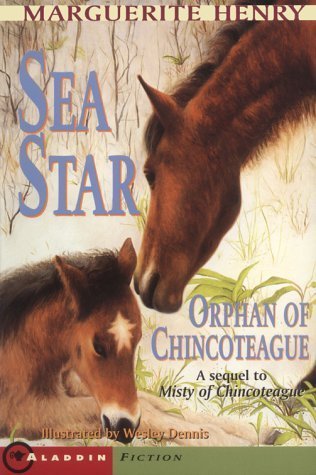
Sea Star: Orphan of Chincoteague – Marguerite Henry

Way to betray the entire premise of your original classic, Ms. Henry.

https://i.gr-assets.com/images/S/compressed.photo.goodreads.com/books/1452289973l/1351766.jpgTitle: Sea Star: Orphan of Chincoteague
Author: Marguerite Henry
Illustrator: Wesley Dennis
Original Publication Date: 1949
Edition: Aladdin Paperbacks (1991), 172 pages
Genre: Animal Stories.
Ages: 8-11
First Line: Paul was separating each silver hair in Misty’s tail.

I’ll begin with a quote from Misty of Chincoteague to explain my frustration with this book: Now when a buyer came to look at the colts, Maureen did not run to her room as she used to do, pressing her face in the feather bed to stifle her sobs. Nor did Paul swing up on one of Grandpa’s ponies and gallop down the hard point of land to keep from crying. Now they actually led the colts out to the buyers to show how gentle they were. They even helped load them onto waiting trucks. All the while they kept thinking that soon they would have a pony of their own, never to be sold. Not for any price.

Well, that didn’t age well.

It’s a bright July day when a silver airplane lands at Pony Ranch. Movie men have come to film the annual Pony Penning, and they want to purchase Misty for the film and subsequent tour. Paul and Maureen are guilt-tripped into selling Misty in order to put their uncle through college, and are afterwards thankful to discover an orphaned colt on Assateague. Little Sea Star helps to distract them from their loss but the colt is frail and refuses to eat – it’s up to the whole Beebe family to find some way to save the poor thing.

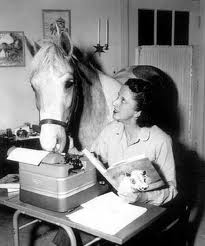
https://missmollys-inn.com/wp-content/uploads//2012/12/Marguerite-Henry-misty-of-chincoteague.jpeg
Marguerite and Misty.

Marguerite Henry had no plans to write a sequel to Misty of Chincoteague – having taken great liberties with the true story, she thought it stood well enough on its own, at least until she heard about little Sea Star. In this follow-up novel she tried to bring the plot more in line with reality. The real Misty had actually been sold to Marguerite Henry herself, and she did bring Misty to book signings to delight children. One important difference is that the real Misty was purchased before she’d even been weaned – while Clarence Beebe had not been planning to sell her, the little foal was not a beloved family pet, hard won from the wilds of Assateague and saved up for over a hard summer’s work by the Beebe children. Misty of Chincoteague was pure poetic license, delivered in gratitude to the Beebes for agreeing to sell such a wonderful pony. The characters by the end of the book were in a different place than they’d ever been in the real world, so the follow-up act of selling Misty was impossible to replicate naturally – instead, Marguerite Henry had to devote a portion of Sea Star‘s dialogue to a series of justifications for the decision. Unfortunately, none of them are very convincing.

Now it’s worth pointing out that the novel’s dialogues are only the connective tissue between the A and B plots. With the exception of the scene where Misty is crated for the plane trip, all of the horse material is entertaining for kids – the first half details the excitement of Pony Penning Day and the last third is all about saving Sea Star. Any child who loved Misty will easily pick this sequel out in a bookstore and they will probably like most of it – while it was my least favorite of the original trilogy as a kid, I still read it multiple times. Children might not agree with the decision to sell Misty, but it’s not likely to be a total deal-breaker and they certainly aren’t going to care about the mathematics of commerce or possible communistic overtones. That being said…

So the two men from New York arrive and, upon learning that the Beebe grandparents are both out, immediately start horse-trading with the kids. First they offer the tempting good news – a movie! how exciting! – and afterwards explain that they’d have to purchase Misty to make the film happen. They also want to take her to schools, libraries and movie theaters, and start guilting Paul and Maureen:

Mr. Van Meter said, “We had a feeling you might want to share Misty with boys and girls everywhere.”
“Boys and girls who have never seen a real pony,” Mr. Jacobs continued.
It was Mr. Van Meter’s turn now. “Sometimes when I hear children in New York talk about Misty, it seems she no longer belongs to a boy and girl on an island, but to boys and girls everywhere.”
The words kept flying, back and forth, higher and higher. “Misty has grown bigger than you know,” Mr. Jacobs said. “She isn’t just a pony. She’s a heroine in a book!”

Apart from the interesting metafictional element going on here (Misty of Chincoteague is a book within the sequel to the book) this is some appalling behaviour by two grown men, and Grandpa Beebe is rightly disgusted on his return. Also, no, Misty does not “belong” to all children everywhere, the book does. But the kids fall in line and even parrot some of this back at Grandma to shore up their decision to sell. “When they told how much Misty meant to poor little city children,” says Maureen. Well, as a former “poor little city child” who dreamt of riding lessons which my parents could never afford, I would not have wanted a girl in the countryside to give up her pony so that I could spend five minutes petting it. Not to mention the cold business decision to make thousands of children momentarily happy at the expense of making two extremely sad. As Grandpa says, “livin’ out here on this lonely marshland, why, Misty’s the nighest to a friend these childern got.” Are they undeserving of the pony they worked so hard for, just because she’s famous now?

Misty sold
Wesley Dennis does a great job with a sad scene.

The picture men’s arguments fail to entirely sway the family and Grandpa gladly sends them packing. However, shortly afterwards Grandma Beebe shows up with the woeful news that Clarence Lee, Paul and Maureen’s young uncle, can’t afford the college tuition of 300 dollars to study for the ministry. The children must now nobly sacrifice their beloved pony for the greater good of the family… No, hang on, that argument is also flawed.

First of all, it hinges on a character we never get to meet. Saintly Clarence Lee does not feature in a single scene in any of the three Misty books, so it is very difficult to care about his hopes and dreams. This is a failure in terms of dramatic impact, but it would still be an understandable decision for the characters in an era when college could have a great positive impact on an entire family’s prospects – until you do the math and realise that Grandpa Beebe is being taken for a fool.

The movie men explain that their company was young and struggling and could afford to pay only two hundred and fifty dollars for Misty. So she’s a famous pony and they’re trying to get her on the cheap. Grandpa agrees to this arrangement because, after a sale he was making fell through, he’s only got 50 dollars to his name. Combined, that makes up the entire tuition fee in one fell swoop. Problem is, the deal Grandpa had lost involved selling a “whole flock” of ponies – the buyer he had lined up decided to buy used trucks instead. So Grandpa has a “whole flock” of unsold ponies, and the going rate of wild ponies back in Misty of Chincoteague was 100 dollars. In that novel it was also made clear that gentled ponies could be sold for higher price. They’re sitting on a number of ponies that could easily turn a profit and instead they sell their famous Misty for beneath her value? How has Pony Ranch stayed in business?

Also, since when is college a one-time deal? Why can’t Clarence Lee wait a year and reapply? Grandma even says he’s recovering from pneumonia, which is why he can’t be expected to earn the money for himself. If he’s that physically frail, maybe it’s not the best time to embark on a grueling course of study? Selling out a beloved family pet to be hauled from place to place (which is bound to be stressful for a pony who has never traveled before), and giving her into the care of people who see a financial meal ticket decades before the film industry enforced an animal welfare code, all because college is worth any price? This has not aged well. Attempts to parallel them putting Misty in a sale crate with Paul releasing the Phantom back into the wilds also miss the mark because the Phantom was not happy at Pony Ranch while Misty clearly is.

happy misty
Behold happy Misty.

And so Misty is sold. They don’t even write up a formal contract, just a vague promise that Misty will be sent home after the tour is over. Luckily, Henry was inspired to write a third book in the series in the 1960s, assuring new generations of children that Misty did indeed come back to Paul and Maureen – unless those children got the Aladdin Horseshoe Library box set, which went ahead and listed the books in the wrong order so that Sea Star appeared to be the conclusion to the series after all.

https://d20eq91zdmkqd.cloudfront.net/assets/images/book/large/9780/6897/9780689716249.jpg
No, I’m not bitter.
Sea Star rescued, wesley dennis
Sea Star rescued.

Within hours of Misty’s departure, Paul and Maureen find little Sea Star in a cove on Assateague, and the whole family is delighted and relieved. Once this plot is finally under way, the novel does a 180 and becomes classic Marguerite Henry – the story of an orphaned colt wasting away in sorrow, and of an injured mare pining for her own lost foal and how they are brought together to grow strong and heal the sorrows of an entire family with the help of a lot of myrtle leaves. Sea Star, with his toothpick legs and wondering expression, is adorable and Wesley Dennis’s illustrations are a wonderful accompaniment once more. There are no dubious motivations amongst the native Chincoteaguers – nope, real salt of the earth types one and all. Scrumptious food descriptions are back and there’s even some humour. The first half of the book is all but forgotten, and yet…

I don’t like giving a negative review of a Marguerite Henry book. However, since Misty worked perfectly well as a standalone, I have to say that Henry’s first instinct was right. I will say in its favour that, while I can nitpick its value system, Sea Star would actually make a tremendous vehicle for discussion with even a young child and the writing remains on the same strong read-aloud level of Misty. It’s not essential, but as I said at the start, children will still enjoy the majority of the story.

See Also: Misty of Chincoteague.

Parental Guide, with mild spoilers.

Violence: Sea Star is found beside his mother’s body, but that is hardly described. Both Sea Star and the injured mare are implied to be well on the road to recovery by the end of the book.

Values: College is worth any price. If you love something, let it go. Share your greatest treasure with the impoverished world. Love is a healing force that helps us overcome our sorrows.

Role Models: Obviously the whole plot is meant to make the Beebes look virtuous and self-sacrificing, and it’s obvious what I think about that.

Educational Properties: If it’s used as a read aloud, it could spark some strong feelings and interesting discussion. Always a good thing.

End of Guide.

I’m now halfway through the series, with one more sequel and a final spinoff volume to go.

Up Next: Back to the Anne novels.

Flower Fairies of the Spring – Cicely Mary Barker

Given that the Flower Fairy books are A: standalone, B: poetry and C: have no plot between them, I will be reviewing this series in whatever order and at whatever speed I am able to acquire them. Nothing like a dream of spring in the depths of winter…

https://i.gr-assets.com/images/S/compressed.photo.goodreads.com/books/1309213072l/245680.jpgTitle: Flower Fairies of the Spring
Author: Cicely Mary Barker (1895-1973)
Illustrator: Cicely Mary Barker
Original Publication Date: 1923
Edition: Frederick Warne (2002), 42 pages
Genre: Poetry. Fantasy.
Ages: 3-8
First Line: The World is very old;
But year by year
It groweth new again
When buds appear.

Nursery rhymes are a tremendous learning tool for small children, conveying obvious skills such as memorization and predictive language, along with the specialized knowledge of how to read poetry in the first place – something of a lost art among today’s schoolchildren. Articles about the declining interest in poetry and what to do about it are a dime a dozen, and librarians are forever extolling the virtues of the trendiest middle-grade novels in verse, when the simplest remedy would be to avoid letting a child’s natural proficiency and enthusiasm for Mother Goose atrophy in the first place, via a fairly straightforward progression of English poets.

By providing the natural stepping-stones of Milne, Lear, Kipling and Stevenson, a gradual link would then be made to the classic narrative verse of Browning’s ‘Pied Piper of Hamelin,’ Rossetti’s ‘Goblin Market‘ and Tennyson’s ‘The Lady of Shalott,’ which are themselves not so far removed from romantics like Coleridge and Keats (and once a young person can read those poets, they would be able to progress both forwards and backwards in time from there with no real difficulty). Aside from the Classical Christian website, I couldn’t find a single educator advising this obvious curriculum to get kids reading poetry, probably because it would be way too white for today’s classrooms – thus they deny heritage to some children while offering mediocrity to all. In fact, educators love these new novels in verse specifically because the word count is lower and therefore they can be used to encourage “reluctant readers.” Now picture someone saying that Paradise Lost is simpler than Moll Flanders or that The Waste Land is an easier read for students than The Great Gatsby and you can imagine how topsy-turvy this whole educational trend really is.

https://thewesterncornerofthecastle.home.blog/wp-content/uploads/2019/12/52f10-05windflower.jpg
The Windflower Fairy.

This leads me to the Flower Fairy books of Cicely Mary Barker, which could easily fit on a young child’s poetry curriculum. Barker was an artistic invalid who took correspondence courses to become a painter while her older sister supported the family by opening a kindergarten in their house. Taking inspiration from Kate Greenaway and the Pre-Raphaelites, Barker began a series of children’s poetry books, most famously on the subject of fairies. Fairies were all the rage in the 1920s, enjoying heightened publicity thanks in part to the Cottingley Fairy photographs – and of course the Pre-Raphaelites hadn’t been immune to the lure of fairies either, which made it a natural subject for a book of botanical children’s poems. Queen Mary herself admired the results. At some point I will find a complete set of the little books, but for now this first one will have to suffice.


Every open page of this pocket-sized book contains a portrait of a fairy child with the flower he or she represents and on the facing page an ode to the flower in question. Her fairies were modeled by interested children from the household kindergarten, giving each character an individual appearance which combine over the book into a harmonious image of the English schoolchild of the 1920s. They are bright and happy, yet shy. They are impudent and proud and pleasant. They are beautiful, they are the generation who would grow up to endure the Second World War, and they are captured here fancifully and forever.

https://www.bing.com/th?id=OIP.A29LuxycpoD6TG5w_0VL8AHaLa&pid=Api&rs=1
The Dandelion Fairy.

Each costume for the fairies was based around the flower to be illustrated, which Barker would faithfully paint from real specimens. The costumes were where true flights of fancy would occur, and Barker created physical costumes and wing miniatures to paint, drawn from the different parts of the plant with rewarding detail. As an American, the flower I was most familiar with in this book was the dauntless dandelion and so it was his costume I most closely examined, discovering botanical inspiration from cuffs to shoes to the very shades of green and gold. Every portrait has this level of care, and the result really does have the feel of Pre-Raphaelites for toddlers.


Barker’s artwork is only half the volume, and the accompanying poems are every bit as enjoyable, particularly for parents who are big fans of Victorian poets. I could read this book aloud dozens of times and the poems would only become more engaging due to their mellifluous and leisurely rhythm. This is a book that rewards repetition.

https://www.bing.com/th/id/OIP.V2EcwpaQ-aaJhRwq0VgdDQHaLS?pid=Api&rs=1
The Daffodil Fairy.

I’m everyone’s darling; the blackbird and
    starling
Are shouting about me from blossoming
    boughs;
For I, the Lent Lily, the Daffy-down-dilly,
Have heard through the country the call to
    arouse.
The orchards are ringing with voices
    a-singing
The praise of my petticoat, praise of my
    gown;
The children are playing, and hark! they are
    saying
That Daffy-down-dilly is come up to town!


This collection is best suited for nature-oriented families, those with English gardens or wildflowers of their own to hunt and observe, for the poems are not narrative, meaning Barker will always be more niche than someone like Beatrix Potter. Nevertheless, these pages cover a variety of imaginative ground, some simply descriptive of the flowers themselves while others take to their viewpoint, like that of the cheerful daffodil. ‘The Song of the Lords-and-Ladies Fairy’ ends with a fierce warning likely to stick in its young audience’s mind and keep them from getting poisoned:
And my berries are a glory in September.
(BUT BEWARE!)

Meanwhile the Willow-Catkin admonishes:

To keep a Holy Feast, they say,
They take my pretty boughs away.
I should be glad– I should not mind–
If only people weren’t unkind.

Oh, you may pick a piece, you may
(So dear and silky, soft and grey);
But if you’re rough and greedy, why
You’ll make the little fairies cry.

There’s star imagery in the Windflower Song, there’s a little Mother Goose to Sing a song of Larch trees and the shortest poem in the lot is the humble ode to the Lesser Celandine. Over it all hang the twin centerpiece of the King and Queen of Spring, who are unfortunately not placed side by side in the middle of the book as they should be by rights. The Primrose has a simple charm and grace while the Bluebell (Wild Hyacinth in this case, not Scottish Harebell) is proud and superb.

https://i.pinimg.com/originals/ae/f8/55/aef8556c9c149bfe6be2ed6bb6947708.jpg
The Bluebell Fairy.

My hundred thousand bells of blue,
    The splendour of the Spring,
They carpet all the woods anew
With royalty of sapphire hue;
The Primrose is the Queen, ’tis true.
    But surely I am King!
            Ah yes,
    The peerless Woodland King!


Loud, loud the thrushes sing their song;
    The bluebell woods are wide;
My stems are tall and straight and strong;
From ugly streets the children throng,
They gather armfuls, great and long,
    Then home they troop in pride–
             Ah yes,
    With laughter and with pride!

https://i.pinimg.com/originals/3b/5b/6f/3b5b6f3b615843f9645c70f0e0933333.jpgOut of curiosity I made a list of the poems to see how often the rhyme schemes and templates repeated, to find that there were no exact replicas. When Barker reused a rhyme scheme she would change the number of stanzas, ensuring that every rhyme had its own face. I expect some repetitiveness would start to appear in the seven companion volumes but for now everything is very fresh, and in truth I would be very surprised if the artistic quality of subsequent installments ever dropped. Highly recommended to all English and Anglophile families.

Parental Guide, with no spoilers for once.

Violence: Completely inapplicable.

Values: English country flowers, landscape, children and folkways. Pre-Raphaelite influences.

Role Models: The children depicted are idealized, which is one of the chief purposes of art that has now been forgotten – to inspire.

Educational Properties: Memorization, recitation and elocution. Use for inspiration to plant and tend an English garden or to take a nature walk (in the right parts of the world) to hunt for the flowers – I’ve seen a number of them here in New England. Families who make their own doll costumes or other textile or artistic crafts might want a copy even if they hate poetry.

End of Guide.

I hope to acquire a complete set of the Flower Fairy books sometime soon, at which point I will make a full review series. I’m very happy to have stumbled upon this English gem I missed in my Anglophile childhood.

Up Next: Staying British with Enid Blyton.

Misty of Chincoteague – Marguerite Henry

Remember when you could buy a pony for 100 dollars? Me neither.

Related imageTitle: Misty of Chincoteague (Misty #1)
Author: Marguerite Henry (1902-1997)
Illustrator: Wesley Dennis (1903-1966)
Original Publication Date: 1947
Edition: Aladdin Paperbacks (1991), 174 pages
Genre: Animal Stories. Adventure.
Ages: 5-11
First Line: A wild, ringing neigh shrilled up from the hold of the Spanish galleon.

Paul and Maureen Beebe are growing up on their grandparent’s horse farm in the isolated commuity of Chincoteague Island. Tired of bonding with colts that always get sold, the siblings set out to earn 100 dollars to spend at the annual Pony Penning Day, when the wild herds on Assateague Island are rounded up and the colts auctioned. Paul and Maureen have their hearts set on an elusive mare called the Phantom, who has avoided capture two years in a row. Faced with the challenges of earning enough money, capturing and gentling her, an added complication is thrown into the mix when Pony Penning Day arrives and reveals that this year the Phantom has a colt of her own…

The Newbery list is certainly hit-and-miss but (with a few notable exceptions like The Phantom Tollbooth and Little House on the Prairie) they have historically been quite good at recognising children’s classics when they appear on the American stage and that’s exactly what the 1948 Honor Book Misty of Chincoteague is. A horse story that can appeal to a broad age range, full of action and purpose as the protagonists dedicate themselves to a series of goals, yet devoid of the emotional punches that are found in other famous horse books like Black Beauty. The ending is memorable and wistful, but without tragedy, and the story as a whole is sunny, lacking any villains beyond circumstances that must be overcome. With Paul and Maureen sharing viewpoints, it even has equal appeal to boys as well as girls, something that has become unusual in the genre.

Wesley Dennis
Paul heading off to work.

Marguerite Henry instills her book with a strong sense of place right from the start, not only with the wild herds on Assateague but also the fishing community of Chincoteague, whose independence forms a parallel to the ponies, for these men and women are also making do with less, cut off from the larger nation yet thriving. There’s a real American ethos within the book and it captures a place in time with its own culture and cuisine (there’s a small pile of food descriptions with oysters, cornbread, clam fritters, dumplings and wild blackberry jam). Henry spent a great deal of time on Chincoteague, and even though she changed the larger “true story” drastically, I have no reason to distrust her eye for detail, which even renders the old-timers’ accent through Grandpa and Grandma Beebe:

Maureen: “…if you came here to Pony Ranch to buy a colt, would you choose one that was gentled or would you choose a wild one?”
Grandpa chuckled. “Can’t you jes’ see yer Grandma crow-hoppin’ along on a wild colt!”
“Thar’s yer answer,” laughed Grandma, as she cut golden squares of cornbread. “I’d take the mannerly colt.”

The real draw are the horses, of course, and Henry supplies two perfect equine characters in the Phantom and Misty. The Phantom has a map of the United States on her withers – a clear cut case of symbolism in a patriotic novel. “Lad,” [Grandpa] said, “the Phantom don’t wear that white map on her withers for nothing. It stands for Liberty, and ain’t no human being going to take her liberty away from her. … The Phantom ain’t a hoss. She ain’t even a lady. She’s just a piece of wind and sky.”

https://78.media.tumblr.com/a995b367ed67762425a704e360e5c91e/tumblr_oigdbozsVX1tedwcmo7_500.jpg
Paul’s first glimpse of the Phantom and Misty.

The only thing that really tames the Phantom is her “colt” (islanders in this book refer to every young horse as a colt, which I thought only referred to males), whom Paul names Misty. Misty drives none of the plot – she is the counterweight to the Phantom’s wildness, playful and domestic by nature, belonging to Chincoteague from the moment her hooves land on the shore. Slowly and dejectedly the wild ponies paraded through the main streets of Chincoteague. Only the Phantom’s colt seemed happy with her lot.

I would be remiss not to single out Wesley Dennis as a large part of Misty of Chncoteague‘s charm, as he always supplies the perfect image for every scene. The personalities of every character, horse and human, shine through and equal the best of Garth Williams’ work. Dennis draws comic characters without caricaturing and his equines emote without crossing the line and losing their realism. His dramatic talents also enhance the impact of what is a fairly short and low-stakes adventure tale, making the risks feel bigger and the triumphs sweeter. Nicely done.

https://thehaynesblog.files.wordpress.com/2015/08/il_fullxfull-291177439.jpg
Maureen surrounded by wild ponies – a brief line of text given epic treatment.

I have no complaints to make. Misty of Chincoteague was quite nearly as enjoyable today as it was when I was a child. It makes a lovely addition to the family bookshelf and would make a good read-aloud for high summer, maybe even for 4th of July week given how civic minded the story is. For more on the 1940s value system this is steeped in, check out the Parental Guide below.

Violence: The book opens with a Spanish shipwreck in which the original Assateague ponies, destined for the mines of Peru, successfully swim to shore. All hands perish in the storm, with Henry softening that blow by depicting the Captain as gold-hungry and indifferent to the ponies’ welfare. In the present day, there’s a high ratio of distressed ponies, due to their captivity on Pony Penning Day and the auction. None are injured or die.

Values: Hard work and responsibility as Paul and Maureen seize any type of summer employment they can find to earn money for the Phantom – and then do it all over again to pay for Misty. They have a whole series of chores round the Ranch and almost every time the grandparents are depicted they are in the middle of work, whether that be feeding chickens, preparing food, maintaining the horses or doing laundry.

Misty is very patriotic in tone – Pony Penning revenue goes toward maintaining the island’s fire department, school is “what me and Grandma pays taxes for,” every roundup man is well-known by his day job and the island is a well oiled machine with every man, woman and child doing their part to keep it running. The kids have a great deal of independence and are allowed their own goals and their own time to tell about them, but once Paul is picked for the roundup crew he is expected to obey his leader’s orders (and is promptly rewarded when following instructions leads him to the Phantom). There’s even material about fair play, as Paul and Maureen pull a wishbone to decide who gets to race the Phantom, and liberty, when Paul makes a hard decision about the Phantom’s future.

Role Models: Paul has a keen head for business but also a romantic streak, and he’s the one most attuned to the Phantom. Maureen is given less to do, which disappointed me growing up, and a friend of mine found several disparaging remarks (such as “Quit acting like a girl, Maureen!”) concerning as a parent. As such, I paid close attention to the topic and found the only source of the quotes to be Paul, which could easily be attributed to big brother posturing. Such occasional put-downs never stop him from treating her as an equal partner in their plan to buy and gentle the Phantom and the actual text never devalues Maureen’s (or Grandma Beebe’s) contributions. It’s certainly true that she doesn’t get any action scenes, but it’s also true that not everything has to be about girls. There are thousands of horse and pony books catering to the pre-teen girl demographic, books which I devoured indiscriminately and which rarely ever give equal time or weight to male characters – such that when I first read Misty I assumed that Maureen should naturally have a greater bond with the Phantom just because she was a girl. No one ever labels that a cause for concern, so a mix of recent and vintage horse books would balance out nicely.

https://upload.wikimedia.org/wikipedia/en/thumb/c/cf/Marguerite_Henry.jpg/220px-Marguerite_Henry.jpg
Marguerite Henry was owner of the real Misty.

Aside from that, not a lot to say. Every character is trustworthy and fair and probably most kids would wish they had grandparents like the Beebes. Oddly, Paul and Maureen’s parents are absent due to being in China (I guess Henry thought orphaning them would be too predictable).

Educational Properties: I would normally advise researching the true story behind the fiction, but in this case there is no historical sweep that would prove schoolworthy and Misty is meant for such young readers that there’s no point digging for disillusion here.

On the other hand, the wild ponies have been observed for decades, which offers quite a lot of information and data for a bit of natural science. Theories on how the ponies arrived on Assateague are also well worth researching. Those in nearby states might want to take a trip to the islands as well.

End of Guide.

I have copies of all three sequels to Misty, which I will be posting in the next few months. I can then embark on her larger bibliography, which consists mostly of other horse stories (one of which won the Newbery Medal), many of which were also illustrated by Wesley Dennis.

Up Next: A springtime poetry collection by Cicely Mary Barker.

The Cat Who Wished to Be a Man – Lloyd Alexander

A comic parable for kids who will likely grow up to read Terry Pratchett.

https://images-na.ssl-images-amazon.com/images/P/0440405807.01._SX450_SY635_SCLZZZZZZZ_.jpgTitle: The Cat Who Wished to Be a Man
Author: Lloyd Alexander
Original Publication Date: 1973
Edition: Dell Yearling (1992), 107 pages
Genre: Fantasy. Humour.
Ages: 9-12
First Line: “Please, master,” said the cat, “will you change me into a man?”

Lionel is an improbably nice cat whose master, the cynical wizard Magister Stephanus, gives him the gift of human speech. However, with this new trait Lionel begins to wonder what life is like as a man, and so Magister Stephanus reluctantly changes him into one – sending him to the nearby town of Brightford in hopes of curing the cat’s folly. Lionel’s journey is full of dangers and he encounters thieves, knaves and corruption in Brightford, but also generosity, courage and love. In the end Lionel must make a choice: does he wish to become an innocent feline once more, or remain human?

https://images.gr-assets.com/authors/1353430382p5/8924.jpg
Lloyd Alexander, top of his field and pleased about it.

In the ten years after publishing Time Cat, Lloyd Alexander became one of the premier children’s novelists of his era, winning a Newbery Honor, Newbery Medal and the National Book Award for three separate works. The Cat Who Wished to Be a Man finds him post magnum opus and probably looking to decompress – hence another cat-centric fantasy, this time set in a generic medieval time that probably required only five minutes of world-building. The characters sport Dickensian names like Pursewig, Tudbelly and Swaggart and to all appearances it’s a fairly simple little book, a comic trifle. However, it is an obviously more sophisticated affair than Time Cat, and shows a new mastery and conviction of the form.

I mentioned in my review of Time Cat that its prose was not quite polished enough to made a great readaloud, a criticism which is no longer the case. Alexander’s writing is sharper, wry and intelligent enough to place real demands on a young reader’s vocabulary and cultural understanding – helped in large part by the character of the endearing snake-oil salesman Dr. Tudbelly, whose commercial patter features a sizable amount of Latin, cod-Latin and medical misuse. Read widely or miss the jokes:

“Everything is more confusing on an empty stomach. Natura abhoret vacuo. I dislike having my breakfast interrupted. It produces palpitations of the jejunum.”
Opening a compartment of the Armamentarium, Dr. Tudbelly took out the leftovers he had salvaged from the inn: the remains of chicken and some bread crusts.
“Here,” he said cheerfully, offering half to Lionel. “You’d better have something. You look a little green around the gills.”
“Gills?” cried Lionel, clapping his hands to his neck. “Am I turning into a fish?”
“Only a manner of speaking,” Dr. Tudbelly said. “Eat, my boy. It’s the best way to ward off splenetic chilblains.”

Combining memorable characters with wide-ranging comedy and clever writing makes The Cat Who Wished to Be a Man an easy book to recommend. Lionel’s absolute innocence as he careens from one problem to the next like Candide for 10 year olds creates ample plot, both humourous and suspenseful, all in a novel that barely breaks 100 pages. Throughout the silly escapade Lionel finds that as he grows more human he begins to lose his catlike qualities such as the ability to land on his feet, threading a theme of lost innocence into the mix. Indeed, it is implied that Magister Stephanus is himself to blame for Lionel’s “fall,” for:

“Since when does a cat not feel like a cat?”
“Since you gave me human speech.”

https://dreamingandsleeping.com/wp-content/uploads/2018/04/Prometheus-Greek-God-Mythology-Symbolism-and-Facts.jpg
Alexander probably expected his audience to know about Prometheus before reading his stuff.

In some ways, Stephanus actually has more in common with science fiction doctors – tampering with the natural order of things like Moreau and Frankenstein – rather than the good wizard archetype who appears to restore order. There is also an odd variation on the Prometheus story, where the wizard regrets his interference in mankind’s evolution:

“When I first came here, the people of Brightford were tilling their soil with pointed sticks. I pitied them in those days. So I gave them a gift: all the secrets of metalworking. I taught them to forge iron for plows, rakes, and hoes.”
“They must have been glad for such tools.”
“Tools? They made swords and spears! There’s not one gift I gave them they didn’t turn inside out, upside down, and wrong side to. They were a feeble, sickly lot, so I taught them to use roots and herbs for medicines. They found a way to brew deadly poisons. I taught them to make mild wine; they distilled strong brandy! I taught them to raise cows and horses as helpful friends; they turned them into drudges. Selfish creatures! They care for nothing, not even each other. Love? They love only gold.”

https://i.imgflip.com/tcoht.jpg
The supreme self-satisfaction of the true cat.

Once Lionel arrives in Brightford, he finds himself taking sides in a conflict between young innkeeper Mistress Gillian and corrupt Mayor Pursewig, who seeks to put her out of business and take control of the inn’s revenue himself. Lionel makes a much better man than he ever did a cat, being appalled at Pursewig’s greed rather than bored and indifferent. Really Lionel should have gone home immediately upon realising how hard it was to get a bowl of milk in human form, and slept on a shelf the rest of the day. Instead, Lionel learns the finer points of humanity as the situation in Brightford goes from bad to worse. After a good samaritan intervenes on his behalf, Lionel said glumly to him:

“You’d have been better off if you hadn’t tried to do us a good turn.”
“I suppose I would,” replied Tolliver, with a grin. “Even so, I’d do the same again.”
Lionel looked at him in surprise. “Why, not even a cat would make the same mistake twice.”
“Well, now,”said Tolliver, “what may be true for a cat isn’t always true for a man. I might regret doing a wrong thing, but I’ll surely never be sorry for doing a right thing.”

Alexander grew in subtlety after Time Cat, and the morals are seeded through the narrative naturally rather than given grand summations. The ending is extremely pat but it still avoids insulting the intelligence, and the comedy runs quite a gamut (without dipping into vulgarity), from slapstick to rhetorical confusion, and with the added bonus of a Kafka shoutout:

“Silence!” cried Pursewig, rapping on the table. “I’ll judge the facts for myself.”
“They’re already noted down,” said Swaggart. “And the verdict. Guilty as charged.”
“Guilty?” exclaimed Lionel. “Of what?”
“That will be determined in due course,” replied Pursewig. “One thing sure: You’re guilty of something. Otherwise, you’d not be on trial in the first place.”

https://images-na.ssl-images-amazon.com/images/I/51xJ1eIABXL._SX329_BO1,204,203,200_.jpg
Does anyone remember this fabulous little trilogy?

This is a clever little book and it might give its young readership a taste for other clever books going forward – after all, it’s not so far from Alexander’s cats-eye view of humanity to Terry Pratchett’s musings from the nome perspective in Truckers. There’s more thoughtful material to be found here than in many modern fantasies of five times the length. Vintage wins again.

See Also: Time Cat, which is suitable to a slightly younger readership.

Parental Guide.

There’s a little romance between Lionel and Gillian. He learns what kissing is and, although they get off to a rocky start given that she thinks he’s a half-wit, they do end up in love. This subplot is integral to the book’s themes, so I can’t really fault it for being an improbable love story.

Violence: Lionel spends much time being threatened by crossbow, thumbscrew, drowning and a burning building – nothing is very detailed, though (what thumbscrews actually do isn’t described). Swaggart gets into some G rated harassment of Gillian, reminiscent of the old swashbuckler films. “Vixen! You’ll wish you’d sung me a sweeter tune!” Nobody dies or is seriously injured and the villains are quickly dispatched at the end, with Swaggart transformed into a skunk and Pursewig humiliated before the town and somehow demoted to dishwasher.

Values: Magister Stephanus condemns humanity as greedy, violent and self-serving at the start of the book, and Lionel is never able to prove him wrong. Instead, Lionel embraces the better nature of humanity and refuses the offer of returning to cat form. Indeed, the only way he could go back would be by forgetting everything that had happened, losing his memories to reclaim the unknowing Edenic state of the animals. Fairly theological for so small a tale.

Lionel accepts the world as it is, the good and the bad. Stephanus refuses to do the same (in the one plot thread that doesn’t end in a neat little bow) and remains a bitter and begrudging hermit, unconvinced to the end.

Role Models: Lionel is a brave, good-natured innocent, making for a nice hero who is comical yet both sympathetic and just. Gillian has inherited her father’s inn and has a good head for business, also holding her own against the “village gallants” by giving them a whack of her broom. The illustrious Dr. Tudbelly is quite generous with his time, ready to commit to Lionel’s cause or enact a little stone soup scamming for the benefit of Brightford. Even Stephanus, a powerful wizard, spends much of his day gardening and cooking rather than enchanting his house to run itself (as is stated to be well within his power).

Educational Properties: If you and your family are studying Latin, this might have some added use. Otherwise, just read, reference and discuss.

End of Guide.

At this point I am thoroughly charmed by Lloyd Alexander and look forward to my next acquisition of his, whatever it may be.

Up Next: A Newbery Honor Book by Marguerite Henry.

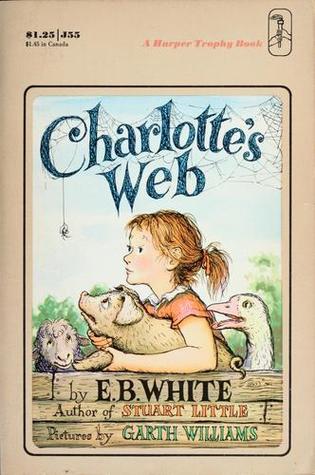
Anthropomorphic Fantasy: Charlotte’s Web

I never read Charlotte’s Web growing up and have vague memories of disliking the animated movie, but having read it at last I must conclude that it is in fact worthy of all the praise it has received.

https://i.gr-assets.com/images/S/compressed.photo.goodreads.com/books/1506253069l/11124601._SY475_.jpgTitle: Charlotte’s Web
Author: E.B. White (1899-1985)
Illustrator: Garth Williams (1912-1996)
Original Publication Date: 1952
Edition: Harper Trophy (1973), 184 pages
Genre: Anthropomorphic fantasy.
Ages: 5-8
First Sentence: “Where’s Papa going with that ax?” said Fern to her mother as they were setting the table for breakfast.

Wilbur the pig is born a runt, saved from an untimely death by the intervention of eight-year-old Fern Arable, who raises him on a bottle until he’s big enough to sell. He’s bought by her uncle Mr. Zuckerman, which is awfully nice at first since Fern visits him almost every day, but it soon turns out Mr. Zuckerman intends Wilbur for future dinners. Only the clever spider Charlotte can save Wilbur from his fate.

Charlotte’s Web won a 1953 Newbery Honor; it’s often considered the most grievous oversight of the Newbery committee that it lost to Secret of the Andes. Based purely on the writing I have to suspect that it should have carried the Newbery Medal that year, but I withhold further judgement until I actually read Secret of the Andes. E.B. White here far outstrips what he was doing in Stuart Little, with distinct voices for every animal on the farm, from pig to spider to rat to geese. He achieves a truly perfect level of repetition, enough to feel sonorous without impeding the actual flow of the story. The structure is episodic enough for good bedtime material but the actual plot is very tight, with natural rises and falls in the drama, and a final bittersweet triumph. It introduces children to the nature of death but also to rebirth and the regenerative cycle of seasons and progeny. It is, in short, a perfect read-aloud. You could adapt whole chapters into picture books and almost every line would be capable of sustaining a new image. From Chapter IV, Loneliness:

The next day was rainy and dark. Rain fell on the roof of the barn and dripped steadily from the eaves. Rain fell in the barnyard and ran in crooked courses down into the lane where thistles and pigweed grew. Rain spattered against Mrs. Zuckerman’s kitchen windows and came gushing out of the downspouts. Rain fell on the backs of the sheep as they grazed in the meadow. When the sheep tired of standing in the rain, they walked slowly up the lane and into the fold.

https://i.pinimg.com/236x/80/05/58/80055881f97eb2c6875f8c7fce73a4c8--garth-williams-charlottes-web.jpg
A haughty lamb refuses to talk to Wilbur, from Garth Williams’ illustrations.

The novel is gorgeously agrarian in focus without being sentimental. White understood farming and, aside from a strange bias against lambs in this book, is more than willing to address mother nature fairly. Charlotte may be the sweetest spider in all of literature, but she’s a bloodsucking predator and that’s not glossed over. While no direct parallel is ever made between her nature and that of humans, it’s definitely something I picked up on. Charlotte anaesthetizes her victims so they don’t feel pain; farm animals (until the advent of factory farming) would generally lead very comfortable lives and then be quickly killed. Charlotte’s nature brings death to other beings, but she has the gifts of intellect, artistry and compassion, and chooses to exercise them, saying “perhaps I was trying to lift up my life a trifle.”

Charlotte also becomes a mother figure for Wilbur, protecting and comforting him while also instilling some education on subjects big and small. She has a lovely vocabulary and is often explaining words to Wilbur; unlike Lemony Snicket, this never comes across as patronizing on the part of the author.

Wilbur walked into his yard just at that moment.
“What are you thinking about, Charlotte?” he asked.
“I was just thinking,” said the spider, “that people are very gullible.”
“What does ‘gullible’ mean?”
“Easy to fool,” said Charlotte.
“That’s a mercy,” replied Wilbur, and he lay down in the shade of his fence and went fast asleep.

https://www.thefamouspeople.com/profiles/images/e-b-white-4.jpg
E.B. White.

White takes every opportunity that he can to layer language and give his young audience as much raw material as he can without interrupting his story. He morphs into a thesaurus: The rat had no morals, no conscience, no scruples, no consideration, no decency, no milk of rodent kindness, no compunctions, no higher feeling, no friendliness, no anything. He adds a touch of math: Mr. Arable gave Fern two quarters and two dimes. He gave Avery five dimes and four nickels. Yes, they did name their son Avery Arable. He even introduces a little Latin to the small fry, as Charlotte says: “It is my egg sac, my magnum opus.” And in what I thought was the funniest part of the whole book, White transforms a verbal tic (his geese repeat words when they talk) into a spelling joke, with a bonus obscure medical condition of history thrown in:

Charlotte: “Does anybody here know how to spell ‘terrific’?”
“I think,” said the gander, “it’s tee double ee double rr double rr double eye double ff double eye double see see see see see.”
“What kind of an acrobat do you think I am?” said Charlotte in disgust. “I would have to have St. Vitus’s Dance to weave a word like that into my web.”

The language jokes work much better than the occasional slapstick sequence, but then I’m not a fan of slapstick. Aside from this minor flaw, Charlotte’s Web is quite perfect, in both writing and story. After my recent revisit with Stuart Little, I am pleased to find this book such a rich, well-rounded experience that fixes every problem that first novel contained. The characters are more memorable, the world-building is comparatively sane and White really threads the needle with his brand new addition of an actual ending: Wilbur and Charlotte earn thematically rich conclusions to their tale, but the final message of Stuart Little – that life is not tidy – is revisited rather than directly contradicted. For all Templeton’s importance to the rescue of Wilbur, White is scrupulously honest with his small readers about the nature of some people in the world and the rat never repents or has any change of heart, remaining exactly what he was introduced as – a bastion of greed, malice and self-interest – to the end.

https://spaceintext.files.wordpress.com/2010/12/templetons-egg-charlottes-web-page-46-illustration-1952-gm-williams.jpg
Templeton under the disapproving eyes of the local animals and Fern.

It should be obvious that this gets a very high recommendation from me and I’m very happy to see that this is one vintage children’s book that remains on everyone’s radar, secure from either focused attack or general amnesia at present.

Parental Guide. Spoilers ahoy for anyone who doesn’t know the ending.

Violence: Charlotte dies in the end, and it’s plainly telegraphed for several chapters beforehand. Kids who haven’t had any prior exposure to the subject of death in fiction might be as shocked as Wilbur is, but I think most could figure out what’s inevitable. It is still very moving at any age though. No one was with her when she died.

On a more cheerful note, I was impressed with the subtle comeuppance for Templeton’s selfishness. He refuses to help save Charlotte’s children until Wilbur bribes him with the promise of first go at the pig trough… forever. Wilbur keeps his promise and we last see Templeton eating his way to an early grave. Forever won’t be lasting too long in this case and Sun Tzu would be proud of this pig.

Values: Charlotte saves Wilbur through cleverness, the power of words – and knowing who to bribe to get things done around the farm.

https://i0.wp.com/api.ning.com/files/kV4MbYiv7oSxHFJWLwFCPCf6i9ZYGHMph46ms1kDgjKFn-an-4w%2AkvBeJWpLJY-Gpnz%2At2SgWFfx1sbjkUcp1VLT%2A-mX81Hx/1082054003.jpeg
Wilbur at the fair, humble to the last.

White chooses to focus on the unsung animals of the farmyard – pigs, spiders and rats – while the cute and cuddly lambs are proud and ill-mannered. Humans are by and large gullible and capricious. Fern saves Wilbur yet loses interest in him by the end of the book while her brother Avery, indifferent to animal welfare theretofore, takes over her vacated role during Wilbur’s hour of triumph at the fair.

Role Models: Readers tend to focus on Charlotte, and I’ve already covered her finer attributes. I would like to focus on Wilbur here. He’s a passive figure for much of the novel, friendly and happy to be directed by other characters. He remains humble despite being a figure of great interest but he’s easy to overlook and seemingly incapable of ever repaying Charlotte for saving his life – until the end, where he does actually save her, by saving her egg sac. They’re leaving the fair and the grounds will be deserted through the winter, making it crucial for Wilbur to think on his feet, and he does find a way to return her children to the farm. Once spring arrives, most of the baby spiders depart but three remain and carry on Charlotte’s lineage, and the generations continue to live comfortably in Zuckerman’s barn, hearing stories of their great ancestress – all owing to the humble pig Wilbur.

Educational Properties: Aside from the lingual elements, this category is not really applicable or necessary. Read it aloud and talk it over. Save the homework for other books.

End of Guide.

One more of E.B. White’s books to go, due in September and earnestly anticipated.

Up Next: Back to Tom Sawyer’s world with Huckleberry Finn and my first impressions of this towering giant of American literature are going to be a whole lot less favorable. Stay tuned.

Coming-of-Age Stories: Anne of Avonlea

A lovely follow-up to a great classic that stays true to the characters and doesn’t manufacture drama to keep their lives interesting – preferring to develop new characters for that purpose. Don’t miss it.

https://thewesterncornerofthecastle.home.blog/wp-content/uploads/2019/07/db407-anneofavonlea.jpgTitle: Anne of Avonlea (Anne Novels #2)
Author: L.M. Montgomery (1874-1942)
Original Publication Date: 1909
Edition: Bantam Books (1998), 276 pages
Genre: Coming-of-Age.
Ages: 10-16
First Line: A tall, slim girl, “half-past sixteen,” with serious gray eyes and hair which her friends called auburn, had sat down on the broad red sandstone doorstep of a Prince Edward Island farmhouse one ripe afternoon in August, firmly resolved to construe so many lines of Virgil.

The immediate success of Anne of Green Gables inspired L.M. Montgomery to the swift production of a sequel, published the following year, and taking up almost immediately where the previous installment ended. Anne Shirley, having given up on college to help Marilla, finds joy and purpose in her newly public role in Avonlea, both as the new schoolteacher and as head of the Avonlea Village Improvement Society. Two new orphans are brought to Green Gables, she befriends Avonlea’s most reclusive spinster and, still being Anne, gets into a new series of absurd predicaments as she matures and finds that her path not taken may yet meet up on the road ahead. Yet again, the pacing is episodic and I must warn you that readers holding out for the famed Anne/Gilbert romance will find L.M. Montgomery cruelly indifferent to their wishes, for that major subplot from volume one is almost wholly absent here.

Anne of Avonlea is a slow, comfortable book. Odd as it is to associate Anne of Green Gables with drama and uncertainty, in hindsight this was certainly the case. Anne as a newcomer was never wholly secure and questions, such as whether Marilla would let her stay or whether the Barrys would allow her and Diana to remain friends, gave the novel some stake. In the sequel Anne knows her place and has a teenager’s insufferable certainty of right and wrong. She takes up teaching with ease and she sails into whatever task is at hand full of fresh theories and ideals. This self-confidence becomes something of a plot point in itself, for in the first hundred pages Anne almost loses herself in her new calling as Avonlea’s saintly beautician.

https://i0.wp.com/digital.library.upenn.edu/women/garvin/poets/montgomery.gif
Lucy Maud Montgomery.

Luckily, Montgomery was not blind to her heroine’s foibles and set her a losing battle with human nature in her efforts to win over sullen student Anthony Pye with a simpering “kill him with kindness” approach. The resolution to their battle of wills could not be rendered today with our changed views on corporal punishment but the messy human dynamic is inspired, as Anne betrays her ideals in a fit of pique while the boy responds respectfully to a display of power – because that is what he understands and respects, not an artificial kindness. The next morning finds Anne heartily ashamed of herself, when she runs into Anthony, who to her bewilderment tips his hat and carries her books to school. Anthony walked on in silence to the school, but when Anne took her books she smiled down at him … not the stereotyped “kind” smile she had so persistently assumed for his benefit but a sudden outflashing of good comradeship. Anthony smiled … no, if the truth must be told, Anthony grinned back. A grin is not generally supposed to be a respectful thing; yet Anne suddenly felt that if she had not yet won Anthony’s liking, she had, somehow or other, won his respect.

Elsewhere, Marilla’s decision to adopt a local pair orphan leads to the saga of Davy and Dora, six year old twins who luckily don’t upstage Marilla – she is given plenty of opportunities to be her wonderfully pessimistic self, perhaps even more so than in the first volume owing to Anne having rendered her virtually shock-proof. With Anne despondent after a hoped-for guest fails to appear, Marilla’s response is perfectly in keeping: “You’ll probably have a good many more and worse disappointments than that before you get through life,” said Marilla, who honestly thought she was making a comforting speech. The twins provide fresh havoc for Green Gables as Marilla quickly discovers that a six year old boy is a wholly different creature from an eleven year old girl – Dora, a prim, quiet child, ends up being little heeded while Davy monopolizes the attention of the women, and they play favorites to an extent that actually made me feel bad for Dora.

“Marilla, it may be a dreadful thing to say, but honestly, I like Davy better than Dora, for all she’s so good.”
“I don’t know but that I do, myself,” confessed Marilla, “and it isn’t fair, for Dora isn’t a bit of trouble. There couldn’t be a better child and you’d hardly know she was in the house.”
“Dora is too good,” said Anne. “She’d behave just as well if there wasn’t a soul to tell her what to do. She was born already brought up, so she doesn’t need us; and I think,” concluded Anne, hitting on a very vital truth, “that we always love best the people who need us. Davy needs us badly.”

https://i0.wp.com/great-authors.albertarose.org/mark_twain/novels/the_adventures_of_tom_sawyer/images/01-019.jpg
Tom Sawyer stealing, could not discover the illustrator.

Later on, Davy does improve, though he always reads like a cross between Tom Sawyer and that blonde boy from The Family Circus. First he steals from the jam jar and then, after learning it’s wrong to steal jam, he claims that there will at least be plenty of jam in heaven by quoting the catechism. “Why should we love God? It says, ‘Because he makes preserves and redeems us.’ You either find him adorably funny or you don’t. I vacillated on the question of Davy but I have to admit his request for a bedtime story made me laugh:

“I don’t want a fairy story. They’re all right for girls, I s’pose, but I want something exciting … lots of killing and shooting in it, and a house on fire, and in’trusting things like that.
Fortunately for Anne, Marilla called out at this moment from her room.

https://i0.wp.com/www.victorianweb.org/art/illustration/brock/2.jpg
Miss Havisham and Estella, pen and ink illustration by H.M. Brock.

Otherwise, there are comedic interludes every bit as good as those found in the first volume, with the saga of Mr. Harrison’s cow particularly funny – and of course, no matter what calamities befall her, Anne always makes friends and mends fences. Even Avonlea’s answer to Miss Havisham, complete with a strange little girl always in tow, turns out to be sweet Miss Lavendar, an eccentric old dear who prefers to playact the life that passed her by than to groom little Charlotta the Fourth to avenge herself upon the male sex. After an episodic structure, Miss Lavendar’s story takes up much of the final third, and Montgomery delivers a much purer happy ending than she did in the previous volume.

There is an infectious warmth to her writing that is transmitted, however briefly, to the modern reader and renders the world brighter and more poetic for a time. Seen through Anne’s eyes, the mundane becomes wondrous. I remember the balm that Elizabeth Goudge brought me as a troubled 17 year old and the same traits are found in Montgomery’s world. Avonlea is too good to be true but it is a sustaining myth for the world that we have to live in, right at the age when children are beginning to realize what hardship that world entails. Anne has an instinctive sense for what is noble and good, even in the midst of the most frivolous debate:

“I think her parents gave her the only right and fitting name that could possibly be given her,” said Anne. “If they had been so blind as to name her Elizabeth or Nellie or Muriel she must have been called Lavendar just the same, I think. It’s so suggestive of sweetness and old-fashioned graces and ‘silk attire.’ Now, my name just smacks of bread and butter, patchwork and chores.”
“Oh, I don’t think so,” said Diana. “Anne seems to me real stately and like a queen. But I’d like Kerrenhappuch if it happened to be your name. I think people make their names nice or ugly just by what they are themselves. I can’t bear Josie or Gertie for names now but before I knew the Pye girls I thought them real pretty.”
“That’s a lovely idea, Diana,” said Anne enthusiastically. “Living so that you beautify your name, even if it wasn’t beautiful to begin with … making it stand in people’s thoughts for something so lovely and pleasant that they never think of it by itself. Thank you, Diana.”

See the source image
Job and his Daughters, 1825 engraving by English artist William Blake. The daughters are Jemima, Keziah and Kerrenhappuch.

Anne of Avonlea is a sweet and worthy sequel, growing its heroine and the landscape of Avonlea. It is lighter and more leisurely, yet the charms of the original remain and if you and your children loved Anne of Green Gables you needn’t fear disappointment here. Some children’s classics are followed by deeply inferior products but for her first sequel L.M. Montgomery had no need to manufacture scenarios, as Anne grows into her adopted community and approaches the bend in the road that will take her from girl to young woman with customary optimism. We can only follow after in similar spirit to volume three.

Parental Guide.

Violence: Anne whips and wins her most rebellious student. There’s a violent hailstorm with stones, the smallest of which was as big as a hen’s egg. A neighbour’s parrot dies during the storm and there’s a short scene of the man sitting sorrowfully by his lost companion.

Davy locks Dora in a neighbour’s tool shed for hours to give the women a scare and receives a pitifully slight punishment in response. Anne is actually far more upset that Davy lied about not knowing his sister’s whereabouts than she is that he locked her up to torment them all in the first place.

Values: Contentedness. None of that ‘Road Not Taken’ torment for Anne Shirley. She finds meaning in her relationships and her humble role as village schoolmistress, rather than constantly fretting over what could have been.

Anne and her friends fight staunchly to keep their town lovely, and while some efforts backfire, they do encourage a general move toward landscaping and keep the dread pharmaceutical advertisements off of their roads.

Disapproval is registered toward girls too obsessed with beaus – Anne and Diana fall out with a friend over her immodest and gloating behaviour. Anne, who is completely oblivious to love, is allowed to remain so, and people actually take care not to push the subject – even though most of Avonlea expects her to marry Gilbert Blythe when she does wise up. Mrs. Allan the minister’s wife stops short when about to prod Anne on the topic of Gilbert. In the delicate, whitebrowed face beside her, with its candid eyes and mobile features, there was still far more of the child than of the woman. Anne’s heart so far harbored only dreams of friendship and ambition, and Mrs. Allan did not wish to brush the bloom from her sweet unconsciousness. So she left her sentence for the future years to finish. Innocence respected, not trampled on from every angle.

Role Models: Anne remains a lovely example, of course, and as a completed young person there is less emphasis on her learning from others than before. Gilbert meanwhile decides to become a doctor: “The folks who lived before me have done so much for me that I want to show my gratitude by doing something for the folks who will live after me. It seems to me that is the only way a fellow can get square with his obligations to the race.”

Diana is a loyal friend. Anne is a red-hot Conservative, out of loyalty to Matthew’s memory and Diana’s father was a Liberal, for which reason she and Anne never discussed politics. In fact, all their differences in outlook and imagination do nothing to impede their loyalty to one another.

Educational Properties: Because Anne of Avonlea is a somewhat more prosaic work than the first, it would feels less like a killjoy for a parent to make use of it in exploring early 20th Century Canadian society of the science of storm systems. However, it still makes the most sense as sheer entertainment.

End of Guide.

I’ll be moving on to volume three, where Anne moves away to attend college, in a month or so. In the meantime…

Up Next: Getting started on the enormous bibliography of Lloyd Alexander with an early standalone novel.

Anthropomorphic Fantasy: Stuart Little

This classic holds the dubious distinction of being the first book I ever read that left me feeling cheated of a justly-deserved ending, and I suspect this milestone applies to a lot of other children as well. Yet in hindsight this might even be the thing I appreciate most about the book…

book stuart little coverTitle: Stuart Little
Author: E.B. White (1899-1985)
Illustrator: Garth Williams (1912-1996)
Original Publication Date: 1945
Edition: Scholastic Inc. (1987), 131 pages
Genre: Anthropomorphic fantasy.
Ages: 5-8
First Sentence: When Mrs. Frederick C. Little’s second son arrived, everybody noticed that he was not much bigger than a mouse.

Stuart Little is a mouse born into a human family, an unexpected event that the Littles (and the world) accept with enviable equanimity. Small as he is, any number of misadventures can befall Stuart around the house, but he, his parents and older brother George muddle through, until the arrival of the bird Margalo – a sweet-tempered creature that Stuart quickly falls for. Snowbell, the family cat, is not so pleased, and puts out a hit on the bird, courtesy of a femme fatale feline known only as the Angora (if you haven’t read this book, please be aware I am dramatizing a little here). Margalo gets wind of the plot and flees without saying goodbye to the Littles. Stuart, distraught, decides to head out after her.

book stuart faucet garth williams
Illustration by Garth Williams.

Stuart Little is like two books in one. The first half, consisting of Stuart’s home life, is as perfect a children’s tale as you’re likely to find, effortlessly appealing to the imaginations of those still young enough to be preoccupied with truly important matters – such as what it would be like to be about two inches tall and have to make your way across the house. The second half contains almost nothing which would appeal to the same child at the same age. Instead, Stuart leaves home without a goodbye, takes a job pontificating to a bunch of schoolchildren, gets a date with a human girl who’s just his size, makes a complete mess out of it and gets back on the road, still looking for his bird and without the slightest proof that he’ll ever find her. I find that the only way this complete collapse of momentum and humour makes any sense (and I have no proof of this theory) is if E.B. White took a break and, when he came back, decided to send-up The Great American Novel that a hundred Thomas Wolfe wannabes were busy flooding the market with. This is the only way that Stuart Little’s prosey travelogue of impractical politics and girl troubles can be explained to my satisfaction, anyway. Let me know your theory.

This might be a fatal flaw in a lesser novel, rendering it nothing but a historical curio, but Stuart Little has so much to offer in the first half that it remains a children’s classic to this day. What sets it apart from other mouse tales is White’s wonderful style, which is balanced perfectly between the simplicity that would allow a child to handle it on his own and a verve that makes it a comfortable read-aloud for a parent. White’s manner is warm, wry and elegant, even when the hero is in imminent danger of an undignified death:

One day when he was seven years old, Stuart was in the kitchen watching his mother make tapioca pudding. He was feeling hungry, and when Mrs. Little opened the door of the electric refrigerator to get something, Stuart slipped inside to see if he could find a piece of cheese. He supposed, of course, his mother had seen him, and when the door swung shut and he realized he was locked in, it surprised him greatly.
“Help!” he called. “It’s dark in here! It’s cold in this refrigerator. Help! Let me out! I’m getting colder by the minute.”
But his voice was not strong enough to penetrate the thick wall. In the darkness he stumbled and fell into a saucer of prunes. The juice was cold. Stuart shivered, and his teeth chattered together. It wasn’t until half an hour later that Mrs. Little again opened the door and found him standing on a butter plate, beating his arms together to try to keep warm, and blowing on his hands, and hopping up and down.

book stuart in fridge garth williams
Waiting for rescue.

Stuart is a dapper mouse, with a complete dignity of dress and manner that allows him to feel bigger than his ridiculous circumstances. His request for a “nip of brandy” at the close of the fridge episode cements him as yet another adult protagonist in a story for children. However, I do wonder if the weakness of the second half might not be due to an absence of the other Littles, a flustered chorus to his misadventures and a loving family – even if they never do have the sense to board up the mousehole in the pantry. An example of their interplay from when they mistakenly believe Stuart has gone down it:

George was in favor of ripping up the pantry floor. He ran and got his hammer, his screw driver, and an ice pick.
“I’ll have this old floor up in double-quick time,” he said, inserting his screw driver under the edge of the first board and giving a good vigorous pry.
“We will not rip up this floor till we have had a good search,” announced Mr. Little. “That’s final, George! You can put that hammer away where you got it.”
“Oh, all right,” said George. “I see that nobody in this house cares anything about Stuart but me.”
Mrs. Little began to cry. “My poor dear little son!” she said. “I know he’ll get wedged somewhere.”
“Just because you can’t travel comfortably in a mousehole doesn’t mean that it isn’t a perfectly suitable place for Stuart,” said Mr. Little. “Just don’t get yourself all worked up.”

book stuart little margalo garth williams
A pretty little bird.

All together, including Snowbell, the Littles are a treat. It’s a perfect tale – a little strange, but humanoid mice are a strange concept when you think of it – until Margalo arrives and Stuart falls in love with a bird. Maybe this entire plot is purely to facilitate a pun – a “bird” is a girl, therefore a girl is a bird. However, it starts to feel more and more made up as it goes along. Stuart is too small to carry actual coin, so how does he pay for gasoline? Why does he have to chop down a dandelion for greens, yet is able to travel around with a mouse-sized tin of ham? Also, even as a child, it made no sense that Stuart, going on foot, would be able to find Margalo. Supposing she comes back while he’s out looking for her? I figured the likeliest way they’d meet again is if Margalo heard he was missing, and went looking for him.

The whole second half has a melancholy air. Stuart wrecks his new toy automobile in a sad and improbable bit of slapstick. He’s the world’s most boring substitute teacher, talking about being “Chairman of the World,” claiming that “rats are underprivileged,” and coming up with impracticable laws against being mean (this is the longest chapter in the whole book and has no pertinence on anything else). Meanwhile, the sudden appearance of Thumbelina Miss Ames is just bizarre, and Stuart behaves terribly the whole time he’s with her. Stuart, if you’re lonely for companionship, maybe try locating New York’s mouse population, who probably left you as a changeling in a human hospital to start with (this was always my theory anyway).

https://media1.britannica.com/eb-media/58/99358-004-8DF1F962.jpg
Elwyn Brooks White in the office.

This isn’t to say that the second half of Stuart Little has nothing to offer. White’s writing is consistent, there’s a wealth of local colour regarding 1940s New York, Garth Williams was already a quintessential children’s book illustrator on his very first try, and the non-ending is strangely inspired – especially since E.B. White is a rare example of a children’s author who did not weaken and knock out an inferior sequel when strapped for cash. It just ends. It is a messy novel meant for an age group that collects “practice” books which emphasize rigorous, multi-volume predictability, a la The Boxcar Children series. It is highly recommendable and artistically excellent, even if it does have the inescapable sense of a failed experiment. Just make sure your son or daughter gets Charlotte’s Web first, because Stuart Little is not necessarily the best introduction to E.B. White. Indeed, despite revisiting this (okay, the first half) often enough while growing up, I never trusted White enough to read a second one.

Parental Guide. Stuart’s letter to Miss Ames raised my eyebrows as I read it for this project. Quite frankly, he’s every parents’ nightmare: …my purpose in writing this brief note is to suggest that we meet. I realize that your parents may object to the suddenness and directness of my proposal, as well as to my somewhat mouselike appearance, so I think probably it might be a good idea if you just didn’t mention the matter to them. What they don’t won’t hurt them. He does promise to leave this matter to her own good judgement, and I suppose looked at from the Ames’ point of view the whole “afternoon on the river” sequence is a G rated cautionary tale about going on blind dates with hirsute strangers from out-of-town but it still feels tremendously out of place. Of course, Thumbelina herself was also courted by several wildly inappropriate suitors before finding her fairy prince, so maybe that’s what White was actually referring to here.

book stuart and miss ames garth williams
Stuart and Miss Harriet Ames.

Violence: Stuart gets into several close shaves, among them getting swept into a garbage truck and nearly drowned in the ocean. Snowbell and the Angora both threaten to eat Margalo, and Stuart defends her with a bow and arrow one night in a very Arthurian way. He destroys his toy car, though it’s fixed up again good as new.

Values: Chief among the values displayed here is actually stoicism. When Stuart boasts or brags he gets into trouble, first with the windowshade and then Miss Ames. When he does something truly noble, such as winning the boat race or saving Margalo, he is far too modest to tell anyone and the feat passes by unsung.

The Littles invent all manner of aids to help Stuart get about and enjoy life, while the dentist tinkers with model boats and cars. Stuart enjoys being useful to others and always has proper attire for every possible occasion. E.B. White also briefly morphs into his Elements of Style self, and has Stuart-as-teacher say “a misspelled word is an abomination in the sight of everyone. I consider it a very fine thing to spell words correctly and I strongly urge every one of you to buy a Webster’s Collegiate Dictionary and consult it whenever you are in the slightest doubt.”

You could try to read Stuart Little as a metaphor for a handicapped or adopted child, but I would advise against this search for deeper meaning, as Stuart never really fits in, although his parents love him very much. Indeed, life with the Littles is portrayed as far more of a struggle than his subsequent independent voyage, of which he is a fairly successful navigator. He also leaves home without a word – so as far as families in classic children’s books go, this one is more on the dysfunctional side.

Role Models: Stuart actually regresses over the course of his story, from a gallant young mouse to a petulant one. I think White intended the Miss Ames date to demonstrate the problem of letting a perfect day dream interfere with having an imperfectly good day, but it’s the penultimate chapter and leaves Stuart on a very downcast and immature note.

https://www.nccil.org/img/assets/img/portraits/2323/Garth-Williams-Portrait_e0fc7258c45b5e0ad8ee7dfed878bd55.jpg
Garth Williams.

Everyone, even the devious cats, are fully likable characters and most of them strive to be helpful at some point or other.

Educational Properties: Plenty of thought exercises and physics lessons. Random questions like “why doesn’t the story end? What do you think happened next? If a toy car is driving, is it still a mile?” spring to mind.

End of Guide.

Expect my review of Charlotte’s Web in August and The Trumpet of the Swan in September. E.B. White is going to be the first author on the Western Corner of the Castle whose bibliography I will be completing and I have absolutely no idea what to expect after this one. What are your thoughts on Stuart Little?

Up Next: One of the 1945 Newbery Honor books, so we’re almost staying in the year.