Rilla of Ingleside – L.M. Montgomery

A textbook case in how one single character can nearly ruin an entire novel.

https://lh5.googleusercontent.com/proxy/Y0W4Eq-BljNFpxjAgohlU_J9U4GCFWrJA-1m8qNQpvOHX5y-s-Dkhy_InYS32Q8cYzLu6m_aXbvFIT0LWDPsV75lrWcPufY=w1200-h630-p-k-no-nu

Title: Rilla of Ingleside (Anne Novels #8)
Author: L.M. Montgomery (1874-1942)
Original Publication Date: 1921
Edition: Bantam Books (1998), 277 pages
Genre: Historical Fiction. Romance.
Ages: 12-16
First Line: It was a warm, golden-cloudy, lovable afternoon.

Anne’s youngest child Rilla is now fifteen and excited at the prospect of the fun teenage years ahead of her. She’s completely unaware that a far off Balkan conflict is about to turn into a world war. Yet soon enough she watches as all three of her brothers are taken overseas, joining the military alongside all the other boys she’s grown up with – including handsome Kenneth Ford, Leslie’s only son. Carefree Rilla comes of age in the midst of historical and personal tragedy, raising a neighbour’s orphaned war baby and waiting for those who will make it home…

There’s been a romantic timelessness to the Anne series, but that ends once and for all here. From our perspective, Rilla of Ingleside is historical fiction but of all the books it was the closest to its author’s own day while writing. It’s a living document of the Great War, only a couple of years removed. Beginning on page one with the news report of the assassination of Archduke Franz Ferdinand, it has a panoramic quality as the Blythes follow the news and wait – for four patient, endless years. Because of this, Rilla has a very different perspective on the war than that of following generations, and it’s not exactly pleasant.

However, before I get into that, Rilla deserves praise for its main character. Rilla is quite a different protagonist from Anne – giddy, shallow and making no apologies for it. Her older sisters are the ones following in Anne’s footsteps by going to college, while Rilla has no great plans beyond having a good time and getting married. Her ungifted ordinariness thus makes her a much better lead for a wartime story than an Anne-type heroine, because she is being tested constantly and she has to rise to the occasion. She has pluck but no one ever realised it before, while Anne always wore hers confidently on her sleeve.

The accompanying love story is also a very simple affair – a war is not the time for the painfully slow courtships Montgomery normally depicts. Rilla fancies Kenneth Ford straight away, in the most shallow, appearance-led manner possible, and the feeling is mutual – yet Montgomery is actually able to wrestle meaning, poignancy and commitment out of this relationship, notable when Ken’s last evening before shipping out is interrupted by Rilla’s war-baby:

Kenneth sat very still and silent, looking at Rilla–at the delicate, girlish silhouette of her, her long lashes, her dented lip, her adorable chin. In the dim moonlight, as she sat with her head bent a little over Jims, the lamplight glinting on her pearls until they glistened like a slender nimbus, he thought she looked exactly like the Madonna that hung over his mother’s desk at home. He carried that picture of her in his heart to the horror of the battlefields of France. He had had a strong fancy for Rilla Blythe ever since the night of the Four Winds dance; but it was when he saw her there, with little Jims in her arms, that he loved her and realized it. And all the while, poor Rilla was sitting, disappointed and humiliated, feeling that her last evening with Ken was spoiled and wondering why things always had to go so contrarily outside of books. She felt too absurd to try to talk. Evidently Ken was completely disgusted, too, since he was sitting there in such stony silence.

The figure of little Jims brings a needed note of levity into what is certainly the darkest of the series. The early scene where Rilla goes collecting for the red cross and brings home this orphaned baby in a soup tureen is undoubtedly the most Dickensian moment in the series, and one where Montgomery pulls no punches setting her tableau. Rilla walks in on a scene straight out of Oliver Twist:

Through the open door of the small bedroom opposite her, Rilla saw Mrs. Anderson lying on the untidy bed; and Mrs. Anderson was dead. There was no doubt of that; neither was there any doubt that the big, frowzy, red-headed, red-faced, over-fat woman sitting near the door-way, smoking a pipe quite comfortably, was very much alive. She rocked idly back and forth amid her surroundings of squalid disorder, and paid no attention whatever to the piercing wails proceeding from a cradle in the middle of the room.
Rilla knew the woman by sight and reputation. Her name was Mrs. Conover; she lived down at the fishing village; she was a great-aunt of Mrs. Anderson; and she drank as well as smoked. Her first impulse was to turn and flee. But that would not do. Perhaps this woman, repulsive as she was, needed help–though she certainly did not look as if she were worrying over the lack of it.
“Come in,” said Mrs. Conover, removing her pipe and staring at Rilla with little, rat-like eyes.

https://www.virago.co.uk/wp-content/uploads/2019/01/hbg-title-9780349004501-9.jpg?fit=422%2C675

Rilla, who knows nothing about infants and has no liking for them, is left petrified that her little war-baby will expire and yet is resentfully determined to do her part. She would look after this detestable little animal if it killed her. This creates a handy yardstick to measure Rilla’s personal growth, as she diligently looks after Jims, giving over from resentment to pride as she slowly forms a bond with the boy.

Unfortunately, Rilla was just about the only thing I really liked in this book. Once again Montgomery ignores her sizable cast of characters built up over the series, cherrypicking a favored few to revisit – and one of them is Susan the housekeeper, a previously minor character who is now featured in almost every chapter. Her role is simple: Zealously follow the news, swallow every bit of war propaganda and maintain a steady stream of invective under pretense of “keeping spirits up.” Sometimes she makes Anne cry. Unforgivable. She hates the German (of course), but tries not to leave anyone out. “The Germans would never have got back Passchendaele if the Canadians had been left there; and it was bad business trusting to those Portuguese at the Lys River.” She hates Woodrow Wilson with deathless passion for staying out the war, but turns on a dime once he joins in and becomes a blind supporter of his every utterance. She frets if baby Jims has “pro-German” blood and even thinks the Blythes’ cat is pro-German.

At first I had hopes that she was a figure of satire – the most vociferous supporter of the war a childless old woman, baying for blood from the safety of her Canadian kitchen – but it is made very clear that she is meant to be admired for her unwavering patriotism. She was one of the women–courageous, unquailing, patient, heroic–who had made victory possible. In her, they all saluted the symbol for which their dearest had fought.

Meanwhile, there’s only one pacifist character and he is hated by the entire cast (and the author), such that whenever some indignity or misfortune befalls him the narrative halts so everyone can cheer. As the war drags on, the most moving material is given to Anne and Gilbert, watching their sons sign up and their daughters be robbed of youth, after having taken such care to give their six children the same opportunities and joys which they had experienced in peacetime. Yet these two beloved characters are kept almost entirely out of the way in favour of their housekeeper’s dozenth “kill the krauts!” rant.

Maybe Montgomery found it too painful to focus on the parents (the Blythes, Merediths, Fords and Wrights) whose children are taken, or are returned to them aged and injured. Later generations of writers could tell these stories from a distance, but I don’t think Montgomery felt capable of it. And this, this is what makes Rilla of Ingleside so heartbreaking to read. It’s a novel that shows us its author grasping at straws to justify what she and the world had just been through, holding on to hope that the old world had been destroyed so that something better could be built on the rubble. She has one soldier say in a letter home to take courage, for there will be a day “when the ‘red rain’ of Langemarck and Verdun shall have brought forth a golden harvest–not in a year or two, as some foolishly think, but a generation later, when the seed sown now shall have had time to germinate and grow.”

A generation later there was another world war.

Being completely honest, I found this book quite a bitter experience. It came so close to being among my favorites in the series – the cinematic sweep and Rilla’s character growth was so entertaining and moving, but between the war propaganda, several ghastly scenes (see the Violence category) and the existence of Susan my overall response was anger and sorrow. Not really what I’m looking for in a sequel to Anne of Green Gables…

And so it’s farewell to the Blythes and a long break from L.M. Montgomery. I still find it easy to recommend the full series to interested parties – uneven it may be, but even the weakest volumes have some standout material.

Parental Guide.

Violence: The pacifist character suffers a paralytic stroke on Armistice Day, which Susan takes as divine judgement and practically dances a jig for. One of Rilla’s brothers doesn’t make it.

However, the most ghastly moment in the entire series comes when the minister’s little boy relapses into pagan blood sacrifice to try and get the Blythes’ MIA son to return home. He takes his beloved kitten out and drowns him. “I thought if I sacrificed Stripey God would send [the Blythes’ son] back.” His parents don’t address his disturbing beliefs, Rilla finds his gesture “splendid–and sad–and beautiful,” and as he gets his wish I shudder to think what he’ll be “sacrificing” next year.

Values: The nobility of sacrifice. Patriotism, war fever, hatred of Germans and pacifists. Faith in the modern experiment.

Role Models: Everyone except for the pacifist and a female rival of Rilla’s are clearly intended for admiration.

Educational Properties: A wealth of immediate material which could be utilized alongside more recent information to gain both the long and short view of the war.

End of Guide.

Expect one last post on the subject of the Anne books sometime next week. Only five reviews remain to post.
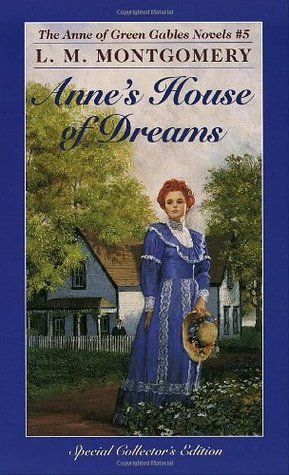
Anne’s House of Dreams – L.M. Montgomery

Even though Anne has apparently forgotten how to dress thanks to one of the worst covers in the whole series, this is definitely my favorite of the sequels thus far.

https://images.gr-assets.com/books/1442471048l/77394.jpgTitle: Anne’s House of Dreams (Anne Novels #5)
Author: L.M. Montgomery (1874-1942)
Original Publication Date: 1917
Edition: Bantam Books (1998), 227 pages
Genre: Sentimental Fiction. Romance.
Ages: 12-17
First Line: “Thanks be, I’m done with geometry, learning or teaching it,” said Anne Shirley, a trifle vindictively, as she thumped a somewhat battered volume of Euclid into a big chest of books, banged the lid in triumph, and sat down upon it, looking at Diana Wright across the Green Gables garret, with gray eyes that were like a morning sky.

Anne is married at last and is moving to a dear little cottage at Four Winds Harbor, where her charmed life will be marred by tragedy. Our beloved heroine must face up to the difficulties of life when she meets her neighbor Leslie Moore, who is trapped in a marriage from which Anne’s customary meddling has no hope of freeing her – but she also forms some of her closest and most genuine friendships in this isolated place.

https://i.pinimg.com/236x/73/90/fb/7390fb8a4a1b5ce428be639846aa19f9.jpg
This publisher commissioned a better idea.

After a series of opening chapters detailing Anne’s longed-for Green Gables wedding in all of its dreamy perfection, the sentimental guff Anne fans are accustomed to is jettisoned to make way for Montgomery’s darkest work yet. Written during the First World War, Anne’s House of Dreams is remarkably somber, thoughtful and honest. It utilizes a smaller cast of characters (mostly Anne, Gilbert and their three nearest neighbors) and develops them beyond the usual comedic figures that have featured in other stories of Anne as an adult.

The cast we meet upon Anne’s arrival at Four Winds are the sentimental lighthouse-keeper Captain Jim, with his stories of the sea; man-hating, fervent Presbyterian Miss Cornelia Bryant; and fair heroine Leslie Moore. Anne’s House of Dreams plays to one of Montgomery’s hidden strengths, as she usually packs her novels with so many ancillaries that they crowd each other out; here, every character has a sense of depth and development missing from those such as Anne’s dorm buddies. This deliberate downscaling makes Anne’s House of Dreams the most tightly plotted of the series so far, abandoning much of the episodic structure in favor of Anne’s continuous attempt to unravel the mystery of Leslie Moore and befriend her.

https://i0.wp.com/images2.fanpop.com/images/photos/4100000/The-Goose-Girl-grimms-fairy-tales-4125926-345-500.jpg
Arthur Rackham’s Goose Girl.

Leslie is one of Montgomery’s best creations, introduced as a modern Goose Girl: Anne saw a girl who was driving a flock of snow-white geese along the crest of a velvety green hill on the right. … The girl was tall and wore a dress of pale blue print. … But it was the girl’s beauty which made Anne give a little gasp–a beauty so marked that it must have attracted attention anywhere. She was hatless, but heavy braids of burnished hair, the hue of ripe wheat, were twined about her head like a coronet; her eyes were blue and star-like; her figure, in its plain print gown, was magnificent; and her lips were as crimson as the bunch of blood-red poppies she wore at her belt. Anne’s friendship with Leslie is fascinating because it is fraught with tension, not blithe and carefree as in books past. Grave in aspect, embittered from the many tragedies in her life, Leslie feels pain and envy just being near Anne, and Anne in turn is unsure if her cold new neighbour even likes her. This is much more convincing than the Katherine plotline from Windy Poplars (which was very much recycled from this story), as Anne cannot cure Leslie’s woes by her mere star-like presence this time. Instead, the author relies on some of Dickens’ techniques to bring about the necessary happy ending.

Meanwhile, the change of scenery reinvigorates Montgomery’s prose. The ocean is this novel’s muse, and Four Winds is no sleepy hamlet: There was a certain tang of romance and adventure in the atmosphere of their new home which Anne had never found in Avonlea. There, although she had lived in sight of the sea, it had not entered intimately into her life. In Four Winds it surrounded her and called to her constantly. From every window of her new home she saw some varying aspect of it. Its haunting murmur was ever in her ears. Vessels sailed up the harbour every day to the wharf at the Glen, or sailed out again through the sunset, bound for ports that might be half way round the globe. Fishing boats went white-winged down the channel in the mornings, and returned laden in the evenings.

Montgomery’s reliable humour takes on a new shade as well, in compliment of the book’s changeable atmosphere. Miss Cornelia, the latest in her trademark line of comical spinsters, has an acerbic tongue unmatched even by Marilla Cuthbert. “He’s noted for his beautiful pigs. He’s a heap prouder of his pigs than of his children. But then, to be sure, his pigs are the best pigs possible, while his children don’t amount to much.” While claiming to hate only men, Miss Cornelia offers scathing indictment of her entire community, while still sitting down to the job of making baby clothes for expectant mothers. “I s’pose I’m a fool, to be putting hand embroidery on this dress for an eighth baby. But, Lord, Mrs. Blythe, dearie, it isn’t to blame for being the eighth, and I kind of wished it to have one real pretty dress, just as if it was wanted.”

https://thewesterncornerofthecastle.home.blog/wp-content/uploads/2020/07/3e8c4-lucymaudmontgomery.jpg
Lucy Maud Montgomery.

I went into Anne’s House of Dreams with rather low expectations, after many reviews made it sound like this is where Anne first becomes a Mary Sue, yet my fears were unfounded. She still has her rich inner life, her after-dark strolls, her fancies about ghost ships in the fog and her strong belief system. What she doesn’t do anymore is write, and that choice has driven legions of Anne fans berserk. Montgomery must have anticipated this, as she has Gilbert say, “some people might think that a Redmond B.A., whom editors were beginning to honour, was ‘wasted’ as the wife of a struggling country doctor.” Anne does not set her dreams of literary greatness aside from lack of support, though; rather, it is by honest self-evaluation. “I know what I can do. I can write pretty, fanciful little sketches that children love and editors send welcome cheques for. But I can do nothing big.” Anne chooses to get married instead and readers lament the waste of her talent, ambition and education, as if none of that will be utilized raising children.

I would not be commenting on this point, were it not for how many of these reviewers seem to take that choice as almost a personal affront, as if they secretly wanted Anne to embrace a future as an old maid. Perhaps it’s a testament to the personal impact of the Anne books – this series charts more years of a single life than most children’s literature ever attempts, and as she grows up with so many paths to pick from it’s only natural that we would all want to see Anne choose the road that affirms our own life choices and dreams, to prove once and for all that she truly is a kindred spirit. Every girl who yearns for marriage and motherhood will be rewarded, but for a lot of others it’s clear that Anne becomes a stranger to them.

https://i0.wp.com/ecx.images-amazon.com/images/I/51wrG5wav3L._SL500_.jpg
This Little House spinoff went the other way, and inspired an equal and opposite backlash because you can’t please everyone.

All the signs pointed this way, of course – for her to become a career girl after three volumes in which she longed for and sacrificed for family (and finally realised how she felt about Gilbert) would have been disingenuous and contradictory. Those who dislike the idea of her embracing the domestic might prefer to just stop with Anne of Windy Poplars, which is the apex of her career plot – but you’d be missing out.

Anne’s House of Dreams is a very heartfelt book, and it delves fairly deeply into big themes, notably an ambiguous look at predestination and the question of evil. There is the tragedy that befalls Anne at what should be the pinnacle of her happiness, causing her to question providence for the first time. This is echoed in the regretful spinsterdom of Anne’s new cook Susan, and brought to a head when Gilbert’s medical ethics come into conflict with Anne’s concern for Leslie’s welfare. Captain Jim and Miss Cornelia each take a side in the ensuing argument, with the latter angrily crying, “I don’t believe the doctor has any business to tamper with the visitations of God.” Montgomery gives weight to the human conundrums of life, death, truth and promises, and allows every character in this tiny drama to have their say. It’s certainly the most grown-up of the Anne books, perhaps less likely to be appreciated by a teenage girl than the comic early adventures or the Austenian plot of Anne of the Island, but its focused themes and touching drama make it essential to the complete story.

See Also: I have reviewed the entire series so far, starting with Anne of Green Gables. Warmly recommended.

Parental Guide, with major Spoilers in the Violence section below.

Violence: Leslie’s past is an unending misery, as related to Anne by Miss Cornelia.

At twelve, Leslie witnessed her little brother get crushed beneath a cart and two years later found her father hanging in the parlour, “his face as black as a coal.” She was emotionally blackmailed by her mother into a loveless marriage with wealthy Dick Moore, who it’s strongly hinted was an abusive drunk. He soon went to Havana, got into a bar fight, suffered brain damage and came home mentally disabled, trapping Leslie as his caregiver for eleven long years.

Aside from this backstory, there’s also the tragedy of Anne’s first child, a daughter who dies within hours of birth (a reason is never given, which was common practice in those days). At the close of the novel, Captain Jim also passes away, though that was heavily foreshadowed.

Values: To live a good and happy life irrespective of fame or fortune. The acceptance that all things must pass, as Anne and Gilbert must leave their happy little house at the end of the book for the sake of Gilbert’s work and the many children to come. The cherished value of the smallest things. The capacity to overcome grief and, in Leslie’s case, to rise above bitterness and not be defined by misfortune. The hand of providence in second chances. The idea that the truth will set you free – rather literally in this case. And of course, the necessity of love and friendship in life.

Role Models: Anne and Gilbert model a happy, supportive marriage. The Blythes, Leslie, Miss Cornelia and Captain Jim are all good neighbours.

Educational Properties: I stick to my usual recommendation for this series, although if you’re participating in a book club (family or otherwise) the ethical quandaries make this one of the more suitable Anne novels for debate.

End of Guide.

The next Anne novel is the very last one Montgomery wrote and I can’t help wonder if it will simply retread the failures of Windy Poplars. Is Anne the meddlesome Mary Sue, adored by all and incapable of mistakes, due for one more appearance? I’ll find out next month.

Up Next: A book from the 2010s at last! Let’s see how Kevin Henkes measures up to what came before.

Coming-of-Age Stories: Anne of the Island

A college novel without a single scene set in a classroom! That’s like a romance novel where the leading man never actually appears. There is plenty of romance, at any rate, but I felt the whole time like something was missing…

https://www.mylusciouslife.com/wp-content/uploads/2012/11/anne-of-green-gables22.jpgTitle: Anne of the Island (Anne Novels #3)
Author: L.M. Montgomery (1874-1942)
Original Publication Date: 1915
Edition: Bantam Books (1998), 243 pages
Genre: Coming-of-Age. Romance.
Ages: 12-16
First Line: “Harvest is ended and summer is gone,” quoted Anne Shirley, gazing across the shorn fields dreamily.

L.M. Montgomery moved on after Anne of Avonlea, inventing new characters and revisiting Avonlea only in short story form. However, Anne remained her most popular heroine and so she returned to her story in 1915, six years later, and dedicated Anne of the Island to “all the girls all over the world who have ‘wanted more’ about ANNE.” The good news: everyone remains perfectly in character despite the author’s break, and many charming episodes occur that any fans of the first two novels will not want to miss. The bad news: Montgomery feels less inspired on this outing, given that her interests were clearly elsewhere by this time. As such, Anne of the Island has a slightly uneven feel, sometimes delightful and sometimes perfunctory.

So Anne goes to Redmond College to gain her B.A. What does such a four-year course consist of? Who knows! She’s said to study hard but all we get to experience of college is Anne’s busy social life, including several different marriage proposals and a batch of frivolous friends who also claim to study hard but never evince any academic interests. Anne also takes regular visits to Avonlea and other places, usually to visit friends, though on one occasion for a summer teaching job. Throughout, Anne refuses to engage in any self-reflection on the subject of Gilbert Blythe and she careens through her college years willfully blind to her own feelings for him until a last-minute attack of remorse finally makes her see sense. It’s a mildly irritating read because of this, but in some ways the story of Anne Shirley finally feels “real,” going beyond escapism into the realm of consequences, with a future of long-term depression or fulfillment for our heroine, based on the crossroads she comes to at the end of the novel.

https://thewesterncornerofthecastle.home.blog/wp-content/uploads/2019/09/9caea-prideandprejudice.jpg
Pride and Prejudice, a perfect introduction to the classics.

The novel duly delivers on the romance so thoroughly quashed until the final page of Anne of Avonlea, and the whole thing bears similarity to Jane Austen, complete with the best suitor’s hopes dashed early on, comically awful proposals and a dashing but unsuitable fellow distracting the heroine from her true love – although Montgomery couldn’t seem to bring herself to give Royal Gardner (yes, really) a worse defect than lack of humour, so it lacks the gravity and sharpness of Austen. I would say that if your daughter has read and loved Anne of the Island, she’s ready for Pride and Prejudice.

Romance forms the best and worst portions of the book, as it turns out that love triangles were indeed just as infuriating 100 years ago as they are today, and just as liable to make the heroine look bad for stringing two decent fellows along. On the other hand, Gilbert remains a stellar romantic lead, especially because he’s so refreshingly normal in this day and age – he’s working toward a steady job as a doctor, keeps a sense of humour about him and is ordinarily attractive rather than devastatingly Byronic. Hence, it’s all the more shocking and worrisome to hear of him growing ever more “pale and thin” over the course of the story, a small, slow burn detail that pays off richly in the end.

Since Anne and Gilbert is reason enough for any fan of the first volumes to go ahead and tackle number three, the rest of this review is just going to be some random observations which popped out at me while reading, for better or worse, rather than a cohesive portrait of the novel.

https://www.literaryladiesguide.com/wp-content/uploads/2012/07/L.M.-Montgomery1.jpg
L.M. Montgomery.

A common complaint I see regarding modern YA is the often negative portrayal of female friendships. It turns out that when the heroine acts like one of the guys she (surprise, surprise) tends to be a loner who disparages more conventional women. “Not like other girls,” indeed. In more realistic tales, friendships are often portrayed as catty and wholly secondary to the heroine’s romantic concerns. The Anne novels are a very good alternative to such depictions, as Anne and her friends (of which there are many) stick together even when they disagree. Anne is there even for her estranged friend Ruby in what is the darkest chapter of the book. Meanwhile, during the humorous sage of Anne’s first published story she forgives Diana for her humiliating but truly well-meant artistic interference. “I think you are the sweetest and truest friend in the world, Diana,” she said, with a little tremble in her voice, “and I assure you I appreciate the motive of what you’ve done.” None of the girls ever fight over the same guy and they share a strong sense of unity as they are all struggling with the same approaching choices in life: marriage or spinsterhood? A happy marriage or a terrible mistake?

While friendships are strong, Montgomery finally calls upon her kindred spirit principle once too often with the unlikely saga of Patty’s Place. Patty decides to rent her home to Anne and her roommates on the strength of one meeting with Anne and her friend Priscilla. Anne immediately breaks the agreed-upon terms of the lease (three girls and an aunt for housekeeper-chaperone) with the addition of a fourth girl and three cats. It’s quite the entourage, though perhaps in that time and place renting to young ladies all “of a class” was unlikely to backfire. I simply found the whole plotline much too convenient, especially as it removed any need for scenes on campus with the girls all living in the same cottage. Why write a college novel and waste the fresh opportunities of the setting?

https://sarahemsley.files.wordpress.com/2015/03/img_4740.jpg
Dalhousie University, Halifax, the basis for fictional Redmond College. Built 1887.

Also, while I normally agree with Montgomery’s taste in these matters, Patty’s Place never stopped making me think of a sports bar and jolting me out of the lovely Edwardian ambiance. Granted, that’s not her fault. I think it’s supposed to sound quaint and personable, not “try the fish and chips.”

Lastly, while Anne’s lack of self-reflection vis-à-vis Gilbert and Royal makes the novel a bit frustrating at points, I also found it by far the funniest of the Anne books thus far, with the creation of Anne’s short story “Averil’s Atonement” eclipsing all of Montgomery’s previous comic set pieces. Anne sets out to write a grand romance, complete with heroine Averil, heroic Perceval Dalrymple and villainous Maurice Lennox. When she turns it loose on her chosen preview audience, Diana proves that absolutely nothing has changed in 100 years when it comes to the tastes of female readership:

“Why did you kill Maurice Lennox?” she asked reproachfully.
“He was the villain,” protested Anne. “He had to be punished.”
“I like him best of them all,” said unreasonable Diana.
“Well, he’s dead, and he’ll have to stay dead,” said Anne, rather resentfully. “If I had let him live he’d have gone on persecuting Averil and Perceval.”
“Yes–unless you had reformed him.”


https://i0.wp.com/images6.fanpop.com/image/photos/32800000/dramione-3-draco-malfoy-and-hermione-granger-32884016-373-500.jpg
I couldn’t trace the creator of this photo-manip, but it was obviously a modern Diana Barry – something J.K. Rowling is decidedly not.

Anne then gets further feedback from Mr. Harrison – cementing him as my favorite character in the series and one who is tragically underutilized.

Says Mr. Harrison: …”your folks ain’t like real folks anywhere. They talk too much and use too high-flown language. There’s one place where that Dalrymple chap talks even on for two pages, and never lets the girl get a word in edgewise. If he’d done that in real life she’d have pitched him.”
“I don’t believe that,” said Anne flatly. In her secret soul she thought that the beautiful, poetic things said to Averil would win any girl’s heart completely. Besides, it was gruesome to hear of Averil, the stately, queen-like Averil, “pitching” any one. Averil “declined her suitors.”
“Anyhow,” resumed the merciless Mr. Harrison, “I don’t see why Maurice Lennox didn’t get her. He was twice the man the other is. He did bad things, but he did them. Perceval hadn’t time for anything but mooning.”
“Mooning.” That was even worse than “pitching!”
“Maurice Lennox was the villain,” said Anne indignantly. “I don’t see why every one likes him better than Perceval.”
“Perceval is too good. He’s aggravating. Next time you write about a hero put a little spice of human nature in him.”
“Averil couldn’t have married Maurice. He was bad.”
“She’d have reformed him. You can reform a man; you can’t reform a jelly-fish, of course. Your story isn’t bad–it’s kind of interesting, I’ll admit. But you’re too young to write a story that would be worthwhile. Wait ten years.”

Then the unexpected reprise of “Averil’s Atonement” is icing on the cake, a perfect comic punchline that I have no wish to spoil. Delightfully ridiculous. The Anne books are so episodic that it is really the little things like this that make them so very enjoyable, and Anne of the Island is packed out with such rewards: Anne visits her childhood home on Nova Scotia, she comforts poor Ruby in her hour of dread and her frivolous new friend Philippa Gordon (who mostly annoyed me) calls her out with brilliant insight on the Gilbert and Royal affair. Throughout, there are Montgomery’s painterly descriptions and, all in all, it’s only a small letdown after the brilliance of the earlier novels. An easy recommendation for Anne fans.

See Also: The first two volumes of the series, Anne of Green Gables and Anne of Avonlea, both of which walk the line between young adult and middle-grade fiction that as of this volume the series has officially crossed over.

Parental Guide with spoilers.

Violence: I’ve raised the recommended age for this book due mostly to the heavy focus on romance rather than misadventures, but also because it contains the darkest scene in any of the books so far – fun-loving Ruby Gillis gets “galloping consumption” and, with only a few hours left to live, confesses her fear of dying to a distraught and helpless Anne.

https://cdn.shopify.com/s/files/1/0344/6469/files/Screen_Shot_2017-10-03_at_4.29.10_PM_grande.png?v=1507062584
A black cat similar to Anne’s Rusty.

Some animal cruelty is also on display. Philippa explains how to go about chloroforming unwanted cats and attempts the procedure on a stray. The attempt fails and Anne takes pity and adopts the cat. Mr. Harrison is mentioned to have had to hang a dog twice before it died. Several GoodReads reviewers were appalled at these incidents, but you have to remember that there was no other way to keep the domestic animal population down in those days, explaining Montgomery’s tone here.

Values: Higher education is paid some lip service but really it’s just a place to go if you want to step into society and net yourself a good husband.

Friendship is more the focus than love. The passage of time weighs keenly on Anne and there’s much emphasis on trying to appreciate the here and now rather than pine for times gone by.

True romance goes far beyond mere romantic daydreams, which are nothing but a distraction and hindrance, not a blueprint for future happiness. Anne’s silly fancies about proposals contrast harshly with reality – and self-awareness is a great asset she desperately needs to cultivate.

Anne learns about love through several observed romances, including the grotesque courtship of extreme-doormat Janet, who has just turned forty, and her true love John Douglas, who can’t marry her until his mother dies – hence, twenty years of their lives are washed away in emptiness when they should have taken a stand long ago. It’s a bitter pill in Montgomery’s rosy universe and feels out-of-place, though perhaps it is meant to plant the seed that she needs to make a decision about Gilbert before she becomes an old maid.

Role Models: Anne is older, so her mistakes begin to have graver consequences for her future, and she ends up in a subtle but continual tailspin during the second half of the novel. As she fritters away her four years in college she becomes more and more disillusioned by life: The bloom had been brushed from one little maiden dream. Would the painful process go on until everything became prosaic and hum-drum? This process does continue in merciless and alarming fashion, as she starts to claim she feels like a stranger in Avonlea, becoming rootless and depressed. She had dreamed some brilliant dreams during the past winter and now they lay in the dust around her. In her present mood of self-disgust, she could not immediately begin dreaming again. And she discovered that, while solitude with dreams is glorious, solitude without them has few charms. … Life was stripped of several more illusions, and Anne began to think drearily that it seemed rather bare. This is a grim vocabulary for the Anne-girl we know and love. Here she is, free and modern, yet she doesn’t quite feel like Anne Shirley anymore, just a world-weary and ever more jaded shadow of her former vibrant self. And then Gilbert returns and with him all the meaning and fulfillment of love and a shared future, while the audience breathes a sigh of relief as Anne’s poetry and optimism return.

Educational Properties: Nothing whatsoever to report. Honestly, it’s not much of a college novel.

End of Guide.

Look for Anne of Windy Poplars in November – I’m spacing them out as much as I can with an eventual April deadline, just to keep them fresh. From here out the publishing sequence gets a little choppy, as Montgomery had finished a six-volume Anne series when she went back to tell the story of what Anne did while waiting for Gilbert to finish medical school. Hence, Windy Poplars dates from 1936.

Up Next: Branching out from my North American authors with the French father of science fiction. The promised Jules Verne, Around the World in Eighty Days, up next.

Fantasy: Seven Tears Into the Sea

I was not originally planning to review very much young adult fantasy (or modern young adult in general) on the Castle, given how massively popular the speculative genres are right now, and given that a little over half of the readers of young adult books are adults themselves, who probably aren’t looking for a Parental Guide to Throne of Glass and the like. However, I have started to notice that almost all of the fantasy books being recommended to teens and getting discussed on YouTube are extremely modern, always post-Twilight, with the entirety of the post-Potter boom somehow forgotten about. This is strange, and a little disconcerting to be honest – I really thought writers of Patricia McKillip’s and Terry Pratchett’s caliber were sure to live on in YA memory. Guess not.

Meanwhile, the very conceit of this blog is that it’s for parents or planning-to-be-parents who want to construct a youth library at home, rather than trust modern libraries to do the job for them. As such, there’s no reason not to care about what’s in the books your eventual teenagers will be reading. So I will be reviewing books for teens in the same fashion as books for younger kids.

Thank you and on to the review…

https://thewesterncornerofthecastle.home.blog/wp-content/uploads/2019/08/64f4a-seventearsintothesea.jpgTitle: Seven Tears Into the Sea
Author: Terri Farley (1950-)
Original Publication Date: 2005
Edition: Simon Pulse (2005), 279 pages
Genre: Fantasy. Romance.
Ages: 15-17
First Sentence: This is what it’s like to be crazy.

Everyone knows which novel swept the young adult world in 2005 (Twilight) and every young adult fantasy fan who cares about good writing, creative plots and believable characters knows that this book essentially ruined the genre, both by turning romance into a prerequisite (and people act like it’s a surprise boys don’t read) and incidentally creating the “Bella Swan backlash” that led to YA being flooded with sexually active assassin chick role models to compensate. Sadly, a far worthier alternative with a better take on paranormal romance was published that same year, a short standalone novel whose supernatural love interest was not a literal predator, whose heroine did not treat her humanity like last year’s shoes and whose author actually knew the meaning of the term “star-crossed.” While not a masterpiece, Seven Tears Into the Sea quietly offers some surprisingly good themes and a very pleasant atmosphere.

At ten years old, Gwen Cooke sleepwalked into the ocean and was rescued by a strange boy who vanished after whispering a mysterious poem in her ear:

Beckon the sea,
I’ll come to thee…
Shed seven tears,
Perchance seven years…

The incident became the focal point of small town gossip and her parents soon decided to move away and start fresh. Now, seven years later, Gwen returns to Mirage Beach to see her grandmother and find out the truth of her supposed hallucination. The truth turns up soon enough in the form of a cute guy named Jesse and Gwen has to fight rationality when all the evidence indicates that Jesse is a selkie.

https://ak7.picdn.net/shutterstock/videos/3846677/thumb/1.jpg
The stormy coastline of northern California.

It’s a little bit unusual to find the selkie legend transplanted to the Pacific but what could have been a disaster was rather cleverly utilized. Sea lions replace seals and the coast of northern California is suitably rocky and fog-bound, but what really makes it work is the clash of the old world and the new, ancient and modern ways of living. Gwen has the old country in her blood and in her red hair but like most modern people she’s been taught not to care. I wasn’t playing dress-up for the tourists, she thinks. Fantasy stories often have an initiation aspect, where the experience the main character has is impossible to share with the friends left behind and the same is true of this story, with tensions between Gwen and her city friends reaching a boil when the latter show up unexpectedly at the Summer Solstice celebrations.

Seven Tears is rather short on plot, compensating with leisurely charm. The second half of the book opens each chapter with an entry from a sea garden guide Gwen is creating, to wit:

https://i0.wp.com/www.rarexoticseeds.com/media/catalog/product/cache/1/image/600x600/9df78eab33525d08d6e5fb8d27136e95/r/u/rubus-parviflorus.jpgWild Western Thimbleberry
(Rubus parviflorus)
Velvety pink berries, dark green leaves, and cautioning spines mark this woodsy berry. Cousin to the blackberry, it may live at the shore, in red-wood forests, and on the High Sierra, but deprived of moisture it will sicken and die. Thimbleberry wine is nectar to fairies, and herbal lore praises the thimbleberry for shielding the virtuous. Running through a thimbleberry thicket is rumored to dispel illness, while a sip of thimbleberry tea returns evil to those who wish it on others.

The Sea Horse Inn, run by Gwen’s grandmother Nana, hosts a proper tea. “Be certain you have your caddy spoons, mote spoons, serving plates, sugar tongs, cream pitcher…” Nana keeps a scrying glass in her pocket and tells folk tales to the guests. One of the locals plays the bagpipe. Gwen brings her cat to the cottage and protects the swallows’ nest above her porch door. The book is full of nice things, culminating again with Midsummer Eve, and because of this the pacing is unexpectedly languid. It’s as close as paranormal romance can get to regular slice-of-life, almost a seamless merger of genres. I expect this would frustrate a lot of fantasy fans, as there is no real magic to be found until the very end of the book. However, for readers more willing to put aside expectations, they’ll find the lifestyle Gwen is introduced to on Mirage Beach as lovely as a Pinterest board. I think that still counts as escapism.

Then everyone hushed at the bagpipes’ skirl.
Red wore a tartan kilt and a plaid fastened at his left shoulder. It was easy to overlook his knobby old-man knees and everyday orneriness while he played. He cradled the leather bag as if it were a child, and though I doubt anyone knew the song, they watched, faces turned amber by firelight, falling under a spell.

https://i0.wp.com/elelur.com/data_images/mammals/california-sea-lion/california-sea-lion-04.jpg
A California sea lion (Zalophus californianus).

Jesse should really be at the center of this narrative but I find little to say about him because he’s rather thinly sketched. To begin with his attention is played for menace: His eyes darted past me, as if he’d block my escape. … He stood slowly, staying entirely too close. … He tossed out the words like a lure. He’s secretive about his life and he’s been seen with the wrong crowd but it’s all a red herring because this image of a dark, menacing lover from the ancient folktales turns out to be merely Gwen’s preconception. Being a selkie, Jesse is actually just a simple soul who likes to eat raw seafood and is bothered by enclosed spaces. And because Farley clearly loves animals he’s also a peaceful child of nature who wouldn’t hurt a living thing (although he’s a dab hand in a fistfight and, incidentally, a carnivore). This all makes for a neat subversion of the standard brooding hero with a dark past that crops up almost automatically in stories of this type but it ends up being less than satisfying because he doesn’t really have a past at all. It doesn’t help that the timeframe for this epic love story is one week. That was a hard sell even for Shakespeare.

Since Jesse is not dangerous and Gwen’s fear of inciting old gossip is revealed to be an empty worry, a villain is provided in the form of Zack McCracken, who looked like a young Brad Pitt who’d been living behind one of those dumpsters for a week and decided to crawl out for a joint. There is no love triangle here, nor hint of one. Zack belongs on a fishing boat but the fish are gone and as such he’s deteriorated into a full-time thug. As nice as the beachside appears, the scene isn’t fully set until Nana finally takes a reluctant Gwen to the local town of Siena Bay:

“Siena Bay has changed a lot, hasn’t it?” Nana asked, as if she’d noticed my head swinging around, taking it all in. “The Chamber of Commerce tries to keep the atmosphere of an old fishing village but-“
I followed Nana’s gesture and focused beyond the booths.
I remembered coming down to the docks at dawn with Mom. She’d buy me hot chocolate from Sal’s Fish and Chips, which was the only thing open that early. We’d watch sun-browned men shout and sling around nets before putting off into the turquoise water.
Now, though the nautical decorations remained, they draped a dozen places I could find in the Valencia mall.
“Someone must still fish,” I insisted.
“They try,” Nana allowed. “In fact, most of them still put out to sea every morning, but they have to supplement.”
Supplement? Was that a nice word for welfare? Or something shady? Nana had said the gang in town was made up of fishermen’s sons with nothing to do.
“They say it’s fished out and blame the sea lions and tourists,” Nana went on. “I blame it on pollution and the industrial fisheries, but not many listen to an old woman. I’m glad we’re up the coast a ways.”

With the setting so strongly emphasised throughout, the above passage must be seen as of key importance. The coastal way of life is dying, replaced by global tourism (guests at the inn are portrayed as a rather pointless bunch, with Tolkien enthusiasts and unhappily married couples) and this culture clash plays right into the Midsummer Eve celebration and the choices Gwen makes that directly impact the tragic ending, as Gwen sees the look on Jesse’s face. Anger wouldn’t have surprised me, or even sadness, but he looked as if I’d given up our very last night together.

https://www.bookpeople.com/sites/bookpeople.com/files/TerriFarleycrop%284%29.jpg
Terri Farley.

Seven Tears Into the Sea is a good example of young adult fantasy, written right before the Twilight boom solidified all the cliches it’s now hard to avoid in paranormal romance. The novel also feels very personal. Terri Farley has otherwise kept to the topic of horses in all of her works, specializing in romantic “girl and her horse” series for pre-teen girls, both in the Phantom Stallion series (I read 15 of those books back in the day) and its spin-off Wild Horse Island. Seven Tears Into the Sea stands out as a unique entry in her catalogue and, given that it came out right alongside Twilight, it can’t claim to be influenced by that runaway success. In other words, Farley must have felt a strong compulsion to break form and write this story.

The writing is simple but fairly solid, with a well-rendered atmosphere and an effective example of present tense usage in the opening flashback, with the rest of the novel conveyed in the traditional past tense. This lends immediacy to Gwen’s memory of nearly drowning and keeps the rest of the novel from feeling like a wannabe movie script. The biggest flaws are the rushed ending and lack of developed subplots, but it’s a good choice for those readers who enjoy a cozy seaside atmosphere alongside their doomed romance. If you’re planning to read it yourself, you should stop here. Otherwise, spoilers below.

https://media.mnn.com/assets/images/2016/06/midsummer-bonfire.jpg.990x0_q80_crop-smart.jpg
A Midsummer bonfire.

On the night of Midsummer’s Eve, there are bonfires to jump over, music and dancing, and games meant to single out the King and Queen of Summer. The locals takes pride in Gwen and Jesse’s accomplishment and there’s the sense of a growing bond not just between the two of them but also between them and the whole town. This is exactly what the ancient festivals were built to do: strengthen the bonds of family, friends, community and the new young couples that carry the future.

Then a voice sliced through the magic.

Gwen’s two city friends crash the festival, Mandi drunk and slutting around, Jill detached and critical of her surroundings, both demanding Gwen leave her Midsummer’s Eve coronation and return to the “real world” with them. Depressingly, her sense of obligation makes her do what they want – and Terri Farley portrays this as a horrible choice. At three thirty in the morning I was sprawled on my couch, eating pizza I didn’t want, with guests I didn’t welcome. Gwen washes the seawater from her hair and changes from her Midsummer dress into fresh jeans and a sweatshirt. Hungover Mandi tries to give her a bleach makeover and sarcastic Jill starts psychoanalyzing her new relationship. Her cat is victimized because the girls foolishly let Zack into the cottage in Gwen’s absence. Jesse then steps in to confront Zack – which leads to a mortal wound, sharks in the water, storms, magic and farewells. All this instead of watching the fires burn low and seeing the sun come up on Midsummer morn. For want of a nail… Gulls banked and cried, scolding me for not observing at least one Midsummer morn tradition. I was Queen, after all.

The resolution to the threat of Zack feels rushed and I believe Farley made a mistake by keeping Gwen away from the action, instead leaving readers with a fragmentary, secondhand account of violence on a boat and a shark attack. Without seeing any of it, this portion of the story lacks dramatic heft. Gwen heals Jesse via some mystical bond they have that was only briefly hinted at, finally acquiring proof that selkies are real just in time for the truth to hit her: Jesse can only return to the shore every seven years. Here we get what the story has been building to, and it’s a worthy payoff because Terri Farley won’t cheat her way to a happy ending. Gwen is stricken. “That would mean, after this summer, I’d be twenty-four before I saw you again. Then, thirty-one-” I kept counting on my fingers -“thirty-eight, forty-five, fifty-two! Jesse! Fifty-two. If we had kids, they’d be grown. I would have wrinkles around my eyes from staring out to sea, watching for you. I could die, and you wouldn’t hear of it for years.” This is the tragedy of Celtic legend updated for a modern setting. Gwen did give up her last night with him. There will be no Midsummer dancing next year, no crowning, no belonging – not with Jesse. This was a once in a lifetime experience that Gwen let herself be talked out of. That’s worth more than seven tears.

Parental Guide up next.

This is quite modest as modern teen romances go. There’s some passionate kissing and some underwater manhandling that would probably look sexy on film but isn’t graphic in print. It’s not aiming for the Printz longlist, in other words.

Violence: Zack gets eaten by a shark offscreen in what may be termed disproportionate retribution. Jesse’s fatal stabbing is described in the mildest possible terms – “blood” and “wound” are as graphic as the language gets. One fistfight which Gwen leaves in the middle of.

Values: Nature conservation is right up there among Terri Farley’s cardinal virtues. The loss of small-town economies, traditions and cohesion is also an obvious theme.

https://www.ancient-origins.net/sites/default/files/field/image/Manannan-mac-Lir-sculpture.jpg
An Irish statue of Manannan Mac Lir, the Celtic sea god.

The book takes on a significant pagan holiday with great affection. Was this some Celtic deity’s way of convincing me he still ruled? Gwen wonders, which is as close as Farley gets to the religious aspect of all this.

Gwen’s parents vacate early on, leaving her to free-range for the summer in a cabin with no phone that’s just down the beach from her grandmother’s house. Convenient. Nana is the only parental figure around but she’s a very positive one.

Female friendship is not portrayed in a remotely positive light, as Gwen’s friends guilt-trip her hard for preferring Jesse to their drunken company. “You almost went off with him instead of us.” Jill retells Gwen’s childhood sleepwalking experience to Mandi (after Gwen told her in confidence) and the two of them also invite Zack into Gwen’s cabin, where he steals her cat – luckily he does return the cat alive. While in Gwen’s last scene with Mandi and Jill she thinks they’ll patch things up and continue on, that’s before she loses Jesse. It can only be hoped she finds some better friends after that.

Role Models: Gwen is a typical YA heroine – not too smart, not too quirky, somewhat insecure, easy to project on to – but she’s responsible, hard working and unselfish (to a fault, in fact), making for a decent heroine. Gwen later gives up her own happiness for Jesse’s when she refuses to steal his skin, knowing he would grow to hate her in time. This could be seen as a feminist commentary on the men in the old selkie legends who put any such scruples aside to keep their wives. On the other hand, it might also be seen as a girl putting her boyfriend’s needs before her own. No matter, as it’s quite poetic.

Jesse is masculine but non-threatening and socially rather awkward. He’s not an interesting character unless you’re a teenage girl, but (aside from the selkie problem) he’s not a walking warning label, which is a nice change.

Zack is clearly meant to be disliked (he’s both lewd and cruel to animals), while Mandi is incredibly annoying and infantile – not people to emulate or make excuses for.

Educational Properties: Unlikely, unless it inspires a teen to research the selkie legends.

End of Guide.

https://i.pinimg.com/564x/41/4d/6b/414d6b7c82caed6b57203e6efeb48d4a.jpg
Someone else’s complete set. They are marvelously pretty books.

Terri Farley has not revisited the fantasy genre, and I’m left slightly non-plussed by the remainder of her bibliography. With twenty-four books in the Phantom Stallion series, it’s unlikely I’ll ever acquire the complete set, and my first thought was to simply discontinue her bibliography from time constraints. However, since I am planning to do the twenty Black Stallion books for this project (eventually), and since I remember Phantom Stallion as being higher than average quality compared with some of the other horse series I was reading as a child, I would like to do an overview of the series some day. Certainly all “easy read” franchises are not created equal, and the best ones deserve acknowledgement.

Up Next: Returning to Prince Edward Island for the continuing story of Anne Shirley…

Historical Fiction: Time Enough for Drums

Headstrong teenage girl falls for dashing tutor against the sweeping backdrop of the American Revolution. Horses and pretty dresses also feature. Never say Ann Rinaldi didn’t know her audience.

time enough for drumsTitle: Time Enough for Drums
Author: Ann Rinaldi (1934-)
Original Publication Date: 1986
Edition: Laurel-Leaf Books (2000), 249 pages
Genre: Historical. Romance.
Ages: 13-15
First Sentence: The cold wind stung my face and brought tears to my eyes when I turned into it to look at my brother Dan, who stood next to me on the hill.

Trenton, New Jersey, 1775. Fifteen year old Jemima Emerson is engaged in a battle of wills with her hated tutor John Reid, an avowed Tory. Jem doesn’t understand why her parents insist on employing him despite their own devotion to the Revolutionary cause. Over the next two years war comes to the Emerson doorstep as Jem grows from an air-headed patriot to a strong young woman – and falls in love with the man she despised, who is not all he first seemed. Time Enough for Drums has a bit of a mini Gone With the Wind vibe as the spoiled girl is forged into a woman by the deprivations of war, while John Reid is more of a Mr. Knightley figure, battling Jemima for her own good – and certainly nothing like John Reed from Jane Eyre (okay, I’m done).

Ann Rinaldi had already published three contemporary young adult novels when, apparently with the encouragement of Avi, she made the jump to historical fiction and became the reigning queen of the genre for the next 20 years or so. Time Enough for Drums was selected as an ALA notable book and made the indispensable CC Education Booklist. While the romance between Jem and John Reid is a major plot thread, this is certainly a more serious historical novel than the cover would lead one to surmise.

Ann Rinaldi
Ann Rinaldi

The book contains a lengthy author’s note explaining the historical background and which portions she fictionalized. Also included are Rinaldi’s lengthy acknowledgements to various historical societies and a good-sized bibliography (of which only one title, Spies of the Revolution by Katherine and John Bakeless, Scholastic Book Services, would fit within the purview of this blog, though I doubt I’ll ever see a copy). Rinaldi clearly took her new genre very seriously and it shows.

She also seems to have had an unromantic understanding of teenage girls. Jemima begins this story as an absolute brat – she skips school, lies and snipes and says whatever petulant thing springs to mind. She is highly politicized (using ‘Tory’ like a curse word) but very immature, hating to study, ignorant of complications to her simple worldview and embracing the concept of “liberty” as a child does, as an excuse to never get married or work. She does start to grow up later in the book but this puts a lot of weight on the secondary characters to provide some rational discourse early on. Luckily, Jem’s parents and grandfathers fulfill this role and keep the story from sagging into undivided teen angst. Mr. Emerson with his love for breakfast table debates is an especially enjoyable character. From his conversation with oldest son Dan:

Father was about to say more when Dan stood up.
“I’d like to be excused, Father.”
“Excused? From what? Breakfast? You not hungry? Impossible.”
“Breakfast and services. I can’t go to church and pray for the king.”
“Ah.” Father took off his spectacles, intrigued by the possibility of the discussion. “Nobody expects you to pray for the king.”
“Reverend Panton always includes prayers for him in the services.”
“So he does. And do you know why?”
“Because Reverend Panton is a Tory.”
“Not so simple, Dan. As a condition of his ordination in the Church of England he has taken an oath of the king’s supremacy. To depart from that oath would be to break his solemn vows.”
“Well, I took no such vows. My loyalties are to our Cause.”
“As they should be. But we still belong to the Church of England. So we go to services. But we don’t have to join in the prayers for the king. Many remain silent.”
“I know that. But I also know that the whole parish is torn. And that church is a hotbed of controversy. Why go and practice hypocrisy? You always said hypocrisy is the worst sin of mankind.”
“Second only to rudeness, Dan. Civility is all we have left in times of war. As an officer, you should know that.”
“As an officer in the Continental army I know one thing, Father. That I have no place in a church where prayers are said for George the Third–or any king.”

Of course, to the target audience the major attraction of this novel is neither Jemima nor her family. It is of course arrogant John Reid, with his dark good looks and long legs. At fourteen, I would have found John Reid very appealing and I expect many of the girls who read this book felt the same. He’s manly, bitingly sarcastic and he gives Jem Shakespeare sonnets as a token of affection. Their romantic battle of wills is quite entertaining, though I did notice several killjoys on GoodReads talking about grooming and abuse. Listen, in the eighteenth century John Reid is a catch. He’s intelligent, hardworking, stalwart and mature, and he expects no less from Jemima – perish the thought. The only pity in this romance is that Jem’s attitude doesn’t begin to improve until she learns he isn’t really a Tory, which limits her character growth.

Ann Rinaldi uses short chapters and numerous subplots to maintain an illusion of swift pace in the early portion of the novel. These subplots range from Jem’s relationship with a Quaker boy to the various contributions the Emersons make to the war effort to Jem’s frosty interactions with her older sister. In the second half of the story, most of these extra characters are dispensed with and the tone darkens considerably. Jem deals with the British occupation, Hessian mercenaries and war deprivations without the aid of her family. I went into Time Enough for Drums expecting something highly romanticized but Rinaldi does convey the cost of war fairly well to her young audience.

hessian-soldiers
Hessian mercenaries. Maybe lose the hats.

The writing is decent overall, if a little uneven. The dialogue is intelligent and entertaining, as demonstrated above, but Jem’s narration does have its weaknesses: When he stopped [kissing me], I felt an anguish I had not known a body was capable of. And in that moment I possessed and lost the whole world and everything in it and was left with the feeling and the knowledge, which is love, that no matter how we give ourselves we always end up losing. That to love is to lose, the moment we agree to the bargain. And that, being human, we keep standing there wanting to lose more. Say what?

Historically, Time Enough for Drums is quite sound. Rinaldi takes care to note where she embellished, and the only thing that did not ring true for me was her fictional Quaker family, the Moores. When their son Raymond decides to enlist (kind of a big deal, I thought) and their daughter Betsy wants to marry Jem’s brother the Moore parents respond with a shrug. “For the most part we Quakers do not look kindly on our children marrying out,” says Mrs. Moore, and then proceeds to do just that.

On a larger scale, Rinaldi does very well, relating the fall of Fort Washington, the British occupation of Trenton and their subsequent rout by General Washington in an entertaining and relatable fashion. It would help girls learn an important piece of American military history in the guise of a romance and it does so with integrity. Recommended.

washington
Washington Crossing the Delaware, 1851 oil-on-canvas by German American artist Emanuel Leutze.

For the spoiler-packed Parental Guide this is what I believe is called a “clean romance.” Jem moons over Reid’s arms, legs and face. There’s some kissing, first with Raymond the lapsed Quaker and then, after Jem has “let him down easily,” with John Reid. They get engaged afterward. That’s it. If your daughter/niece/etc is just getting interested in romantic plotlines this is a good option.

Violence: This is a fairly soft-focus war novel with only off-screen deaths. For instance, Jem hears that Raymond the lapsed Quaker has died of dysentery in a letter. She witnesses the battle of Trenton, which amounts to confusion, cannon fire and men falling down. There’s an unspoken understanding of what could befall Jem in an occupied town, with one young officer later saying “Don’t you think, if I were going to ravish you, I would have tried it already?” The only surprising moment was the death of Jem’s father, a twist that did take me by surprise. Between chapters it is revealed that he was beaten to death and Jem viewed the body, related in about the same language (not how modern YA would play it).

Values: Jemima is taught to use a musket in the opening chapter. She’s not very good at it and never has to use it but it comforts her to know its an option.

Jem makes disparaging comments regarding feminine behaviour but it’s always thrown back in her face as an insult to her mother and her brother’s fiancee. She also insults the house slave Lucy, later realizing how poor that behaviour was. Jem’s parents are planning to free Lucy and later do so.

The Emerson family seems tight-knit at the beginning but gets blown apart by the war. Between death, madness and political estrangement, the family is a quarter of the size by the end and the Patriot/Tory divide (as represented by Jem and her sister) is not healed.

The teaser of my Laurel-Leaf edition gives away John Reid’s secret – he’s a spy for the Patriots – and while this is a rather dirty profession for a romantic lead he at least responds harshly when Jemima tries to admire his bravery.

Role Models: Jem’s parents and grandfathers model reason, hard work and stoicism – traits she eventually shares, though it takes time. Worth noting here is that Mrs. Emerson turns out to be a really horrible person, full stop. Feeling to blame for her husband’s death, she feigns madness and hides from the world, pretending not to recognize anyone and leaving her 16 year old daughter to struggle on alone. It’s an incredibly cold betrayal. Interestingly, her mother’s hollow justification that “your heart breaks in life no matter what decision you make” is rejected by Jem at the close of the novel. “I’ve learned that sometimes you just have to keep on going when you want to do nothing but drop. And that just doing the everyday things, like keeping a shop running or getting up every morning, will keep the world going until things can straighten out again.” Well done, Jem.

Educational Properties: Twofold. Time Enough for Drums is a good historical supplement to the Revolutionary War and if you live in or near New Jersey it might inspire a visit to some historic sites. There are references in the text to the complications of running a shop. It’s not a big part of the story but Jem does worry over blockades, inflation and military requisition of goods – all good things to learn about.

219250ef31e00de9ac28a520fcb44026
MDCCLVIII = 1758.

Jem’s own education is vastly different to a modern teenager’s: French, Latin, penmanship, etiquette, geography and sums. Her required reading includes Shakespeare, Milton and Dryden while she reads Tom Jones on the sly. When she melts down over how boring her assignments are and disses Milton, John Reid responds in passive-aggressive style, gifting her a copy of Paradise Lost for her birthday. I laughed, anyway.

End of Guide.

I enjoyed Time Enough for Drums and do plan to review more of Ann Rinaldi’s novels in the future. Is she consistent? Can you recommend some of her best novels? Is Time Enough for Drums among them? Also, do homeschoolers and libraries still utilize her books or has she been forgotten? Comments greatly appreciated.

Up Next: We remain in the decade with a Newbery Honor Book from 1989. Must have been a thin year because there’s only two choices for what that could be.

Historical Fiction: The Scarlet Pimpernel

A Hungarian Baroness writes a love letter to all things British starring a French heroine and incidentally creates one of the greatest swashbucklers of all time all without recourse to a single swordfight. This is why we read classics.

Scarlet Pimpernel
My scanner isn’t working today, so I had to take a picture of my edition.

Title: The Scarlet Pimpernel (The Scarlet Pimpernel #1)
Author: Baroness Emmuska Orczy (1865-1947)
Original Publication Date: 1905
Edition: Puffin Classics (1997), 323 pages.
Genre: Historical. Romance. Swashbuckler.
Ages: 12-14
First Sentence: A surging, seething, murmuring crowd of beings that are human only in name, for to the eye and ear they seem naught but savage creatures, animated by vile passions and by the lust of vengeance and of hate.

One has to admire the effort taken by a publisher like Puffin. Their line of classics, complete and unabridged, gives a gentle yet firm admonishment to today’s parents: children, when competently taught and engaged, are highly capable readers and, once given a foundational vocabulary and cultural knowledge, many of the classics would appeal to them just as they did to previous generations. Teens looking for unsightly horror once sought out Frankenstein or The Phantom of the Opera while romantics read Jane Eyre. It is worth remembering that adventure and romance narratives WERE the young adult literature of past decades, among them the Baroness Orczy’s tale of love, espionage and a mysterious hero rescuing aristocrats from the bloody French Revolution…The Scarlet Pimpernel.

 Half-empty glasses littered the table, unfolded napkins lay about, the chairs–turned towards one another in groups, of twos and threes–seemed like the seats of ghosts, in close conversation with one another. There were sets of two chairs–very close to one another–in the far corners of the room, which spoke of recent whispered flirtations, over cold game-pie and champagne; there were sets of three and four chairs, that recalled pleasant, animated discussions over the latest scandal; there were chairs straight in a row that still looked starchy, critical, acid, like antiquated dowagers; there were a few isolated, single chairs, close to the table, that spoke of gourmands intent on the most recherche dishes, and others overturned on the floor, that spoke volumes on the subject of my Lord Grenville’s cellars.
 It was a ghostlike replica, in fact, of that fashionable gathering upstairs; a ghost that haunts every house where balls and good suppers are given; a picture drawn with white chalk on grey cardboard, dull and colourless, now that the bright silk dresses and gorgeously embroidered coats were no longer there to fill it in the foreground, and now that the candles flickered sleepily in their sockets.

 It all looked so peaceful, so luxurious, and so still, that the keenest observer–a veritable prophet–could never have guessed that, at this present moment, that deserted supper-room was nothing but a trap laid for the capture of the most cunning and audacious plotter those stirring times had ever seen.

Just this one passage is proof enough that the Baroness, a native Hungarian who chose to write in English and spent the majority of her life in England, adored the English language. She was also a creative force in her time, penning her historical romance when “modernity” was the fashion and publishers scorned the result. Rather than giving up on her mysterious hero, the Baroness adapted her work into a play, adopting the “if you can’t go through, go around” idea. The play was such a success on stage that it proved there was a demand for old-fashioned heroism and the novel The Scarlet Pimpernel was published in 1905 and affectionately dedicated to the lead actors of the play. Johnston McCulley’s first Zorro story, The Curse of Capistrano, did not appear until capistrano1919, leaving Baroness Orczy the clear originator of the “masked avenger” so widespread in 20th Century entertainment. Given how prevalent the trope has become, I have to wonder if anyone could possibly be surprised by the identity of the Scarlet Pimpernel anymore. Given how few characters are in the book, I also wonder when her original audience was expected to have it sussed out.

The Scarlet Pimpernel is told mostly from the perspective of Marguerite Blakeney, a Frenchwoman married to the wealthy English fop Sir Percy. The couple is not a happy one since the day of their marriage and now they avoid one another in private and wound each other in public. Marguerite’s only happiness is an occasional visit from her brother Armand. Approached by the French agent Chauvelin with evidence incriminating Armand as a traitor to the Revolution, Marguerite is blackmailed. To save her brother she must discover the location of the brave and cunning Scarlet Pimpernel and hand him over to Chauvelin. Marguerite must summon all her resourcefulness to save the hero all of England admires from her own betrayal.

This is fairly gripping stuff despite having very few action scenes. Baroness Orczy focuses on Marguerite’s internal struggle in the high stakes choice she must make: to save her brother she must send a noble man to the guillotine. Her emotions are believable and her motives sympathetic while the choices she must make are so dire that they keep the pages turning as she devises a spying method, tries to avoid getting caught, wonders whether to engage her husband on the matter and finally struggles to locate the Pimpernel before Chauvelin and his men – one woman alone in France. It’s very well done and livened up by Chauvelin’s always appearing at the worst possible moments and by occasional bouts of delightful realism little seen in books of this type. After all, when an epic chase is underway and the Channel must be crossed before it’s too late one hardly expects the mission to be called off on account of weather, yet heroes and villains alike are forced to wait out a sudden storm in a quiet seaside town. A sure drowning is of no use to the cause, yet so many adventure tales would prefer a dramatic battle with the elements where the practical Baroness chose to delay, thus exacerbating Marguerite’s fears and putting her in a spirit of desperation as things build to a finish.

The Scarlet Pimpernel is not without its flaws, however. Baroness Orczy falls prey to some repetitive language, more noticeable in some chapters than others. I lost track of how many times she referred to Percy’s inane laugh. In spite of the brilliantly ghoulish opening scene, she seems averse to violence and this lack of traditional derring-do, while not impairing the story as a whole, does leave the grand finale feeling somewhat deflated. The cinematic adaptations I have watched have each changed the ending to have greater suspense, and they also inject more scenes from the rescue missions performed by the League of the Scarlet Pimpernel, crafting a more conventional swashbuckler around the Baroness’ framework.

Though the ending disappointed me, there is plenty of satisfaction to be had in getting there and I was surprised by how reminiscent the set-up was to the young adult books I read as a teen. A nominally clever heroine interacting with two moody guys who are not all they might seem on the surface. It’s a common enough recipe and Chauvelin, whose impeccable manners never conflict with his gleeful villainy, is a splendid antagonist. Cosmetically, this whole plot could probably be instantly recycled with the addition of fangs or feminism, and the result would probably look a lot like the miniseries from 1999, which traded in guile for violence, gave Marguerite a more active role in events, equipped Chauvelin with a multilayered personality and hinted at some past attraction between the two. Baroness Orczy on the other hand maintains a strict demarcation between the just and the unjust in her story and I’m not holding my breath for a more accurate adaptation in the future.

Richard E. Grant 1999
It did have its good points.

I enjoyed this novel a great deal and would highly recommend it for literary, conservative and homeschooling families. Perhaps best suited for those 12 to 14 year olds who are old enough to be interested in romance plotlines but who are not ready to try and field the more explicit material to be found in modern young adult. While there are something like a dozen sequels, none of them are held in the same regard. All are available on Project Gutenberg but I don’t have any plan to pursue them. The original has a fond place on my shelves and that will do for me.

Here follows the spoiler-packed Parental Guide:

Violence: For a novel of the French Revolution this is fairly genteel stuff, owing to the majority of the novel taking place in England and on a lonely stretch of French coast. Chapter One, told from the combined viewpoint of the salivating mobs of Paris, is a much different kettle of fish, full of ghoulish rejoicing and vivid little details, with the tricotteuses especially memorable: knitting and gossipping…whilst head after head fell beneath the knife, and they themselves got quite bespattered with the blood of those cursed aristos. Orczy paints a grim picture of the mob rule she had so feared from her youth and it colours the whole book the appropriate scarlet. Elsewhere there’s not much to speak of – a scuffle where two of the League are captured (later released anticlimactically offscreen) and a severe flogging toward the very end of the book, all described in mild language. Speaking of language, this book is replete with wonderfully quaint expressions of vexation: La! Lud! Zooks! Zounds! Demmed! Jackanapes! Odd’s life! One usage of “damn” late in the book is therefore a little surprising.

Values: The Scarlet Pimpernel takes a staunchly conservative view on the French Revolution with hints of disapproval at the Revolution’s atheism and full sympathy for the aristocrats. All things English are revered.

This being a romance, a great deal of attention is paid to the Blakeney’s strained marriage. They only have one big scene together, a fairly electric conversation as they hesitate – cautious, proud, suspicious and yet hurt by the distance between them as the omniscient narration shows their frustrated love and inability to voice it. It’s truly a marvel that so much can be achieved within one dialogue while the grievances and poor decisions made by Marguerite and Percy are a rich example of the immature ideals of “romance” that plague relationships. After Marguerite finally confesses the full history of her time as a Revolutionary this stinging dialogue follows:

Percy: “…at the time of the Marquis’ death, I entreated you for an explanation… I fancy that you refused me all explanation then, and demanded of my love a humiliating allegiance it was not prepared to give.”
 “I wished to test your love for me, and it did not bear the test. You used to tell me that you drew the very breath of life but for me, and for love of me.”
 “And to prove that love, you demanded that I should forfeit mine honour,” he said, whilst gradually his impassiveness seemed to leave him, his rigidity to relax; “that I should accept without murmur or question, as a dumb and submissive slave, every action of my mistress.”

If they’d just talked it out from the first instead of arranging tests of character and dishing out the silent treatment… However, heroism wins the day and brings about reconciliation and reaffirmed devotion between these two. The language is a treat, by the way. “Forfeit mine honour” is the sort of phrase I love but will probably never have opportunity to use.

Bravery is valued but the Baroness yet more highly prized cleverness, for the Scarlet Pimpernel never once confronts his enemies but instead uses disguise and subterfuge. The finale has him disguised as a Jew, relying on French anti-semitism to see him escape unnoticed. This doesn’t really work as a plot point since it shares identical tactics and motivation with the role of the pestilential old woman he played in the first scene, and it ends up feeling both drab and parodic – perhaps it had some comedic visual element that worked in theaters of the time, but subsequent filmmakers always change the ending to something more workable.

Role Models: The Scarlet Pimpernel achieves his ends without the use of violence, preferring trickery. His valor and daring are unmatched in the text and the men who follow him are loyal unto death, yet Baroness Orczy contrasts them starkly with Chauvelin’s men, who follow the boss’s directives with unbending zeal and what proves a disastrous lack of imagination. The League of the Pimpernel have that spark of independent thought which allows Sir Andrew Ffoulkes to accompany Marguerite on her mission to France without any input from his leader.

As for Marguerite, while she does make a fairly believable (if somewhat abrupt) transformation from a distant and disdainful wife to loving and self-sacrificing, several GoodReads reviewers took issue with her being described as the cleverest woman in Europe when she is so often slow on the uptake. However, I do believe this reference is made to social wit and repartee rather than intelligence as we would think of it today. From being surprised that accusing an aristocrat of treason would get him executed to completely missing all clues to her husband’s hidden depths, Marguerite is sadly just not that bright.

Educational Properties: This is one of the big reasons I recommend this book to homeschoolers. This would make a great kickstart to a unit on the French Revolution, perhaps compared and contrasted with the American Revolution or even (since so much of the book is about Britain) a nice civics lesson on the differences between the neighboring monarchies and the attendant results. This book would also make a good springboard to classic Hollywood filmmaking through the 1934 film, starring Leslie Howard, Merle Oberon and Raymond Massey. The film still holds up very well today and could itself make a good compare and contrast with The Mark of Zorro, as the two masked avengers share many qualities. Superheroes would also apply if your child likes them.

Creative exercises might include something like a map charting escape routes from Paris or some kind of Diary of an Aristo. The storm system halting all action could tie-in to the science of storms and famous shipwrecks in history. And if your child really enjoys the novel, A Tale of Two Cities could be a good future read.

End of Guide.

Overall this is an enjoyable yarn that’s held up well through the years. Let me know your thoughts on The Scarlet Pimpernel. Also, if you’ve read any of the sequels, am I wrong to dismiss them?

baroness orczy
The Baroness.

Up Next: We jump ahead to the 1980s and a historical novel by Ann Rinaldi.