Anne of Ingleside – L.M. Montgomery

If you haven’t read them yet, I would highly recommend reading the Anne books in publication order, given that there are big spoilers for Rilla of Ingleside hidden within this supposed sixth book in the series.

https://grabthelapels.files.wordpress.com/2016/08/anne-of-ingleside.jpgTitle: Anne of Ingleside (Anne Novels #6)
Author: L.M. Montgomery (1874-1942)
Original Publication Date: 1939
Edition: Bantam Books (1998), 274 pages
Genre: Sentimental Fiction.
Ages: 12-15
First Line: “How white the moonlight is tonight!” said Anne Blythe to herself, as she went up the walk of the Wright garden to Diana Wright’s front door, where little cherry-blossom petals were coming down on the salty, breeze-stirred air.

Anne is now mother to six darling children, though only five of them are featured in this book. The Blythe children are imaginative, precocious and sweet – although they share a sad tendency to befriend the most unsuitable schoolmates. Luckily, Anne is always there to solve their particular trials and tribulations, even though she is no longer remotely proactive in fixing her own…

Sixth in chronology and final in publication order, Anne of Ingleside is typically seen as one of the weakest books in the series, right alongside Anne of Windy Poplars, with which it shares one primary flaw: somewhere along the way, L.M. Montgomery lost any desire to write about Anne as a proactive character. As in Windy Poplars, Anne is here presented with difficulties that solve themselves. The story begins with a particularly aggravating in-law coming to visit. Aunt Mary Maria (and it’s written out in full like that for 80 pages) quickly outlasts her welcome while ignoring all hints that she should be on her way home soon. As the months go by, Anne silently endures all of Aunt Mary Maria’s officious and overbearing behaviour – she does not talk to Gilbert about it, she devises no plans and doesn’t even get to vent her frustrations through Austenian repartee. No, she just tries so, so hard to be nice that she accidentally sends Aunt Mary Maria packing. It’s the Pringles all over again.

https://image3.mouthshut.com/images/ImagesR/2008/8/Anne-of-Ingleside-Lucy-Maud-Montgomery-925054685-3422750-1.gif?a=1/6/2016%203:36:48%20PM
Once again, other editions offer much nicer cover art.

Anne only features at the beginning and end of this book, which is actually good given how uninspired her storylines are and how tepidly they resolve. The bulk of the text is instead given over to her children, all of whom have lessons to learn and goals to work toward, whether that’s walking home in the dark for the first time, winning the love of a homesick dog or “earning” the friendship of various manipulative little brats. The Blythe children are quite likable, although so naive as to be easy targets on the schoolyard – this is apparently because Anne and Gilbert refuse to lie to them, even in jest, and so the children have no method by which to measure truth, taking everything at face value. Yet they are an engaging set of protagonists, and their escapades and misunderstandings often come with a touch of gently acerbic humour, as when Walter brings two toads into the cellar and Susan the housekeeper is not keen:

She put one of them out when evening came but could not find the other and Walter lay awake and worried.
“Maybe they were husband and wife,” he thought. “Maybe they’re awful lonely and unhappy now they’re separated. It was the little one Susan put out, so I guess she was the lady toad and maybe she’s frightened to death all alone in that big yard without anyone to protect her … just like a widow.”
Walter couldn’t endure thinking about the widow’s woes, so he slipped down to the cellar to hunt for the gentleman toad, but only succeeded in knocking down a pile of Susan’s discarded tinware with a resulting racket that might have wakened the dead. It woke only Susan, however, who came marching down with a candle, the fluttering flame of which cast the weirdest shadows on her gaunt face.
“Walter Blythe, whatever are you doing?”
“Susan, I’ve got to find that toad,” said Walter desperately. “Susan, just think how you would feel without your husband, if you had one.”
“What on earth are you talking about?” demanded the justifiably mystified Susan.
At this point the gentleman toad, who had evidently given himself up for lost when Susan appeared on the scene, hopped out into the open from behind Susan’s cask of dill pickles. Walter pounced on him and slipped him out through the window, where it is to be hoped he rejoined his supposed love and lived happily ever afterwards.

https://i.pinimg.com/736x/87/d4/8b/87d48b78616ed2f10801a251503f1085.jpg
The old Bantam cover artist from the seventies.

You can tell that Montgomery didn’t take this material very seriously, and it makes for a less predictable set of stories than the perpetual matchmaking plots found in Windy Poplars. Unlike that installment, Anne of Ingleside takes no risks in format. New characters are also given short shrift, as Montgomery prefers to focus on Anne’s family and coast on nostalgia for the pre-war years, crafting a perfect rainbow soap bubble for the children to live in, filled with high ideals and simple pleasures soon to vanish: But in the library or the big kitchen the children planned out their summer playhouse in the Hollow while storms howled outside, or fluffy white clouds were blown over frosty stars. For blow it high or blow it low there was always at Ingleside glowing fires, comfort, shelter from storm, odours of good cheer, beds for tired little creatures.

This would make for an enjoyable read, but there’s a definite bitter streak to Anne of Ingleside, which sits uneasily with the children’s adventures, and crops up at the oddest moments (for instance, during a rather interminable quilting party in which old scandals are raked up and aired). Sadly, nothing is ever seen of Diana’s or Leslie’s children, whom readers must surely be interested in learning about. Instead, Montgomery treats us to a cavalcade of nasty little kids – none quite as bad as the serial killers in training from Windy Poplars, but all chronic liars and bullies. There are the Parkers, who think it’s great fun to tell Walter Blythe that his mother is dying, and there are the various girls (Delilah, Dovie and Jenny) who rejoice in malicious gossip, putting on airs and manipulating Anne’s wide-eyed daughters. The friendships which they pursue inevitably sour, leaving the impression that the only place good enough for the Blythes is their own household, where they live suspended above the roil and choke of the great unwashed. What were gently ribbed foibles in the town of Avonlea have become considerably less pleasant in Ingleside, as Montgomery’s own depression intensified.
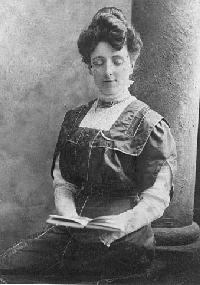
https://www.pc.gc.ca/en/lhn-nhs/pe/greengables/culture/~/media/7F194D2FF61A48609AFC3F688B83D98F.ashx?w=200&h=285&as=1
L.M. Montgomery.

There is one other problem with this late installment in the series. Written long after Rilla of Ingleside, Montgomery clearly did not consider the possibility that people would one day read her Anne books in chronological order, and thus includes blatant foreshadowing of who lives and dies in the war to come. Anne has three sons (even though young Shirley might as well not exist in this book) and if you want to know what’s going to happen to two of them, this is your ticket. It is much better to read the series in publication order.

Anne of Ingleside is a very uneven entry, which is doubly sad as both the longest Anne book and as Montgomery’s final published novel. Of course I still recommend it as part of the complete series.

See Also: The other ones.

Parental Guide.

Violence: Lots of bullying amongst the small fry and lots of dead pets, occasionally treated in a rather flippant manner that modern sensibilities would not condone. Then Tiger Tom, who lived in the barn and was never allowed in the house because of his thievish propensities but got a good deal of petting for all that, was found stark and stiff on the barn floor and had to be buried with pomp and circumstance in the Hollow. Finally Jem’s rabbit, Bun, which he had bought from Joe Russell for a quarter, sickened and died. Perhaps its death was hastened by a dose of patent medicine Jem gave him, perhaps not. Joe had advised it and Joe ought to know. But Jem felt as if he had murdered Bun.

Values: The Blythes learn the worth of common sense and healthy skepticism the hard way. Their problems are often solved by confiding their woes. There is the usual Montgomery mix of idealism, love of beauty, fair play and pursuit of the right and the good, but there is also such foreshadowing of the war that it comes across as a lost world. Montgomery’s heavy heart is tangible.

Role Models: Anne remains a great example of a caring and available mother, using her abilities to bring up well-adjusted and well-behaved children. Again, many readers are critical of this development, and Montgomery oddly echoes this with a late cameo from Christine Stuart, Anne’s supposed rival for Gilbert in Anne of the Island. She appears at a dinner party and makes several pointed comments. “I’m afraid I’m not the maternal type. I really never thought that it was woman’s sole mission to bring children into an already overcrowded world.” She also prods Anne about giving up her writing, to which Anne retorts “I’m writing living epistles now.” This sequence completely destroys Christine’s former characterization, all so she can swoop in to sneer and make Anne feel threatened. I wonder if even back in the day Montgomery received feedback from hurt feminists, because this sequence feels like a retort to critics. Poor childless Christine, shooting her little arrows of mockery.

Educational Properties: About the same as usual.

End of Guide.

Only two to go!

Up Next: Something completely different. A 90s teen thriller by Caroline B. Cooney.
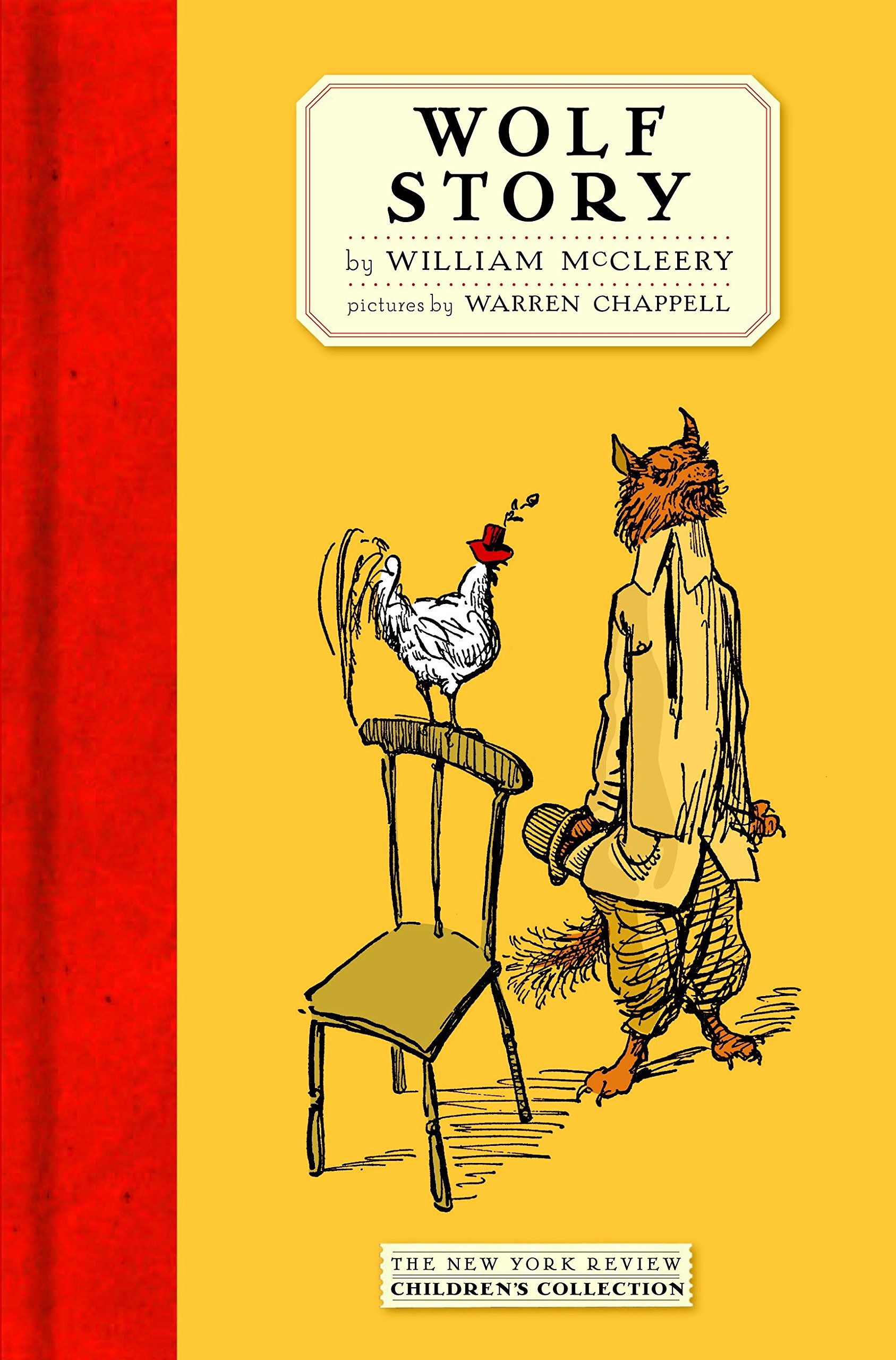
Wolf Story – William McCleery

A mildly meta curio spoiled by an ill-thought moral at the end. Not recommended.

https://images-na.ssl-images-amazon.com/images/I/81JS1tk45RL.jpgTitle: Wolf Story
Author: William McCleery (1911-2000)
Illustrator: Warren Chappell (1904-1991)
Original Publication Date: 1947
Edition: NYRB Children’s Collection (2012), 82 pages
Genre: Humor.
Ages: 4-6
First Sentence: Once upon a time a man was putting his five-year-old son Michael to bed and the boy asked for a story.

A father tucks his son into bed and the son naturally wants a story. After rejecting Goldilocks, Michael requests a new story and is soon “helping” his father make it more exciting by adding a fierce wolf called Waldo to the mix. On subsequent outings with Michael and his best friend Stefan the wolf story continues, despite the father’s boredom, until they reach a mutually satisfying conclusion.

Okay, so this book is nowhere near as meta as it probably sounds. The first two chapters do work quite well in that regard, as the story is constructed while the father and son’s relationship is being sketched out – mostly through the use of dialogue. It’s cozy and endearing, while also forming a humorous commentary on storytelling conventions:

And the man continued: “Once upon a time there was a hen. She was called Rainbow because her feathers were of many different colors: red and pink and purple and lavender and magenta–” The boy yawned. “–and violet and yellow and orange…”
“That will be enough colors,” said the boy.
“And green and dark green and light green…”
“Daddy! Stop!” cried the boy. “Stop saying so many colors. You’re putting me to sleep!”
“Why not?” said the man. “This is bed-time.”
“But I want some story first!” said the boy. “Not just colors.”
“All right, all right,” said the man. “Well, Rainbow lived with many other hens in a house on a farm at the edge of a deep dark forest and in the deep dark forest lived a guess what.”
“A wolf,” said the boy, sitting up in bed.
“No, sir!” cried the man.
“Make it that a wolf lived in the deep dark forest,” said the boy.
“Please,” said the man. “Anything but a wolf. A weasel, a ferret, a lion, an elephant…”
“A wolf,” said the boy.

wolfs hen and boy
Jimmy Tractorwheel the farmer’s son, and Rainbow the hen.

The rapport between father and son creates a pleasantly homey vibe, so nostalgic that it seems pulled directly from McCleery’s own experiences telling bedtime stories to his son. However, the novel proceeds to take on a slightly different tone, as subsequent chapters take place on various Sunday outings, accompanied by Michael’s best friend Stefan – from then on it’s two against one as the boys hijack and control the story, reducing the early delightful tug of war. The wolf story is then continuously interrupted by forays into the wider world of 1940s New York:

“Do you mind if we have lunch in the park?” said the boy’s father to the boy’s mother. “Would you mind not having to fix lunch for us?”
“Oh, that would be terrible,” said the boy’s mother. “If I don’t have to fix lunch for you I will be forced to go back to bed and read the Sunday paper!”
Soon the man and the two boys were driving along the West Side Highway toward Fort Tryon Park. The boys could see freighters, tankers, ferry boats and other craft in the Hudson River. “Enemy battleships!” the boys cried, and raked them with fire from their wooden rifles. Sometimes the man had to speak sternly to the boys, saying, “Boys! Sit down! Stop waving those rifles around. Do you want to knock my front teeth out?”
The boys were very well behaved, and every time the man spoke sternly to them they would stop waving the rifles around, for a few seconds anyway.

As you can tell, McCleery has a fairly repetitive style and prefers to avoid using names or descriptions for his characters. The story is completely trivial and its lack of suspense probably works in favor of a young audience – the wolf story is constantly being treated as a game by the boys, cutting any build-up of suspense with interruptions. It’s packed with dialogue, onomatopoeia and exclamation points, and supposedly makes an enjoyable read-aloud (although I have some caveats in the Parental Guide). McCleery wrote plays for television and Broadway, which explains a lot about his style.

wolf bestiary
Cute.

I would say that Wolf Story‘s greatest asset is its illustrator, Warren Chappell. Leaving the family wholly anonymous, he only illustrates the tale within the tale. Chappell takes McCleery’s dim-witted wolf and makes him hulking and villainous, yet absurd, while Rainbow the hen looks like she wandered in from Greenwich Village, sporting a debonair hat. Most charming of all are his medieval letters at the start of every chapter, with the wolf lurking behind them (it’s a pity the 10 chapters only opened with 5 individual letters).

Wolf Story is a very short book. It’s nicely packaged by NYRB and it seems to be well-received by modern parents – however, it doesn’t strike me as a lost children’s classic and I’m a little surprised it was chosen out of the sea of out-of-print stories waiting for a new lease on life. The plot is slight and gains little development, characters are thinly sketched, the glimpses of 1940s New York are all too brief and the writing is on the flat side. Also, the ending is a huge problem – the wolf story is based around a folktale motif, but if you enjoy the hard-headed sensibilities of classic folktales (where evil, selfishness and stupidity are punished in the end), you will probably find Wolf Story as much a letdown as I did. It looks good at the start but it wouldn’t make my list of vintage gems.

See Also: Stuart Little, another evocation of New York in the 40s, directed to the same basic age group (though the writing has way more style) and with eccentricities all its own…

And now a long Parental Guide for a short novel. Big spoilers for how the book ends.

Language: Quick heads up that there is one appearance of the word “damn,” which the father tries to dissuade his son from using, offering “darn” as a substitute – this book gets called a perfect read-aloud a lot, but I know there are parents who would prefer curse-free books for their six year olds.

wolf attacked
Big five year old or small wolf?

Violence: It’s about as serious as a Road Runner cartoon. Five year old Jimmy Tractorwheel, the farmer’s son, wallops Waldo the Wolf with a baseball bat and all that’s missing from the scene are the circling birdies. Lots of threats of eating the hen or shooting the wolf but no one actually dies, leading to…

Values: …the father inserting an asinine moral when the farmer’s family finally capture Waldo. Jimmy Tractorwheel decides to try and reform Waldo after the wolf whines about how: “I never had no opportunities. I ain’t even been to school.” He’s still a wolf, but that’s forgotten about and social experimentation follows, which the father insists is absolutely successful: “So Waldo was locked up and every day Jimmy would come and ask him questions about how a wolf is treated by his parents and what makes him so fierce. The more Waldo talked about his fierceness the gentler he grew, until finally he was allowed out of the cage on a leash. Jimmy and Waldo wrote a book about wolves which was read by the farmers and the wolves in that part of the country and helped them to understand each other. They all became quite friendly and some wolves even worked on the farms, as sheepdogs.” 

Michael actually tries to have Waldo revert to type and repay the farmer by stealing Rainbow again, but the father won’t have it and ends the story, which put me in mind of the quote by G.K. Chesterton: “For children are innocent and love justice, while most of us are wicked and naturally prefer mercy.”

wolf in prison
Hmm.

Role Models: The father clearly intends Jimmy to be such. Since both the father and Jimmy literally advocate letting a fox wolf guard the hen house, they obviously aren’t very smart. The wolf himself has no redeeming qualities – he is murderous, doltish and cowardly – yet he gets off scot-free.

Educational Properties: Since this is a static novel about the joys of telling a dynamic  story out of thin air, it could be used as an example of meta fiction for the young. You might also discuss the ending and explain that A: wolves are not tameable and B: pop psychology is not a panacea (and that’s just for starters). There are already too many people out there who think they live in a Disney movie. This is not helpful.

End of Guide.

This was William McCleery’s only work for young people, which means I have now completed his bibliography and I’m honestly relieved. Imagine what he’d have done with The Little Red Hen…

Up Next: Back to the story of Anne Shirley.

Stormy, Misty’s Foal – Marguerite Henry

This second sequel is a great improvement on Sea Star and makes so little reference to the events of that book that it could even be read as the first sequel to Misty – which nine year old me believed it to be, thanks to the Aladdin boxset.

stormyTitle: Stormy, Misty’s Foal (Misty #3)
Author: Marguerite Henry
Illustrator: Wesley Dennis
Original Publication Date: 1963
Edition: Aladdin Paperbacks (1991), 223 pages
Genre: Animal Stories. Survival stories.
Ages: 8-12
First Line: In the gigantic Atlantic Ocean, just off the coast of Virginia, a sliver of land lies exposed to the smile of the sun and the fury of wind and tide.

Misty has been home with the Beebes for an indeterminate amount of time and is now ready to have her first foal. Paul and Maureen are excited and impatient, but a violent storm strikes the islands, causing massive tidal flooding and forcing the locals to evacuate. Animals can’t come on the helicopters, so the Beebes have to move Misty into their kitchen and hope for the best. Will Misty and her colt survive? Will the Beebes have a home to return to? And how can the islands ever recover from such terrible devastation?

Stormy, Misty’s Foal is a much darker novel than Misty or Sea Star, death-riddled from the sixth chapter (when a neighbor reports on two thousand drowned baby chicks), onward through the storm and into its aftermath, in which Paul and Grandpa Beebe are enlisted to scour the islands and place markers wherever dead ponies are found. It’s a sequel meant for older kids, with a greater suspense and dread, and it stands on its own identity rather than the laurels of what came before.

cat and dog, wesley dennis
Happy dog, less happy cat.

Being considerably longer than the first two Beebe books, Marguerite Henry is able to place more focus on the location, with Pony Ranch clearly defined as a going concern. There are more details surrounding such things as church visits and the contents of the Beebe’s smokehouse, along with a family cat and dog. Misty is referred to as a “movie star,” and she’s obviously made the family prosperous, but there’s no indication in the text that she was ever gone, which makes it feel like Sea Star never happened.

Again, Henry contradicts a passage in her earlier work, preventing the three books from coming together as an integral whole. From Sea Star: “Look at me, Sea Star,” [Paul] said. “When Misty comes back home, you and she can be a team. Misty and Star. Sound pretty to you? And you can run like birds together and you can raise up foals of your own, and Maureen and I can race you both and we won’t care which wins.” It’s a pretty passage and was a high point of that book, yet Sea Star doesn’t appear or get mentioned here. The reason is probably that the true story had an unhappy ending – orphan foals are hard to keep alive, and the Beebe’s efforts were in vain – but after writing such a positive tale, Henry disappoints any children hoping to see Misty and Star together by silently sticking to the facts.

Grandpa Beebe, wesley dennis
Grandpa Beebe worries over his life’s work.

There are a host of positives that come with this third story, though. Chiefly among them is a real sense of the Beebe family as an ensemble cast. Therefore, Paul is no longer the only really proactive character; everyone has a job to do when the disaster strikes, and they each have their own fears to quell. Grandpa Beebe is particularly changed by this process into a man in his own right rather than the wise authority figure of previous books.

Misty spends much of her time separated from the Beebes, as their symbol of home, history and everything they wish to return to (with Stormy embodying hope for the future). Given this is based off of the Ash Wednesday storm of 1962, it’s clear that Henry is again playing loose with the facts – the real Clarence and Paul Beebe had both sadly died in the intervening decade and a different branch of the family was living at Pony Ranch and caring for Misty during this time. However, the extensive credits at the end of the book make it clear that Henry was determined to do right by the islanders and what they endured. She consulted everyone from the family to the mayor to the coast guard, giving Stormy‘s evacuation and cleanup scenes clarity and definition.

A street sign veered by, narrowly missing the horses’ knees. 98th Street, it said. Grandpa turned around to make sure he had read it aright. “My soul and body!” he boomed. “It scun clear down from Ocean City! That’s thirty mile away!”

In front of Barrett’s Grocery two red gas pumps were being used as mooring posts for skiffs and smacks and trawlers. A Coast Guard DUKW, called a “duck,” and looking like a cross between a jeep and a boat, came churning up alongside Grandpa and Paul.

As they turned onto Main Street, which runs along the very shore of the bay, Paul was stunned. Yesterday the wide street with its white houses and stores and oyster-shucking sheds had been neat and prime, like a Grandma Moses picture. Today boats were on the loose, bashing into houses. A forty-footer had rammed right through one house, its bow sticking out the back door, its stern out the front.
Nothing was sacred to the sea. It swept into the cemetery, lifted up coffins, cast them into peoples’ front yards.

flood destruction, wesley dennis
Flood destruction.

Stormy works just as well as the earlier volumes for reading aloud, and in this case parents might actually find the plot more gripping than their children, who would most likely focus on the ponies and the missing dog while parents would immediately grasp the larger nature of the disaster.

Of course, it isn’t all grim – there’s a great deal of focus on the community supporting one another and on the brave men in the Coast Guard and local volunteers setting forth into the floodlands, by boat and helicopter, providing aid and rescue. Also, the various book covers don’t exactly keep you in suspense about whether Misty safely delivers her foal or not.

Spoilers for the final chapters below.

Misty and Stormy end up on tour, raising money to restore the depleted herds of Assateague. Because we’ve seen the devastation close up, this tour to help the ecology and economy of Chincoteague comes across as truly heartwarming (unlike the previous college-for-Clarence plot), and it does help a lot that the Beebes don’t sell her off this time.

End of Spoilers.

One bit of advice I’d give is that no matter how many of the Misty books you decide to add to your library, avoid the Aladdin editions pictured at the top of these reviews. The Aladdin books are clearly cheap reprints and Wesley Dennis’s marvelous illustrations lose a great deal of definition in the process.

See Also: Misty of Chincoteague and Sea Star.

Parental Guide!

surviving ponies, wesley dennis
Surviving ponies.

Violence: A great deal. Many animals die in the flood, either drowned or exposed to the elements. Much of the time this is only mentioned in passing, but when Paul and Grandpa finally make it out to their ponies’ winter pasture they find an entire herd dead, and proceed to make a grim search for survivors. The heart-breaking work went on. They came upon snakes floating, and rabbits and rats. And they found more stallions dead, with their mares and colts nearby. And they found lone stragglers caught and tethered fast by twining vines. Grandpa is hit especially hard by this loss.

However, none of the main animal characters die and there are no human casualties at all, so depending on what your own child has already read, this might be very easy to handle. I remember finding it extremely disturbing when I first read it, but a year or so later this became my favorite Misty book.

Values: Faith, hope and charity all get their due, along with love of home and family, some grassroots philanthropy and community pulling together in hard times. The civic emphasis of the previous volumes (obey your elders and sacrifice for college) is replaced by civil disobedience. The Mayor has trouble with the mainland government after the storm:

“The government has approved sending ‘copters to take fresh water to the ponies still alive on Assateague, but they have no orders yet to take out the dead ones.”
Grandpa exploded. “Mayor! The live ones has got water. There’s allus water in the high-up pools in the White Hills. Them ponies know it.”
“You and I know it too, Clarence. But sometimes outside people get sentimental in the wrong places.”

This theme continues when the government refuses to allow women and children to return to Chincoteague, with Grandpa deciding to just smuggle his family home.

Perception of government isn’t the only thing that changed between the 40s and 60s. The role of women had too, and Grandma, a positive and respected figure before, is now singled out for pity at various points for having to always be at home or supporting the Ladies’ Auxiliary. As for Maureen…

Role Models: Maureen is now actively complaining about being a girl. As Maureen and Grandma heaped the trays and carried them back, Maureen’s lip quivered. “Oh, Grandma, Paul didn’t even ask what I did today. He doesn’t even know I was at Doctor Finney’s, riding a famous trotter. Oh, Grandma, why was I born a girl?” This is right after Paul and Grandpa come back from scouting for dead ponies, both so stricken by the sight that they can’t even talk about it, and she’s whining because she was spared all that and got to play with living ponies instead. She spends much of this book bursting into tears. “Oh, Grandma, being a girl is horrible. Paul always gets to have the most excitement.”

She’s acting as if trawling the death-choked waters is fun and games, and that’s not to mention that Paul only gets to accompany his grandfather on these forays back to the islands because he’s getting near full-grown, and the Coast Guard needs able-bodied men to do these jobs. Maureen is a pre-teen girl. She comes off far worse here than she ever did back in the 40s, precisely because Henry is trying to make her more outspoken – chafing at restrictions while ignoring that those restrictions are perfectly logical in this situation. The author never has any of her characters sit down and talk to Maureen about her attitude, and the girl is now a terrible role model, even though the others all remain admirable.

Educational Properties: Storms and flooding are serious concerns in coastal communities, and Stormy covers many aspects of such crises, from the creation of tidal storms to which citizens are most vulnerable when the power goes out (there’s a subplot involving a man who lives in an “electric cradle”). The details of evacuation, clean up and recovery mean that a lot of research and discussion could take place around this book, whether or not such a scenario could happen where you live. Obviously, massive amounts of natural science could also be tied in with Stormy, and there are also some random bonuses – like the reference to Grandma Moses and a world news report on the radio which is a time capsule in and of itself.

End of Guide.

I highly recommend Stormy, Misty’s Foal. It could foster some great conversations, and it’s full of drama without feeling lopsided the way Sea Star did. At this point, it seemed that Marguerite Henry had said all she needed to about Misty’s life, but Misty had three foals in all and Henry kept tabs on the descendants of her former pet and muse, eventually resulting in one final book about an especially gifted descendant: Misty’s Twilight. Expect my review next month.

Up Next: An odd little book by William McCleery, brought back in print by the NYRB Children’s Collection.

The Midnight Fox – Betsy Byars

It turns out that my first choice for Betsy Byars was her own favorite among her many books. For those who are also wondering where to begin with Byars, this is quite a good choice.

Putting the finishing touches on this review, I discovered that both she and her illustrator have passed away this year – a clear loss to children’s literature.

midnight fox cover, byarsTitle: The Midnight Fox
Author: Betsy Byars (1928-2020)
Illustrator: Ann Grifalconi (1929-2020)
Original Publication Date: 1968
Edition: Puffin Books (1981), 159 pages
Genre: Realistic Fiction. Animal stories.
Ages: 8-12
First Line: Sometimes at night when the rain is beating against the windows of my room, I think about that summer on the farm.

The summer before Tom turns ten, his parents send him to stay with his Aunt Millie, Uncle Fred and cousin Hazeline for a couple of months while they embark on a cycling tour of Europe. Tom is dismayed – as a comfortable city boy he’s sure to be miserable on Fred and Millie’s farm. He’s scared of animals and he misses his best friend Petie Burkis every day. Things change for the better when he catches a glimpse of an elusive black fox, but foxes are not welcome animals on a farm…

The Midnight Fox lacks a shiny award sticker on the cover and so I figured the fox’s chance of living to the end of the book was actually fairly high, although Byars got me second-guessing myself several times before it was finished – if your main concern in animal stories is whether the headlining critter lives or dies, please skip to the Violence section of the Parental Guide below.

While the fox plotline creates drama and suspense, the bulk of The Midnight Fox is a quiet and introspective portrait of a lonely nine year old boy on a depressing vacation – comparisons to my previous Castle read, Junonia (a quiet and introspective portrait of a lonely nine year old girl on a depressing vacation), are inevitable. So how does the vintage choice stand up?

Two of the most notable differences between Betsy Byars and Kevin Henkes are that Byars makes use of humour throughout her book and she allows her child protagonist to have actual interests. Henkes focused completely on the emotions of his heroine Alice, while her life back home, friends or any hobbies outside of shell collecting were barely acknowledged. She got “books” for her birthday; Tom actually reads:

Tom and Petie
Tom and Petie.

I would go over to Petie’s and he would be sitting on the porch reading. He would be so interested in the book that he wouldn’t even look up to see who I was.
“What are you reading, Petie?”
He would lift the book so I could see the title and it would be something like Mystery of the Deep.
“Can I read it when you’re through?”
He would nod.
“How much more you got?”
Still without missing a word, he would flip the remaining pages.
“Well, hurry up, will you?”
He would nod again, but Petie Burkis had never hurried through a book in his life. So I would wait. And wait. And finally, when I was ready to go out and get the book out of the library myself, then he would come over and give it to me.

Tom has an endearing range of hobbies besides, whether inventing games with Petie, building models, daydreaming or watching the kind of movies that show on “Chiller Theater.” He has a quirky and boyish view of the world which buoys up what would otherwise be a fairly dour and strait-laced narrative. He certainly has a melancholic disposition, but he isn’t depressed. Of course, faulting Henkes for depicting pre-teen depression would be unfair – it was all but unknown in the 60s, and seems to be everywhere today. So in spite of their many similarities, The Midnight Fox and Junonia are closer to apples and oranges than they appear. After all, realistic fiction is framed by the limits of reality – if reality is that pre-teen depression is skyrocketing and many kids are hemmed in by loneliness, anxiety and obsessively structured playtime, novels like The Midnight Fox aren’t going to be written anymore. However, this ensures that Byars is by far the more entertaining choice in this instance.

fox sighting
Ann Grifalconi gives a distinctive look to the story.

One of her best tricks within this novel is to keep Tom’s best friend Petie a presence throughout the book, mentioned with great frequency – true friendships matter even if they have no bearing on the plot. Much of the novel’s accompanying humour comes from Tom’s anecdotes of Petie, alongside his self-deprecating image of what a ridiculous figure he makes on the farm:

I continued to walk until I came out of the forest, right by the pasture where the cows were grazing. They were all together in the shade of the trees, and they turned in a body and looked at me.
I had thought, when I first saw these cows from a distance, that if I ever had to do a circus act, I would get about six cows like these and train them. They would be called The Cow Family Dancers, and I would come out in an Alpine suit with an accordion, and as I would start to play, the cows would come dancing out into the circus arena, not trotting like horses, but doing peasant steps, turning and clicking their heels and tossing their heads.
Now that I saw the cows at close range I abandoned this idea for all time and began to walk slowly past them. “Cows do not attack people. Cows do not attack people. Cows do not attack people,” I said to myself as I passed, and then, completely against my will, I found myself making up a Petie Burkis news story:
COW ATTACKS BOY–SCIENTISTS BAFFLED
Scientists in Clinton County were baffled today by the report that a cow attacked a young boy. The young boy, who was passing the cow in a respectful manner, was able to give no reason for the attack. “She just came at me,” he managed to whisper before he was driven to the hospital. No one has been able to reach the parents of the young boy, as they are having a vacation in Europe.

fox and kit
Grifalconi’s stylized foxes.

A positive change comes over Tom after he catches a glimpse of the black fox, hunting for her sole surviving kit. At first he’s certain that he only dreamed it, not knowing that foxes could even come in black, and afterwards he takes an interest in fox habitat and hunting patterns, forging a link through this new rural hobby with nature, gaining the ability to hold still and really look at the world around him. His terror of domestic animals is replaced by a fascination with wildlife, and he becomes calmer and braver because of it. This is a fairly standard character progression in children’s literature, probably because of how true it is, and it works very well here:

I had found a hornets’ nest like a huge gray shield in a tree. I had found a bird’s nest, low in a bush, with five pale-blue eggs and no mother to hatch them. I had found seven places where chipmunks lived. I had found a brown owl who never moved from one certain limb of one certain tree. I had heard a tree, split by lightning years ago, suddenly topple and crash to the ground, and I ran and got there in time to see a disgruntled possum run down the broken tree and into the woods. But I did not find the place where the black fox lived.

Byars has an enjoyable writing style, a bit rambling but oddly graceful. Her writing advice was to always read your own prose out loud and that pays dividends here. The Midnight Fox does not suffer from any dry prose and it is personal and character-driven while still being amusing. The story is sure to please nature-loving kids, especially if they’ve already enjoyed other vintage options.

See Also: Junonia by Kevin Henkes. Same issues, different generation.

Parental Guide has only one important spoiler. Does the fox live?

Violence: Tom’s cousin Hazeline reluctantly talks about a recent incident with a farmer, a poultry farm and a family of foxes:

“…underneath the moss was an open trap, and that very night the fox came by and he saw the raw chicken and he put his foot right on that moss and sprung the trap. Bingo!”
“Oh.”
“End of fox,” she said. “That was about two weeks ago, and then he found the den and went and got a stick of dynamite and blew it up and that was the end of the baby foxes.”
“Oh.” It was one of those stories that you’re sorry afterward that you made somebody tell you.

There is some real pathos to the separation of the foxes, with the mother fox trying to bring food to the cage her kit is kept in. Animal lovers will be relieved that they survive.

fox hunting
Uncle Fred fox hunting.

Values: Hunting is not shown in a positive light, although Byars never turns this into a polemic. Tom does not attack or condemn his uncle, nor does he judge his aunt for wanting her poultry protected – he just doesn’t want the foxes to die and so he makes a stand.

Role Models: Tom is a worrier from the start, but he’s well-behaved and tries to keep his petulance under wraps. He’s creative and observant, self-contained and self-aware. In the end, he gets the classic coming-of-age moment of conquering his fears to save something that matters to him.

Tom’s finds his relatives very hard to relate to, but they aren’t villains. Uncle Fred’s understated response to Tom’s defiance is quite heartwarming, the more so since this is not a sentimental story.

Educational Properties: Certainly there’s a fair amount of discussion on the life cycle of the fox, which would tie this to a nature study. With its extremely small cast and limited setting, The Midnight Fox would also be a good choice for mapping out a novel.

End of Guide.

This was an unexpectedly enjoyable book and I shall certainly be keeping an eye out for more Betsy Byars. She went on from this to win a Newbery, an Edgar and the National Book Award and her books regularly appear in used bookstores (or they did before 2020 happened, anyway).

Up Next: Returning to the ongoing saga of Misty of Chincoteague.


Junonia – Kevin Henkes

Diagnostic.

https://kevinhenkes.com/wp-content/uploads/Junonia.jpgTitle: Junonia
Author: Kevin Henkes
Illustrator: Kevin Henkes
Original Publication Date: 2011
Edition: Greenwillow Books/HarperCollins (2011), 176 pages
Genre: Realistic Fiction.
Ages: 8-10
First Line: When Alice Rice and her parents were halfway across the bridge, Alice felt strange.

Alice is an only child. She has no grandparents, aunts, uncles or cousins. Every year she and her parents go on a seaside vacation to Sanibel Island in Florida, where Alice celebrates her birthday and hunts for seashells, including the rare junonia – which she hopes to finally find this year, for her tenth birthday. Alice has created an extended family out of the other yearly vacationers who share neighboring cottages, but this year several of them aren’t coming and her “aunt” Kate is bringing a new boyfriend and his six year old daughter Mallory, who is in anguish over her mother leaving her to go live in France. Alice watches her make-believe family turn into strangers while her birthday is overshadowed by Mallory’s misery and subsequent bad behaviour. Will everything still turn out alright?

Junonia bird, Kevin Henkes
One of Junonia’s seaside vignettes.

Junonia has an eye catching cover and pretty blue ink illustrations heading every chapter, giving it an endearing appearance of vintage charm. It’s written by Caldecott winner (and 2020 recipient of the Award Formerly Known as the Laura Ingalls Wilder Award) Kevin Henkes, a beloved author/illustrator of picture books. He has also won Newbery Honors for two of his middle grade novels. Junonia has an idyllic setting, thoughtful pace and great perception, giving voice to the emotional life of a lonely and imaginative little girl. It suffers from none of the grittiness and gimmickry that bog down many modern books for pre-teens, and its retro vibe will appeal to cautious parents – but in spite of the sweetly vintage packaging, Junonia carries a hefty dose of spiritual malaise which seeps into every corner of this melancholic little book.

Let’s start with Alice, who is about to turn ten and is depressed. I’m really not sure what else to call this: Being low in the kayak made the water seem so vast and deep, the sky so far and wide. Alice felt like a dust mite compared to all of it. She whispered, “It’s so big.”
Her mother turned her head partway and nodded.
Alice wanted to ask her: Do you ever feel too small to matter? But she didn’t.

Junonia flower
Gladiolus.

Her previous summer vacations were always magical, but this year isn’t and she senses that right from the moment they arrive. Although plenty of nice things do happen this year, the happiness she’d felt was as thin as an eggshell, and as easily broken. She feels resentment toward even the smallest changes, she struggles with body image and awkwardness, and she’s waiting for something wonderful to happen (symbolized by the junonia) which fails to materialize. She is incredibly lonely: Kate was the closest thing Alice had to a relative. It would be different this year. Every other year, Kate had stayed with Alice’s family in their pink cottage, sleeping on the sofa in the living room. Every other year, Alice had had Kate to herself; she hadn’t had to share her with anyone except her parents. Her parents are older, non-religious, they don’t appear to have any pets waiting back home, Alice had given up wanting a brother or sister, and it’s nearly the end of the book before a best friend Libby is even mentioned. She’s never been allowed to walk down to the beach alone. Her parents are financially well off, however, and so she has everything that she really needs – like a Florida vacation and stacks of birthday presents.

Alice is a well-drawn and believable character whose constantly fluctuating inner life is related very clearly. Henkes is renowned for his ability to convey the inner life of children and several GoodReads reviewers referred to this book as Mrs. Dalloway for ten year olds. Aside from the question of whether ten year olds really need their own Mrs. Dalloway, I had no trouble believing in Alice as a real person and I felt great sympathy for her immediately. Henkes uses small details which accumulate into a portrait – not only for Alice, but also the smaller role of Mallory.

Mallory introduces herself by introducing her doll and we (and Alice) can immediately tell that something has gone wrong in the little girl’s life. “Munchkey’s mother went to sea in a pot, and she’s been missing for weeks,” Mallory said, her voice high and thin. “She might never come back.” The little girl proceeds to annoy and trouble Alice, and they never quite become friends. Alice doesn’t seem to have much experience with younger kids (wonder why) and she struggles not to be resentful, while Mallory grasps at any little thing that makes her happy, whether it belongs to her or not. Alice is capable of being patient and compassionate but finds it difficult, especially as Mallory has several breakdowns that spoil everyone’s vacation fun. Many reviewers have expressed annoyance towards both girls for being sullen, but in all honesty they were the only two characters in Junonia that I could stand. Why should they be expected to cavort through their summer vacation like the Bobbsey Twins when the adults in their lives have utterly failed to provide them any of the things those children could rely on?

https://i0.wp.com/i.ebayimg.com/images/i/110723678806-0-1/s-l1000.jpg

Henkes depicts the pain, confusion and despondency these girls are dealing with expertly, informing every small moment (and Junonia is nothing but a book of small moments). However, in contrast to books from even the 80s and 90s, neither he nor any of his characters treat the divorce of Mallory’s parents as something unusual – because these days it isn’t. It’s simply a part of life, and of course it hurts kids but they just don’t realize how complicated the situation is. Alice felt as if she had only a dim understanding of adult life. That’s all we are given of her inner thoughts when “aunt” Kate decides to bail. Kate, who chose to start a relationship with a single father, acts sensitive about it but in the end she blames Mallory for ruining everyone’s day. “Next year,” said Kate. “Next year will be better.” She came forward for hugs. “Maybe I’ll be alone.” No accountability.

All of this is incredibly realistic. It’s not uplifting or pretty, but it can’t be said that Henkes puts a foot wrong in depicting this world. His prose is simple and efficient, filled with small details that ring true; however, I did not find it to be as graceful or poetic as I’d heard it described. In fact, I was driven slightly insane by Henkes’s love of similes, which seem to be his go-to literary flourish:

Within minutes Alice was asleep … her hands curled at her chin like unusual, smooth pink seashells.

Banks of clouds sat on the western horizon like great cottony hedgerows with deep lilac shadows.

At the horizon, clouds crammed the sky like rolls of cotton smashed against glass. But up above, the sky was a bright blue bowl.

Seconds earlier, Alice had been thinking that the surface of the water was like glossy, peaked blue-green icing sprinkled with truckloads of sugar.

She watched the endless procession of long waves rolling toward the shore. The crests were white and foamy. The hollows between the crests were deep, like trenches scooped out by a huge shovel. After a while, she saw the crests as strips of lace laid out on folds of steel blue cloth.

Junonia seascape, Henkes
These similes are less effective than his art.

Junonia is a sad little book. This effect owes much to the realism of the story, as Henkes never cheats, never offers a scenario that is even remotely unlikely – everything here can happen, does happen. There’s a subtle and omnipresent depression going on. Lonely and introspective preteen girls might have an easier time relating to Alice than to the Railway Children or the Melendys, but maybe those older books would introduce or inspire a different value system, something more sustaining than Junonia, which simply reflects back to its young readers, honestly and accurately, the rising tide of pre-teen depression, for which “adopting” a sea turtle just isn’t much of a consolation prize.

See Also: The Hundred Dresses, another melancholy realistic story, only with better writing and a greater degree of hope.

Parental Guide.

Violence: None. Not even any bad language outside of one use of “bloody hell.”

Values: Life is disappointing and its best to accept that with grace. Loneliness and disillusionment are a part of life. Change is inevitable. It’s good to be understanding of others. It’s important to see yourself in a positive light, because everyone is pretty in their own way.

Junonia is almost aggressively secular at points, with Alice inventing a sea goddess called Junonia after deciding out of the blue that God wasn’t an old man in flowing robes with a white beard and a temper to beware of. An old man who didn’t come to the rescue during wars or when kids got picked on at school. Her new and improved perfect, personal god is then discarded like a disappointing toy when things go wrong. …it was a silly waste of time to think about a god named Junonia. Obviously she, Junonia, didn’t exist. She hadn’t saved Alice’s party from being spoiled, and she hadn’t stopped Mallory from becoming a thief. When it turns out that Mallory didn’t steal anything, Alice doesn’t reflect back on this dismissal.

Also of note is the final passage of the book, which put me so much in mind of the ending of Little House in the Big Woods that I immediately got out my copy and compared, only to notice a significant difference.

Little House: She thought to herself, “This is now.”
She was glad that the cosy house, and Pa and Ma and the firelight and the music, were now. They could not be forgotten, she thought, because now is now. It can never be a long time ago.

Henkes: Suddenly she felt as if she were the center of everything, like the sun. She was thinking: Here I am. I have my parents. We’re alone together. I will never be old. I will never die. It’s right now. I’m ten.

Laura falls into the stillness of the present because she cannot believe it will ever be forgotten. Alice falls into the stillness of the present because she’s gone from looking forward to turning ten, to no longer wanting to grow up. What’s the opposite of coming-of-age?

Role Models: Alice is a good kid trying to navigate life with few resources at her disposal. The same goes for Mallory times ten. The ghost of an ideal family is still felt, but it’s treated as something unreasonable to expect. The entire cast of vacationers and absentees are well-off, and small families are an unquestioned norm. Alice’s parents are well-meaning and still together, but their idea of a fun birthday surprise is to “give” their daughter a sea turtle, so they can show how much they love the environment together or something.

Junonia shells

Educational Properties: There’s a lot of talk throughout the book of sea shells and Henkes provides a hand drawn chart of them that was very helpful and appreciated. The text includes almost no scientific info on the local flora and fauna though, because Alice just isn’t much of a nerd. This is also reflected in the sea goddess subplot; Alice could have chosen to invest in any of a dozen mythological sea gods and goddesses, which would at least have offered her some cultural backbone, yet she conjured up a New Age alternative. In fact, the phrase Alice got books pretty much sums up what you won’t find here, as Henkes puts all his investment in Alice’s emotions rather than her interests.

Junonia is a successful example of a book that actually could be used to teach some empathy, due to its absolute commitment to realism. Lonely middle-class white kids whose parents take them on vacation and shower them with creature comforts are not high on the prescribed list of “people to feel sorry for,” yet a girl with siblings might take them less for granted after reading about Alice’s imaginary family. It might make a reasonable mother/daughter book choice, although there are many better options out there.

End of Guide.

Fans of modern realistic fiction would undoubtedly be the best fit for Junonia. Those who prefer a real vintage style and outlook will be disappointed. I don’t see much harm in the book when taken by itself, but if Junonia is indicative of the themes in modern middle-grade stories – loneliness, depression, dysfunction, disillusion – then well-adjusted children are really being left out in the cold.

I wasn’t a fan of Henkes’s writing in this book, but I admired his honesty and maintain a policy of never judging authors by just one work – especially when, like Junonia, it’s one of their minor endeavors. Henkes won two Newbery Honors and I won’t make any further pronouncements on his writing style until I’ve tried them both out.

Up Next: The vintage equivalent with a novel by Betsy Byars.

Anne’s House of Dreams – L.M. Montgomery

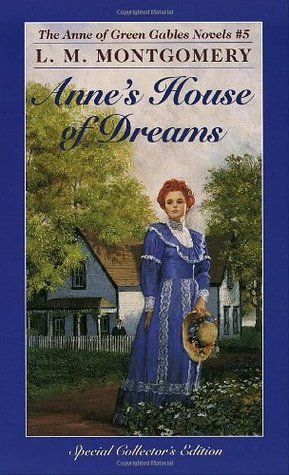
Even though Anne has apparently forgotten how to dress thanks to one of the worst covers in the whole series, this is definitely my favorite of the sequels thus far.

https://images.gr-assets.com/books/1442471048l/77394.jpgTitle: Anne’s House of Dreams (Anne Novels #5)
Author: L.M. Montgomery (1874-1942)
Original Publication Date: 1917
Edition: Bantam Books (1998), 227 pages
Genre: Sentimental Fiction. Romance.
Ages: 12-17
First Line: “Thanks be, I’m done with geometry, learning or teaching it,” said Anne Shirley, a trifle vindictively, as she thumped a somewhat battered volume of Euclid into a big chest of books, banged the lid in triumph, and sat down upon it, looking at Diana Wright across the Green Gables garret, with gray eyes that were like a morning sky.

Anne is married at last and is moving to a dear little cottage at Four Winds Harbor, where her charmed life will be marred by tragedy. Our beloved heroine must face up to the difficulties of life when she meets her neighbor Leslie Moore, who is trapped in a marriage from which Anne’s customary meddling has no hope of freeing her – but she also forms some of her closest and most genuine friendships in this isolated place.

https://i.pinimg.com/236x/73/90/fb/7390fb8a4a1b5ce428be639846aa19f9.jpg
This publisher commissioned a better idea.

After a series of opening chapters detailing Anne’s longed-for Green Gables wedding in all of its dreamy perfection, the sentimental guff Anne fans are accustomed to is jettisoned to make way for Montgomery’s darkest work yet. Written during the First World War, Anne’s House of Dreams is remarkably somber, thoughtful and honest. It utilizes a smaller cast of characters (mostly Anne, Gilbert and their three nearest neighbors) and develops them beyond the usual comedic figures that have featured in other stories of Anne as an adult.

The cast we meet upon Anne’s arrival at Four Winds are the sentimental lighthouse-keeper Captain Jim, with his stories of the sea; man-hating, fervent Presbyterian Miss Cornelia Bryant; and fair heroine Leslie Moore. Anne’s House of Dreams plays to one of Montgomery’s hidden strengths, as she usually packs her novels with so many ancillaries that they crowd each other out; here, every character has a sense of depth and development missing from those such as Anne’s dorm buddies. This deliberate downscaling makes Anne’s House of Dreams the most tightly plotted of the series so far, abandoning much of the episodic structure in favor of Anne’s continuous attempt to unravel the mystery of Leslie Moore and befriend her.

https://i0.wp.com/images2.fanpop.com/images/photos/4100000/The-Goose-Girl-grimms-fairy-tales-4125926-345-500.jpg
Arthur Rackham’s Goose Girl.

Leslie is one of Montgomery’s best creations, introduced as a modern Goose Girl: Anne saw a girl who was driving a flock of snow-white geese along the crest of a velvety green hill on the right. … The girl was tall and wore a dress of pale blue print. … But it was the girl’s beauty which made Anne give a little gasp–a beauty so marked that it must have attracted attention anywhere. She was hatless, but heavy braids of burnished hair, the hue of ripe wheat, were twined about her head like a coronet; her eyes were blue and star-like; her figure, in its plain print gown, was magnificent; and her lips were as crimson as the bunch of blood-red poppies she wore at her belt. Anne’s friendship with Leslie is fascinating because it is fraught with tension, not blithe and carefree as in books past. Grave in aspect, embittered from the many tragedies in her life, Leslie feels pain and envy just being near Anne, and Anne in turn is unsure if her cold new neighbour even likes her. This is much more convincing than the Katherine plotline from Windy Poplars (which was very much recycled from this story), as Anne cannot cure Leslie’s woes by her mere star-like presence this time. Instead, the author relies on some of Dickens’ techniques to bring about the necessary happy ending.

Meanwhile, the change of scenery reinvigorates Montgomery’s prose. The ocean is this novel’s muse, and Four Winds is no sleepy hamlet: There was a certain tang of romance and adventure in the atmosphere of their new home which Anne had never found in Avonlea. There, although she had lived in sight of the sea, it had not entered intimately into her life. In Four Winds it surrounded her and called to her constantly. From every window of her new home she saw some varying aspect of it. Its haunting murmur was ever in her ears. Vessels sailed up the harbour every day to the wharf at the Glen, or sailed out again through the sunset, bound for ports that might be half way round the globe. Fishing boats went white-winged down the channel in the mornings, and returned laden in the evenings.

Montgomery’s reliable humour takes on a new shade as well, in compliment of the book’s changeable atmosphere. Miss Cornelia, the latest in her trademark line of comical spinsters, has an acerbic tongue unmatched even by Marilla Cuthbert. “He’s noted for his beautiful pigs. He’s a heap prouder of his pigs than of his children. But then, to be sure, his pigs are the best pigs possible, while his children don’t amount to much.” While claiming to hate only men, Miss Cornelia offers scathing indictment of her entire community, while still sitting down to the job of making baby clothes for expectant mothers. “I s’pose I’m a fool, to be putting hand embroidery on this dress for an eighth baby. But, Lord, Mrs. Blythe, dearie, it isn’t to blame for being the eighth, and I kind of wished it to have one real pretty dress, just as if it was wanted.”

https://thewesterncornerofthecastle.home.blog/wp-content/uploads/2020/07/3e8c4-lucymaudmontgomery.jpg
Lucy Maud Montgomery.

I went into Anne’s House of Dreams with rather low expectations, after many reviews made it sound like this is where Anne first becomes a Mary Sue, yet my fears were unfounded. She still has her rich inner life, her after-dark strolls, her fancies about ghost ships in the fog and her strong belief system. What she doesn’t do anymore is write, and that choice has driven legions of Anne fans berserk. Montgomery must have anticipated this, as she has Gilbert say, “some people might think that a Redmond B.A., whom editors were beginning to honour, was ‘wasted’ as the wife of a struggling country doctor.” Anne does not set her dreams of literary greatness aside from lack of support, though; rather, it is by honest self-evaluation. “I know what I can do. I can write pretty, fanciful little sketches that children love and editors send welcome cheques for. But I can do nothing big.” Anne chooses to get married instead and readers lament the waste of her talent, ambition and education, as if none of that will be utilized raising children.

I would not be commenting on this point, were it not for how many of these reviewers seem to take that choice as almost a personal affront, as if they secretly wanted Anne to embrace a future as an old maid. Perhaps it’s a testament to the personal impact of the Anne books – this series charts more years of a single life than most children’s literature ever attempts, and as she grows up with so many paths to pick from it’s only natural that we would all want to see Anne choose the road that affirms our own life choices and dreams, to prove once and for all that she truly is a kindred spirit. Every girl who yearns for marriage and motherhood will be rewarded, but for a lot of others it’s clear that Anne becomes a stranger to them.

https://i0.wp.com/ecx.images-amazon.com/images/I/51wrG5wav3L._SL500_.jpg
This Little House spinoff went the other way, and inspired an equal and opposite backlash because you can’t please everyone.

All the signs pointed this way, of course – for her to become a career girl after three volumes in which she longed for and sacrificed for family (and finally realised how she felt about Gilbert) would have been disingenuous and contradictory. Those who dislike the idea of her embracing the domestic might prefer to just stop with Anne of Windy Poplars, which is the apex of her career plot – but you’d be missing out.

Anne’s House of Dreams is a very heartfelt book, and it delves fairly deeply into big themes, notably an ambiguous look at predestination and the question of evil. There is the tragedy that befalls Anne at what should be the pinnacle of her happiness, causing her to question providence for the first time. This is echoed in the regretful spinsterdom of Anne’s new cook Susan, and brought to a head when Gilbert’s medical ethics come into conflict with Anne’s concern for Leslie’s welfare. Captain Jim and Miss Cornelia each take a side in the ensuing argument, with the latter angrily crying, “I don’t believe the doctor has any business to tamper with the visitations of God.” Montgomery gives weight to the human conundrums of life, death, truth and promises, and allows every character in this tiny drama to have their say. It’s certainly the most grown-up of the Anne books, perhaps less likely to be appreciated by a teenage girl than the comic early adventures or the Austenian plot of Anne of the Island, but its focused themes and touching drama make it essential to the complete story.

See Also: I have reviewed the entire series so far, starting with Anne of Green Gables. Warmly recommended.

Parental Guide, with major Spoilers in the Violence section below.

Violence: Leslie’s past is an unending misery, as related to Anne by Miss Cornelia.

At twelve, Leslie witnessed her little brother get crushed beneath a cart and two years later found her father hanging in the parlour, “his face as black as a coal.” She was emotionally blackmailed by her mother into a loveless marriage with wealthy Dick Moore, who it’s strongly hinted was an abusive drunk. He soon went to Havana, got into a bar fight, suffered brain damage and came home mentally disabled, trapping Leslie as his caregiver for eleven long years.

Aside from this backstory, there’s also the tragedy of Anne’s first child, a daughter who dies within hours of birth (a reason is never given, which was common practice in those days). At the close of the novel, Captain Jim also passes away, though that was heavily foreshadowed.

Values: To live a good and happy life irrespective of fame or fortune. The acceptance that all things must pass, as Anne and Gilbert must leave their happy little house at the end of the book for the sake of Gilbert’s work and the many children to come. The cherished value of the smallest things. The capacity to overcome grief and, in Leslie’s case, to rise above bitterness and not be defined by misfortune. The hand of providence in second chances. The idea that the truth will set you free – rather literally in this case. And of course, the necessity of love and friendship in life.

Role Models: Anne and Gilbert model a happy, supportive marriage. The Blythes, Leslie, Miss Cornelia and Captain Jim are all good neighbours.

Educational Properties: I stick to my usual recommendation for this series, although if you’re participating in a book club (family or otherwise) the ethical quandaries make this one of the more suitable Anne novels for debate.

End of Guide.

The next Anne novel is the very last one Montgomery wrote and I can’t help wonder if it will simply retread the failures of Windy Poplars. Is Anne the meddlesome Mary Sue, adored by all and incapable of mistakes, due for one more appearance? I’ll find out next month.

Up Next: A book from the 2010s at last! Let’s see how Kevin Henkes measures up to what came before.

Sea Star: Orphan of Chincoteague – Marguerite Henry

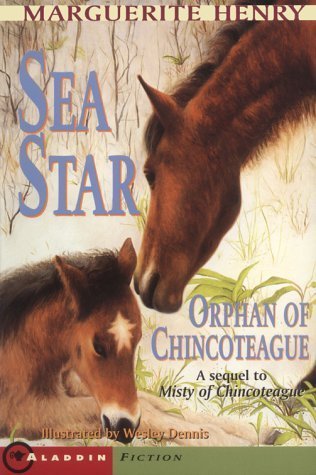
Way to betray the entire premise of your original classic, Ms. Henry.

https://i.gr-assets.com/images/S/compressed.photo.goodreads.com/books/1452289973l/1351766.jpgTitle: Sea Star: Orphan of Chincoteague
Author: Marguerite Henry
Illustrator: Wesley Dennis
Original Publication Date: 1949
Edition: Aladdin Paperbacks (1991), 172 pages
Genre: Animal Stories.
Ages: 8-11
First Line: Paul was separating each silver hair in Misty’s tail.

I’ll begin with a quote from Misty of Chincoteague to explain my frustration with this book: Now when a buyer came to look at the colts, Maureen did not run to her room as she used to do, pressing her face in the feather bed to stifle her sobs. Nor did Paul swing up on one of Grandpa’s ponies and gallop down the hard point of land to keep from crying. Now they actually led the colts out to the buyers to show how gentle they were. They even helped load them onto waiting trucks. All the while they kept thinking that soon they would have a pony of their own, never to be sold. Not for any price.

Well, that didn’t age well.

It’s a bright July day when a silver airplane lands at Pony Ranch. Movie men have come to film the annual Pony Penning, and they want to purchase Misty for the film and subsequent tour. Paul and Maureen are guilt-tripped into selling Misty in order to put their uncle through college, and are afterwards thankful to discover an orphaned colt on Assateague. Little Sea Star helps to distract them from their loss but the colt is frail and refuses to eat – it’s up to the whole Beebe family to find some way to save the poor thing.

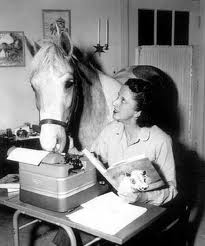
https://missmollys-inn.com/wp-content/uploads//2012/12/Marguerite-Henry-misty-of-chincoteague.jpeg
Marguerite and Misty.

Marguerite Henry had no plans to write a sequel to Misty of Chincoteague – having taken great liberties with the true story, she thought it stood well enough on its own, at least until she heard about little Sea Star. In this follow-up novel she tried to bring the plot more in line with reality. The real Misty had actually been sold to Marguerite Henry herself, and she did bring Misty to book signings to delight children. One important difference is that the real Misty was purchased before she’d even been weaned – while Clarence Beebe had not been planning to sell her, the little foal was not a beloved family pet, hard won from the wilds of Assateague and saved up for over a hard summer’s work by the Beebe children. Misty of Chincoteague was pure poetic license, delivered in gratitude to the Beebes for agreeing to sell such a wonderful pony. The characters by the end of the book were in a different place than they’d ever been in the real world, so the follow-up act of selling Misty was impossible to replicate naturally – instead, Marguerite Henry had to devote a portion of Sea Star‘s dialogue to a series of justifications for the decision. Unfortunately, none of them are very convincing.

Now it’s worth pointing out that the novel’s dialogues are only the connective tissue between the A and B plots. With the exception of the scene where Misty is crated for the plane trip, all of the horse material is entertaining for kids – the first half details the excitement of Pony Penning Day and the last third is all about saving Sea Star. Any child who loved Misty will easily pick this sequel out in a bookstore and they will probably like most of it – while it was my least favorite of the original trilogy as a kid, I still read it multiple times. Children might not agree with the decision to sell Misty, but it’s not likely to be a total deal-breaker and they certainly aren’t going to care about the mathematics of commerce or possible communistic overtones. That being said…

So the two men from New York arrive and, upon learning that the Beebe grandparents are both out, immediately start horse-trading with the kids. First they offer the tempting good news – a movie! how exciting! – and afterwards explain that they’d have to purchase Misty to make the film happen. They also want to take her to schools, libraries and movie theaters, and start guilting Paul and Maureen:

Mr. Van Meter said, “We had a feeling you might want to share Misty with boys and girls everywhere.”
“Boys and girls who have never seen a real pony,” Mr. Jacobs continued.
It was Mr. Van Meter’s turn now. “Sometimes when I hear children in New York talk about Misty, it seems she no longer belongs to a boy and girl on an island, but to boys and girls everywhere.”
The words kept flying, back and forth, higher and higher. “Misty has grown bigger than you know,” Mr. Jacobs said. “She isn’t just a pony. She’s a heroine in a book!”

Apart from the interesting metafictional element going on here (Misty of Chincoteague is a book within the sequel to the book) this is some appalling behaviour by two grown men, and Grandpa Beebe is rightly disgusted on his return. Also, no, Misty does not “belong” to all children everywhere, the book does. But the kids fall in line and even parrot some of this back at Grandma to shore up their decision to sell. “When they told how much Misty meant to poor little city children,” says Maureen. Well, as a former “poor little city child” who dreamt of riding lessons which my parents could never afford, I would not have wanted a girl in the countryside to give up her pony so that I could spend five minutes petting it. Not to mention the cold business decision to make thousands of children momentarily happy at the expense of making two extremely sad. As Grandpa says, “livin’ out here on this lonely marshland, why, Misty’s the nighest to a friend these childern got.” Are they undeserving of the pony they worked so hard for, just because she’s famous now?

Misty sold
Wesley Dennis does a great job with a sad scene.

The picture men’s arguments fail to entirely sway the family and Grandpa gladly sends them packing. However, shortly afterwards Grandma Beebe shows up with the woeful news that Clarence Lee, Paul and Maureen’s young uncle, can’t afford the college tuition of 300 dollars to study for the ministry. The children must now nobly sacrifice their beloved pony for the greater good of the family… No, hang on, that argument is also flawed.

First of all, it hinges on a character we never get to meet. Saintly Clarence Lee does not feature in a single scene in any of the three Misty books, so it is very difficult to care about his hopes and dreams. This is a failure in terms of dramatic impact, but it would still be an understandable decision for the characters in an era when college could have a great positive impact on an entire family’s prospects – until you do the math and realise that Grandpa Beebe is being taken for a fool.

The movie men explain that their company was young and struggling and could afford to pay only two hundred and fifty dollars for Misty. So she’s a famous pony and they’re trying to get her on the cheap. Grandpa agrees to this arrangement because, after a sale he was making fell through, he’s only got 50 dollars to his name. Combined, that makes up the entire tuition fee in one fell swoop. Problem is, the deal Grandpa had lost involved selling a “whole flock” of ponies – the buyer he had lined up decided to buy used trucks instead. So Grandpa has a “whole flock” of unsold ponies, and the going rate of wild ponies back in Misty of Chincoteague was 100 dollars. In that novel it was also made clear that gentled ponies could be sold for higher price. They’re sitting on a number of ponies that could easily turn a profit and instead they sell their famous Misty for beneath her value? How has Pony Ranch stayed in business?

Also, since when is college a one-time deal? Why can’t Clarence Lee wait a year and reapply? Grandma even says he’s recovering from pneumonia, which is why he can’t be expected to earn the money for himself. If he’s that physically frail, maybe it’s not the best time to embark on a grueling course of study? Selling out a beloved family pet to be hauled from place to place (which is bound to be stressful for a pony who has never traveled before), and giving her into the care of people who see a financial meal ticket decades before the film industry enforced an animal welfare code, all because college is worth any price? This has not aged well. Attempts to parallel them putting Misty in a sale crate with Paul releasing the Phantom back into the wilds also miss the mark because the Phantom was not happy at Pony Ranch while Misty clearly is.

happy misty
Behold happy Misty.

And so Misty is sold. They don’t even write up a formal contract, just a vague promise that Misty will be sent home after the tour is over. Luckily, Henry was inspired to write a third book in the series in the 1960s, assuring new generations of children that Misty did indeed come back to Paul and Maureen – unless those children got the Aladdin Horseshoe Library box set, which went ahead and listed the books in the wrong order so that Sea Star appeared to be the conclusion to the series after all.

https://d20eq91zdmkqd.cloudfront.net/assets/images/book/large/9780/6897/9780689716249.jpg
No, I’m not bitter.
Sea Star rescued, wesley dennis
Sea Star rescued.

Within hours of Misty’s departure, Paul and Maureen find little Sea Star in a cove on Assateague, and the whole family is delighted and relieved. Once this plot is finally under way, the novel does a 180 and becomes classic Marguerite Henry – the story of an orphaned colt wasting away in sorrow, and of an injured mare pining for her own lost foal and how they are brought together to grow strong and heal the sorrows of an entire family with the help of a lot of myrtle leaves. Sea Star, with his toothpick legs and wondering expression, is adorable and Wesley Dennis’s illustrations are a wonderful accompaniment once more. There are no dubious motivations amongst the native Chincoteaguers – nope, real salt of the earth types one and all. Scrumptious food descriptions are back and there’s even some humour. The first half of the book is all but forgotten, and yet…

I don’t like giving a negative review of a Marguerite Henry book. However, since Misty worked perfectly well as a standalone, I have to say that Henry’s first instinct was right. I will say in its favour that, while I can nitpick its value system, Sea Star would actually make a tremendous vehicle for discussion with even a young child and the writing remains on the same strong read-aloud level of Misty. It’s not essential, but as I said at the start, children will still enjoy the majority of the story.

See Also: Misty of Chincoteague.

Parental Guide, with mild spoilers.

Violence: Sea Star is found beside his mother’s body, but that is hardly described. Both Sea Star and the injured mare are implied to be well on the road to recovery by the end of the book.

Values: College is worth any price. If you love something, let it go. Share your greatest treasure with the impoverished world. Love is a healing force that helps us overcome our sorrows.

Role Models: Obviously the whole plot is meant to make the Beebes look virtuous and self-sacrificing, and it’s obvious what I think about that.

Educational Properties: If it’s used as a read aloud, it could spark some strong feelings and interesting discussion. Always a good thing.

End of Guide.

I’m now halfway through the series, with one more sequel and a final spinoff volume to go.

Up Next: Back to the Anne novels.

Hans Brinker, or The Silver Skates – Mary Mapes Dodge

A history of Holland, a tour guide of the same and a novel all rolled into one. It has its flaws, but perhaps they reflect more poorly on we the modern audience than on the book itself.

https://images-na.ssl-images-amazon.com/images/I/51ozLydwHrL._SX317_BO1,204,203,200_.jpgTitle: Hans Brinker, or The Silver Skates
Author: Mary Mapes Dodge (1831-1905)
Original Publication Date: 1865
Edition: Dover Publications, Inc (2003), 276 pages
Genre: Sentimental fiction.
Ages: 11-14
First Line: On a bright December morning long ago, two thinly clad children were kneeling upon the bank of a frozen canal in Holland.

The Brinkers are the poorest family in their Dutch village, ever since the terrible day when father Raff Brinker fell from a dike, struck his head and was brought home a lunatic – an event which coincided with the arrival of a mysterious watch and the disappearance of the family’s life savings, rendering the Brinkers destitute. It’s been ten years but young Hans Brinker is determined to earn money and hire the finest doctor in Holland to attempt a cure. All the other boys and girls in the village are more excited about an upcoming race whose prize is a pair of silver skates, but Hans and his sister Gretel possess only wooden skates and could never hope to compete. A group of local boys are about to set off on a skating tour of Holland and Hans sees them off with a message to the doctor to please hurry, for his father has taken a turn for the worse…

Hans Brinker is a Victorian novel, perhaps even quintessential of all those tropes and styles now associated with that age. You’ll find the worthy poor, prolonged suffering rewarded by a sentimental conclusion, the long arm of coincidence, high culture and lengthy digressions. This is a challenging book to read, and impossible for a child to enjoy unless they have been raised on the more accessible 19th Century classics. There are ample rewards to be had, especially for homeschooling families, but fair warning must be given.

https://upload.wikimedia.org/wikipedia/commons/4/40/Portrait_of_Mary_Mapes_Dodge.jpg
Mary Mapes Dodge.

Mary Mapes Dodge had never been to the Netherlands when she wrote Hans Brinker, but she knew many Dutch immigrants to America and did scrupulous research on Dutch landscape, culture and history, crafting a novel so accurate that it actually became a rare American novel of the time period to become popular overseas, while at home it outsold all but Charles Dickens himself. Hans Brinker became an undisputed children’s classic, and Dodge contributed to children’s literature in another way by becoming the editor of St. Nicholas magazine. She took this job very seriously and attracted great writers to the magazine, serializing Burnett’s Little Lord Fauntleroy, Alcott’s Eight Cousins, Kipling’s Jungle Book and Twain’s Tom Sawyer Abroad.

Dodge’s importance to the field should not be overlooked; however, her one great novel was an odd mix of genres. The dramatic tale of the Brinker family had to share time with the sights and sounds of Holland, and since Hans and his family were far too poor to be traveling anywhere, Dodge had to devise a way to get the story out of the small town of Broek and into the great cities of Amsterdam and Haarlem. Her solution was to cut the story of Hans in half and give the middle portion of the book over to a skating tour, even adding the English boy Benjamin Dobbs to ensure that customs and monuments would receive naturalistic explanations within the text.

The skating portion is somewhat hard going for the modern reader, but the book-ending plot is designed to captivate the audience and still succeeds. The Brinkers live in dire poverty and although they are symbols of the virtuous poor, Dodge is willing to dive surprisingly deep into their inner lives. They feel real and developed, down to the smallest details like the slight religious schism between Dame Brinker and her very Protestant children, who are shocked when she considers praying to Saint Nicholas. The Dutch are not demonstrative in their affections, and thus the difference between “thee” and “thine” is of great importance to them. His mother had said “thee” to him, and that was quite enough to make even a dark day sunny. Gretel is burdened by tremendous guilt because she was only an infant when her father went crazy; having never known the real man, she is incapable of loving him the way her mother and Hans do. Even Dame Brinker is depicted as a real woman who had a life before her children were born, rather than a static mother figure. She remembers her lost husband with fondness but has carried a heavy burden which Hans is only just old enough to help with:

“When you and Gretel had the fever last winter, and our bread was nearly gone, and I could earn nothing, for fear you would die while my face was turned, oh! I tried then! I smoothed [Raff’s] hair and whispered to him soft as a kitten, about the money–where is was, who had it? Alack! He would pick at my sleeve and whisper gibberish till my blood ran cold. At last, while Gretel lay whiter than snow and you were raving on the bed, I screamed to him–it seemed as if he must hear me–‘Raff, where is our money? Do you know aught of the money, Raff? The money in the pouch and the stocking, in the big chest?’ But I might as well have talked to a stone. I might as–“
The mother’s voice sounded so strange, and her eye was so bright, that Hans, with a new anxiety, laid his hand upon her shoulder.
“Come, Mother,” he said, “let us try to forget this money. I am big and strong. Gretel, too, is very quick and willing. Soon all will be prosperous with us again.”

https://i.pinimg.com/originals/10/a4/23/10a4230fb00a1d96b1af6439e8dd5a22.jpg
From the picture book adaptation by Bruce Coville, illustrated by Laurel Long.

The family is very genuine, and this creates immediate interest in their plight. Dodge also weaves together several compelling questions around them. Will they find the money – and where on earth was it? Can Raff Brinker by cured? What’s up with the pocket watch? Who will win the race for the skates? With these looming mysteries waiting in the wings, Dodge goes in for a cliffhanger: It was a scream–a very faint scream! She then drops the plot entirely for 30 pages, at which point the Brinkers are revisited just long enough to resolve the scream incident and then are abandoned for a further 90 pages while Dodge shifts her focus to happy children on holiday.

The biggest problem with the resultant skating tour is that it is comprised of boys who are almost entirely removed from the main plot – only the leader, Peter van Holp, has any meaningful interaction with Hans, and that only happens after the party sets out. The tour also suffers from having one too many boys in tow, leaving me even at the end struggling to differentiate between Lambert and Ludwig. However, these problems being set aside, there’s actually a lot to enjoy about this portion of the novel, especially if you’re a history buff.

The 120 pages of the tour are a schoolbook tucked inside a novel. As such, it’s perfect for homeschoolers, or for anyone who wants to study Dutch history in a broader European context. Hans Brinker is a very cultured book, packed with references to explore. Dodge expects young readers to know who Handel was and to care about his visit to Haarlem, while her reference to Charles the First anticipates that children will either know or seek out further info on their own, as it brings up more questions than answers: A fresco features a number of family portraits, among them a group of royal children who in time were orphaned by a certain ax, which figures very frequently in European history. These children were painted many times by the Dutch artist Van Dyck, who was court painter to their father, Charles the First, of England. Beautiful children they were. What a deal of trouble the English nation would have been spared had they been as perfect in heart and soul as they were in form!

https://www.rct.uk/sites/default/files/styles/rctr-scale-1300-500/public/collection-online/5/0/245397-1537434105.jpg?itok=hByWl2Gp
The Five Children of Charles I, 1637 painting by Anthony van Dyck.

I read Hans Brinker as a kid, and since I never bothered to look up context for the books I read, I found it incredibly tedious. One must be willing to engage with the text or it turns into so much white noise, while the frustrated reader waits for something to happen. There are some scattered dramatic incidents along the tour, including an attempted robbery, and a surprising amount of humour (I was astonished to find a precursor to Monty Python’s Cheese Shop Sketch, in which Peter orders various foodstuffs at an inn only to be continuously told they’ve run out), but the pace is leisurely. The main purpose of this book is to transmit culture, and so it is atmospheric, descriptive and dense with Dutch inventors, physicians, painters and war heroes. It’s worth noting that English Ben squabbles with his Dutch cousin over which of their homelands is superior, yet their shared patriotism actually seems to knit them closer together rather than drive them apart.

Lambert: “I saw much to admire in England, and I hope I shall be sent back with you to study at Oxford, but take everything together, I like Holland best.”
“Of course you do,” said Ben in a tone of hearty approval. ” You wouldn’t be a good Hollander if you didn’t. Nothing like loving one’s country.”

https://regenerationandrepentance.files.wordpress.com/2014/07/dike.jpg
Engraving of Dutch boy, sadly couldn’t find artist credit.

The most famous part of Hans Brinker is actually far removed from both the A and B plots (or even the C plot surrounding the race). It is the famous story of the Dutch boy who stuck his finger in the hole in the dike and saved his town. This incident is a folktale facsimile which is apparently based on nothing, but Dodge makes it feel so credible that she convinced whole generations this was an old story – despite appearing in the text only as an English school lesson. It took on a life of its own, and Dutch Genealogy did an interesting article on the topic.

Of course, it’s just one more in a sea of digressions in this sprawling, thoughtful novel. Hans Brinker became an American children’s classic well before Tom Sawyer had appeared and a year before Little Women was published in book form, yet it has lost out to them both and is today rather difficult to recommend. The lack of streamlining which adds to the charming content of the book is now seen as a hindrance. While some aspects of the writing have dated very badly (most notably the climactic race sequence, which reads like closed-captioning in places) even at its best Hans Brinker feels like a novel whose time has passed. It makes me sad, but I’m not the one to judge, given that everything which Hans Brinker offers of interest, pathos and entertainment completely passed me by as a child. May other families have more luck.

See Also: The Adventures of Tom Sawyer, which also contains challenging prose but is far more modern in its commitment to entertainment rather than education.

Around the World in Eighty Days, another Victorian tour guide with endless asides, yet  its digressions actually propel the ridiculous plot along rather than hinder it.

Parental Guide

Violence: The most memorable portion of the story concerns the lunatic father and the family’s wretched state of poverty, including an incident in which Raff seizes his wife and holds her so near the fire her dress begins to burn, laughing all the while.

Another incident occurs on the skating trip, wherein the boys count their money in an inn’s sitting room only to have one of the other patrons sneak into their room by night, armed with a knife. The boys overpower him and the episode is played as a schoolboy adventure.

Values: The book is laced with them, from family loyalty to noble suffering – for the Brinkers, begging is never an option. Education, care of the poor, Christian piety, humility and hard work all get their due.

This bit sums up much of the era’s outlook on what a boy should be, when Peter’s group realise they’ve lost their money purse and have to return home without food. A surly boy, Carl, says “Well, I see no better way than to go back hungry.”
“I see a better plan than that,” said the Captain.
“What is it?” cried all the boys.
“Why, to make the best of a bad business and go back pleasantly and like men,” said Peter, looking so gallant and handsome as he turned his frank face and clear blue eyes upon them that they caught his spirit.

Role Models: Hans, Gretel and a variety of other children are all virtuous, with character flaws given only to Carl and a couple of girls too proud to play with Gretel – all of whom are hinted to have a harder time in adulthood because of their lack of noble principles.

Educational Properties: Fairly well demonstrated already. Besides cultural and military history, there’s also plenty of descriptions of the region’s landscape and how human engineering and endeavor wrested the land away from the sea. Of course, all of its potential is useless if it fails to engage a modern audience, so make sure its a good fit for your family.

End of Guide.

Mary Mapes Dodge has a very short bibliography, of which only this novel is remembered. Her life’s work was St. Nicholas magazine, and between that and Hans Brinker, or The Silver Skates she did a great deal to improve what was still a very new market. My work here is done and I’m glad I took the time to revisit this.

Up Next: A lengthy and regrettable hiatus for personal reasons.

The Magic Snow Bird and Other Stories – Enid Blyton

Charlotte Mason would have called this twaddle, and she’d have been right. However, twaddle is a necessary step on the road to literacy and Blyton’s contributions, seen in this sampling of her posthumous Popular Rewards short story anthologies, are so clean you can practically hear the squeak. These days, that’s refreshing.

https://www.enidblytonsociety.co.uk/author/covers/the-magic-snow-bird-award.jpgTitle: The Magic Snow Bird and Other Stories
Author: Enid Blyton (1897-1968)
Illustrator: Dorothy Hamilton (1906-)
Original Publication Date: 1989
Edition: Award Publications (1990), 192 pages
Genre: Short stories. Fantasy. Anthropomorphic fantasy. Realistic fiction.
Ages: 4-7
First Line: Once upon a time, Derry the dormouse hid a nice little store of cherry-stones in the hole of a hollow tree.

If you happened upon this particular volume out of a Blyton bibliography consisting of hundreds of books, you would find 19 stories inside of a durable hardback printed in the German Democratic Republic, with large type, plentiful illustrations and what appears to be surprisingly low-acid paper. The stories are taken in part from a 1951 collection with the same name while the rest possibly date from the same era. Of the stories, 13 are fantasy tales, 4 are realistic tales of little British children at play and 2 are anthropomorphic stories of field and farm animals. The shortest selections are 4 pages long, while the longest, ‘Bobbo’s Magic Stocking,’ runs to 50. There is a slight Christmas theme at work, in that the title story and ‘Bobbo’ both involve trips to the North Pole to visit Santa’s Workshop – however, the rest of the material lacks a proper winter theme and appears to be selected mostly for variety.

The book is trite, just as one would suspect given the cover art. The writing is simple and fond of exclamation points: How all the others laughed! Funny old Thomas–wouldn’t go out into the water with his brothers and sisters, but didn’t think twice about going up to his chin for his boat! The illustrations are not exactly subtle. The pixies sport names like Littlefeet and Scatterbrain. And yet, none of that matters because The Magic Snow Bird (and I suspect many other Blyton works) are absolutely perfect for early readers.

The stories each stand alone and are equipped with simple plots, light comedy and wholesome messages. Three basic topics are covered:

snow bird, blyton, hamilton
Snow bird and cargo.

1. Stories meant purely to delight. Fairy treats such as the titular snow bird, which takes two children to visit Santa, or a magic blackberry which grows into a whole pie. Others ignore magic and involve simple visits from wildlife, such as the story of a dormouse who decides to hibernate in a little girl’s dollhouse. These are all low-stakes adventures based on ideas that children would enjoy.

2. “Just so stories.” Blyton’s whimsical answers to questions like how holly got its spines and why the blackbird’s beak is yellow. “A pixie did it” appears to be a favorite answer.

3. Cautionary tales. Stories of foolish or naughty children learning the error of their ways, such as Bobbo, the greedy materialist who sneaks aboard the annual good children’s trip to the North Pole because elves don’t know how to do head counts. Blyton changes up the standard Santa mythology regarding such questions as how the reindeer fly:

Bobbo looked, and he saw a most enormous hill stretching up in front of the sleigh. It was very, very steep, but the reindeer leapt up it as easily as if it was level ground. The sleigh tilted backwards, and the children held on more tightly than ever. Up and up went the sleigh, right to the very, very top, and then, on the summit, drenched in moonlight, it stopped.
‘We’ve come to a little inn!’ cried one of the children, leaning out. ‘Oh, and here come six little gnomes, carrying something! What are they going to do?’
All the children leaned out to watch. They saw the gnomes come hurrying up, carrying pairs of lovely green wings. There were six pairs of these, and the gnomes knew just what to do with them.
Four of the gnomes went to the reindeer, and fastened a pair of wings on to their backs. The other two bent down by the sleigh, and the children saw that they had fastened two pairs of wings on to the sides of the sleigh as well!

cat, blyton, hamilton
Dormouse and interested neighbour.

For all that the writing is simplistic, I actually enjoyed Blyton’s imagery quite a bit. Her stories are of the halcyon 1950s and utterly reject anything approaching relevance even for the time period. Her children play hide and seek, sail toy boats and have dollhouses. Her families are automatically intact and her reference pool consists of pixies, brownies and gnomes alongside classic British plants like holly and primroses. It’s simple escapism, something for the child graduating from I Can Read books to chapter books, completely clean-cut and cuddly. I suspect Blyton was consistent in this regard – series like Malory Towers might be aimed at an older group of kids than these anthologies, but I highly doubt the content takes any darker shifts.

Now here’s where things get interesting, as librarians and educators have been waging a war against Enid Blyton for the past 50 years. It’s almost funny, given how innocuous a target she appears, and I suspect a large part of their continued bitterness against Blyton stems from the fact that she won. Her books are still massively popular, such that British publisher Hachette’s attempt to doctor the Famous Five books hurt sales so badly that they actually returned to their earlier edition in 2016. Educators and librarians fume but Blyton remains standing. Used bookstores in Britain feature whole shelves stuffed with her books (which I’ve seen firsthand) and there she stays, not on the strength of one canonized classic so much as her whole output.

Normally I would be inclined to sympathize with critics taking a stand against poor prose – however, these critics sit mute over much of the modern dross saturating the markets while insisting that bad old Blyton should be quashed. As such I suspect the “literary standards” argument was simply a handy cudgel in this instance, with the real objection being Blyton’s perpetual popularity. These heartlessly conservative and blindingly white books are still widely read today, while successive Carnegie winners and acclaimed intersectional efforts lapse into obscurity. The so-called experts have failed to turn public opinion against her for over 50 years. That’s gotta sting.

https://d.gr-assets.com/books/1320495328l/7095563.jpg
The bait-and-switch winner of 2010, perhaps?

To best illustrate why I so warmly recommend Blyton, have a quick look at the GoodReads reviews for The Very Little Princess, a Stepping Stones chapter book by Newbery Honor author Marion Dane Bauer. With its quaint title, sweet pink cover and Blytonian premise of a doll coming to life, what could possibly go wrong? Surely any parent could gift this to their daughter in full confidence and leave it at that! Yet this book ends with its young heroine being abandoned by her bipolar mother at her grandmother’s house – a grandmother she’d never met before. The packaging thus appears deeply subversive – bypassing parents and cutting them out of the conversation they should be having (and deciding when to have) with their children about such topics. And it’s not the first, the worst or the last of this trend.

For a cautious parent, researching every book you pick up for your child is an overwhelming task, which leads us back to Blyton. With her, you’re off the hook. Children love her and parents can relax around her. Oh, the horror!

Check out the Parental Guide and see what I mean.

Violence: In one story, a duckling is angry at the mean ducks on the farm and so he goes to the farmer demanding that all the ducks be killed. Mr. Farmer laughs and tells him to come back in eight weeks, since he might change his mind by then – a bit of folktaleish cynicism on display here, though it’s obvious the farmer does not intend to follow through with the duckling’s idea. The duckling is ridiculed as a fool for wishing harm on his own while seeing himself as exempt.

No other stories go near the concept of death. There are some references to scary goblins, but they never actually appear.

Values: Blyton likes to tell her audience not to be idiots. Don’t be greedy. Don’t make assumptions. Don’t lose your temper. Don’t bite your nails. Don’t be like that duckling. Meanwhile, her good children are always helpful, generous and provide shelter for local wildlife.

Role Models: Naughty children learn the error of their ways. Good children visit Santa.

Educational Properties: A fine option for reading practice.

https://www.egmont.co.uk/wp-content/uploads/2018/08/enid-blyton.jpg
Enid Blyton and dog.

As I said, this book is being recommended on faith as a stand-in for much of Blyton’s work, as the odds of finding specific titles here in America seem small. She’s not great literature – and she doesn’t have to be. She gave children stories they loved.

Up Next: A wintry children’s classic and Dutch travelogue all rolled up in one for the Christmas season: Mary Mapes Dodge.

Flower Fairies of the Spring – Cicely Mary Barker

Given that the Flower Fairy books are A: standalone, B: poetry and C: have no plot between them, I will be reviewing this series in whatever order and at whatever speed I am able to acquire them. Nothing like a dream of spring in the depths of winter…

https://i.gr-assets.com/images/S/compressed.photo.goodreads.com/books/1309213072l/245680.jpgTitle: Flower Fairies of the Spring
Author: Cicely Mary Barker (1895-1973)
Illustrator: Cicely Mary Barker
Original Publication Date: 1923
Edition: Frederick Warne (2002), 42 pages
Genre: Poetry. Fantasy.
Ages: 3-8
First Line: The World is very old;
But year by year
It groweth new again
When buds appear.

Nursery rhymes are a tremendous learning tool for small children, conveying obvious skills such as memorization and predictive language, along with the specialized knowledge of how to read poetry in the first place – something of a lost art among today’s schoolchildren. Articles about the declining interest in poetry and what to do about it are a dime a dozen, and librarians are forever extolling the virtues of the trendiest middle-grade novels in verse, when the simplest remedy would be to avoid letting a child’s natural proficiency and enthusiasm for Mother Goose atrophy in the first place, via a fairly straightforward progression of English poets.

By providing the natural stepping-stones of Milne, Lear, Kipling and Stevenson, a gradual link would then be made to the classic narrative verse of Browning’s ‘Pied Piper of Hamelin,’ Rossetti’s ‘Goblin Market‘ and Tennyson’s ‘The Lady of Shalott,’ which are themselves not so far removed from romantics like Coleridge and Keats (and once a young person can read those poets, they would be able to progress both forwards and backwards in time from there with no real difficulty). Aside from the Classical Christian website, I couldn’t find a single educator advising this obvious curriculum to get kids reading poetry, probably because it would be way too white for today’s classrooms – thus they deny heritage to some children while offering mediocrity to all. In fact, educators love these new novels in verse specifically because the word count is lower and therefore they can be used to encourage “reluctant readers.” Now picture someone saying that Paradise Lost is simpler than Moll Flanders or that The Waste Land is an easier read for students than The Great Gatsby and you can imagine how topsy-turvy this whole educational trend really is.

https://thewesterncornerofthecastle.home.blog/wp-content/uploads/2019/12/52f10-05windflower.jpg
The Windflower Fairy.

This leads me to the Flower Fairy books of Cicely Mary Barker, which could easily fit on a young child’s poetry curriculum. Barker was an artistic invalid who took correspondence courses to become a painter while her older sister supported the family by opening a kindergarten in their house. Taking inspiration from Kate Greenaway and the Pre-Raphaelites, Barker began a series of children’s poetry books, most famously on the subject of fairies. Fairies were all the rage in the 1920s, enjoying heightened publicity thanks in part to the Cottingley Fairy photographs – and of course the Pre-Raphaelites hadn’t been immune to the lure of fairies either, which made it a natural subject for a book of botanical children’s poems. Queen Mary herself admired the results. At some point I will find a complete set of the little books, but for now this first one will have to suffice.


Every open page of this pocket-sized book contains a portrait of a fairy child with the flower he or she represents and on the facing page an ode to the flower in question. Her fairies were modeled by interested children from the household kindergarten, giving each character an individual appearance which combine over the book into a harmonious image of the English schoolchild of the 1920s. They are bright and happy, yet shy. They are impudent and proud and pleasant. They are beautiful, they are the generation who would grow up to endure the Second World War, and they are captured here fancifully and forever.

https://www.bing.com/th?id=OIP.A29LuxycpoD6TG5w_0VL8AHaLa&pid=Api&rs=1
The Dandelion Fairy.

Each costume for the fairies was based around the flower to be illustrated, which Barker would faithfully paint from real specimens. The costumes were where true flights of fancy would occur, and Barker created physical costumes and wing miniatures to paint, drawn from the different parts of the plant with rewarding detail. As an American, the flower I was most familiar with in this book was the dauntless dandelion and so it was his costume I most closely examined, discovering botanical inspiration from cuffs to shoes to the very shades of green and gold. Every portrait has this level of care, and the result really does have the feel of Pre-Raphaelites for toddlers.


Barker’s artwork is only half the volume, and the accompanying poems are every bit as enjoyable, particularly for parents who are big fans of Victorian poets. I could read this book aloud dozens of times and the poems would only become more engaging due to their mellifluous and leisurely rhythm. This is a book that rewards repetition.

https://www.bing.com/th/id/OIP.V2EcwpaQ-aaJhRwq0VgdDQHaLS?pid=Api&rs=1
The Daffodil Fairy.

I’m everyone’s darling; the blackbird and
    starling
Are shouting about me from blossoming
    boughs;
For I, the Lent Lily, the Daffy-down-dilly,
Have heard through the country the call to
    arouse.
The orchards are ringing with voices
    a-singing
The praise of my petticoat, praise of my
    gown;
The children are playing, and hark! they are
    saying
That Daffy-down-dilly is come up to town!


This collection is best suited for nature-oriented families, those with English gardens or wildflowers of their own to hunt and observe, for the poems are not narrative, meaning Barker will always be more niche than someone like Beatrix Potter. Nevertheless, these pages cover a variety of imaginative ground, some simply descriptive of the flowers themselves while others take to their viewpoint, like that of the cheerful daffodil. ‘The Song of the Lords-and-Ladies Fairy’ ends with a fierce warning likely to stick in its young audience’s mind and keep them from getting poisoned:
And my berries are a glory in September.
(BUT BEWARE!)

Meanwhile the Willow-Catkin admonishes:

To keep a Holy Feast, they say,
They take my pretty boughs away.
I should be glad– I should not mind–
If only people weren’t unkind.

Oh, you may pick a piece, you may
(So dear and silky, soft and grey);
But if you’re rough and greedy, why
You’ll make the little fairies cry.

There’s star imagery in the Windflower Song, there’s a little Mother Goose to Sing a song of Larch trees and the shortest poem in the lot is the humble ode to the Lesser Celandine. Over it all hang the twin centerpiece of the King and Queen of Spring, who are unfortunately not placed side by side in the middle of the book as they should be by rights. The Primrose has a simple charm and grace while the Bluebell (Wild Hyacinth in this case, not Scottish Harebell) is proud and superb.

https://i.pinimg.com/originals/ae/f8/55/aef8556c9c149bfe6be2ed6bb6947708.jpg
The Bluebell Fairy.

My hundred thousand bells of blue,
    The splendour of the Spring,
They carpet all the woods anew
With royalty of sapphire hue;
The Primrose is the Queen, ’tis true.
    But surely I am King!
            Ah yes,
    The peerless Woodland King!


Loud, loud the thrushes sing their song;
    The bluebell woods are wide;
My stems are tall and straight and strong;
From ugly streets the children throng,
They gather armfuls, great and long,
    Then home they troop in pride–
             Ah yes,
    With laughter and with pride!

https://i.pinimg.com/originals/3b/5b/6f/3b5b6f3b615843f9645c70f0e0933333.jpgOut of curiosity I made a list of the poems to see how often the rhyme schemes and templates repeated, to find that there were no exact replicas. When Barker reused a rhyme scheme she would change the number of stanzas, ensuring that every rhyme had its own face. I expect some repetitiveness would start to appear in the seven companion volumes but for now everything is very fresh, and in truth I would be very surprised if the artistic quality of subsequent installments ever dropped. Highly recommended to all English and Anglophile families.

Parental Guide, with no spoilers for once.

Violence: Completely inapplicable.

Values: English country flowers, landscape, children and folkways. Pre-Raphaelite influences.

Role Models: The children depicted are idealized, which is one of the chief purposes of art that has now been forgotten – to inspire.

Educational Properties: Memorization, recitation and elocution. Use for inspiration to plant and tend an English garden or to take a nature walk (in the right parts of the world) to hunt for the flowers – I’ve seen a number of them here in New England. Families who make their own doll costumes or other textile or artistic crafts might want a copy even if they hate poetry.

End of Guide.

I hope to acquire a complete set of the Flower Fairy books sometime soon, at which point I will make a full review series. I’m very happy to have stumbled upon this English gem I missed in my Anglophile childhood.

Up Next: Staying British with Enid Blyton.