Historical Fiction: Black Duck

All authors of historical fiction should make proper scholarly use of the Author’s Note – no matter what age group they’re writing for. Aside from that, this is an entertaining novel that only took me a day and a half to read.

https://thewesterncornerofthecastle.home.blog/wp-content/uploads/2019/08/29adf-blackduckjacketfront.jpgTitle: Black Duck
Author: Janet Taylor Lisle (1947-)
Original Publication Date: 2006
Edition: Philomel Books/Sleuth (2006), 252 pages
Genre: Historical Fiction. Mystery.
Ages: 10-12
First Sentence: Newport Daily Journal, December 30, 1929: COAST GUARDS KILL THREE SUSPECTED RUM RUNNERS.

It’s 1929, Rhode Island, and rum running is in full swing, with every local family forced to pick a side – easy money on the wrong side of the law, or ratting out the neighbours to what could be the crooked side of the law. Teenagers Ruben and Jeddy are best friends but Jeddy’s father is the local police chief while Ruben’s father is slowly getting ensnared in the bootlegging industry, despite his efforts to remain neutral. One day, Ruben and Jeddy find a dead man in an evening suit washed up on the beach, but by the time they’ve returned with a cop the body’s vanished. Ruben made the mistake of searching the body and soon finds himself plunged into the dangerous underworld of the rum runners, who think he’s taken something valuable from the corpse. Isolated from Jeddy as well as his own father, Ruben gains a new ally in the dashing captain of the Black Duck, the most elusive of the smugglers, but one whose tiny local outfit is threatened by the encroaching big-city operations. Ruben, in way over his head in a world of warring criminal factions and shifting loyalties, becomes the only witness to a terrible night on the water…

https://www.janettaylorlisle.com/images/photos/jtl_sunroom_300dpi_bw.jpg
Janet Taylor Lisle.

This middle-grade novel by Janet Taylor Lisle (who won a Newbery Honor in 1990 for Afternoon of the Elves) is based on the true story of the Black Duck, the fastest rum running vessel on the Rhode Island coast, which was caught by the Coast Guard on the 29th of December in a dense fog. The Coast Guard opened fire on the cabin and three of the four man crew died, while the captain lost a thumb and later insisted that no warning had been given before the authorities opened fire. Given they were ambushed in a fog right after a pick-up of liquor, it seems fairly likely that someone tipped off the authorities to the Black Duck’s whereabouts, but in the end nothing was ever proven and, despite local outrage, the Coast Guard was cleared of all wrongdoing in the incident. Lisle changed this story in a few significant ways, and there will be more information on that in the Parental Guide.

Obviously there is plenty here to hang a novel on, and Lisle makes use of an interview framing device to help propel the plot and its mystery, as a teenager interviews elderly Ruben about the events in his youth, interspersed with (fictional) newspaper clippings about the Black Duck, raising new questions as Ruben answers the old. Lisle knows how to use a hook of the old-fashioned kind when she ends her chapters: There were probably ten perfectly legal reasons why Police Chief Ralph McKenzie would be up late counting out stacks of money at his supper table. I just couldn’t right then think of what they might be. The plot thickens constantly and involves multiple factions beyond a simple cops vs. criminals outlook, with small local outfits, big time operators muscling in, crooked cops on the take, and civilians trying and often failing to stay clear of the whole mess. It’s a rich soup of conflicts, secrets and betrayals. The rum running world is shown in perfectly comprehensible detail – anything that won’t fit organically into Ruben’s story gets brought up in the interview sections – with the governing laws and nighttime operations easy to understand.

https://i0.wp.com/www.traveltourismblog.com/images/Rhode-Island-Mohegan-bluffs-coast.jpg
A rocky stretch of Rhode Island coast.

I’d never been on the beach at Brown’s, though I’d passed it going upriver on the Fall River boat a couple of times. It was a natural cove sheltered by a dip in the coast, a good place for a hidden landing. When I rode up, about twenty men were already there and a bunch of skiffs were pulled up on the beach, oars set and ready. The place was lit up bright as day with oil lanterns planted on the beach and car headlights shining across the sand. When I looked across the water, I was astonished to see a freighter looming like a gigantic cliff just outside the blaze of lights. It was in the process of dropping anchor. I soon found out that she was the Lucy M., a Canadian vessel that usually moored outside the twelve-mile U.S. territorial limit of the coast to avoid arrest.
The way the Prohibition law was written, the Coast Guard couldn’t touch an outside rig, since it was in international waters. So ships from Canada and the West Indies, Europe and Great Britain would lie off there, sell their liquor cargos and unload them onto rum-running speedboats like the Black Duck to carry into shore. Sometimes as many as ten or fifteen ocean-going vessels would be moored at sea, waiting to make contact with the right runner. “Rum row,” these groups of ships were called. You couldn’t see them from land, but you knew they were out there lying in wait over the horizon. It gave you an eerie feeling, as if some pirate ship from the last century was ghosting around our coast.
I couldn’t believe the Lucy M.‘s captain would be so bold as to bring her into Brown’s, where any Coast Guard cutter in the area could breeze up and put the pinch on her. Nobody at Brown’s seemed worried about it, though, and unloading operations soon commenced.

Lisle’s writing is very straightforward and plain, lacking the richer textures and colours of great historical fiction, but she’s good at telling an exciting story and she doesn’t pack Black Duck out with a load of extra gritty details – no foul language, graphic violence or nasty medical conditions – to artificially propel her middle grade story into the reach of the larger young adult market.


One drawback to the novel is a lack of emotional weight. By rights, the story should be perfect for it, with death and betrayal centered around the broken friendship of two boys. However, Jeddy retreats into the background halfway through the book and is barely glimpsed after that, mitigating the impact of subsequent events. It’s a pity, as their relationship is well-drawn, with a tense mixture of small lies and family loyalties pulling them apart. Once that happens, though, Ruben is left fairly isolated save for his visits to the local hermit, Tom, and his interactions with Jeddy’s older sister Marina, whom Ruben is besotted with.

Marina is referred to on the dust jacket as “strong willed,” but I found it refreshing that Lisle did not make use of her as a cynical back door invite to girl readers – you know, “look, there’s a girl helping the boy protagonist and she’s just as important to the story, so please buy this book because boys don’t read enough anymore…” Marina’s role in Black Duck is closer to that of the good girls in old noir films than to a modern “strong female character.” In other words, Marina is not dressing as a boy and moonlighting with the Black Duck crew.

Ruben’s own character development proceeds along the classic path – he starts the story naive, seeking excitement and resenting the steady job he has waiting in his future, feeling unappreciated by his father and jumping at the offer of twenty bucks no matter the source. However, following the fate of the Black Duck’s daredevil crew, well…
A sadder and a wiser man
He rose the morrow morn.

https://englishromanticism.files.wordpress.com/2013/03/the-rime-of-the-ancient-mariner-by-gustave-dorc3a9-jonnard-engraver-plate-2-the-wedding-guest.jpg?w=750
The Ancient Mariner and the Wedding Guest, from the wood-engravings by French artist Gustave Dore.

My final thoughts on Black Duck could best be summed up by calling it decent. This sounds like a terribly low bar, but it’s an important one in these days of constant envelope-pushing. Lisle’s book is entirely suitable light reading, mixing an intriguing time period with a mystery format. It’s perfect for kids who enjoy the historical genre. However, it lacks staying power, and I would strongly recommend making it a buddy read with Farley Mowat’s The Black Joke, which looks at the rum running business from the Canadian side of things. Together the two books would offer a neat crash course in the coastal landscape of Prohibition for homeschooling families, and with that I offer a new category in my reviews:

See Also: The Black Joke by Farley Mowat, set in the early 30s off the coast of Newfoundland, considerably better written yet also far more boat-centric.

Onwards to the Parental Guide, packed with spoilers and historical links today.

Violence: The original corpse in the water is thusly described: Above it, swathed in a shawl of brown seaweed, a rubbery-looking shoulder peeked out, white as a girl’s. Above that, a bloated face the color of slate; two sightless eyes, open. And there in his neck, what was that? I saw a small dark-rimmed hole. … I went forward and felt around, trying not to brush up against the corpse’s skin. It had a cold, blubbery feel that turned my stomach. The murderers come back later, toting machine guns and killing Tom’s old dog because they tripped over her. The boys, hiding further down the beach and thinking that Tom’s been killed, come upon the scene after the gangsters leave.
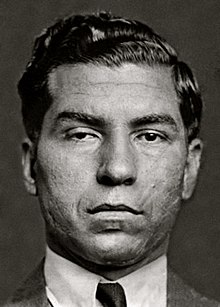
https://upload.wikimedia.org/wikipedia/commons/thumb/1/1b/LuckyLucianoSmaller.jpeg/220px-LuckyLucianoSmaller.jpeg
Italian gangster Lucky Luciano has a brief cameo.

Ruben gets kidnapped by the villains later, and then re-abducted by a bigger New York crew, who toss him into the back of the getaway car so roughly that he strikes his head on something and spends a considerable amount of time bleeding all over the place. After being rescued, he becomes the fictional fifth member of the Black Duck, who shelters in the tarp-covered lifeboat while listening to the gunfire above.

Lastly, Marina is a pretty girl. Ruben’s crush is obvious but never vulgarly described. A crooked cop takes an interest in Marina, and gives her a ride in his car under false pretenses. When he pulls over, she exits the vehicle immediately and flags down another driver to get home. Marina keeps this a secret, with the takeaway being she doesn’t think anyone would believe her side of the story. This whole sequence feels somewhat shoehorned into the plot, but it’s nowhere near as disturbing as Julie of the Wolves.

Values: Lip service is paid to good cops, but every single one in this story is crooked in some way or other, including Jeddy and his dad.

There’s some family dysfunction on display, though it’s fairly mild for modern youth literature and Ruben actually gets over his resentment of his straight-laced father. In fact, there’s a parallel between Ruben and his young present-day interviewer David, as they both chafe against working in the family business. Ruben came to accept it, and it’s shown how the friendship that develops over the interviews appears to have a good influence on young David.

The Black Duck crew is heavily romanticized and fictionalized, becoming an outlaw crew with Robin Hood allure: They were local men from local families with a need to make ends meet during hard times, different altogether from the big-city syndicates that were beginning to bully their way into the business at that time. Many folks quietly cheered them on around their supper tables, proud that one of their own could outsmart both the government and the gangsters. Their status as good guys makes their fate more impactful, but it’s also a questionable interpretation of events. More on that under Ed. Properties.

Role Models: This whole novel is about murky ethical dilemmas that the young teens at the heart of the story aren’t sure how to navigate. This is apparently a recurring theme in Lisle’s fiction. In consequence, Ruben, Jeddy and Marina flail around and never really come up with any answers to their questions. Jeddy clings with absolute loyalty to his father, ignoring all evidence against him. Marina falls in love with the Black Duck’s captain and says “if you have to make a choice, you do what’s best for the people you love,” but finds out that isn’t really an applicable rule when those “people you love” are in conflict. Ruben decides to move on with a civilian life while trying to forgive everyone involved in the Black Duck incident. Ruben’s got some old-school pluck, but his naievety and trusting nature get pretty frustrating after a while, coming across as willful blindness (like Jeddy’s) that he really can’t afford. It’s actually quite realistic.

Educational Properties: Okay, Lisle changed all the names of the crew of the Black Duck. Her captain is a fellow named Billy Brady, a daring and enterprising young man with a grassroots operation. It’s no wonder Marina’s in love with him. The real Black Duck was owned by a guy called Charlie Travers. Interesting switch takes place here – Charlie was the sole survivor of the shooting, whereas Lisle’s Billy is killed and a minor character survives instead, doubtless to increase the emotional factor.

https://i0.wp.com/www.newenglandhistoricalsociety.com/wp-content/uploads/2015/01/solomon-solomon.jpg
Russian-Jewish gangster Charles Solomon.

Charlie Travers does appear to have started out as a hotshot kid, reworking the Black Duck’s engine to get up to 32 knots and proving nearly impossible to catch. However, he was a shady figure, becoming the partner of Max Fox, one of Charles ‘King’ Solomon’s lieutenants. Solomon was Boston’s answer to Lucky Luciano, being heavily involved in narcotics and bootlegging, gambling, prostitution and witness intimidation. When he died, Max Fox was one of the men who acquired his divvied-up territory. So if this Charlie Travers person was independent and local, he didn’t stay that way for long. Since Lisle changed all the names (except of the boat itself), this might not seem like important information, but I do feel that Lisle should have clarified her changes in the Author’s Note at the end, Ann Rinaldi style, given that this novel is inspired by real accounts. When Lisle has Marina say of the Black Duck’s crew “they kept clear of the syndicates and they didn’t carry guns,” she’s referring to the fictional Billy Brady, but what reader would know that without looking up the original newspaper clippings?

Therefore, in addition to Black Duck‘s excellent use in a study on Prohibition, I think it could also work as a demonstration of how stories can be retold and repackaged with opposing facts – historical references to machine guns and “King Solomon” become fictional references to unarmed men avoiding the syndicates. It’s kind of like Island of the Blue Dolphins (and oh, suddenly I can’t wait to unpack that “true story”).

End of Guide.

Lisle has a fair number of books out and I would be quite content to try a few more as I see them. I was surprised to find that Black Duck is her most popular work on GoodReads, but like I said, it’s both entertaining and decent, and post-millennium, decency is the first hurdle that any youth literature has to clear, at least on the Western Corner of the Castle…

Up Next: Teenage paranormal romance. Set on the west coast. Published in 2005. No, it’s not Twilight.
Adventure Novels: Adventures of Huckleberry Finn

If you loved The Adventures of Tom Sawyer for its prose or its characters or even its brand of humour, then I have some bad news for you. Adventures of Huckleberry Finn (whose loss of the definite article has always been a pet peeve of mine) is not a true sequel or even a companion volume to that first installment – rather, it is a wholly separate entity piggybacking on The Adventures of Tom Sawyer to that novel’s and its own detriment. Bear with me as I wrestle my sprawling notes into form, as this will be almost twice as long as my regular reviews…

https://images-na.ssl-images-amazon.com/images/I/517SX7S197L._SY291_BO1,204,203,200_QL40_.jpgTitle: Adventures of Huckleberry Finn
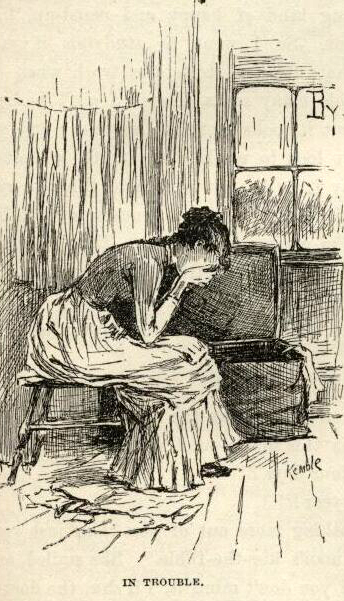
Author: Mark Twain (1835-1910)
Illustrator: Edward Winsor Kemble (1861-1933)
Original Publication Date: 1884
Edition: New Riverside Editions (2000), pages 69 to 320 of 392 pages.
Genre: Adventure. Humour. Historical Fiction.
Ages: 14-17
First Sentence: You don’t know about me, without you have read a book by the name of “The Adventures of Tom Sawyer,” but that ain’t no matter.

I owe a great deal of the following information to the contextual material included in the New Riverside Edition, specifically ‘The Composition of Adventures of Huckleberry Finn‘ by Victor A. Doyno and ‘Introduction to Adventures of Huckleberry Finn (1958)’ by Henry Nash Smith. Smith incidentally cautions against what I am about to do when he says “a book so clearly great, yet with such evident defects, poses a difficult critical problem. There is little profit in making a mere checklist of faults and beauties. We must try to see the book integrally.” There are apparently rules to reading Huckleberry Finn. I didn’t know this and it is now considerably too late for me to start playing by them.
https://thewesterncornerofthecastle.home.blog/wp-content/uploads/2019/08/057bb-mark-twain-.jpg
Mark Twain.

So to really understand the artistic debacle that is this novel, we have to start with a recap not of the plot, but of its very creation. Mark Twain began work on it in 1876, upon completing Tom Sawyer and got the plot well underway before losing steam and setting the manuscript aside for several years. In the meantime he went to Europe, got irritated at the aristocracy and wrote The Prince and the Pauper. Between 1879 and 1880 he returned to Huckleberry Finn and wrote the middle portion of the work, filled with feuds, charlatans and angry mobs. He also added a ‘Snicket Warning Label’ to the front of the book (more on that in a moment), presumably not willing to spend the extra time reworking part one to match up with his new interests and themes in part two. Then he lost interest and put the manuscript aside for another three years. Twain finally finished it up from 1883 to 1885, tagging on the ending – which is famously reviled even by those who in the same breath call Adventures of Huckleberry Finn the Great American Novel. To be fair, he also went back into the early portion and added the eerie sequence set on the wreck of the Walter Scott, which provides a window into what the whole book could have been had he pursued further revisions. Instead, he sent it to print and made some quick cash.

Now, about that warning label. NOTICE: Persons attempting to find a motive in this narrative will be prosecuted; persons attempting to find a moral in it will be banished; persons attempting to find a plot in it will be shot. Does ironic self-criticism ward off or negate external criticism? It certainly seems to have worked for Twain, at least as far as the plot warning goes.

The plot I’m not supposed to look for begins in a very straightforward manner: Huck flees from his abusive father, runs into escaped slave Jim and they decide to drift down the Mississippi on a raft to the mouth of the Ohio River. Jim will then be able to make his way north to freedom, Huck will be safe from his father finding him and there’s just one problem: Mark Twain didn’t know about the Ohio, he knew about the lower Mississippi and that’s what he wanted to write about. His solution to this problem of plot versus intention was for Huck and Jim to travel in a fog, overshoot the Ohio and have to find a canoe to get back up the river. Fair enough, but Twain then ceased to care about his original story at all. For a large portion of the book they have acquired a canoe and yet they just keep drifting down the Mississippi against all logic because Twain was unwilling to go back and rework his early material to fit his new direction. He had also conceived an antipathy to The Adventures of Tom Sawyer at some point in all this, which perhaps explains his slow work on the follow-up and certainly explains the new and improved Tom Sawyer we get in the finished product.

https://www.raptisrarebooks.com/images/52070/adventures-of-tom-sawyer-mark-twain-first-edition-signed-1876-rare.jpg
Tom Sawyer from the first edition frontispiece.

If you really loved Tom in his book, there is pretty much nothing for you here. The clever and admirable boy is completely gone and his superstitions and make-believe have now transformed into an inability to tell the difference between fantasy and reality. The problem is very obvious if you read the two novels close together: Tom explains quite cogently what “ransom” means at the end of The Adventures of Tom Sawyer, while in the opening chapters of Huckleberry Finn he is suddenly clueless about the word, saying “per’aps if we keep them till they’re ransomed, it means that we keep them till they’re dead.” I read the scene carefully to see if maybe Tom was pranking his friends in some way, but no, it’s just a lengthy and not terribly funny joke on Twain’s part. Tom is now just as ignorant as his peers and can’t even comprehend the stories he so avidly devours. His pranks are cruel and actively dangerous. The boy who testified to save an innocent man from execution, delaying to the last moment from fear, now makes revelations for “dramatic effect.” His code, his better qualities, are all gone.

On the other hand, if you really thought Tom was just a brat in his book, but loved The Adventures of Tom Sawyer for the writing, there is still little for you here. Twain trades in the larger-than-life narration that was a big part of Tom Sawyer‘s charm and turns to the first-person American vernacular. This is a historic moment in American literature and I’m certainly not saying it’s a bad decision or the wrong choice to make – it just further distances the two volumes from each other. Many people read Huckleberry Finn first, or never get around to Tom Sawyer because “it’s just a kid’s book,” and I suppose doing so would negate several of my criticisms. Huckleberry Finn breaks so thoroughly away from its predecessor in form, character and content that being a sequel actually does it a disservice. Here’s a taste of Twain’s excellent use of the vernacular, from Huck’s time spent abducted and living up in the woods with his father:

He kept me with him all the time, and I never got a chance to run off. We lived in that old cabin, and he always locked the door and put the key under his head, nights. He had a gun which he had stole, I reckon, and we fished and hunted, and that was what we lived on. Every little while he locked me in and went down to the store, three miles, to the ferry, and traded fish and game for whiskey and fetched it home and got drunk and had a good time, and licked me. The widow she found out where I was, by-and-by, and she sent a man over to try to get hold of me, but pap drove him off with the gun, and it warn’t long after that till I was used to being where I was, and liked it, all but the cowhide part.
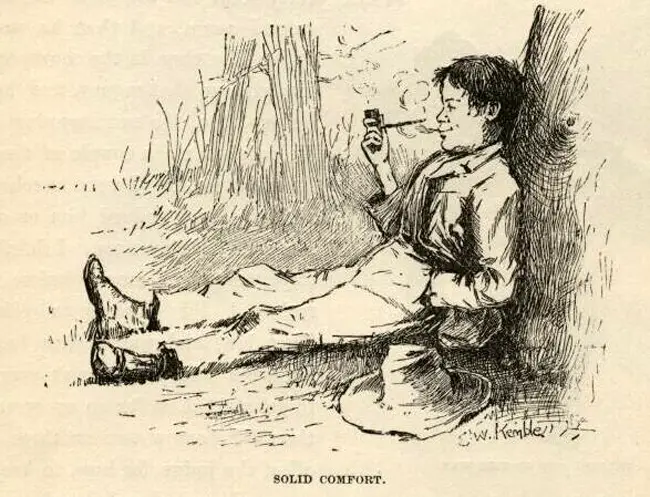
It was kind of lazy and jolly, laying off comfortable all day, smoking and fishing, and no books nor study. Two months or more run along, and my clothes got to be all rags and dirt, and I didn’t see how I’d ever got to like it so well at the widow’s, where you had to wash, and eat on a plate, and comb up, and go to bed and get up regular, and be forever bothering over a book and have old Miss Watson pecking at you all the time. I didn’t want to go back no more. … It was pretty good times up in the woods there, take it all around.

https://flaglerlive.com/wp-content/uploads/huck-solid-comfort.jpg
Huck having a good time, E.W. Kemble illustration.

After Huck escapes down the river with Jim he revels in his new freedom – a freedom that looks almost identical to the above passage, the ability to loll about and do nothing all day rather than build a new life for himself. Always moving but never going anywhere, and that’s before the raft gets hijacked by the so-called King and the Duke, a pair of charlatans that Huck and Jim put up with while they go from town to town playing a variety of con games. At this point in the novel, Huck and Jim have a canoe, they could easily give the charlatans the slip and make a getaway and they don’t because it’s too much trouble. If I never learnt nothing else out of pap, I learnt that the best way to get along with his kind of people is to let them have their own way. So they continue to clock in the miles down to Arkansas.

My opinion of this novel would actually be fairly high if I could believe that this was the point. After all, being worthlessly free on a raft and going south to go north have merit for satire, but none of this seems to have been Twain’s intention. I can’t find any critics taking up the idea that Huck and Jim are meant to be comic figures of incompetent fun. Twain doesn’t spend very much of his time mocking the two of them – they are the good guys in this story, society’s outcasts, and Twain clearly despises society. His Mississippi feels more like the River Styx a lot of the time. Twain’s disgust is very genuine – this is the man who expressed approval for both French and nascent Russian revolutions in the last years of his life – and this explains his treatment of Tom Sawyer as well. Tom can get along with society and succeed in it, which seemingly makes him part of the problem in Twain’s eyes.

The moral conviction of the book does have the desired effect at points. The Grangerford-Shepherdson feud is one of the best portions, with Huck arriving amongst the well-to-do Grangerford family and, with sincere admiration in his heart, accidentally ridiculing their lifestyle, including the Mortuary School of poetry, in the obituary verse and paintings left behind by a deceased daughter of the family. Huck pores over them and concludes: Everybody was sorry she died, because she had laid out a lot more of these pictures to do, and a body could see by what she had done what they had lost. But I reckoned, that with her disposition, she was having a better time in the graveyard. When the Grangerfords are wiped out in a day, Huck watching in horror from a nearby tree, it matters to the reader because it mattered to Huck. I ain’t agoing to tell all that happened–it would make me sick again if I was to do that. I wished I hadn’t ever come ashore that night, to see such things. Emotional impact is similarly gained during the charlatans’ lengthy con of the Wilks’ daughters, because Huck cares for virtuous Mary Jane Wilks and hates to watch the game go down. This adds some tension to the tale, especially when he becomes proactive for her sake. There are things that are good about this book, but they are overshadowed more and more heavily by flaws as the plot progresses to its insane conclusion.

https://flaglerlive.com/wp-content/uploads/twain-huck-finn-kemble-28a.jpg
Poor Mary Jane gets put through the wringer.

Regarding the King and the Duke, Twain’s wholehearted commitment to satire on this outing damages one of the most successful features of Tom Sawyer, namely a credible villain. Injun Joe was a terrifying psychopath and far scarier than anything Twain serves up in this technically darker work, because now every evil is dished up with a load of vaudeville humour alongside. Pap is one of the worst fathers in literature, and Huck’s situation with him is grim and alarming, but pap is not that frightening because Twain is clearly showing him up as a slack-jawed moron the whole time. The charlatans are even worse, one introducing himself as “the rightful Duke of Bridgewater” and the other following up with saying he’s the “rightful King of France” and then he said it often made him feel easier and better for a while if people treated him according to his rights, and got down on one knee to speak to him, and always called him “Your Majesty,” and waited on him first at meals, and didn’t set down in his presence till he asked them. So Jim and me set to majestying him, and doing this and that and t’other for him, and standing up till he told us we might set down. This done him heaps of good, and so he got cheerful and comfortable. Twain’s humour in the previous volume relied mostly on verbal wit which was sophisticated enough to sail over kids’ heads much of the time. Huckleberry Finn features far more broad comedy, both backwoods humour and slapstick. If you like that better, you’re in luck, but from my point of view it’s not an improvement.

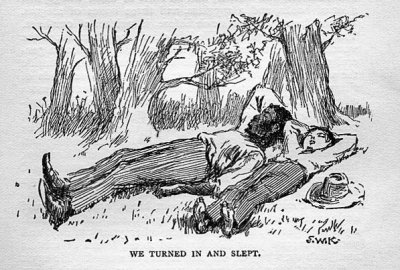
https://a4.pbase.com/g9/09/268309/3/160638773.xDDv4MGd.jpg
Huck and Jim asleep after a hard night’s drifting.

There is one single element of Adventures of Huckleberry Finn that works perfectly: the evolving friendship of Huck and Jim, and Huck’s changed attitude regarding Jim’s status as a slave. Yes, Huck’s battle with his conscience is riveting and tremendously realistic. His famous decision to “go to hell” and commit to the crime of stealing a slave is a great moment in American literature. It’s also only two pages long. Alas, alack, the Huck and Jim relationship is a subplot. Everyone talks about it and I was going to pitch in with my praise but since I’ve broken the other rules of reading Huck Finn I might as well break this one too.

However, at least reading the book has finally cleared up one mystery for me. It is now very clear why the ALA continues to defend Adventures of Huckleberry Finn with such energy, when no other old children’s book qualifies; no, I do not consider a negative defense a real one. The story of Huck Finn is a blueprint for many of the young adult (and now middle grade) themes the ALA loves to champion: Huck is from a broken home, he must make his own way and pointedly not learn from his elders who are all morally compromised and/or bankrupt. Instead, he joins forces with an outsider in society, who is a far better role model in every way. Huck’s most important character trait is compassion (I would have said lying, but if the Jim story is the most important part of the book, Huck’s lies are incidental to his changed view of Jim) and being caring is today’s cardinal virtue, rather than being courageous, strong, intelligent, honest, hard-working or decisive. Meanwhile, white society is a rotten structure with racism just the cherry on top – unlike Tom Sawyer or Little House or other old books the ALA mostly ignores these days, where an independently reading child might not even notice the racism and prefer to admire the good qualities being shown instead. This is indeed remarkably modern.

Last things last, we come to the artist’s solution to his problem of plot. Keep in mind it took him eight years to come up with this. Spoilers beyond.

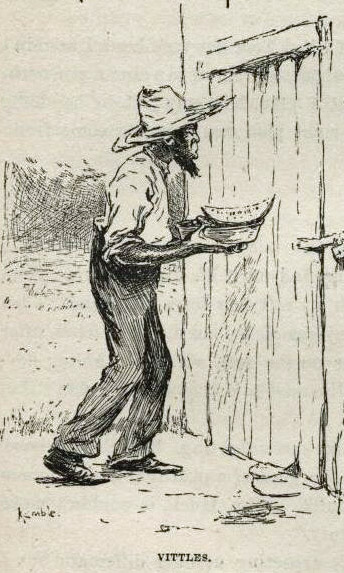
https://flaglerlive.com/wp-content/uploads/c34-293.jpg
The shed Jim gets stuck in for roughly a quarter of the novel.

Huck and Jim have drifted eleven hundred miles away from St. Petersburg, Missouri when the charlatans have a streak of bad luck and do the natural thing: hand over Jim for the “reward money” from an invented flybill. Huck has his final crisis of conscience and commits to saving Jim, tracking him to a little one-horse cotton plantation owned by one Silas Phelps. Then, in the most outrageous Dickensian twist I think I’ve ever read, this man turns out to be Tom Sawyer’s uncle and Huck gets mistaken for Tom, who just so happens to be expected down for a visit. Huck ropes in Tom to help free Jim and the infamously stupid jailbreak plot ensues – basically, to reenact the great escapes from The Count of Monte Cristo and the like. This is justly criticized; however, nobody ever gives Tom’s plan credit for at least being lightyears ahead of Huck’s proposal. The following paragraph is legitimately the funniest part of this whole book and I’ve bolded the important bits:

“My plan is this,” I says. “We can easy find out if it’s Jim in there. Then get up my canoe to-morrow night, and fetch my raft over from the island. Then the first dark night that comes, steal the key out of the old man’s britches, after he goes to bed, and shove off down the river on the raft, with Jim, hiding daytimes and running nights, the way me and Jim used to do before. Wouldn’t that plan work?

I almost laughed till I cried. To think I complained about Tom’s drop in intelligence when Huckleberry Finn now has the collective I.Q. of a ham sandwich and a jar of mayonnaise.

https://i0.wp.com/huckleberry.pbworks.com/f/thinking_it_over.jpg
Please stop.

It would have been so, so easy for Mark Twain to fix this if he even pretended to care. JUST GET RID OF THE CANOE. Seriously, this book is supposed to be loaded with metaphorical significance, and what better than for the one thing that should be common along the river, the key to the north and freedom, to be so elusive that they are forced to drift south, sustained by the hope that today there’ll be an unguarded or drifting canoe that will turn everything around for them. This is the laziest fix possible – I can see why he might not have wanted to overhaul the whole thing by having Jim part with Huck at the Ohio, or turn the whole book on its head by starting down at Phelps’s plantation and going up the river, but he could have done something. Why are you asking me to accept this plot as the work of a genius? Oh right, because I’m not supposed to talk about the plot, I’m supposed to talk about Jim.

https://flaglerlive.com/wp-content/uploads/c42-355.jpg
Golly gee, the little sociopath sure knows how to enjoy himself.

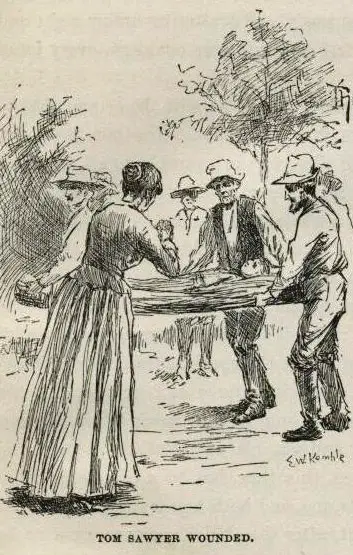
Anyway, Twain wasn’t done with his masterpiece yet. After Tom’s ludicrous escape plan is ruined, he gets shot in the leg and Jim gets recaptured. Tom then reveals that Jim’s been freed this whole time – his owner had a crisis of conscience on her deathbed – and Tom set the whole escape plan up just to have some fun.

Well, at least someone is.

But why limit yourself to one twist, or even just two, when you could really knock em down with a third whole plot twist? On the last actual page of this lunatic book, Jim reveals to Huck that his evil pap is dead – the body they found in an early night on the river, which Jim didn’t let Huck get a look at, was pap all along, and Huck could have gone home anytime after that. Who cares if the likelihood of stumbling over Huck’s dead dad was fairly minute? I mean, does probability even matter after the convergence of Tom, Huck, Jim and Uncle Silas on a patch of land in Arkansas? Who cares if this reduces Huck’s entire journey and the traumas he’s endured to a shaggy dog story? Who cares if this turns Jim, previously a caring father-figure to Huck, into a selfish manipulator of a poor child? Or maybe this was just Twain’s way of saying that there truly is nothing good in American society after all? What a twist!

End Spoilers.

It’s possible I would have a more favorable opinion of Adventures of Huckleberry Finn if I hadn’t already read Pudd’nhead Wilson, another of his late works where he did the exact same thing – started one story, lost interest, switched focus (this time completely) and instead of going back and starting over, he rushed his comedy-turned-tragedy-turned-detective-story to print for fast revenue. I am well aware that Mark Twain had financial difficulties. So did a lot of great writers, yet they somehow stuck to their artistry – often at the expense of family and friends, though some of them even had day jobs. Twain’s talent and innovation are here placed at the service of rank commercialism, for why else would he persist in a sequel to a work he had lost interest in? Because The Adventures of Tom Sawyer had become a popular novel, so much that he later knocked out two more short sequels starring these beloved characters, sequels which everyone agrees were pure commercial product.

https://i.pinimg.com/736x/17/93/19/17931907345bc34062dafffd88db9567--huckleberry-finn-classic-books.jpg
The iconic first edition.

My personal response to this novel was so strongly negative that I find it impossible to fairly judge it as part of the Castle Project. I do not know what kind of a reaction it would get from young readers, beyond pointing out that many, many people do love this book and seem to find it a gripping story. The only thing I can state for certain is that it is a superfluous sequel in that outside of Huck himself, the second book offers no real continuation of the material in the first and is not necessary to complete the experience. If you stick to The Adventures of Tom Sawyer as a stand-alone, it’s not going to hurt anything.

Parental Guide, which I will keep brief.

Violence: Drunken abuse from pap, a family feud ending in massacre, a ghost story about a dead baby, a man shot down in the street, a couple of angry mobs forming, an incident of tarring and feathering, gold being hidden with a corpse in a coffin, casual references made to animal cruelty, murder, drownings, cruel pranks and crueller cons, much talk of slavery and copious quantities of the word “nigger.” I might be forgetting something. All is told in a tone of mixed humour and disgust not generally associated with youth literature until fairly recently.

Values: Black people are human beings and should no more be slaves than anyone else. Society is a disease. Human beings can be awful cruel to one another, as Huck thinks late in the book.

Role Models: Huck lies, steals and passively watches the King and the Duke rip off town after town before becoming proactive for the sake of Mary Jane. Jim briefly becomes the best character in the book right after the charlatans sell him, when he quite logically pays them back by spreading word about their con game, leading to them finally getting the tar and feathering they so richly deserve. Given that they betrayed a guy who could squeal on them and didn’t even have sense to blow town afterward, it’s extra satisfying. And yes, Huck and Jim together on the raft in harmony is truly a lesson to us all – though given how things literally go south for them I’m not sure I want to unpack that metaphor.

Educational Properties: Most people use this to discuss race relations in America but I expect you know by now what I’d suggest: a structural autopsy.

End of Guide.

There are two more (thankfully short) books in the Tom Sawyer series and I do already own them. Since the third volume, Tom Sawyer Abroad, gives me some Jules Verne vibes, I’m scheduling Around the World in Eighty Days for next month. This will hopefully give me some time to recover myself and gain some at least morbid curiosity for the remainder. I am genuinely shocked by just how much I hated this book, given how rewarding I found Tom Sawyer.

Up Next: I’m leapfrogging right over the 20th Century and into the 21st at last, with a work of historical fiction by Janet Taylor Lisle.

Anthropomorphic Fantasy: Charlotte’s Web

I never read Charlotte’s Web growing up and have vague memories of disliking the animated movie, but having read it at last I must conclude that it is in fact worthy of all the praise it has received.

https://i.gr-assets.com/images/S/compressed.photo.goodreads.com/books/1506253069l/11124601._SY475_.jpgTitle: Charlotte’s Web
Author: E.B. White (1899-1985)
Illustrator: Garth Williams (1912-1996)
Original Publication Date: 1952
Edition: Harper Trophy (1973), 184 pages
Genre: Anthropomorphic fantasy.
Ages: 5-8
First Sentence: “Where’s Papa going with that ax?” said Fern to her mother as they were setting the table for breakfast.

Wilbur the pig is born a runt, saved from an untimely death by the intervention of eight-year-old Fern Arable, who raises him on a bottle until he’s big enough to sell. He’s bought by her uncle Mr. Zuckerman, which is awfully nice at first since Fern visits him almost every day, but it soon turns out Mr. Zuckerman intends Wilbur for future dinners. Only the clever spider Charlotte can save Wilbur from his fate.

Charlotte’s Web won a 1953 Newbery Honor; it’s often considered the most grievous oversight of the Newbery committee that it lost to Secret of the Andes. Based purely on the writing I have to suspect that it should have carried the Newbery Medal that year, but I withhold further judgement until I actually read Secret of the Andes. E.B. White here far outstrips what he was doing in Stuart Little, with distinct voices for every animal on the farm, from pig to spider to rat to geese. He achieves a truly perfect level of repetition, enough to feel sonorous without impeding the actual flow of the story. The structure is episodic enough for good bedtime material but the actual plot is very tight, with natural rises and falls in the drama, and a final bittersweet triumph. It introduces children to the nature of death but also to rebirth and the regenerative cycle of seasons and progeny. It is, in short, a perfect read-aloud. You could adapt whole chapters into picture books and almost every line would be capable of sustaining a new image. From Chapter IV, Loneliness:

The next day was rainy and dark. Rain fell on the roof of the barn and dripped steadily from the eaves. Rain fell in the barnyard and ran in crooked courses down into the lane where thistles and pigweed grew. Rain spattered against Mrs. Zuckerman’s kitchen windows and came gushing out of the downspouts. Rain fell on the backs of the sheep as they grazed in the meadow. When the sheep tired of standing in the rain, they walked slowly up the lane and into the fold.

https://i.pinimg.com/236x/80/05/58/80055881f97eb2c6875f8c7fce73a4c8--garth-williams-charlottes-web.jpg
A haughty lamb refuses to talk to Wilbur, from Garth Williams’ illustrations.

The novel is gorgeously agrarian in focus without being sentimental. White understood farming and, aside from a strange bias against lambs in this book, is more than willing to address mother nature fairly. Charlotte may be the sweetest spider in all of literature, but she’s a bloodsucking predator and that’s not glossed over. While no direct parallel is ever made between her nature and that of humans, it’s definitely something I picked up on. Charlotte anaesthetizes her victims so they don’t feel pain; farm animals (until the advent of factory farming) would generally lead very comfortable lives and then be quickly killed. Charlotte’s nature brings death to other beings, but she has the gifts of intellect, artistry and compassion, and chooses to exercise them, saying “perhaps I was trying to lift up my life a trifle.”

Charlotte also becomes a mother figure for Wilbur, protecting and comforting him while also instilling some education on subjects big and small. She has a lovely vocabulary and is often explaining words to Wilbur; unlike Lemony Snicket, this never comes across as patronizing on the part of the author.

Wilbur walked into his yard just at that moment.
“What are you thinking about, Charlotte?” he asked.
“I was just thinking,” said the spider, “that people are very gullible.”
“What does ‘gullible’ mean?”
“Easy to fool,” said Charlotte.
“That’s a mercy,” replied Wilbur, and he lay down in the shade of his fence and went fast asleep.

https://www.thefamouspeople.com/profiles/images/e-b-white-4.jpg
E.B. White.

White takes every opportunity that he can to layer language and give his young audience as much raw material as he can without interrupting his story. He morphs into a thesaurus: The rat had no morals, no conscience, no scruples, no consideration, no decency, no milk of rodent kindness, no compunctions, no higher feeling, no friendliness, no anything. He adds a touch of math: Mr. Arable gave Fern two quarters and two dimes. He gave Avery five dimes and four nickels. Yes, they did name their son Avery Arable. He even introduces a little Latin to the small fry, as Charlotte says: “It is my egg sac, my magnum opus.” And in what I thought was the funniest part of the whole book, White transforms a verbal tic (his geese repeat words when they talk) into a spelling joke, with a bonus obscure medical condition of history thrown in:

Charlotte: “Does anybody here know how to spell ‘terrific’?”
“I think,” said the gander, “it’s tee double ee double rr double rr double eye double ff double eye double see see see see see.”
“What kind of an acrobat do you think I am?” said Charlotte in disgust. “I would have to have St. Vitus’s Dance to weave a word like that into my web.”

The language jokes work much better than the occasional slapstick sequence, but then I’m not a fan of slapstick. Aside from this minor flaw, Charlotte’s Web is quite perfect, in both writing and story. After my recent revisit with Stuart Little, I am pleased to find this book such a rich, well-rounded experience that fixes every problem that first novel contained. The characters are more memorable, the world-building is comparatively sane and White really threads the needle with his brand new addition of an actual ending: Wilbur and Charlotte earn thematically rich conclusions to their tale, but the final message of Stuart Little – that life is not tidy – is revisited rather than directly contradicted. For all Templeton’s importance to the rescue of Wilbur, White is scrupulously honest with his small readers about the nature of some people in the world and the rat never repents or has any change of heart, remaining exactly what he was introduced as – a bastion of greed, malice and self-interest – to the end.

https://spaceintext.files.wordpress.com/2010/12/templetons-egg-charlottes-web-page-46-illustration-1952-gm-williams.jpg
Templeton under the disapproving eyes of the local animals and Fern.

It should be obvious that this gets a very high recommendation from me and I’m very happy to see that this is one vintage children’s book that remains on everyone’s radar, secure from either focused attack or general amnesia at present.

Parental Guide. Spoilers ahoy for anyone who doesn’t know the ending.

Violence: Charlotte dies in the end, and it’s plainly telegraphed for several chapters beforehand. Kids who haven’t had any prior exposure to the subject of death in fiction might be as shocked as Wilbur is, but I think most could figure out what’s inevitable. It is still very moving at any age though. No one was with her when she died.

On a more cheerful note, I was impressed with the subtle comeuppance for Templeton’s selfishness. He refuses to help save Charlotte’s children until Wilbur bribes him with the promise of first go at the pig trough… forever. Wilbur keeps his promise and we last see Templeton eating his way to an early grave. Forever won’t be lasting too long in this case and Sun Tzu would be proud of this pig.

Values: Charlotte saves Wilbur through cleverness, the power of words – and knowing who to bribe to get things done around the farm.

https://i0.wp.com/api.ning.com/files/kV4MbYiv7oSxHFJWLwFCPCf6i9ZYGHMph46ms1kDgjKFn-an-4w%2AkvBeJWpLJY-Gpnz%2At2SgWFfx1sbjkUcp1VLT%2A-mX81Hx/1082054003.jpeg
Wilbur at the fair, humble to the last.

White chooses to focus on the unsung animals of the farmyard – pigs, spiders and rats – while the cute and cuddly lambs are proud and ill-mannered. Humans are by and large gullible and capricious. Fern saves Wilbur yet loses interest in him by the end of the book while her brother Avery, indifferent to animal welfare theretofore, takes over her vacated role during Wilbur’s hour of triumph at the fair.

Role Models: Readers tend to focus on Charlotte, and I’ve already covered her finer attributes. I would like to focus on Wilbur here. He’s a passive figure for much of the novel, friendly and happy to be directed by other characters. He remains humble despite being a figure of great interest but he’s easy to overlook and seemingly incapable of ever repaying Charlotte for saving his life – until the end, where he does actually save her, by saving her egg sac. They’re leaving the fair and the grounds will be deserted through the winter, making it crucial for Wilbur to think on his feet, and he does find a way to return her children to the farm. Once spring arrives, most of the baby spiders depart but three remain and carry on Charlotte’s lineage, and the generations continue to live comfortably in Zuckerman’s barn, hearing stories of their great ancestress – all owing to the humble pig Wilbur.

Educational Properties: Aside from the lingual elements, this category is not really applicable or necessary. Read it aloud and talk it over. Save the homework for other books.

End of Guide.

One more of E.B. White’s books to go, due in September and earnestly anticipated.

Up Next: Back to Tom Sawyer’s world with Huckleberry Finn and my first impressions of this towering giant of American literature are going to be a whole lot less favorable. Stay tuned.

Adventure Novels: Shane

A great introduction to the western, although if you don’t like westerns this will not do much to convince you otherwise.

https://i0.wp.com/images.wolfgangsvault.com/shane/book/memorabilia/ZZZ032594-BK.jpgTitle: Shane
Author: Jack Schaefer (1907-1991)
Original Publication Date: 1949
Edition: Bantam Pathfinder Editions (1966), 119 pages
Genre: Western. Adventure. Historical Fiction. Coming-of-Age.
Ages: 12-15
First Line: He rode into our valley in the summer of ’89.

In the year of 1889 young Bob Starrett’s parents, Joe and Marian, take on a well-dressed drifter as a farmhand. Shane’s past is unknown but he quickly becomes a loyal friend to the Starretts and they need his help when local cattleman Luke Fletcher decides he’s had enough of all the new homesteaders crowding “his” range. Joe refuses to sell out and encourages his neighbours to stand strong, at which point Fletcher decides to intimidate the Starretts into leaving town, taking more and more violent steps to acquire the homesteaders’ land. The settlement is so small they don’t even have a sheriff to defend them and suddenly Shane’s hidden talent for violence is the only thing protecting the Starretts from losing everything they’ve worked so hard to build.

https://i0.wp.com/d.gr-assets.com/authors/1342979492p5/150701.jpg
Jack Schaefer.

Shane is a classic western of the old unreformed school. Published originally in slightly shortened form in Argosy magazine in 1946, it appeared in book form in 1949 and was an instant hit, securing its place in the “western” canon and (although far less known today) it has remained in print ever since. Jack Schaefer had never been out west at this point in his life, but he had been to Oberlin College and could write reasonably well. All westerns are myth, Shane is just more appreciative of that fact. Everything from the gunslinger to the family to the land – and the hulking stump disfiguring it – is a part of Schaefer’s grandiose myth of the west.

So Shane arrives, riding a lone trail out of a closed and guarded past, and immediately takes over the entire novel. He’s a marvelous creation: courteous, fastidious, tense, always alert. His first action after going from guest to hired hand is to commandeer father Joe Starrett’s place at the table. Joe lets it pass without comment but Bob is puzzled at first. I could not see any reason for the shift until the first time one of our homestead neighbors knocked on the door while we were eating and came straight on in as most of them usually did. Then I suddenly realized that Shane was sitting opposite the door where he could directly confront anyone coming through it.

https://cdn0.wideopencountry.com/wp-content/uploads/2017/01/shane.jpg
Shane from the 1953 movie does not appear to dress in black, wrecking the novel’s fundamental image. Hollywood….

Shane is calm and controlled and he knows a lot about guns but never carries one. His background is murky but it’s also not really the driving mystery of the novel – this is not a soap opera where Shane’s dark past literally blows into town as an outlaw with a grudge or a lost love from back east, and indeed the one person in town who recognises Shane packs and leaves immediately, with no explanation ever given. Shane’s past is never brought to light and it doesn’t have to be because it’s fairly obvious that he’s marked as different – everyone can sense he’s a dangerous man, one with a talent for violence. He might have good manners and make a good farmhand but he’s outside of civilization and can’t just cozy his way back in; indeed the very thing that separates him from the farmers and shopkeepers of civilization is imperative to its defense. This cements Shane as a tragic figure, even if Bob is too young to really understand why.

To Bob, Shane’s simply a child’s hero, who knew what would please a boy, including letting Bob sneak into town with him when there could be trouble lying in wait:

I was afraid father would stop me, so I waited till Shane was driving out of the lane. I ducked behind the barn, around the end of the corral, and hopped into the wagon going past. As I did, I saw the cowboy across the river spin his horse and ride rapidly off in the direction of the ranch-house.
Shane saw it, too, and it seemed to give him a grim amusement. He reached backwards and hauled me over the seat and set me beside him.
“You Starretts like to mix into things.” For a moment I thought he might send me back. Instead he grinned at me. “I’ll buy you a jackknife when we hit town.”

The story isn’t about Bob or his coming-of-age, and as such it wouldn’t be considered a YA novel by modern standards, but since the market didn’t “exist” back then, I imagine a lot of kids in the 50s would have read this bestseller without any problem. Even though Bob’s role is limited to observer, he is quite important to the novel’s tone. I’ve read westerns by some of the bigger names of this time period – Zane Grey, Max Brand – and they could have done with a humble narrator to connect their taciturn wanderers with the common run of humanity. The boy’s innocence turns Shane from a mere action novel into one of men and the nature of violence – the need for steel in a civilized world.

https://thewesterncornerofthecastle.home.blog/wp-content/uploads/2019/08/e9778-shane-1.jpg
Frankly, this is more how I pictured Shane. Jack Palance for the win.

Speaking of action, this is definitely a slow burn, with no violence at all until chapter 7, page 60, and with a major portion of the first chapters devoted to an epic of stump-removal that is really not as interesting as Schaefer seems to think it is. However, the back half of Shane is filled with brawls and gunfire, and Schaefer is a dab hand at concise, easy-to-picture action. I counted only two paragraphs that fell back on the cliched vagary of a blur of movement. The rest is very clear and unmistakable in what exactly is happening when. For example, Joe Starrett’s transformation into a furious Hercules when Fletcher’s men gang up on Shane and have him pinned:

I never thought he could move so fast. He was on them before they even knew he was in the room. He hurtled into Morgan with ruthless force, sending that huge man reeling across the room. He reached out one broad hand and grabbed Curly by the shoulder and you could see the fingers sink into the flesh. He took hold of Curly’s belt with the other hand and ripped him loose from Shane and his own shirt shredded down the back and the great muscles there knotted and bulged as he lifted Curly right up over his head and hurled the threshing body from him. Curly spun through the air, his limbs waving wildly, and crashed on the top of a table way over by the wall. It cracked under him, collapsing in splintered pieces, and the man and the wreckage smacked against the wall. Curly tried to rise, pushing himself with hands on the floor, and fell back and was still.

See the source image
Edgar Rice Burroughs, 1912.

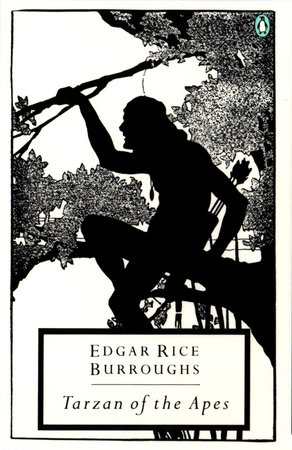
Now, this is definitely glamorized violence and some parents don’t want their kids exposed to that kind of thing, so you probably already know whether Shane is something you want in the family library. I’d put it in the same category with Tarzan of the Apes or even the original Conan the Barbarian stories, as portraits of an idealized masculinity, fiercesome yet just. Given the times we live in, current culture is far more interested in deconstructing or parodying masculine traits, or saying that these traits only look good on girls. Shane, at a certain age, is perfect light reading for boys, providing a piece of the needed counterweight to the culture they are now steeped in 24/7. Shane is not a billionaire playboy or similar juvenile power trip fantasy. He doesn’t degrade women and he retains his personal dignity in all situations. Nor does he preach pacifism only to hypocritically embrace violence at the last second; instead, he is committed to his purpose of saving the Starretts from the beginning, retaliating as soon as the cattlemen cross the line from verbal intimidation to physical harm. The traits Shane exhibits are those of classic heroes and they are shown in a healthy light that is increasingly hard to find in modern representations, where masculinity is all about ego, brute force and cluelessness. In consequence, I give it high marks and advise its inclusion on a young man’s reading list.

Parental Guide square ahead, with spoilers.

Shane and Mrs. Starrett fall in love over the course of the story, but they are unwilling to even speak on the subject until the night of Shane’s departure. Joe isn’t an idiot and is more aware of the situation than Bob is, even seeming to accept the idea that if he gets killed Shane would probably do a better job of protecting the family than he could. His comment to this effect is seemingly what spurs Shane to pack his things and take up his gun-slinging ways again. This subplot exists seemingly to drive home the loneliness of Shane’s life, as his continued presence on the farm would only harm those he cares for and risks his life defending.

Violence: Two fistfights, of which my earlier quote should help provide the tenor. Two gunfights which, in a nod to reality, involve simply drawing faster, Leone-style, rather than High Noon duck-and-dodge shootouts. And the room rocked in the sudden blur of action indistinct in its incredible swiftness and the roar of their guns was a single sustained blast. And Shane stood, solid on his feet as a rooted oak, and Wilson swayed, his right arm hanging useless, blood beginning to show in a small stream from under the sleeve over the hand, the gun slipping from the numbing fingers. These scenes are short, but they are what the entire book is building towards.

The villains might say “hell” occasionally, but Joe Starrett speaks only in a steady stream of “by Godfrey’s.” One line of bad movie innuendo spoken by soon-to-be-dead Wilson: “You wouldn’t like someone else to be enjoying this place of yours–and that woman there in the window,” regarding Mrs. Starrett.

Values: If you uphold the Second Amendment, this is your kind of book, as Shane tells Bob that “a gun is just a tool. No better and no worse than any other tool, a shovel–or an axe or a saddle or a stove or anything. Think of it always that way. A gun is as good–and as bad–as the man who carries it.”

Land is identity, to be prized, not given away without a fight. This is not a deconstructed western. Man’s capacity to conquer the elements is given its ode through the Epic of the Stump. A worthy cause justifies violence and the show of power. A beating can improve a man’s character – young Chris (one of Fletcher’s boys) gets his arm broken by Shane and goes straight as a result. There’s poetry in the violence and a joy of being alive and released from long discipline and answering the urge in mind and body.

Role Models: I think I’ve covered that aspect thoroughly enough already. A boy’s hero and an unbreakable family unit.

Educational Properties: The clash of cattleman and farmer – life, business and economic reality in the old west. Towns, how they sprang up, thrived and sometimes perished overnight. There’s a lot of real history mixed up with the western and that’s well worth exploring.

End of Guide.

Jack Schaefer did move out west eventually, settling in Santa Fe and writing material that he had more experience with. He stuck to westerns for all the Shane fans, and I don’t plan on pursuing any of them as I expect they fall well outside the purview of this blog. However, he also won a 1961 Newbery Honor for a book called Old Ramon, and I’ll be keeping my eyes out for that one.

Up Next: No coy clues this time. It’s Charlotte’s Web, everyone.

Fantasy: Time Cat

Apologies for formatting errors that I can’t seem to fix in this post.

Lloyd Alexander’s first novel for children is a tour guide of slightly cat-centric history and a promise of things to come. This bibliography is going to be fun.

See the source imageTitle: Time Cat
Author: Lloyd Alexander (1924-2007)
Original Publication Date: 1963
Edition: Puffin Books (1996), 206 pages
Genre: Fantasy. Historical Fiction.
Ages: 7-10
First Line: Gareth was a black cat with orange eyes.

A somewhat immature boy named Jason is sulking in his room after a bad day when his cat Gareth decides to speak to him. Jason (whose last name is never given, but I expect it’s probably Little) accepts this easily enough – Jason had always been sure he could if he wanted to and it’s left at that. However, he is surprised when Gareth shares a feline secret with him: cats don’t have nine lives, but they can visit nine lives, and Gareth has only been waiting for an “important reason” to do so. Jason gets to come along on a trip from Ancient Egypt to the American Revolution, learning about cats, people and life along the way.

Time Cat is a fairly perfect independent read for kids who are ready to tackle books without any illustrations. It’s a good standalone tale with adventure, humour and a cool premise: when cats disappear from a room they have actually gone time traveling. Short segments sustain the action, an occasional slimy villain pops up to threaten Jason and the situations he lands in are different enough from one to the next that any child should be fully entertained. Incidentally being introduced to the writing of Lloyd Alexander is just a bonus for down the road. Of course, Time Cat‘s very excellence for young kids dooms it to a fairly short shelf life, as it is so broadly sketched as to be soon outgrown in favor of deeper fantasy and historical narratives. That’s as it should be and it is certainly worth all 100+ Magic Treehouse books, and will do far more good for a child’s vocabulary, imagination and shelf space. To give an example: in Italy, 1468, Jason meets a boy called Leonardo (hint, hint) who shows him his room – the sort most scientifically-minded boys have probably wanted at one time or another.

Inside, Jason looked with amazement–tables crowded with piles of paper; collections of butterflies, rocks, pressed flowers. A squirrel raced back and forth in a small cage. In another cage, a sleepy green snake lay coiled. Great bottles and jars held clumps of moss and long-tailed, speckled lizards. From another bottle, a few fish stared at the inquisitive Gareth.
On a table, Leonardo had set a water bottle over a candle flame. “Did you ever notice how the bubbles come up?” Leonardo asked. “I’ve been watching them. There must be something inside, something invisible–I don’t know what it is. Perhaps the philosophers in Florence know and some day I’ll ask them. First, I want to try to find out for myself.”

https://www.johnnytimes.com/wp-content/uploads/2016/08/a-cat-by-leonardo-da-vinci.jpg
Detail from Cats in Motion, 1513-16 pen-and-ink by Italian artist Leonardo Da Vinci.

A quick rundown of places visited: The obvious cliche and weakest segment in ancient Egypt where cats are worshipped as gods; time spent tramping with the Roman legionaries before getting captured by some agreeable Britons; meeting a medieval Irish princess (with red-gold hair and a penchant for chatter, by the way) and a dignified slave by name of Sucat; teaching Japanese boy-Emperor Ichigo to stand up to his Regent, Uncle Fujiwara; meeting young Leonardo Da Vinci in Italy as he tries to convince his father that he’s an artist, not a notary; hanging out in post-Pizarro Peru; greeting the original Manx cat as she washes ashore on the Isle of Man; trying to avoid a nasty death in witch-burning Germany; and finally taking the rural tour of America in 1775.

https://upload.wikimedia.org/wikipedia/commons/7/7d/Manx_by_Gambier_Bolton.JPG
A historical photo of a Manx cat by photographer Gambier Bolton.

Almost every segment is two chapters long and everywhere they go Gareth imparts some fortune cookie wisdom like “even a kitten knows if you wait long enough someone’s bound to open the door.” Jason isn’t very proactive on their journey – whatever age he is, it’s apparently too young for active military service. Instead, he observes people and learns about life from them, to return home a steadier and wiser boy. Fantasy novels have a natural aspect of initiation and this one is no different, as Gareth points out at the end that he took Jason with to help him grow. There’s even a (very mild) sacrifice come journey’s end before Jason returns home in a cross between the movie version of The Wizard of Oz and Where the Wild Things Are.


Time Cat was Lloyd Alexander’s first novel for children after a string of flops, including a translation of Sartre’s La Nausée, which got roasted (along with Nausea itself) by Vladimir Nabokov. The moral: aim high and at least the giants themselves shall smite you. Alexander finally changed gears as he neared forty, and later described writing Time Cat as “the most creative and liberating experience of my life.” There’s a real joy that comes through the book, as it’s so clear that Alexander was simply enjoying the freedom of his new path in life. He loved cats, so they feature prominently. His villains are an entertaining series of oily and absurd caricatures, with the German witch-judge a standout:


The eldest judge, a bony, black-robed man with a lantern jaw and eyes as sharp as thorns, shuffled through some parchment sheets on the table. “We have studied your cases thoroughly,” he began, licking his lips, as if tasting every word.
“You’ve had no time to study anything,” shouted the miller.
The judge paid no attention. His little eyes turned sharper than ever as he read from his parchments.
“The accused witch, Johannes the miller: guilty.”
“The accused witch, Ursulina: guilty.”
“The accused witch, Master Speckfresser: guilty.”
“One demon disguised as a boy disguised as a demon: guilty.”
“One demon disguised as a cat: guilty.”
The judge set down his papers. “You will be burned at the stake in the morning. Believe me,” he added with a smile, “this is all for your own good.”

https://thewesterncornerofthecastle.home.blog/wp-content/uploads/2019/07/dda3e-lloyd2balexander.jpg
Lloyd Alexander.

Alexander’s writing is comfortable and witty, although it’s not quite polished enough to qualify as a great read-aloud on this early outing. He tosses around historic images like favorite toys, expecting kids to grasp the concept of centurions and Imperial Obeisance through context, rather than interrupting the plot to explain different factoids. Because of this it’s very light on educational material compared with more modern historical fiction for the same age group, and it has recently received some pointless criticism for cultural stereotyping. Honestly though, it’s for eight year olds. Try capturing a child’s imagination by explaining how the Incas were “exactly like you and me,” and see how much they remember about the subject in a month. We always begin with the broadest stereotypes, gaining detail and nuance as we grow up – so the Incas are memorable because they have llamas, while the Egyptians worship cats and ancient Britons wave spears around. Such details are memorable and interesting to a young child, and then swiftly outgrown as their reading naturally progresses.

Time Cat is simply a delightful experience at the right age. I read it avidly at around nine or so, and then within a couple of years I had moved on to Alexander’s far more mysterious Rope Trick. It’s easy to recommend and, while I don’t know exactly how consistent a writer Lloyd Alexander was over his long career, I’m looking forward to finding out.


https://i0.wp.com/img2.wikia.nocookie.net/__cb20110830042922/lloydalexander/images/3/3e/Time-Cat.jpg
My original copy of the book.

The Parental Guide up next, with some spoilers as always.

Violence: Death hangs over Jason’s head multiple times, including three threats of getting burned alive, but he never sustains any injury and after the danger is brought up it’s always swiftly negated. There are no other casualties until the final segment, when the likable Professor Parker is hit by British fire, though it’s never clear if he dies, since this is all we get: He smiled and tried to pull a shilling out of Jason’s ear, but his hand went slack and the coin dropped to the earth.

It is mentioned that cats are regularly killed in 1600 Germany, but none of the animal characters in the book suffer any harm. If you’re wondering, the “sacrifice” I mentioned Jason makes upon returning home is that Gareth will no longer be able to speak to him, but they will still understand one another without words.

Values: Sucat in the Ireland segment has a secular role, but it is revealed in a rather solemn moment at the end that Jason has actually just met Saint Patrick.

Cats are life’s great treasure, and this is not the last time Alexander would write a supremely cat-centric fantasy. In fact, it ends up such a trademark of his that I’m fairly surprised he kicked off his Prydain Chronicles with the hunt for an oracular animal of the porcine persuasion.

Monarchy is a fairly suspect arrangement in Time Cat, with rulers in general portrayed as ridiculously isolated from their subjects.

During the quiet story on the Isle of Man, Gareth states that everyone is pretty if they have pride in themselves, demonstrated by Dulcinea the Manx cat who doesn’t envy Gareth his tail. He also states the theme of Alexander’s career heretofore: “Trying to make someone do what they aren’t really good at is foolish.”

The most eye-rolling bit is easily when Sayri Tupac the Great Inca lets Jason and Gareth (being held for ransom) go because Don Diego the Spaniard gives a mushy speech about peace and understanding between cultures. “Understanding is better than gold,” says Sayri Tupac. Well, it was the sixties…

Role Models: Jason is a completely bland character; while he improves on his journey, it’s mostly by observing other, more interesting people. Gareth is a better creation, wise and unflappable, and when it’s time to save the princess, it’s Gareth who battles and slays the threatening serpent.

Educational Properties: The historical sketches are very light on detail, so even though you could tie the characters of Ichigo and Uncle Fujiwara to their real counterparts, it really belongs in the entertainment and fluency pile.

End of Guide.

Alexander’s books appear with some frequency at my local used bookstore, and I will be acquiring them whenever I can. As always, I invite those who’ve read more of his work than I have to share their opinions.

Up Next: Going for a classic western, and an example of what young adults were probably reading in the 1940s.

Coming-of-Age Stories: Anne of Avonlea

A lovely follow-up to a great classic that stays true to the characters and doesn’t manufacture drama to keep their lives interesting – preferring to develop new characters for that purpose. Don’t miss it.

https://thewesterncornerofthecastle.home.blog/wp-content/uploads/2019/07/db407-anneofavonlea.jpgTitle: Anne of Avonlea (Anne Novels #2)
Author: L.M. Montgomery (1874-1942)
Original Publication Date: 1909
Edition: Bantam Books (1998), 276 pages
Genre: Coming-of-Age.
Ages: 10-16
First Line: A tall, slim girl, “half-past sixteen,” with serious gray eyes and hair which her friends called auburn, had sat down on the broad red sandstone doorstep of a Prince Edward Island farmhouse one ripe afternoon in August, firmly resolved to construe so many lines of Virgil.

The immediate success of Anne of Green Gables inspired L.M. Montgomery to the swift production of a sequel, published the following year, and taking up almost immediately where the previous installment ended. Anne Shirley, having given up on college to help Marilla, finds joy and purpose in her newly public role in Avonlea, both as the new schoolteacher and as head of the Avonlea Village Improvement Society. Two new orphans are brought to Green Gables, she befriends Avonlea’s most reclusive spinster and, still being Anne, gets into a new series of absurd predicaments as she matures and finds that her path not taken may yet meet up on the road ahead. Yet again, the pacing is episodic and I must warn you that readers holding out for the famed Anne/Gilbert romance will find L.M. Montgomery cruelly indifferent to their wishes, for that major subplot from volume one is almost wholly absent here.

Anne of Avonlea is a slow, comfortable book. Odd as it is to associate Anne of Green Gables with drama and uncertainty, in hindsight this was certainly the case. Anne as a newcomer was never wholly secure and questions, such as whether Marilla would let her stay or whether the Barrys would allow her and Diana to remain friends, gave the novel some stake. In the sequel Anne knows her place and has a teenager’s insufferable certainty of right and wrong. She takes up teaching with ease and she sails into whatever task is at hand full of fresh theories and ideals. This self-confidence becomes something of a plot point in itself, for in the first hundred pages Anne almost loses herself in her new calling as Avonlea’s saintly beautician.

https://i0.wp.com/digital.library.upenn.edu/women/garvin/poets/montgomery.gif
Lucy Maud Montgomery.

Luckily, Montgomery was not blind to her heroine’s foibles and set her a losing battle with human nature in her efforts to win over sullen student Anthony Pye with a simpering “kill him with kindness” approach. The resolution to their battle of wills could not be rendered today with our changed views on corporal punishment but the messy human dynamic is inspired, as Anne betrays her ideals in a fit of pique while the boy responds respectfully to a display of power – because that is what he understands and respects, not an artificial kindness. The next morning finds Anne heartily ashamed of herself, when she runs into Anthony, who to her bewilderment tips his hat and carries her books to school. Anthony walked on in silence to the school, but when Anne took her books she smiled down at him … not the stereotyped “kind” smile she had so persistently assumed for his benefit but a sudden outflashing of good comradeship. Anthony smiled … no, if the truth must be told, Anthony grinned back. A grin is not generally supposed to be a respectful thing; yet Anne suddenly felt that if she had not yet won Anthony’s liking, she had, somehow or other, won his respect.

Elsewhere, Marilla’s decision to adopt a local pair orphan leads to the saga of Davy and Dora, six year old twins who luckily don’t upstage Marilla – she is given plenty of opportunities to be her wonderfully pessimistic self, perhaps even more so than in the first volume owing to Anne having rendered her virtually shock-proof. With Anne despondent after a hoped-for guest fails to appear, Marilla’s response is perfectly in keeping: “You’ll probably have a good many more and worse disappointments than that before you get through life,” said Marilla, who honestly thought she was making a comforting speech. The twins provide fresh havoc for Green Gables as Marilla quickly discovers that a six year old boy is a wholly different creature from an eleven year old girl – Dora, a prim, quiet child, ends up being little heeded while Davy monopolizes the attention of the women, and they play favorites to an extent that actually made me feel bad for Dora.

“Marilla, it may be a dreadful thing to say, but honestly, I like Davy better than Dora, for all she’s so good.”
“I don’t know but that I do, myself,” confessed Marilla, “and it isn’t fair, for Dora isn’t a bit of trouble. There couldn’t be a better child and you’d hardly know she was in the house.”
“Dora is too good,” said Anne. “She’d behave just as well if there wasn’t a soul to tell her what to do. She was born already brought up, so she doesn’t need us; and I think,” concluded Anne, hitting on a very vital truth, “that we always love best the people who need us. Davy needs us badly.”

https://i0.wp.com/great-authors.albertarose.org/mark_twain/novels/the_adventures_of_tom_sawyer/images/01-019.jpg
Tom Sawyer stealing, could not discover the illustrator.

Later on, Davy does improve, though he always reads like a cross between Tom Sawyer and that blonde boy from The Family Circus. First he steals from the jam jar and then, after learning it’s wrong to steal jam, he claims that there will at least be plenty of jam in heaven by quoting the catechism. “Why should we love God? It says, ‘Because he makes preserves and redeems us.’ You either find him adorably funny or you don’t. I vacillated on the question of Davy but I have to admit his request for a bedtime story made me laugh:

“I don’t want a fairy story. They’re all right for girls, I s’pose, but I want something exciting … lots of killing and shooting in it, and a house on fire, and in’trusting things like that.
Fortunately for Anne, Marilla called out at this moment from her room.

https://i0.wp.com/www.victorianweb.org/art/illustration/brock/2.jpg
Miss Havisham and Estella, pen and ink illustration by H.M. Brock.

Otherwise, there are comedic interludes every bit as good as those found in the first volume, with the saga of Mr. Harrison’s cow particularly funny – and of course, no matter what calamities befall her, Anne always makes friends and mends fences. Even Avonlea’s answer to Miss Havisham, complete with a strange little girl always in tow, turns out to be sweet Miss Lavendar, an eccentric old dear who prefers to playact the life that passed her by than to groom little Charlotta the Fourth to avenge herself upon the male sex. After an episodic structure, Miss Lavendar’s story takes up much of the final third, and Montgomery delivers a much purer happy ending than she did in the previous volume.

There is an infectious warmth to her writing that is transmitted, however briefly, to the modern reader and renders the world brighter and more poetic for a time. Seen through Anne’s eyes, the mundane becomes wondrous. I remember the balm that Elizabeth Goudge brought me as a troubled 17 year old and the same traits are found in Montgomery’s world. Avonlea is too good to be true but it is a sustaining myth for the world that we have to live in, right at the age when children are beginning to realize what hardship that world entails. Anne has an instinctive sense for what is noble and good, even in the midst of the most frivolous debate:

“I think her parents gave her the only right and fitting name that could possibly be given her,” said Anne. “If they had been so blind as to name her Elizabeth or Nellie or Muriel she must have been called Lavendar just the same, I think. It’s so suggestive of sweetness and old-fashioned graces and ‘silk attire.’ Now, my name just smacks of bread and butter, patchwork and chores.”
“Oh, I don’t think so,” said Diana. “Anne seems to me real stately and like a queen. But I’d like Kerrenhappuch if it happened to be your name. I think people make their names nice or ugly just by what they are themselves. I can’t bear Josie or Gertie for names now but before I knew the Pye girls I thought them real pretty.”
“That’s a lovely idea, Diana,” said Anne enthusiastically. “Living so that you beautify your name, even if it wasn’t beautiful to begin with … making it stand in people’s thoughts for something so lovely and pleasant that they never think of it by itself. Thank you, Diana.”

See the source image
Job and his Daughters, 1825 engraving by English artist William Blake. The daughters are Jemima, Keziah and Kerrenhappuch.

Anne of Avonlea is a sweet and worthy sequel, growing its heroine and the landscape of Avonlea. It is lighter and more leisurely, yet the charms of the original remain and if you and your children loved Anne of Green Gables you needn’t fear disappointment here. Some children’s classics are followed by deeply inferior products but for her first sequel L.M. Montgomery had no need to manufacture scenarios, as Anne grows into her adopted community and approaches the bend in the road that will take her from girl to young woman with customary optimism. We can only follow after in similar spirit to volume three.

Parental Guide.

Violence: Anne whips and wins her most rebellious student. There’s a violent hailstorm with stones, the smallest of which was as big as a hen’s egg. A neighbour’s parrot dies during the storm and there’s a short scene of the man sitting sorrowfully by his lost companion.

Davy locks Dora in a neighbour’s tool shed for hours to give the women a scare and receives a pitifully slight punishment in response. Anne is actually far more upset that Davy lied about not knowing his sister’s whereabouts than she is that he locked her up to torment them all in the first place.

Values: Contentedness. None of that ‘Road Not Taken’ torment for Anne Shirley. She finds meaning in her relationships and her humble role as village schoolmistress, rather than constantly fretting over what could have been.

Anne and her friends fight staunchly to keep their town lovely, and while some efforts backfire, they do encourage a general move toward landscaping and keep the dread pharmaceutical advertisements off of their roads.

Disapproval is registered toward girls too obsessed with beaus – Anne and Diana fall out with a friend over her immodest and gloating behaviour. Anne, who is completely oblivious to love, is allowed to remain so, and people actually take care not to push the subject – even though most of Avonlea expects her to marry Gilbert Blythe when she does wise up. Mrs. Allan the minister’s wife stops short when about to prod Anne on the topic of Gilbert. In the delicate, whitebrowed face beside her, with its candid eyes and mobile features, there was still far more of the child than of the woman. Anne’s heart so far harbored only dreams of friendship and ambition, and Mrs. Allan did not wish to brush the bloom from her sweet unconsciousness. So she left her sentence for the future years to finish. Innocence respected, not trampled on from every angle.

Role Models: Anne remains a lovely example, of course, and as a completed young person there is less emphasis on her learning from others than before. Gilbert meanwhile decides to become a doctor: “The folks who lived before me have done so much for me that I want to show my gratitude by doing something for the folks who will live after me. It seems to me that is the only way a fellow can get square with his obligations to the race.”

Diana is a loyal friend. Anne is a red-hot Conservative, out of loyalty to Matthew’s memory and Diana’s father was a Liberal, for which reason she and Anne never discussed politics. In fact, all their differences in outlook and imagination do nothing to impede their loyalty to one another.

Educational Properties: Because Anne of Avonlea is a somewhat more prosaic work than the first, it would feels less like a killjoy for a parent to make use of it in exploring early 20th Century Canadian society of the science of storm systems. However, it still makes the most sense as sheer entertainment.

End of Guide.

I’ll be moving on to volume three, where Anne moves away to attend college, in a month or so. In the meantime…

Up Next: Getting started on the enormous bibliography of Lloyd Alexander with an early standalone novel.

Realistic Fiction: The Hundred Dresses

A tidy package of 79 pages of psychological accuracy that I suspect is wasted on grade schoolers.

https://i0.wp.com/resource.scholastic.com.au/ProductImages/7907633_Z.jpgTitle: The Hundred Dresses
Author: Eleanor Estes (1906-1988)
Illustrator: Louis Slobodkin (1903-1975)
Original Publication Date: 1944
Edition: Scholastic Inc. (unknown year), 79 pages
Genre: Realistic Fiction.
Ages: 5-8
First Sentence: Today, Monday, Wanda Petronski was not in her seat.

Every morning, the girls in the class of Room 13 mill outside talking about dresses, specifically the hundred dresses Wanda Petronski claims to have. Wanda, a Polish girl, wears the same faded dress every day, and all the girls find her claim extremely funny, with popular Peggy going out of her way to question her on the matter. Peggy’s best friend Maddie feels awkward but goes along with the game – until the Petronskis move away and she regrets her silence. However, it turns out there was a lot more to Wanda than met the eye and Maddie wonders how she and Peggy can ever make amends.

https://i0.wp.com/pics.cdn.librarything.com/picsizes/cb/50/cb50dbae378ab98636d4d5241674331414f6744.jpg
Eleanor Estes.

Eleanor Estes based this brief story on childhood recollections of a girl in her classroom. She grew up in New Haven, Connecticut and the girl had a strange sounding name, wore shabby clothes, and was ill-treated by classmates. Estes wrote The Hundred Dresses to address the situation and it has remained her most popular work; it is also an early example of an “issues novel” (yes, this seems to be the official phrase) on the subject of bullying. I acquired the book in first grade, the very year I was being bullied and I read it several times with no adult input. I did not even recognise what Peggy and company were doing as bullying Wanda, and the intended message made a soft whooshing noise as it went over my head. Still, I read it many times because I loved Wanda Petronski. Her home on Boggins Heights sounded like paradise to a reluctant city girl like me, and “pretending to walk to Wanda’s house” became a standard backyard game for the rest of that friendless school year.

I bring this reaction up to demonstrate the problem I have with “issues novels.” I didn’t care about Maddie or her remorse and didn’t connect this story with anything that was happening in my life. I just liked Wanda. Of course other kids could respond differently, but I wonder how much time teachers/parents spend leading their charges to the “correct” response. This somewhat misses the point, because The Hundred Dresses is not at all didactic.

hundred dresses eleanor estes louis slobodkin
Illustration by Louis Slobodkin.

For one thing, the structure is surprisingly sophisticated for first graders, as Wanda only ever appears in flashback – adding an extra layer of poignancy to the text, as by the opening line she’s already gone. It also appeared almost like a conjuring trick to my young self as it dawned on me that she never actually appeared in a story which was all about her.

Estes has a very simple prose style that nevertheless contains many telling details, establishing “the facts” in the Petronski case in the exact way a child would, with Wanda relegated to a portion of the scenery that never quite matches the rest:

Usually Wanda sat in the next to the last seat in the last row in Room 13. She sat in the corner of the room where the rough boys who did not make good marks on their report cards sat; the corner of the room where there was the most scuffling of feet, most roars of laughter when anything funny was said, and most mud and dirt on the floor.
Wanda did not sit there because she was rough and noisy. On the contrary she was very quiet and rarely said anything at all. And nobody had ever heard her laugh out loud. Sometimes she twisted her mouth into a crooked sort of smile, but that was all.
Nobody knew exactly why Wanda sat in that seat unless it was because she came all the way from Boggins Heights, and her feet were usually caked with dry mud that she picked up coming down the country roads. Maybe the teacher liked to keep all the children who were apt to come in with dirty shoes in one corner of the room. But no one really thought much about Wanda Petronski once she was in the classroom.

hundred dresses empty seat
Wanda’s empty desk…

The poignant qualities of prose and tale are aided by Louis Slobodkin’s accompanying illustrations, which can be haunting in places. He often worked with Estes, having illustrated her three previous Moffat novels, the last two of which won Newbery Honors, making The Hundred Dresses her third consecutive win. I’m not a big fan of his half-finished style, but it does suit the brevity of this tale.

Maddie’s psychology is also remarkably nuanced. Much is made of her epiphany that she was never going to stand by and say nothing again; however, for the remainder of the novel we never actually see her make good on her vow to speak up. Instead, what we see is Maddie putting herself to sleep at night making speeches about Wanda, defending her from great crowds of girls who were trying to tease her with, “How many dresses have you got?” Before Wanda could press her lips together in a tight line the way she did before answering, Maddie would cry out, “Stop! This girl is just a girl just like you are….” And then everybody would feel ashamed, the way she used to feel. Sometimes she rescued Wanda from a sinking ship or the hoofs of a runaway horse. “Oh, that’s all right,” she’d say when Wanda thanked her with dull, pained eyes.

Maddie casts Wanda as a perpetual victim in a play with herself as the heroine. But it is Wanda who is the heroine of this book, as she draws her hundred dresses, wins the school drawing contest with them and, in her eventual letter to Room 13, behaves with complete magnanimity to her former classmates: Please tell the girls they can keep those hundred dresses because in my new house I have a hundred new ones all lined up in my closet.

hundred dresses Peggy and Wanda
Peggy and Wanda.

When we look at Peggy, we see that, to all appearances, she is indifferent to the pain she caused Wanda; yet it is she, not Maddie, who instigates their trip to Boggins Heights and it is she who plucks up courage to ask the neighbour “When did the Petronskis move?” When she’s done all she can to make amends with Wanda, she moves on with her life untroubled – and given Wanda’s behaviour, it’s quite possible that Peggy’s read on the Polish girl is far more accurate than Maddie’s guilt-ridden visions. “Besides, when I was asking her about all of her dresses she probably was getting good ideas for her drawings. She might not even have won the contest otherwise.” Peggy, for all her self-centered ways, at least grants Wanda some autonomy.

However, all of this will probably pass right over the heads of young children. I love that Eleanor Estes didn’t patronize or pander but I also think this is a book that takes growing into, more likely to be loved by children once they’re adults looking back. While it is written with understanding and compassion toward all three girls, it is by no means as didactic as educators seem to think it is, and that’s where its long-term value comes from. The Hundred Dresses is well worth the Honor it received.

Parental Guide.

Violence: The most genteel and picturesque portrait of bullying you are ever likely to come across.

Values: The message of compassion and awareness seems tailored to the Maddies and Peggys of the schoolyard, not the Wandas. There’s no actual insistence that they should have “included” Wanda more; the girls should rather have given Wanda’s situation some consideration and refrained from personal remarks. They knew she didn’t have any mother, but they hadn’t thought about it. They hadn’t thought she had to do her own washing and ironing. She only had one dress and she must have had to wash and iron it overnight. Maybe sometimes it wasn’t dry when it was time to put it on in the morning. But it was always clean.

The small town society is treated in a fairly neutral manner rather than a haven of small-minded bigotry. The teacher is saddened by the departure of the Petronskis, and the children are completely silent when she reads letters from Wanda and her father. The impression is less of deliberate malice and more of simple thoughtlessness.

Role Models: Wanda is a paragon of virtue – she’s artistic and dedicated, but also patient and forgiving. Maddie’s new outlook might seem nice, but she’s a satellite, while I maintain that Peggy is actually better at getting things done and therefore more worthy of emulation.

hundred dresses umbrella
Walking to school.

Educational Properties: The class of Room 13 recites the Gettysburg Address at the start of every day and later they learn about Winfield Scott. A little background on Polish immigrants might be a way to add context to Wanda’s story, but I would save details on what was happening to Poland while Estes was writing about this sympathetic little girl for when your children are older.

Because of The Hundred Dresses‘ brevity and structure, I think it could be a useful tool to demonstrate some of the rules of composition, always provided your student/child is invested in Wanda’s plight to start with. Any book can be used to practice writing, creative or not, but I suppose this one might make a more tempting target with all of its ethical elements.

End of Guide.

I am now keen as mustard to get more of Estes’ works, even though my chief memory of Ginger Pye is of not finishing it. Let me know your thoughts on Eleanor Estes and The Hundred Dresses.

Up Next: Anne Shirley finds gainful employment in L.M. Montgomery’s first sequel.

Anthropomorphic Fantasy: Stuart Little

This classic holds the dubious distinction of being the first book I ever read that left me feeling cheated of a justly-deserved ending, and I suspect this milestone applies to a lot of other children as well. Yet in hindsight this might even be the thing I appreciate most about the book…

book stuart little coverTitle: Stuart Little
Author: E.B. White (1899-1985)
Illustrator: Garth Williams (1912-1996)
Original Publication Date: 1945
Edition: Scholastic Inc. (1987), 131 pages
Genre: Anthropomorphic fantasy.
Ages: 5-8
First Sentence: When Mrs. Frederick C. Little’s second son arrived, everybody noticed that he was not much bigger than a mouse.

Stuart Little is a mouse born into a human family, an unexpected event that the Littles (and the world) accept with enviable equanimity. Small as he is, any number of misadventures can befall Stuart around the house, but he, his parents and older brother George muddle through, until the arrival of the bird Margalo – a sweet-tempered creature that Stuart quickly falls for. Snowbell, the family cat, is not so pleased, and puts out a hit on the bird, courtesy of a femme fatale feline known only as the Angora (if you haven’t read this book, please be aware I am dramatizing a little here). Margalo gets wind of the plot and flees without saying goodbye to the Littles. Stuart, distraught, decides to head out after her.

book stuart faucet garth williams
Illustration by Garth Williams.

Stuart Little is like two books in one. The first half, consisting of Stuart’s home life, is as perfect a children’s tale as you’re likely to find, effortlessly appealing to the imaginations of those still young enough to be preoccupied with truly important matters – such as what it would be like to be about two inches tall and have to make your way across the house. The second half contains almost nothing which would appeal to the same child at the same age. Instead, Stuart leaves home without a goodbye, takes a job pontificating to a bunch of schoolchildren, gets a date with a human girl who’s just his size, makes a complete mess out of it and gets back on the road, still looking for his bird and without the slightest proof that he’ll ever find her. I find that the only way this complete collapse of momentum and humour makes any sense (and I have no proof of this theory) is if E.B. White took a break and, when he came back, decided to send-up The Great American Novel that a hundred Thomas Wolfe wannabes were busy flooding the market with. This is the only way that Stuart Little’s prosey travelogue of impractical politics and girl troubles can be explained to my satisfaction, anyway. Let me know your theory.

This might be a fatal flaw in a lesser novel, rendering it nothing but a historical curio, but Stuart Little has so much to offer in the first half that it remains a children’s classic to this day. What sets it apart from other mouse tales is White’s wonderful style, which is balanced perfectly between the simplicity that would allow a child to handle it on his own and a verve that makes it a comfortable read-aloud for a parent. White’s manner is warm, wry and elegant, even when the hero is in imminent danger of an undignified death:

One day when he was seven years old, Stuart was in the kitchen watching his mother make tapioca pudding. He was feeling hungry, and when Mrs. Little opened the door of the electric refrigerator to get something, Stuart slipped inside to see if he could find a piece of cheese. He supposed, of course, his mother had seen him, and when the door swung shut and he realized he was locked in, it surprised him greatly.
“Help!” he called. “It’s dark in here! It’s cold in this refrigerator. Help! Let me out! I’m getting colder by the minute.”
But his voice was not strong enough to penetrate the thick wall. In the darkness he stumbled and fell into a saucer of prunes. The juice was cold. Stuart shivered, and his teeth chattered together. It wasn’t until half an hour later that Mrs. Little again opened the door and found him standing on a butter plate, beating his arms together to try to keep warm, and blowing on his hands, and hopping up and down.

book stuart in fridge garth williams
Waiting for rescue.

Stuart is a dapper mouse, with a complete dignity of dress and manner that allows him to feel bigger than his ridiculous circumstances. His request for a “nip of brandy” at the close of the fridge episode cements him as yet another adult protagonist in a story for children. However, I do wonder if the weakness of the second half might not be due to an absence of the other Littles, a flustered chorus to his misadventures and a loving family – even if they never do have the sense to board up the mousehole in the pantry. An example of their interplay from when they mistakenly believe Stuart has gone down it:

George was in favor of ripping up the pantry floor. He ran and got his hammer, his screw driver, and an ice pick.
“I’ll have this old floor up in double-quick time,” he said, inserting his screw driver under the edge of the first board and giving a good vigorous pry.
“We will not rip up this floor till we have had a good search,” announced Mr. Little. “That’s final, George! You can put that hammer away where you got it.”
“Oh, all right,” said George. “I see that nobody in this house cares anything about Stuart but me.”
Mrs. Little began to cry. “My poor dear little son!” she said. “I know he’ll get wedged somewhere.”
“Just because you can’t travel comfortably in a mousehole doesn’t mean that it isn’t a perfectly suitable place for Stuart,” said Mr. Little. “Just don’t get yourself all worked up.”

book stuart little margalo garth williams
A pretty little bird.

All together, including Snowbell, the Littles are a treat. It’s a perfect tale – a little strange, but humanoid mice are a strange concept when you think of it – until Margalo arrives and Stuart falls in love with a bird. Maybe this entire plot is purely to facilitate a pun – a “bird” is a girl, therefore a girl is a bird. However, it starts to feel more and more made up as it goes along. Stuart is too small to carry actual coin, so how does he pay for gasoline? Why does he have to chop down a dandelion for greens, yet is able to travel around with a mouse-sized tin of ham? Also, even as a child, it made no sense that Stuart, going on foot, would be able to find Margalo. Supposing she comes back while he’s out looking for her? I figured the likeliest way they’d meet again is if Margalo heard he was missing, and went looking for him.

The whole second half has a melancholy air. Stuart wrecks his new toy automobile in a sad and improbable bit of slapstick. He’s the world’s most boring substitute teacher, talking about being “Chairman of the World,” claiming that “rats are underprivileged,” and coming up with impracticable laws against being mean (this is the longest chapter in the whole book and has no pertinence on anything else). Meanwhile, the sudden appearance of Thumbelina Miss Ames is just bizarre, and Stuart behaves terribly the whole time he’s with her. Stuart, if you’re lonely for companionship, maybe try locating New York’s mouse population, who probably left you as a changeling in a human hospital to start with (this was always my theory anyway).

https://media1.britannica.com/eb-media/58/99358-004-8DF1F962.jpg
Elwyn Brooks White in the office.

This isn’t to say that the second half of Stuart Little has nothing to offer. White’s writing is consistent, there’s a wealth of local colour regarding 1940s New York, Garth Williams was already a quintessential children’s book illustrator on his very first try, and the non-ending is strangely inspired – especially since E.B. White is a rare example of a children’s author who did not weaken and knock out an inferior sequel when strapped for cash. It just ends. It is a messy novel meant for an age group that collects “practice” books which emphasize rigorous, multi-volume predictability, a la The Boxcar Children series. It is highly recommendable and artistically excellent, even if it does have the inescapable sense of a failed experiment. Just make sure your son or daughter gets Charlotte’s Web first, because Stuart Little is not necessarily the best introduction to E.B. White. Indeed, despite revisiting this (okay, the first half) often enough while growing up, I never trusted White enough to read a second one.

Parental Guide. Stuart’s letter to Miss Ames raised my eyebrows as I read it for this project. Quite frankly, he’s every parents’ nightmare: …my purpose in writing this brief note is to suggest that we meet. I realize that your parents may object to the suddenness and directness of my proposal, as well as to my somewhat mouselike appearance, so I think probably it might be a good idea if you just didn’t mention the matter to them. What they don’t won’t hurt them. He does promise to leave this matter to her own good judgement, and I suppose looked at from the Ames’ point of view the whole “afternoon on the river” sequence is a G rated cautionary tale about going on blind dates with hirsute strangers from out-of-town but it still feels tremendously out of place. Of course, Thumbelina herself was also courted by several wildly inappropriate suitors before finding her fairy prince, so maybe that’s what White was actually referring to here.

book stuart and miss ames garth williams
Stuart and Miss Harriet Ames.

Violence: Stuart gets into several close shaves, among them getting swept into a garbage truck and nearly drowned in the ocean. Snowbell and the Angora both threaten to eat Margalo, and Stuart defends her with a bow and arrow one night in a very Arthurian way. He destroys his toy car, though it’s fixed up again good as new.

Values: Chief among the values displayed here is actually stoicism. When Stuart boasts or brags he gets into trouble, first with the windowshade and then Miss Ames. When he does something truly noble, such as winning the boat race or saving Margalo, he is far too modest to tell anyone and the feat passes by unsung.

The Littles invent all manner of aids to help Stuart get about and enjoy life, while the dentist tinkers with model boats and cars. Stuart enjoys being useful to others and always has proper attire for every possible occasion. E.B. White also briefly morphs into his Elements of Style self, and has Stuart-as-teacher say “a misspelled word is an abomination in the sight of everyone. I consider it a very fine thing to spell words correctly and I strongly urge every one of you to buy a Webster’s Collegiate Dictionary and consult it whenever you are in the slightest doubt.”

You could try to read Stuart Little as a metaphor for a handicapped or adopted child, but I would advise against this search for deeper meaning, as Stuart never really fits in, although his parents love him very much. Indeed, life with the Littles is portrayed as far more of a struggle than his subsequent independent voyage, of which he is a fairly successful navigator. He also leaves home without a word – so as far as families in classic children’s books go, this one is more on the dysfunctional side.

Role Models: Stuart actually regresses over the course of his story, from a gallant young mouse to a petulant one. I think White intended the Miss Ames date to demonstrate the problem of letting a perfect day dream interfere with having an imperfectly good day, but it’s the penultimate chapter and leaves Stuart on a very downcast and immature note.

https://www.nccil.org/img/assets/img/portraits/2323/Garth-Williams-Portrait_e0fc7258c45b5e0ad8ee7dfed878bd55.jpg
Garth Williams.

Everyone, even the devious cats, are fully likable characters and most of them strive to be helpful at some point or other.

Educational Properties: Plenty of thought exercises and physics lessons. Random questions like “why doesn’t the story end? What do you think happened next? If a toy car is driving, is it still a mile?” spring to mind.

End of Guide.

Expect my review of Charlotte’s Web in August and The Trumpet of the Swan in September. E.B. White is going to be the first author on the Western Corner of the Castle whose bibliography I will be completing and I have absolutely no idea what to expect after this one. What are your thoughts on Stuart Little?

Up Next: One of the 1945 Newbery Honor books, so we’re almost staying in the year.

Adventure Novels: The Adventures of Tom Sawyer

An unassailable classic for boys, splendidly written and full of incident. Truly better than I had dared hoped it would be (hey, the only other Twain novel I’ve ever read was Pudd’nhead Wilson).

book tom sawyerTitle: The Adventures of Tom Sawyer
Author: Mark Twain (1835-1910)
Original Publication Date: 1876
Edition: The Complete Adventures of Tom Sawyer, Borders Classics (2006), 190 of 337 pages
Genre: Adventure. Humour. Historical Fiction.
Ages: 11-14
First Sentence: “Tom!”

In the opening chapter of this classic of children’s literature you will find this sampler of outdated items and high-octane spelling bee words: spectacles, stove-lids, resurrected, “jimpson,” roundabout (article of clothing), ruination, kindlings, guile, revealments, diplomacy, transparent, forestalled, vexed, enterprises, diligence, unalloyed, pantaloons, ambuscade, adamantine. As awesome as this is to behold, it is a language for those generations of children who had very few books written solely for them, and who therefore learned to read by constant exposure to the King James Bible and memorization of such poets as Lord Byron and Longfellow. I suspect that my recommended age group skews higher than the historical average but this is by no means a novel to spring on a child without a firm foundation in the English language that Mark Twain wields with such expertise. I read a children’s adaptation when I was probably eight but it didn’t stick with me and I would recommend against such things – in general, because it’s ridiculous to read a simplified version of a story when simply waiting a year or two will make the original available, and more specifically, because the success of The Adventures of Tom Sawyer owes everything to Twain’s grandiloquent language: There comes a time in every rightly constructed boy’s life when he has a raging desire to go somewhere and dig for hidden treasure. This desire suddenly came upon Tom one day. He sallied out to find Joe Harper, but failed of success. Next he sought Ben Rogers; he had gone fishing. Presently he stumbled upon Huck Finn the Red-Handed. Huck would answer. Tom took him to a private place and opened the matter to him confidentially. Huck was willing. Huck was always willing to take a hand in any enterprise that offered entertainment and required no capital, for he had a troublesome superabundance of that sort of time which is not money. The descriptions are so wildly inflated as to bring a smile to the face. Take that language away and both comedy and drama suffer while the honestly ramshackle plot stands alone.

https://www.bing.com/th?id=OIP.iL4p20dAaSEu-1j6DpkJrwHaHt&pid=Api&rs=1&p=0
Mark Twain’s house in Hannibal.

Tom Sawyer is a young rascal growing up in St. Petersburg, Missouri (based on Mark Twain’s boyhood town of Hannibal) in the care of his long-suffering Aunt Polly. He spends most of his time in the pursuit of fun, whether that be choreographing Robin Hood scenes in the woods, stealing from the jam jar or skipping school. When he and Huckleberry Finn sneak off to the graveyard at midnight, hoping to see some devils or witchcraft, they instead witness an all-too-human murder, which is promptly pinned on the wrong man. Too scared to testify and with the real murderer on the loose, the boys bury their nagging consciences in elaborate games of make-believe. However, run-ins with the terrifying Injun Joe punctuate their summer fun until Tom, and later Huck, finally have the courage to come forward in time to save the innocent – and maybe find some hidden treasure in the process.

What I most enjoyed regarding The Adventures of Tom Sawyer was not Tom himself, but actually the wealth of historical detail provided, putting modern readers infinitely closer to the realities of growing up in that time than anything modern, however well researched, could accomplish. Shoeless in summer, the kids are off by themselves for most of the day, with their own parallel society. Tom and his friends swear oaths, court girls, hold trials (even if just a juvenile court that was trying a cat for murder, in the presence of her victim, a bird) and have a strict code of honour that is not imposed by adults; instead it is all based on superstitions, folk customs, Christian commandments and the romantic literature available at the time, all filtered through the powerful imaginations of children.

https://stephenbasdeodotorg.files.wordpress.com/2016/05/egan-robin-hood.jpg?w=809
‘Robin Hood and Little John’ by Pierce Egan the Younger was published in 1840 and was one of the earliest versions of Robin Hood for a strictly juvenile audience.

For fun Tom and his friends will dig for buried treasure or trade bits of eye catching rubbish back and forth. There is also a gradual crescendo to these games, as they grow in ambition, impact and dramatic peril – from running away to play pirates (and crashing their subsequent funeral) to searching haunted houses (and discovering the whereabouts of Injun Joe) to getting lost in a cave system (a truly impressive sequence in which Tom and his sweetheart Becky have to choose between staying near a water source or trying random passages while their candles burn down). As trifling as the plot may be at times, the cavalcade of mishaps, hijinks and peril keep things moving along while waiting for the next appearance of Injun Joe.

Mark Twain handles his villain perfectly, avoiding the pitfall of creating a bumbling idiot outsmarted by a couple of kids by the simple means of never having Injun Joe interact with the boys at all. Tom believes that Joe has it in for him, but Twain never confirms or denies this, and since Tom always hides when he catches sight of Joe, the sense of a truly menacing villain is maintained. Seen and heard only in glimpses, Injun Joe is a very convincing psychopath, not a cartoon bad guy.

The writing is very cinematic as well, so provided that you could handle the dialect this would indeed make a superb read-aloud: It was a graveyard of the old-fashioned Western kind. It was on a hill, about a mile and a half from the village. It had a crazy board fence around it, which leaned inward in places, and outward the rest of the time, but stood upright nowhere. Grass and weeds grew rank over the whole cemetary. All the old graves were sunken in, there was not a tombstone on the place; round-topped, worm-eaten boards staggered over the graves, leaning for support and finding none. “Sacred to the memory of” So-and-So had been painted on them once, but it could no longer have been read, on the most of them, now, even if there had been light.

https://thewesterncornerofthecastle.home.blog/wp-content/uploads/2019/06/854ee-adventuresoftomsawyer_003.jpg
Raymond Sheppard illustration of the famous murder in the graveyard.

The dialogue is the most challenging part of Tom Sawyer, and Twain has gotten into endless trouble for making it too realistic. His contemporaries found it coarse and more recent audiences find it offensive; neither group seems to appreciate how in keeping it is with Twain’s focus on the concrete details of a childhood in the 1840s. The dialogue often slows the pace, with full pages of back-and-forth before the point of a conversation can even be arrived at, or the full transcript of every word and sound a boy pretending to be a steamboat under full crew would make. It’s a verbal verisimilitude that I sometimes found tedious but it is integral to Twain’s artistic vision.

If it is your goal to raise a generation which can read and engage with the western canon, The Adventures of Tom Sawyer is an excellent bridge in that process. The writing is high caliber, Tom is a memorable and endearing protagonist (especially for boys), and there is an abundance of humour and tension in his story. I’ve said little about Huckleberry Finn in this review, because he’s often in the background of Tom’s escapades and, while he does have his chance to engage in heroics, he is less than pleased to share in Tom’s happy ending – perhaps setting the stage for a sequel…

Onwards to the thorny tangle that is a Parental Guide for Mark Twain.

Violence: Corporal punishment is routine at home and school, dead animals are used as toys and Tom thrashes other boys with some regularity. The murder involves a trio of grave robbers and, with the head of the operation being a doctor, body snatching is rather strongly implied. Injun Joe threatens the doctor, gets punched in the face, Joe’s partner Muff Potter steps into the fray and Joe stands back awaiting an opening. It is related, like all incidents herein, with a certain dramatic flair: Injun Joe sprang to his feet, his eyes flaming with passion, snatched up Potter’s knife, and went creeping, catlike and stooping, round and round about the combatants, seeking an opportunity. All at once the doctor flung himself free, seized the heavy head-board of Williams’ grave and felled Potter to the earth with it–and in the same instant the half-breed saw his chance and drove the knife to the hilt in the young man’s breast. He reeled and fell partly upon Potter, flooding him with his blood, and in the same moment the clouds blotted out the dreadful spectacle and the frightened boys went speeding away in the dark.

After framing Potter (implied to be a close friend), Joe spends the rest of the novel skulking around before spouting off a remarkably gruesome bit of dialogue as he plots revenge on the widow of a man who once had him horsewhipped – supposedly merely for vagrancy, but I find myself skeptical of Joe’s story. Can’t imagine why. “Kill? Who said anything about killing? I would kill him if he was here; but not her. When you want to get revenge on a woman you don’t kill her–bosh! you go for her looks. You slit her nostrils–you notch her ears like a sow! … I’ll tie her to the bed. If she bleeds to death, is that my fault?” Injun Joe meets his end by getting trapped in a cave and starving before anyone realizes where he was, giving an abounding sense of relief and security to Tom and undoubtedly to legions of children reading and listening down through the decades.

https://i0.wp.com/cdn.history.com/sites/2/2015/05/list-8-things-mark-twain-1870-3353702.jpg
Mark Twain.

Values: Hard to tell, given Twain’s satirical voice. Superstitions don’t work, sermons are boring, medicines are always snake oil, detectives don’t solve crimes and so on. However, Tom is contrasted with other characters, notably his cousin Sid, a relentlessly well-behaved sneak, who avoids getting in trouble but equally avoids doing anything truly exceptional or brave. Tom and Huck only have their opportunities for heroics because they’re out in the night, being the inadvertent neighbourhood watch. Also, one of Tom’s unshakeable rules of the game – whether playing at pirates or robbers – is no harming women, putting him squarely at odds with the actual robber Injun Joe.

There’s also this bit, after Injun Joe is finally buried and Mr. Twain gets noticeably bored of writing for a child audience: This funeral stopped the further growth of one thing–the petition to the governor for Injun Joe’s pardon. The petition had been largely signed; many tearful and eloquent meetings had been held, and a committee of sappy women been appointed to go in deep mourning and wail around the Governor, and implore him to be a merciful ass and trample his duty under foot. Injun Joe was believed to have killed five citizens of the village, but what of that? If he had been Satan himself there would have been plenty of weaklings ready to scribble their name to a pardon-petition, and drip a tear on it from their permanently impaired and leaky waterworks.

Role Models: There’s no denying that Tom has admirable traits – he’s capable of great cleverness, generosity and even nobility – but he is by no means a paragon (I also don’t think it’s necessary for absolutely every book in a child’s library to model good behaviour). In some ways, Tom Sawyer’s independence and self-reliance, even when not terribly constructive, are his finest and most appealing traits. However, while I doubt most kids would notice, I certainly found Aunt Polly quite ill-used and I believe she’s absolutely right when she tells her nephew “Tom, you’ll look back, some day, when it’s too late, and wish you’d cared a little more for me when it would have cost you so little.”

Educational Properties: There’s a wealth of info on life in 19th Century America to be gleaned from Tom Sawyer, everything from temperance movements to body snatching, from river transportation to the operation of a small town. The memorable cave sequence would offer a natural opportunity for a geology lesson (or in certain parts of the world, a field trip). Since the novel is based on Twain’s boyhood, it could also open up Mark Twain’s life and place in American literature to some exploration.

I expect a fairly lively discussion of ethics could also result from a shared read of the book, given the wide variety of bad, questionable and criminal behaviour on display, as well as Tom’s earnest fear of divine reprisal for his sins and Injun Joe’s attempts to justify his own crimes under the guise of “revenge.”

On the subject of 1840s education, Tom and his peers perform recitations at school, from Patrick Henry to Byron’s ‘Destruction of Sennacherib’ to ‘Casabianca,’ while the littlest children stick to nursery rhymes. For Sunday school, memorizing Bible verses is rewarded (with a Bible) and in the woods the boys fall to a more willing reinactment of Robin Hood, though again with memorization of lines a key component.

End of Guide.

I enjoyed The Adventures of Tom Sawyer much more than I expected to at the start, and I suspect that it will prove a blueprint for many of the children’s books to come on this blog. I have copies of all three sequels, but I’m going to pace myself before I launch into them. What did you think of Tom Sawyer at whatever age you read it?

Up Next: One of the three slim novels penned by E.B. White.

Fantasy: The Court of the Stone Children

Forewarned is forearmed, as they say, and if you have the Puffin edition it’s definitely helpful to know going in that this book contains ghosts and prophetic dreams but absolutely no time travel. You will be happier.

See the source imageTitle: The Court of the Stone Children
Author: Eleanor Cameron (1912-1996)
Original Publication Date: 1973
Edition: Puffin Books (1990), 191 pages
Genre: Fantasy.
Ages: 10-14
First Sentence: They were standing in a group under the trees tossing up wishes for the future, wishes and predictions, grand and wild and inflated, boys and girls alike, but Nina, lost in her own musings, wasn’t taking it like that.

The Court of the Stone Children is an intellectually demanding and elusive novel which won the National Book Award for Young People’s Literature in 1974 but has since drifted into obscurity. Recapping the plot is a little tricky since no plot threads take precedence over any others (I would say to the novel’s detriment). The story follows Nina, a girl whose parents have just moved to San Francisco. Nina is dismayed by the ugliness of her surroundings and passionately wants to find a nicer apartment for them to live in. She takes solace in a private French museum and hopes to get a job there, but she soon realizes there is a ghost in the museum, a girl named Dominique, whose father was wrongfully executed by Napoleon and who enlists Nina to help clear his name. There’s also a ghost cat with a living double, a boy named Gil who studies time and a mean girl with the inexplicably ugly nickname Marnychuck.

See the source image
Time is a River Without Banks, 1930-39 oil-on-canvas by Jewish artist Marc Chagall.

The writing is very stylized and quite lovely. Eleanor Cameron had complete confidence in her young audience and her imagery is intriguing, her turns of phrase almost poetic and her references boldly intellectual – few children will be familiar with Chagall, whose Time is a River Without Banks features throughout the book, nor with the epigraphs lifted from Faulkner, Camus and Gerard de Nerval. It gets a bit pretentious and metaphysical but the writing keeps it afloat, being beautiful to read even when Nina is literally soaking in the ugliness of a city in the rain:

 Drenched skirts whipped back; old people in broken shoes and shapeless coats talked to themselves, clutched their bundles in dripping hands, their heads down and faces twisted against the knives of rain. A man swore at her when she butted blindly into his side. Once when the rain stopped for a little, she let the umbrella fall and stood at a street corner gazing up at seagulls planing in circles in a patch of silver sky.
 “Come on, come on, girl–you’ll never get home that way!” An ancient dame, merry and toothless, her old head bare to the elements, grabbed Nina by the arm and swung her into the street, then on the other side skipped off lively as a sand flea and disappeared down an alley where garbage cans spilled their orange rinds and coffee grounds and stained papers onto the sidewalk.

It reminded me somewhat of the Patricia McKillip books I read as a teen, with images of beauty and its absence, a dreamlike slow pace, a maturity of tone and sophisticated (even antiquated) language – behold the merry and toothless dame above. It almost feels as if Cameron just happened to write a child protagonist in this case and could as easily have written the same story for an adult audience. This isn’t to say it’s inappropriate for kids – it shares themes with Madeleine L’engle of time, space, intelligence and alienation, though notably lacking her spiritual center. It simply feels heavy with the influence of grown-up things.

See the source image

I enjoyed Cameron’s writing from the start but language on its own is only half the battle and unfortunately, it’s the half that is most successful here. This is still a children’s book and it still features a ghost girl, ghost cat (Lisabetta looks like the cat on the right, judging by description) and historical mystery to solve. Rather than enhancing any of these elements, the structure of the story keeps them in the background for roughly three quarters of the way. Brief flickers of menace gutter out while Cameron continues with her painstaking scene setting and we wait and wait for Dominique to finally tell her sorrowful tale.

Meanwhile, less compelling B and C plots share equal time with these more intriguing elements and it’s extra frustrating because they could have made interesting mini-arcs were Nina the slightest bit proactive in pursuit of her goals; instead of which we are treated to Nina’s early declaration that she will look for a new apartment since her parents won’t (declaring a problem) and one follow-up scene several chapters later where Nina just happens to overhear a lady talking about an available apartment (solving the problem). Nina gets the address, the landlady is a kindred spirit, her parents are swiftly convinced even though it costs a little more and it’s all over. No conflict. Nina gets her dream summer job in much the same way, with the museum’s owner being another kindred spirit, ready and willing to hire her. Worse, these solutions occur quite late, forcing them to compete with Dominique’s story rather than beefing up the quiet middle section. The pacing felt really off to me, as I kept eyeing the page number and then flipping to the ill-advised cover copy with increasing disbelief. Puffin is partly to blame for my negative reaction, but by the time I adjusted my expectations it was too late.

See the source image
Eleanor Cameron, a lifelong Canadian in America.

As a very introspective book, a lot of time is spent on Nina’s perceptions and inner life, her sense of the reality of those who lived before her. Time has no effect on her and her ability to look at a painting or a manuscript and declare it a lie is not wholly due to the ghosts in her dreams. She feels fully realized as a character and these moments of clarity on her part are earned by Eleanor Cameron’s careful setup. I suspect that in the hands of the right child this could be a very enjoyable story, fully based on the kindred spirit principal that Cameron overuses here.

The intellectual ingredient list is fairly long; here’s an excerpt to give the flavour, where Nina and Gil discuss the meaning of a quote by Henri Bergson:

“But ‘Time is the ghost of space.’ I don’t get that,” Nina said. “How can it be? Why should it be?”
Gil was hunched up, cross-legged on the bed, and he frowned at her for a second. “It can be,” he said, “because space is something real–it exists–but time is only in our heads. Just as there have to be bodies for there ever to be ghosts–or, you could say, shadows–of them, so there has to be space for us to have an idea there is such a thing as time, space for objects to take time to move in, change in, because everything does change. No space, no time.”

I was reminded of Madeleine L’engle several times as I read, but it lacks the resonance I remember finding in A Wrinkle in Time, which I suspect is simply due to a difference in worldview between them. Cameron’s references are mostly secular modernists (Duchamp, Picasso) or post-18th century Jewish intellectuals (Bergson, Chagall). For a

See the source image
Portrait of a Young Woman, c. 1797 oil-on-canvas by French artist Louise Élisabeth Vigée-Lebrun.

book so concerned with the past, it has little to say about how French families of the 18th Century would have seen the world beyond Dominique noting how fast and ugly everything is now. The philosophical underpinnings that Eleanor Cameron flaunts do not enhance her chosen time period and are even alien to it, just as Time is a River Without Banks would be to both artist and model on the right. The Court of the Stone Children is an interesting experience, at times even an elegant one, but it never distills into something more than the sum of its parts.

Up next, the Parental Guide. It’s a 70s book, so I was not surprised to see Nina use “damned” and “stupid ass” during her moments of irritation. Reading so widely in children’s literature is undoubtedly going to reveal some interesting developments and fluctuations in what is and isn’t included at a given time period.

Violence: Dominique’s father was executed by firing squad for criticizing Napoleon (Napoleon comes off rather badly in general), and family servant Maurice was murdered to frame him for it. Dominique describes finding Maurice’s body, but it’s not very descriptive. She also casually mentions that she died giving birth to her third child.

Values: Objects of the past, museums, beauty, authentic and artisan creations, fine French cooking, classic architecture and rooms with a view. Nina desperately loves pretty things but the reasons for former beauty and the 20th Century’s lack of it are not addressed, so her fascination with Dominique’s life feels driven mostly by the ghost girl’s material goods. When she first enters the furnished rooms in the museum, she pretends they are hers: You could lose yourself drifting from one to another, as Nina now did, as though time were indeed a river without banks, “As though this is my home,” she said, then looked to make sure no guard or visitor was nearby, “this French–what is it? Yes, my father’s chateau, and these rooms are ours. That’s his library, and over here, our small private dining room where we have just a few friends–not like that big one back there where we give dinners for ambassadors and things like that.” There’s a recreated French peasant cottage on the grounds, and she’s nowhere near as entranced by that.

Role Models: Nina wants to be a curator, an interesting choice of profession in a children’s book. Her peers think it’s weird but Nina continually runs into older people, mostly women, who understand her quiet passions. Her mother is not included in this elect, and her father is a fairly passive person, so it’s not a family-driven story, but Nina and Gil are both very intelligent and diligent, and although pre-teen love stories are now often featured in middle grade fiction, there’s none of that found here.

See the source image
French Onion Soup.

Educational Properties: There’s not enough meat here to help with a historical study, though it could tie-in fairly well with one on metaphysics. Visiting some art/historical museums wouldn’t go amiss either. French cooking features frequently, which could lead to some lessons on fine cuisine (I got the photo to the left here if you want to check it out, though I haven’t had time to try it myself). Also, if you do want to discuss aesthetics with your child, this could work – even though the book itself never diagnoses the current problem, it at least acknowledges that there is one.

End of Guide.

If your child loves visiting museums, is learning French or enjoys art, this has a good chance of being a favourite, at least if the average reviews are anything to go by. The writing alone elevates it above much of the current competition. However, since I wasn’t that impressed as an adult, I would like some opinions. What did you think of this one? It won a shiny award, but is it really Eleanor Cameron’s best book?

Up Next: My first foray into the 19th Century will be Mark Twain. I’ll try not to be intimidated. Wish me luck.