
For those traumatized in early life, heads up that no animals die during this book.
 Title: Afraid to Ride
Author: C.W. Anderson (1891-1971)
Illustrator: C.W. Anderson
Original Publication Date: 1957
Edition: Scholastic Book Services (1963), 95 pages
Genre: Animal Stories. Realistic Fiction.
Ages: 7-10
First Sentence: Judy pulled the tan jodhpurs over her slim legs.
I came across Afraid to Ride when I was eleven, in a crumbling antique store with a large selection of books, including three shelves devoted to vintage animal stories. The illustrations caught my eye and turned me into a collector of these forgotten gems, though sadly of no other books by C.W. Anderson – although he was a superb illustrator of horses, he has lapsed into obscurity with only the Billy and Blaze books remaining on the radar. Afraid to Ride is a very genuine little tale – I’ve read that Anderson always based his stories on real people and this adds an air of credibility in the midst of what would otherwise be standard horse crazy wish-fulfillment.
Take the beginning: Judy Ellis, who turns sixteen over the course of the novel, gets to go to a special riding camp, but Anderson brusquely pitches his audience into a very different side of the genre. The riding camp is not a dream come true of fast friends, happy trails and extraordinary steeds; instead, it’s a bunch of girls riding circles in a ring, a poisonous brew of incompetent instructors, clueless riders and wrecked mounts. Trapped in this environment, Judy’s nerves are eaten away and when the accident she’s been dreading finally happens, Judy gives up riding and brands herself a coward. Back home, neighboring equestrian Mr. Jeffers takes an interest in her woes and enlists her help to care for a traumatized Cross Country jumper called Fair Lady. Girl and horse bond on their quiet walks in the woods as they are given all the time they need to move forward.

Maybe it sounds like a Very Special Lesson but it never really feels that way. There’s no angst, no whining, no romance and no sense of Judy’s response to her accident being “wrong.” The novel is astoundingly gentle and sensitive to Judy’s fear and while she does conquer it given time, it is never dismissed. Riding and jumping horses is a dangerous sport, and through Mr. Jeffers, Anderson addresses the difference between courage and foolhardiness. Mr. Jeffers is a perfect gentleman, encouraging her not to feel ashamed or cut herself off from the horse community through a mistaken belief that she’s lost her credentials:
Judy felt a warmth rising in her that suffused her with happiness. Suddenly the realization had come to her that a phase of her life that had meant so much had not really ended.
As if reading her thoughts Mr. Jeffers continued. “Some of our greatest trainers have never been riders and many good riders have not been real horsemen. Understanding horses, training them, knowing them as you know yourself is as interesting as riding; I think more so. You have a chance to take something that is utterly spoiled and worthless and bring it back to something all but perfect. Isn’t that worth trying?”
There’s a great deal of emphasis on patience and when Mr. Jeffers talks about giving Lady time to recover it’s also clear how this refers to Judy as well. Trust has to be built between girl and horse for either of them to regain confidence and this is what the middle of the tale is devoted to, centering around quiet ambles in the countryside. There was a tang in the air in spite of the bright sunshine. An occasional splash of red and yellow on the trees in marshy ground told of the coming of autumn. Judy and Lady strolled along the path contentedly and it was apparent that an understanding and feeling of kinship existed between them.

Of course, it’s no real surprise that Judy conquers her fears in the end. Anderson carries the story beyond that moment of triumph to prove that Fair Lady too has returned to former glory, which gives young riding enthusiasts a bit of action to end on and also a look at the workings of a Cross Country Club course: She remembered how she had dreamed of being a member and joining in their marvelous rides, for they tried to get the feeling of real hunting even though it was without the benefit of fox or hound. They had laid out their various rides to include all natural obstacles that a horse could take safely and the reputation of the club was such that it was considered an honor to be invited to join.
Okay, for the nuts and bolts of this production, I think it’s set in New York, because apparently that’s where Anderson set most of his stories, but I didn’t find any proof. There’s a place called Warrenville in the text – nothing came up from that search – and Mr. Jeffers got his start in the horse business in New York City but it’s all fairly amorphous. Judy is a considerate, modest girl but Afraid to Ride isn’t character-driven and very little sense is ever gained of where she lives or what her life is like away from the stables and trails, aside from the fact that she has two supportive and well-off parents. Mr. Jeffers has a wild Irish past which adds some layers to his character at least.
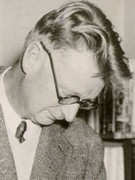
Anderson’s writing style is not the best the field has to offer (with Judy and Lady both female the pronouns got really confusing in the early chapters). However, the manner underlying his direct sentences is very gentlemanly. It’s hard to explain but it’s something I find very valuable in the old books and is a big reason why I believe it is helpful for children to read them. The use of language changes by generation and Anderson was born in 1891. As simple as his sentences are, they resound with occasional turns of phrase such as “shanks’ mare,” which a later generation of writers would simply drop. Even if the child reader doesn’t understand the phrase, anything mannered or “dated” about the end result wouldn’t matter to her anyway. Anderson was an expert draftsman and his illustrations would make it worth bringing Afraid to Ride back into print by themselves. This man did covers for the Saturday Evening Post and he had superb skill. Like his character Mr. Jeffers, he took a keen interest in conformation and his horses just standing still, in plain black and white, are the prettiest things you’ll ever see.

All else aside, this is just a sweet and gentle little story. She stroked Lady’s neck and told her many things that were not strictly true. Perhaps she was not the finest horse in the world. Still, she was in Judy’s world. Aww.
The shorter-than-average Parental Guide!
Violence: No dead animals. There are some anecdotes of runaway horses. Judy’s accident (she breaks a leg but blacks out right away). The “mean girl” prerequisite to this genre has an accident and Judy finds her unconscious, bleeding badly from a cut on her head. In a panic Judy tried to stop the flow of blood with her handkerchief but it did no good. Actually, the image of this accident is the most disturbing bit, as the girl pitching headfirst over her horse looks very similar to Judy and it isn’t until you turn the page that any context for this image is even given.

Values: Patience and compassion. Slowing down and observing nature. Kindness to horses. The concept of real courage as far greater than foolhardy bravado. Also, this bit caught my eye, as Judy observes big stone walls on her walks which showed that once these were cleared fields. Thinking how back-breaking that work must have been, with always the threat of an Indian arrow finding its mark, Judy marveled at the endurance and courage of those pioneers. This is definitely the 1950s, since she’s not ashamed of her ancestors.
Role Models: Judy is considerate, affectionate and conquers her fear. Her parents are positive figures. Mr. Jeffers and the Master of the Country Club have the courtesy of true gentlemen. The Club is male-dominated yet no one belittles Judy and she wins their respect and admiration through skill and courage. No manufactured drama here.
Educational Properties: Unless it becomes your child’s introduction to older novels or equines, probably none.
End of Guide.
I read this several times when I was 11 and was pleased that it held up so well on this revisit, which I don’t think is just nostalgia talking. Have you read any of Anderson’s books?
Up Next: Haven’t done a fantasy novel yet, so I’m trying one that won the National Book Award in the 1970s.
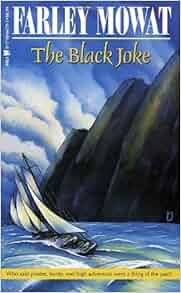 Title: The Black Joke


 Loyalty to one’s boat almost as to a living thing is the driving force of the novel – the Black Joke might as well be the Black Stallion for the Spence’s determination to be reunited with it – but loyalty between people is also emphasised. Communities are very tight-knit and old friends do not forget one another.
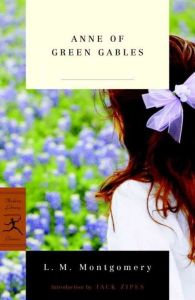 Title: Anne of Green Gables (Anne Novels #1)


 Title: The Cruise of the Dazzler
 specific ideal in mind: We know so well, are reminded so often of the worth of the good book and great, that too often we fail to observe or understand the influence for good of a boy’s recreational reading. Such books may influence him for good or ill as profoundly as his play activities, of which they are a vital part. The needful thing is to find stories in which the heroes have the characteristics boys so much admire—unquenchable courage, immense resourcefulness, absolute fidelity, conspicuous greatness. I would love to find a list of the other books that made the cut.
 Title: In the Beginning: Creation Stories from Around the World


 Title: Time Enough for Drums


 1919, leaving Baroness Orczy the clear originator of the “masked avenger” so widespread in 20th Century entertainment. Given how prevalent the trope has become, I have to wonder if anyone could possibly be surprised by the identity of the Scarlet Pimpernel anymore. Given how few characters are in the book, I also wonder when her original audience was expected to have it sussed out.


 The Western Corner of the Castle