Anthropomorphic Fantasy: The Trumpet of the Swan

Well, that was odd.

https://i0.wp.com/pics.cdn.librarything.com/picsizes/38/57/3857e41d0383d9e597966675a67444341587343.jpgTitle: The Trumpet of the Swan
Author: E.B. White (1899-1985)
Illustrator: Edward Frascino (????-)
Original Publication Date: 1970
Edition: Harper and Row (1973), 210 pages.
Genre: Anthropomorphic fantasy.
Ages: 5-8
First Sentence: Walking back to camp through the swamp, Sam wondered whether to tell his father what he had seen.

https://thewesterncornerofthecastle.home.blog/wp-content/uploads/2019/09/4db91-17b.trumpeter-swan_2199.jpg
The gorgeous trumpeter swan (Cygnus buccinator).

The scene opens on a pond in the vast Canadian wilderness. Two swans have settled there to build a nest and raise their young. Sam Beaver, a boy from Montana, quietly observes them before returning to his father’s camp. The cygnets hatch and a peaceful, thoughtful nature documentary on the life cycle of a trumpeter swan seems about to unfold – except that one of the new cygnets is mute. So Louis, as the unfortunate is called (and that should be given the French pronunciation like Armstrong, or a later joke will fall flat), goes looking for Sam Beaver in Montana, finds him surprisingly quickly, and requests his assistance. Sam takes him to school, where he learns to write, but since swans can’t read, a full-grown Louis must learn to play trumpet to win the beautiful swan of his dreams. His father, the old cob, has to steal a trumpet to secure his son’s future (swans having no purchasing power), and Louis must then go forth across America and seek employment as everything from camp bugler to nightclub musician, all in quest of enough money to pay damages to the music shop in Billings and restore his father’s honour.

E.B. White took a break of nearly two decades between Charlotte’s Web and this, his longest novel, in which he lets loose all restraint and delivers a tale so wholly absurd that it makes Stuart Little look positively staid in comparison – in fact, had there been a cameo from Stuart, all the way to Montana and still looking for his bird, it would have fit the general tone rather perfectly. Many people say this is White’s funniest book and I suppose it is, although I found the constant unremarked absurdity and crazyquilt plotting to be a trifle wearying after a while.

https://i0.wp.com/www.mrslittle.com/wp-content/uploads/2014/06/Trumpet_steal.jpeg
The old cob’s daring heist.

The Trumpet of the Swan is best described as a peculiar mix of ingredients. First there is the riotous comedy of a swan playing trumpet, overnighting at the Ritz and attacking zookeepers. This is tempered by an obsession with “realistic” detail, such as swans being unable to read because they don’t go to school (of course that would be the case) and Louis needing an operation on his webbed foot to be able to use the valves on his new trumpet. Then there is the nature program aspect, detailing nesting habits, natural predators and man-made hazards in the life of the trumpeter swan. Meanwhile, the serious subtext of the novel is that of disability overcome and the final effect is (somehow) of a sweeping fairy tale romance – this in spite of the fact that Louis’s true love, Serena, is barely a character at all. Your individual enjoyment of the book will depend a lot on how successfully you think these elements are handled and how willing you are to see them meshed together in the first place.

What I actually found most refreshing about this novel had to do with the change in illustrator: Edward Frascino won the commission to illustrate because he could allegedly work faster than Garth Williams, and White insisted upon a spring publication date for financial reasons. Williams’ illustrations would undoubtedly have been warm and endearing as always, but I actually found Frascino’s style a far better match to the novel: As White muses on the subjects of freedom, romance and nature conservation, Frascino supplies regal swans and landscapes that are sweeping and full of wonder. There’s a grace implicit to even the silliest images that shows the New Yorker cartoonist had hidden depths. Unlike with Williams, Frascino has never been enshrined as integral to White’s work, and the special 2000 edition of The Trumpet of the Swan replaced his illustrations with those of Fred Marcellino. I have not had a chance to compare them yet other than to note that Marcellino’s swans are far more anthropomorphized than Frascino’s.

https://thewesterncornerofthecastle.home.blog/wp-content/uploads/2019/09/ce877-trumpet-swan-marcellino.jpg
Marcellino’s sad Louis, rejected by an illiterate Serena…
https://i.pinimg.com/originals/81/98/e4/8198e462e65db17bf899d590f6e75059.jpg
…and Frascino’s triumphant Louis, serenading Serena.


As for the actual text, the biggest disappointment to be found this time around is actually in White’s writing style, which has become a good deal plainer than it was before – perhaps because he was hurrying himself as well as his illustrator. The sentences are shorter on average and less suited to reading aloud, as in this scene where Louis rescues a drowning boy at summer camp: Cheers came from the people on the shore and in the boats. Applegate clung to Louis’s neck. He had been saved in the nick of time. Another minute and he would have gone to the bottom. Water would have filled his lungs. He would have been a goner.

https://www.abandonedspaces.com/wp-content/uploads/2018/08/564px-sheldon_church_2.jpg
The South Carolina town of Yemassee is famous for the Old Sheldon Church Ruins, dating from the 1700s. Lots of cool pictures and history in the link to the right.

While this loss of underlying melody is certainly sad, such stiff passages are broken up by measured lines of classic White, with delicate sensibility and a love for the North American landscape (including a shout out to Yemassee, SC, which led me to this cool page). They flew south across Maryland and Virginia. They flew south across the Carolinas. They spent a night in Yemassee and saw huge oak trees with moss hanging from their branches. They visited the great swamps of Georgia and saw the alligator and listened to the mockingbird. They flew across Florida and spent a few days in a bayou where doves moaned in the cedars and little lizards crawled in the sun. They turned west into Louisiana. Then they turned north toward their home in Upper Red Rock Lake.

Louis has wings, allowing him to be a far greater traveller than tiny Stuart in his automobile or sedentary Wilbur, and thus White has him traverse the country, from Canada to Montana to Boston and Philadelphia. This freedom is tremendously important to Louis – it’s truly the classic American saga of the young man going out into the world to make a name for himself, bring prestige to the family, earn a living and win his true love… the archetypal young man is just a swan in this case. With no overhead. So it lacks real drama, making it quite perfect for little kids. Worth noting that Louis is on his own a lot of the time, meaning that one of White’s greatest skills – that of the ensemble cast which made Charlotte’s Web and the first half of Stuart Little so engaging – is almost completely absent last time around.

https://i.pinimg.com/236x/de/7c/66/de7c66672d7559eed92cf1ab3ab4e95c.jpg
From the title page.

The most memorable character here is not even Louis; it’s his father, the old cob, who is prone to long speeches on his own gracefulness and his duty to uphold the swan image of elegance at all times. Yet he is willing to sacrifice that honour so that his mute son will have a future. He is at once both comic and noble, a figure of fun for being overly dignified, rather than a bumbling dad. In these moments The Trumpet of the Swan becomes a true companion for Charlotte’s Web – a story of a father’s love that is quite moving for a parent and comforting to a small child:

“I have robbed a store”, he said to himself. “I have become a thief. What a miserable fate for a bird of my excellent character and high ideals! Why did I do this? What led me to commit this awful crime? My past life has been blameless–a model of good behavior and correct conduct. I am by nature law-abiding. Why, oh, why did I do this?”
Then the answer came to him, as he flew steadily on through the evening sky. “I did it to help my son. I did it for love of my son Louis.”

In spite of my own preference for a less whimsical White, The Trumpet of the Swan is extremely easy to quote from and ends on a truly graceful note. While I never quite warmed to it, it does share the unique charms of Stuart Little and Charlotte’s Web and has its own moments of beauty alongside its wilder eccentricities.

See Also: The other two E.B. White books, Stuart Little and Charlotte’s Web.

Parental Guide up next, with spoilers.

Violence: Male swans have powerful wings and are accustomed to beating up those who cross them, with Louis attacking two zookeepers attempting to corner Serena, and cuffing a little duck who stole his trumpet. The old cob is shot trying to repay the music store he’d previously burgled, but any sense of danger is soon negated as the old cob continues his elegant monologue regardless of the pain, saying “I must die gracefully, as only a swan can” before fainting. He’s soon patched up and on his way again.

Values: In addition to a love for the American landscape and an encouragement for nature preservation, White also writes an ode to freedom, with Louis and Serena choosing to take their chances in the wild rather than remain in the zoo forever. However, in a twist that weirds a lot of people out, they barter for their freedom by promising the zoo an occasional cygnet of theirs in exchange. Louis keeps this promise, as Sam Beaver points out that there’s always a runt in any brood that could benefit from mankind’s protection.

Louis is a swan navigating human society and White does bring up the problem of prejudice, primarily to spoof it. While Louis works as camp bugler, he meets a boy called Applegate who insists he doesn’t like birds. The camp leader says he is “entitled to his likes and dislikes and to his prejudices” but must still treat Louis with the respect accorded a camp bugler. After Louis saves the boy from a watery grave, the camp leader then puts Applegate on the spot, coaxing him toward a “and what have we learned today?” life lesson. Applegate thought hard for a moment. “Well,” he said, “I’m grateful to Louis for saving my life. But I still don’t like birds.” The camp leader is nonplussed and has to leave it at that.

Role Models: Everyone in this book is quite nice and fairly high-minded. Louis works hard, pays his father’s debt and always tips the waiter. His original sense of self-pity is overcome alongside his disability. The old cob does as he promised, and risks life and limb first to steal and then to pay back for the crime. Sam Beaver is kind to animals and is willing to cross the country to help his friend out of a jam. Only Serena lacks positive attributes, seeming to fall for Louis just because he carries so many material goods around and serenades her on the water.

https://i0.wp.com/jasonrobertbrown.com/wp-content/uploads/2012/05/51cdkBfwoZL._SS500_.jpgEducational Properties: Easy tie-in to a music appreciation lesson if you have similar taste as White, who supplies a mixture of American standards (‘Summertime,’ ‘There’s a Small Hotel’ and ‘Beautiful Dreamer’ among those featured) and classical pieces (Brahms’ ‘Cradle Song’ mentioned by name, also Bach, Beethoven and Mozart) for Louis’s set list. A playlist drawn from and inspired by the book could very easily be created. The Trumpet of the Swan was also adapted for symphony in 2011 by Marsha Norman and received very positive reviews – if I ever expand into adaptations, that is certainly one I would like to try.

End of Guide.

With The Trumpet of the Swan I conclude the youth bibliography of Elwyn Brooks White. There is nowhere to go from here and that’s a very satisfying feeling all by itself, the more so given how effortless and enjoyable I found these three short, strange children’s classics to be. My advice for parents would be to gather up all three, start with Charlotte’s Web and see what order your own family would rank them in. I consider The Trumpet of the Swan as the weakest of the three but I also understand why so many other readers are completely charmed by it.

Up Next: Please note that I am changing the posting schedule from Saturday to Monday, owing to recent changes in my life. So next Monday expect a fantasy novel from two-time Carnegie winner Geraldine McCaughrean – finally a British author!
Anthropomorphic Fantasy: Charlotte’s Web

I never read Charlotte’s Web growing up and have vague memories of disliking the animated movie, but having read it at last I must conclude that it is in fact worthy of all the praise it has received.

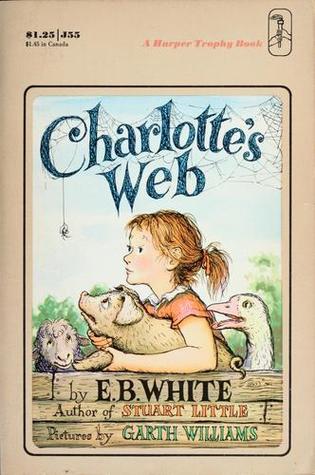
https://i.gr-assets.com/images/S/compressed.photo.goodreads.com/books/1506253069l/11124601._SY475_.jpgTitle: Charlotte’s Web
Author: E.B. White (1899-1985)
Illustrator: Garth Williams (1912-1996)
Original Publication Date: 1952
Edition: Harper Trophy (1973), 184 pages
Genre: Anthropomorphic fantasy.
Ages: 5-8
First Sentence: “Where’s Papa going with that ax?” said Fern to her mother as they were setting the table for breakfast.

Wilbur the pig is born a runt, saved from an untimely death by the intervention of eight-year-old Fern Arable, who raises him on a bottle until he’s big enough to sell. He’s bought by her uncle Mr. Zuckerman, which is awfully nice at first since Fern visits him almost every day, but it soon turns out Mr. Zuckerman intends Wilbur for future dinners. Only the clever spider Charlotte can save Wilbur from his fate.

Charlotte’s Web won a 1953 Newbery Honor; it’s often considered the most grievous oversight of the Newbery committee that it lost to Secret of the Andes. Based purely on the writing I have to suspect that it should have carried the Newbery Medal that year, but I withhold further judgement until I actually read Secret of the Andes. E.B. White here far outstrips what he was doing in Stuart Little, with distinct voices for every animal on the farm, from pig to spider to rat to geese. He achieves a truly perfect level of repetition, enough to feel sonorous without impeding the actual flow of the story. The structure is episodic enough for good bedtime material but the actual plot is very tight, with natural rises and falls in the drama, and a final bittersweet triumph. It introduces children to the nature of death but also to rebirth and the regenerative cycle of seasons and progeny. It is, in short, a perfect read-aloud. You could adapt whole chapters into picture books and almost every line would be capable of sustaining a new image. From Chapter IV, Loneliness:

The next day was rainy and dark. Rain fell on the roof of the barn and dripped steadily from the eaves. Rain fell in the barnyard and ran in crooked courses down into the lane where thistles and pigweed grew. Rain spattered against Mrs. Zuckerman’s kitchen windows and came gushing out of the downspouts. Rain fell on the backs of the sheep as they grazed in the meadow. When the sheep tired of standing in the rain, they walked slowly up the lane and into the fold.

https://i.pinimg.com/236x/80/05/58/80055881f97eb2c6875f8c7fce73a4c8--garth-williams-charlottes-web.jpg
A haughty lamb refuses to talk to Wilbur, from Garth Williams’ illustrations.

The novel is gorgeously agrarian in focus without being sentimental. White understood farming and, aside from a strange bias against lambs in this book, is more than willing to address mother nature fairly. Charlotte may be the sweetest spider in all of literature, but she’s a bloodsucking predator and that’s not glossed over. While no direct parallel is ever made between her nature and that of humans, it’s definitely something I picked up on. Charlotte anaesthetizes her victims so they don’t feel pain; farm animals (until the advent of factory farming) would generally lead very comfortable lives and then be quickly killed. Charlotte’s nature brings death to other beings, but she has the gifts of intellect, artistry and compassion, and chooses to exercise them, saying “perhaps I was trying to lift up my life a trifle.”

Charlotte also becomes a mother figure for Wilbur, protecting and comforting him while also instilling some education on subjects big and small. She has a lovely vocabulary and is often explaining words to Wilbur; unlike Lemony Snicket, this never comes across as patronizing on the part of the author.

Wilbur walked into his yard just at that moment.
“What are you thinking about, Charlotte?” he asked.
“I was just thinking,” said the spider, “that people are very gullible.”
“What does ‘gullible’ mean?”
“Easy to fool,” said Charlotte.
“That’s a mercy,” replied Wilbur, and he lay down in the shade of his fence and went fast asleep.

https://www.thefamouspeople.com/profiles/images/e-b-white-4.jpg
E.B. White.

White takes every opportunity that he can to layer language and give his young audience as much raw material as he can without interrupting his story. He morphs into a thesaurus: The rat had no morals, no conscience, no scruples, no consideration, no decency, no milk of rodent kindness, no compunctions, no higher feeling, no friendliness, no anything. He adds a touch of math: Mr. Arable gave Fern two quarters and two dimes. He gave Avery five dimes and four nickels. Yes, they did name their son Avery Arable. He even introduces a little Latin to the small fry, as Charlotte says: “It is my egg sac, my magnum opus.” And in what I thought was the funniest part of the whole book, White transforms a verbal tic (his geese repeat words when they talk) into a spelling joke, with a bonus obscure medical condition of history thrown in:

Charlotte: “Does anybody here know how to spell ‘terrific’?”
“I think,” said the gander, “it’s tee double ee double rr double rr double eye double ff double eye double see see see see see.”
“What kind of an acrobat do you think I am?” said Charlotte in disgust. “I would have to have St. Vitus’s Dance to weave a word like that into my web.”

The language jokes work much better than the occasional slapstick sequence, but then I’m not a fan of slapstick. Aside from this minor flaw, Charlotte’s Web is quite perfect, in both writing and story. After my recent revisit with Stuart Little, I am pleased to find this book such a rich, well-rounded experience that fixes every problem that first novel contained. The characters are more memorable, the world-building is comparatively sane and White really threads the needle with his brand new addition of an actual ending: Wilbur and Charlotte earn thematically rich conclusions to their tale, but the final message of Stuart Little – that life is not tidy – is revisited rather than directly contradicted. For all Templeton’s importance to the rescue of Wilbur, White is scrupulously honest with his small readers about the nature of some people in the world and the rat never repents or has any change of heart, remaining exactly what he was introduced as – a bastion of greed, malice and self-interest – to the end.

https://spaceintext.files.wordpress.com/2010/12/templetons-egg-charlottes-web-page-46-illustration-1952-gm-williams.jpg
Templeton under the disapproving eyes of the local animals and Fern.

It should be obvious that this gets a very high recommendation from me and I’m very happy to see that this is one vintage children’s book that remains on everyone’s radar, secure from either focused attack or general amnesia at present.

Parental Guide. Spoilers ahoy for anyone who doesn’t know the ending.

Violence: Charlotte dies in the end, and it’s plainly telegraphed for several chapters beforehand. Kids who haven’t had any prior exposure to the subject of death in fiction might be as shocked as Wilbur is, but I think most could figure out what’s inevitable. It is still very moving at any age though. No one was with her when she died.

On a more cheerful note, I was impressed with the subtle comeuppance for Templeton’s selfishness. He refuses to help save Charlotte’s children until Wilbur bribes him with the promise of first go at the pig trough… forever. Wilbur keeps his promise and we last see Templeton eating his way to an early grave. Forever won’t be lasting too long in this case and Sun Tzu would be proud of this pig.

Values: Charlotte saves Wilbur through cleverness, the power of words – and knowing who to bribe to get things done around the farm.

https://i0.wp.com/api.ning.com/files/kV4MbYiv7oSxHFJWLwFCPCf6i9ZYGHMph46ms1kDgjKFn-an-4w%2AkvBeJWpLJY-Gpnz%2At2SgWFfx1sbjkUcp1VLT%2A-mX81Hx/1082054003.jpeg
Wilbur at the fair, humble to the last.

White chooses to focus on the unsung animals of the farmyard – pigs, spiders and rats – while the cute and cuddly lambs are proud and ill-mannered. Humans are by and large gullible and capricious. Fern saves Wilbur yet loses interest in him by the end of the book while her brother Avery, indifferent to animal welfare theretofore, takes over her vacated role during Wilbur’s hour of triumph at the fair.

Role Models: Readers tend to focus on Charlotte, and I’ve already covered her finer attributes. I would like to focus on Wilbur here. He’s a passive figure for much of the novel, friendly and happy to be directed by other characters. He remains humble despite being a figure of great interest but he’s easy to overlook and seemingly incapable of ever repaying Charlotte for saving his life – until the end, where he does actually save her, by saving her egg sac. They’re leaving the fair and the grounds will be deserted through the winter, making it crucial for Wilbur to think on his feet, and he does find a way to return her children to the farm. Once spring arrives, most of the baby spiders depart but three remain and carry on Charlotte’s lineage, and the generations continue to live comfortably in Zuckerman’s barn, hearing stories of their great ancestress – all owing to the humble pig Wilbur.

Educational Properties: Aside from the lingual elements, this category is not really applicable or necessary. Read it aloud and talk it over. Save the homework for other books.

End of Guide.

One more of E.B. White’s books to go, due in September and earnestly anticipated.

Up Next: Back to Tom Sawyer’s world with Huckleberry Finn and my first impressions of this towering giant of American literature are going to be a whole lot less favorable. Stay tuned.

Anthropomorphic Fantasy: Stuart Little

This classic holds the dubious distinction of being the first book I ever read that left me feeling cheated of a justly-deserved ending, and I suspect this milestone applies to a lot of other children as well. Yet in hindsight this might even be the thing I appreciate most about the book…

book stuart little coverTitle: Stuart Little
Author: E.B. White (1899-1985)
Illustrator: Garth Williams (1912-1996)
Original Publication Date: 1945
Edition: Scholastic Inc. (1987), 131 pages
Genre: Anthropomorphic fantasy.
Ages: 5-8
First Sentence: When Mrs. Frederick C. Little’s second son arrived, everybody noticed that he was not much bigger than a mouse.

Stuart Little is a mouse born into a human family, an unexpected event that the Littles (and the world) accept with enviable equanimity. Small as he is, any number of misadventures can befall Stuart around the house, but he, his parents and older brother George muddle through, until the arrival of the bird Margalo – a sweet-tempered creature that Stuart quickly falls for. Snowbell, the family cat, is not so pleased, and puts out a hit on the bird, courtesy of a femme fatale feline known only as the Angora (if you haven’t read this book, please be aware I am dramatizing a little here). Margalo gets wind of the plot and flees without saying goodbye to the Littles. Stuart, distraught, decides to head out after her.

book stuart faucet garth williams
Illustration by Garth Williams.

Stuart Little is like two books in one. The first half, consisting of Stuart’s home life, is as perfect a children’s tale as you’re likely to find, effortlessly appealing to the imaginations of those still young enough to be preoccupied with truly important matters – such as what it would be like to be about two inches tall and have to make your way across the house. The second half contains almost nothing which would appeal to the same child at the same age. Instead, Stuart leaves home without a goodbye, takes a job pontificating to a bunch of schoolchildren, gets a date with a human girl who’s just his size, makes a complete mess out of it and gets back on the road, still looking for his bird and without the slightest proof that he’ll ever find her. I find that the only way this complete collapse of momentum and humour makes any sense (and I have no proof of this theory) is if E.B. White took a break and, when he came back, decided to send-up The Great American Novel that a hundred Thomas Wolfe wannabes were busy flooding the market with. This is the only way that Stuart Little’s prosey travelogue of impractical politics and girl troubles can be explained to my satisfaction, anyway. Let me know your theory.

This might be a fatal flaw in a lesser novel, rendering it nothing but a historical curio, but Stuart Little has so much to offer in the first half that it remains a children’s classic to this day. What sets it apart from other mouse tales is White’s wonderful style, which is balanced perfectly between the simplicity that would allow a child to handle it on his own and a verve that makes it a comfortable read-aloud for a parent. White’s manner is warm, wry and elegant, even when the hero is in imminent danger of an undignified death:

One day when he was seven years old, Stuart was in the kitchen watching his mother make tapioca pudding. He was feeling hungry, and when Mrs. Little opened the door of the electric refrigerator to get something, Stuart slipped inside to see if he could find a piece of cheese. He supposed, of course, his mother had seen him, and when the door swung shut and he realized he was locked in, it surprised him greatly.
“Help!” he called. “It’s dark in here! It’s cold in this refrigerator. Help! Let me out! I’m getting colder by the minute.”
But his voice was not strong enough to penetrate the thick wall. In the darkness he stumbled and fell into a saucer of prunes. The juice was cold. Stuart shivered, and his teeth chattered together. It wasn’t until half an hour later that Mrs. Little again opened the door and found him standing on a butter plate, beating his arms together to try to keep warm, and blowing on his hands, and hopping up and down.

book stuart in fridge garth williams
Waiting for rescue.

Stuart is a dapper mouse, with a complete dignity of dress and manner that allows him to feel bigger than his ridiculous circumstances. His request for a “nip of brandy” at the close of the fridge episode cements him as yet another adult protagonist in a story for children. However, I do wonder if the weakness of the second half might not be due to an absence of the other Littles, a flustered chorus to his misadventures and a loving family – even if they never do have the sense to board up the mousehole in the pantry. An example of their interplay from when they mistakenly believe Stuart has gone down it:

George was in favor of ripping up the pantry floor. He ran and got his hammer, his screw driver, and an ice pick.
“I’ll have this old floor up in double-quick time,” he said, inserting his screw driver under the edge of the first board and giving a good vigorous pry.
“We will not rip up this floor till we have had a good search,” announced Mr. Little. “That’s final, George! You can put that hammer away where you got it.”
“Oh, all right,” said George. “I see that nobody in this house cares anything about Stuart but me.”
Mrs. Little began to cry. “My poor dear little son!” she said. “I know he’ll get wedged somewhere.”
“Just because you can’t travel comfortably in a mousehole doesn’t mean that it isn’t a perfectly suitable place for Stuart,” said Mr. Little. “Just don’t get yourself all worked up.”

book stuart little margalo garth williams
A pretty little bird.

All together, including Snowbell, the Littles are a treat. It’s a perfect tale – a little strange, but humanoid mice are a strange concept when you think of it – until Margalo arrives and Stuart falls in love with a bird. Maybe this entire plot is purely to facilitate a pun – a “bird” is a girl, therefore a girl is a bird. However, it starts to feel more and more made up as it goes along. Stuart is too small to carry actual coin, so how does he pay for gasoline? Why does he have to chop down a dandelion for greens, yet is able to travel around with a mouse-sized tin of ham? Also, even as a child, it made no sense that Stuart, going on foot, would be able to find Margalo. Supposing she comes back while he’s out looking for her? I figured the likeliest way they’d meet again is if Margalo heard he was missing, and went looking for him.

The whole second half has a melancholy air. Stuart wrecks his new toy automobile in a sad and improbable bit of slapstick. He’s the world’s most boring substitute teacher, talking about being “Chairman of the World,” claiming that “rats are underprivileged,” and coming up with impracticable laws against being mean (this is the longest chapter in the whole book and has no pertinence on anything else). Meanwhile, the sudden appearance of Thumbelina Miss Ames is just bizarre, and Stuart behaves terribly the whole time he’s with her. Stuart, if you’re lonely for companionship, maybe try locating New York’s mouse population, who probably left you as a changeling in a human hospital to start with (this was always my theory anyway).

https://media1.britannica.com/eb-media/58/99358-004-8DF1F962.jpg
Elwyn Brooks White in the office.

This isn’t to say that the second half of Stuart Little has nothing to offer. White’s writing is consistent, there’s a wealth of local colour regarding 1940s New York, Garth Williams was already a quintessential children’s book illustrator on his very first try, and the non-ending is strangely inspired – especially since E.B. White is a rare example of a children’s author who did not weaken and knock out an inferior sequel when strapped for cash. It just ends. It is a messy novel meant for an age group that collects “practice” books which emphasize rigorous, multi-volume predictability, a la The Boxcar Children series. It is highly recommendable and artistically excellent, even if it does have the inescapable sense of a failed experiment. Just make sure your son or daughter gets Charlotte’s Web first, because Stuart Little is not necessarily the best introduction to E.B. White. Indeed, despite revisiting this (okay, the first half) often enough while growing up, I never trusted White enough to read a second one.

Parental Guide. Stuart’s letter to Miss Ames raised my eyebrows as I read it for this project. Quite frankly, he’s every parents’ nightmare: …my purpose in writing this brief note is to suggest that we meet. I realize that your parents may object to the suddenness and directness of my proposal, as well as to my somewhat mouselike appearance, so I think probably it might be a good idea if you just didn’t mention the matter to them. What they don’t won’t hurt them. He does promise to leave this matter to her own good judgement, and I suppose looked at from the Ames’ point of view the whole “afternoon on the river” sequence is a G rated cautionary tale about going on blind dates with hirsute strangers from out-of-town but it still feels tremendously out of place. Of course, Thumbelina herself was also courted by several wildly inappropriate suitors before finding her fairy prince, so maybe that’s what White was actually referring to here.

book stuart and miss ames garth williams
Stuart and Miss Harriet Ames.

Violence: Stuart gets into several close shaves, among them getting swept into a garbage truck and nearly drowned in the ocean. Snowbell and the Angora both threaten to eat Margalo, and Stuart defends her with a bow and arrow one night in a very Arthurian way. He destroys his toy car, though it’s fixed up again good as new.

Values: Chief among the values displayed here is actually stoicism. When Stuart boasts or brags he gets into trouble, first with the windowshade and then Miss Ames. When he does something truly noble, such as winning the boat race or saving Margalo, he is far too modest to tell anyone and the feat passes by unsung.

The Littles invent all manner of aids to help Stuart get about and enjoy life, while the dentist tinkers with model boats and cars. Stuart enjoys being useful to others and always has proper attire for every possible occasion. E.B. White also briefly morphs into his Elements of Style self, and has Stuart-as-teacher say “a misspelled word is an abomination in the sight of everyone. I consider it a very fine thing to spell words correctly and I strongly urge every one of you to buy a Webster’s Collegiate Dictionary and consult it whenever you are in the slightest doubt.”

You could try to read Stuart Little as a metaphor for a handicapped or adopted child, but I would advise against this search for deeper meaning, as Stuart never really fits in, although his parents love him very much. Indeed, life with the Littles is portrayed as far more of a struggle than his subsequent independent voyage, of which he is a fairly successful navigator. He also leaves home without a word – so as far as families in classic children’s books go, this one is more on the dysfunctional side.

Role Models: Stuart actually regresses over the course of his story, from a gallant young mouse to a petulant one. I think White intended the Miss Ames date to demonstrate the problem of letting a perfect day dream interfere with having an imperfectly good day, but it’s the penultimate chapter and leaves Stuart on a very downcast and immature note.

https://www.nccil.org/img/assets/img/portraits/2323/Garth-Williams-Portrait_e0fc7258c45b5e0ad8ee7dfed878bd55.jpg
Garth Williams.

Everyone, even the devious cats, are fully likable characters and most of them strive to be helpful at some point or other.

Educational Properties: Plenty of thought exercises and physics lessons. Random questions like “why doesn’t the story end? What do you think happened next? If a toy car is driving, is it still a mile?” spring to mind.

End of Guide.

Expect my review of Charlotte’s Web in August and The Trumpet of the Swan in September. E.B. White is going to be the first author on the Western Corner of the Castle whose bibliography I will be completing and I have absolutely no idea what to expect after this one. What are your thoughts on Stuart Little?

Up Next: One of the 1945 Newbery Honor books, so we’re almost staying in the year.