
I never read Charlotte’s Web growing up and have vague memories of disliking the animated movie, but having read it at last I must conclude that it is in fact worthy of all the praise it has received.
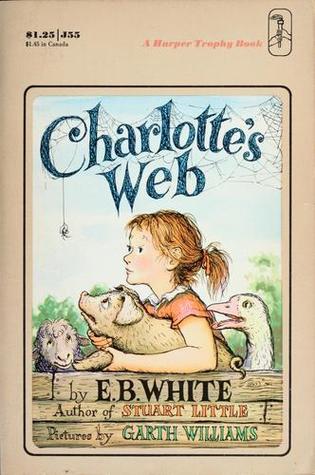 Title: Charlotte’s Web
Author: E.B. White (1899-1985)
Illustrator: Garth Williams (1912-1996)
Original Publication Date: 1952
Edition: Harper Trophy (1973), 184 pages
Genre: Anthropomorphic fantasy.
Ages: 5-8
First Sentence: “Where’s Papa going with that ax?” said Fern to her mother as they were setting the table for breakfast.
Wilbur the pig is born a runt, saved from an untimely death by the intervention of eight-year-old Fern Arable, who raises him on a bottle until he’s big enough to sell. He’s bought by her uncle Mr. Zuckerman, which is awfully nice at first since Fern visits him almost every day, but it soon turns out Mr. Zuckerman intends Wilbur for future dinners. Only the clever spider Charlotte can save Wilbur from his fate.
Charlotte’s Web won a 1953 Newbery Honor; it’s often considered the most grievous oversight of the Newbery committee that it lost to Secret of the Andes. Based purely on the writing I have to suspect that it should have carried the Newbery Medal that year, but I withhold further judgement until I actually read Secret of the Andes. E.B. White here far outstrips what he was doing in Stuart Little, with distinct voices for every animal on the farm, from pig to spider to rat to geese. He achieves a truly perfect level of repetition, enough to feel sonorous without impeding the actual flow of the story. The structure is episodic enough for good bedtime material but the actual plot is very tight, with natural rises and falls in the drama, and a final bittersweet triumph. It introduces children to the nature of death but also to rebirth and the regenerative cycle of seasons and progeny. It is, in short, a perfect read-aloud. You could adapt whole chapters into picture books and almost every line would be capable of sustaining a new image. From Chapter IV, Loneliness:
The next day was rainy and dark. Rain fell on the roof of the barn and dripped steadily from the eaves. Rain fell in the barnyard and ran in crooked courses down into the lane where thistles and pigweed grew. Rain spattered against Mrs. Zuckerman’s kitchen windows and came gushing out of the downspouts. Rain fell on the backs of the sheep as they grazed in the meadow. When the sheep tired of standing in the rain, they walked slowly up the lane and into the fold.

The novel is gorgeously agrarian in focus without being sentimental. White understood farming and, aside from a strange bias against lambs in this book, is more than willing to address mother nature fairly. Charlotte may be the sweetest spider in all of literature, but she’s a bloodsucking predator and that’s not glossed over. While no direct parallel is ever made between her nature and that of humans, it’s definitely something I picked up on. Charlotte anaesthetizes her victims so they don’t feel pain; farm animals (until the advent of factory farming) would generally lead very comfortable lives and then be quickly killed. Charlotte’s nature brings death to other beings, but she has the gifts of intellect, artistry and compassion, and chooses to exercise them, saying “perhaps I was trying to lift up my life a trifle.”
Charlotte also becomes a mother figure for Wilbur, protecting and comforting him while also instilling some education on subjects big and small. She has a lovely vocabulary and is often explaining words to Wilbur; unlike Lemony Snicket, this never comes across as patronizing on the part of the author.
Wilbur walked into his yard just at that moment.
“What are you thinking about, Charlotte?” he asked.
“I was just thinking,” said the spider, “that people are very gullible.”
“What does ‘gullible’ mean?”
“Easy to fool,” said Charlotte.
“That’s a mercy,” replied Wilbur, and he lay down in the shade of his fence and went fast asleep.

White takes every opportunity that he can to layer language and give his young audience as much raw material as he can without interrupting his story. He morphs into a thesaurus: The rat had no morals, no conscience, no scruples, no consideration, no decency, no milk of rodent kindness, no compunctions, no higher feeling, no friendliness, no anything. He adds a touch of math: Mr. Arable gave Fern two quarters and two dimes. He gave Avery five dimes and four nickels. Yes, they did name their son Avery Arable. He even introduces a little Latin to the small fry, as Charlotte says: “It is my egg sac, my magnum opus.” And in what I thought was the funniest part of the whole book, White transforms a verbal tic (his geese repeat words when they talk) into a spelling joke, with a bonus obscure medical condition of history thrown in:
Charlotte: “Does anybody here know how to spell ‘terrific’?”
“I think,” said the gander, “it’s tee double ee double rr double rr double eye double ff double eye double see see see see see.”
“What kind of an acrobat do you think I am?” said Charlotte in disgust. “I would have to have St. Vitus’s Dance to weave a word like that into my web.”
The language jokes work much better than the occasional slapstick sequence, but then I’m not a fan of slapstick. Aside from this minor flaw, Charlotte’s Web is quite perfect, in both writing and story. After my recent revisit with Stuart Little, I am pleased to find this book such a rich, well-rounded experience that fixes every problem that first novel contained. The characters are more memorable, the world-building is comparatively sane and White really threads the needle with his brand new addition of an actual ending: Wilbur and Charlotte earn thematically rich conclusions to their tale, but the final message of Stuart Little – that life is not tidy – is revisited rather than directly contradicted. For all Templeton’s importance to the rescue of Wilbur, White is scrupulously honest with his small readers about the nature of some people in the world and the rat never repents or has any change of heart, remaining exactly what he was introduced as – a bastion of greed, malice and self-interest – to the end.

It should be obvious that this gets a very high recommendation from me and I’m very happy to see that this is one vintage children’s book that remains on everyone’s radar, secure from either focused attack or general amnesia at present.
Parental Guide. Spoilers ahoy for anyone who doesn’t know the ending.
Violence: Charlotte dies in the end, and it’s plainly telegraphed for several chapters beforehand. Kids who haven’t had any prior exposure to the subject of death in fiction might be as shocked as Wilbur is, but I think most could figure out what’s inevitable. It is still very moving at any age though. No one was with her when she died.
On a more cheerful note, I was impressed with the subtle comeuppance for Templeton’s selfishness. He refuses to help save Charlotte’s children until Wilbur bribes him with the promise of first go at the pig trough… forever. Wilbur keeps his promise and we last see Templeton eating his way to an early grave. Forever won’t be lasting too long in this case and Sun Tzu would be proud of this pig.
Values: Charlotte saves Wilbur through cleverness, the power of words – and knowing who to bribe to get things done around the farm.

White chooses to focus on the unsung animals of the farmyard – pigs, spiders and rats – while the cute and cuddly lambs are proud and ill-mannered. Humans are by and large gullible and capricious. Fern saves Wilbur yet loses interest in him by the end of the book while her brother Avery, indifferent to animal welfare theretofore, takes over her vacated role during Wilbur’s hour of triumph at the fair.
Role Models: Readers tend to focus on Charlotte, and I’ve already covered her finer attributes. I would like to focus on Wilbur here. He’s a passive figure for much of the novel, friendly and happy to be directed by other characters. He remains humble despite being a figure of great interest but he’s easy to overlook and seemingly incapable of ever repaying Charlotte for saving his life – until the end, where he does actually save her, by saving her egg sac. They’re leaving the fair and the grounds will be deserted through the winter, making it crucial for Wilbur to think on his feet, and he does find a way to return her children to the farm. Once spring arrives, most of the baby spiders depart but three remain and carry on Charlotte’s lineage, and the generations continue to live comfortably in Zuckerman’s barn, hearing stories of their great ancestress – all owing to the humble pig Wilbur.
Educational Properties: Aside from the lingual elements, this category is not really applicable or necessary. Read it aloud and talk it over. Save the homework for other books.
End of Guide.
One more of E.B. White’s books to go, due in September and earnestly anticipated.
Up Next: Back to Tom Sawyer’s world with Huckleberry Finn and my first impressions of this towering giant of American literature are going to be a whole lot less favorable. Stay tuned.
 Title: Stuart Little


 The Western Corner of the Castle