Misty’s Twilight – Marguerite Henry

Whatever the case may be, I’m going to insist this was actually ghostwritten and so should you.

Misty's Twilight - Marguerite HenryTitle: Misty’s Twilight (Misty #4)
Author: Marguerite Henry (1902-1997)
Illustrator: Karen Haus Grandpré (????-)
Original Publication Date: 1992
Edition: Aladdin Paperbacks (1996), 142 pages
Genre: Animal Stories.
Ages: 8-12
First Line: On an early Saturday in spring, when dreams explode into reality, Dr. Sandy Price tiptoed about her home on Stolen Hours Farm.

This is the story of Twilight, Misty of Chincoteague’s great-great-grandfoal, whose mixed lineage of Chincoteague pony and thoroughbred makes her a potentially brilliant show horse, if only her owner Sandy Price could make up her mind what to do with her.

After 30 years, Marguerite Henry returned to Misty’s legacy in an irritating and completely skippable volume that, besides being graced with surprisingly pretty cover art, offers nothing to its intended child audience or to any grown fans of the earlier trilogy. Lacking Henry’s classic signatures of local colour and lovable characters, it falls far short of the normal standards which have made her a go-to for generations. Consider the rest of this review a set of variations on this statement.

Problem 1. Heavy doses of nostalgia for the original book and its legacy. This isn’t simply the story of a particularly gifted descendant of Misty. You will find herein full recaps and reenactments of scenes from Misty of Chincoteague, along with a protagonist whose whole life changed because she read the book as a twelve year old. It’s astonishing how self-congratulatory the whole thing feels. There are bland recreations of classic scenes, complete with stilted dialogue, most notably when Sandy’s two kids get upset over the foals and mares being split up on Pony Penning Day:

“Pam! Chris!” Sandy’s voice was firm. “Stop worrying! Don’t you remember in the book when Paul and Maureen were upset by this very sight, they went to see the fire chief, and he said, ‘Colts have got to grow up sometime. Their mothers can’t tell a colt in so many words to go rustle his own living. They just kick him away, gentle-like at first. But sometimes they have to get a bit rough, especially when they’ll be birthing a new foal in a few months.'”
Pam stopped crying. “I remember now,” she said, “how the fire chief puffed up in pride at his parting words to Paul and Maureen. ‘Separating the little ones from their mothers for only one night,’ he said, ‘why, that’s the kindest way we know how to wean ’em.'”
A gathering of parents and kids were listening in. Chris and Pam reddened in embarrassment at the attention.

Karen Haus Grandpre, Misty's Twilight
Sandy out shopping with the kids.

Problem 2. Sandy Price is an adult, sure, but it’s far more detrimental that she is not an underdog of any kind. Most kids who like horses don’t actually have any of their own, and reading about somebody lucky enough to live out that dream should be thrilling – provided the fictional proxy actually appreciates his or her good fortune in this matter. Sandy is introduced on her very own thoroughbred farm, but she ignores all of her unnamed horses to go chasing after her childhood dream of owning a Chincoteague pony. Regular thoroughbreds just aren’t enough. Her two kids act like horses are completely humdrum, so already in chapter one there’s nobody for the reader to root for. Sandy goes on to win three Chincoteague ponies at auction, but she still covets having a direct descendant of Misty (regular Chincoteague ponies just aren’t enough) and so she purchases Misty’s great-grandfoal Sunshine. Now she has four Chincoteague ponies, all of whom the book ignores as soon as Sunshine has a foal of her own.

Some readers might forgive Sandy if she at least formed an appropriate bond with newborn Twilight – like Paul and Maureen did with Misty. But it is soon apparent that Sandy has no meaningful interaction with any of her horses. She has a guy named Robert who works in the stable, while she goes to her day job as a skin doctor. She misses Twilight’s birth and she’s never shown training or tending her. Her kids are never shown playing with her. In other words, basically this entire book aimed at ages 8-12 is about a rich woman’s woes because she owns more equines than she has any time for.

Problem 3. Sandy is awful. She’s introduced announcing her decision to make her kids’ shared birthday the launch of a family road trip to Chincoteague – using their birthday to live her dream. She goes downhill from there. An idea was beginning to form in Sandy’s mind of taking one of Misty’s family home to set it free on Stolen Hours Farm. This impulse leads her to purchase Sunshine, a completely docile mare who loves attention, promising that she’ll “never know a bit or bridle.” Sandy appears to be quite bothered by the domestication of Misty’s descendants: What a contrast, these penned-up creatures, from the wild ponies of Assateague. Fame certainly had its price. A sadness came over Sandy that wouldn’t be pushed away. Yet given the chance, she gladly makes Twilight pay that price. What a fight she gave when first she felt the restriction of the rope! With a potential champion of cutting/jumping/dressage on her hands, Sandy gets over her scruples in a hurry. No pasture days for Sunshine’s spitfire daughter.

Grandpre, Misty's Twilight
Poor Twilight.

Sandy’s lack of horse sense then leads to the most horrible chapter of the book when she packs Twilight off to a horse trainer. She’s told Twilight will be ready to come home in three weeks, and during that time Sandy does not visit or supervise the trainer’s methods. When she comes to pick her up she finds out too late that poor Twilight has lost fifty pounds, trembles at the slightest touch and has a deep cut across her tongue to make her more sensitive to the bit. It would take weeks for Twi to learn all over again to trust those who had sent her away. Rather than engaging in a little self-criticism for her own part in her pony’s abuse, Sandy just directs all of her anger and blame at the trainer while she focuses on getting Twi registered. A little due diligence would have spared Twi’s ordeal but that never occurs to Sandy. Instead, she just quietly starts supervising the next trainer and remains impossible to like.

Problem 4. There are absolutely no developed or memorable human characters. Sandy’s story arc is a mess. First she wants a wild pony in pasture, then she wants a show champion, then she wants a wild pony in pasture again. Sandy’s kids are obnoxious at the beginning of the book, but then fifteen years go by and they’re suddenly understanding adults. Robert the horseman is a big guy. Andrew is from England. O’Quinn is Irish. Judy keeps house for Sandy but never features in a single scene. This is the same writer who gave us the Beebe family and their neighbours. Where are the character quirks? The warm humour? The brightness? The local colour? It’s so conspicuously absent that it’s hard to believe this is the same author.

Only one character is truly vibrant, enjoyable and Not a Problem – Twilight herself. Twilight was as unpredictable as a dangling electric wire. She liked to race along the fence rail, taunting the thoroughbreds on the other side, daring them to race. She had speed without question. She scared Sunshine and Sandy half to death as she skidded to the fence corners by sliding on her haunches and waiting until the last second to wheel out. Her poor mother tried to follow with frustrated whinnies, but she just couldn’t keep pace. None of the other Chincoteague ponies could. There was nothing tagalong about Twilight. She went far afield and returned only to nurse.
Unlike her mother, Twilight barely tolerated the bristles of the grooming brush and would pull away from a hand that longed to pet her. But in her frequent gallops she obviously enjoyed the cool fingers of the wind combing her coat.

Karen Grandpre, Misty's Twilight
Little Twilight at play.

Problem 5. Twilight is not the protagonist. She certainly should be, as it’s only when she’s being described that this begins to feel like a proper Marguerite Henry book. Twilight trains, travels and competes and we’re stuck witnessing it through Sandy’s eyes as she… waits at home and watches as ribbons get delivered to her door. She also answers the telephone and watches videos of Twi’s warm ups. Trust me, no child will be impressed with this.

Misty's Twilight, Karen Haus Grandpre
Twilight in her cutting career.

This lack of action does not extend to the illustrations, provided by Karen Haus Grandpre and also Not a Problem. Grandpre makes the most of Twilight’s athleticism, and her sketchy style suits the movement of show horses quite well. She captures Twi’s energy and her delicate build. It’s true that Grandpre lacks the humour and personality that Wesley Dennis always provided, but there’s so little of either to be found in the actual text that let’s be fair: I doubt if Dennis had lived to illustrate Misty’s Twilight that he’d have been able to inject any special life into it either. Let’s move on.

Problem 6. Marguerite Henry’s inability to maintain the natural connective tissue between her various sequels is still a problem. A cameo from fictional Paul or Maureen, grown and guarding Chincoteague’s legacy, would have been too much to expect. However, no acknowledgement of the Beebes or update on their existence is made at all; instead, Misty’s progeny are all owned by some guy called Merritt. Why does Henry insist upon reverting to the facts always after she’s come up with a lovely work of fiction? Here she refers to Stormy as “Misty’s third foal” even though in the novel Stormy, Misty’s Foal she was the fictional Misty’s firstborn, heightening the tension. Documentary facts or human interest drama: pick one and stop flip-flopping like this.

Problem 7. The faceplant ending. When Twi is twelve, Sandy suddenly starts having second thoughts. “Is it fair to work Twi daily and strenuously, to ship her across the ocean to enter the Olympics? Are we satisfying our belief in her … or is it our own vanity?” You’ve had your favorite pony on the ropes for ten years, woman, and you only think of this now? She then has the brilliant idea to make bred-in-captivity, over qualified, overly trained, registered champion Twilight some kind of wilderness ambassador. Okay then. Mercifully, the book finally concludes at this point.

I would not recommend Misty’s Twilight to any family at all. No matter how much you and yours love Marguerite Henry, just skip it and stick to her other books.

See Also: The Misty trilogy (Misty of Chincoteague, Sea Star, Stormy) are all worth it.

https://i2.wp.com/www.alternities.com/images/TX221_Anderson_Afraid.jpgI’d direct your attention to Afraid to Ride by C.W. Anderson as well – long out of print but a much better book. Twilight’s rehabilitation after being abused is completely glossed over, while Afraid to Ride is an entire story dedicated to bringing a traumatized show jumper back to her former glory, with a genuinely nice main character.

Quick Parental Guide.

Violence: The scene with freshly “broken” Twilight, ribs showing.

Values: Misty of Chincoteague is the best book in the world. Horses should be free (or they should be made to jump through every competitive hoop available to make a name for their owners themselves).

Role Models: Terrible. Sandy lacks any introspection – she never examines her own desires or even appears grateful for goals achieved, she just runs from want to want to want. Faceless Judy raises her kids, faceless Robert tends to her horses, and she just obsesses over how to send Twilight straight to the top in whatever category seems best at the moment.

Educational Properties: None, unless you’re really interested in equine sports, and then there are better books on the subject.

End of Guide.

Your family/library/homeschool/students all deserve better. Give it a miss.

Up Next: A spinoff Anne novel about her new neighbours that’s better than it sounds.
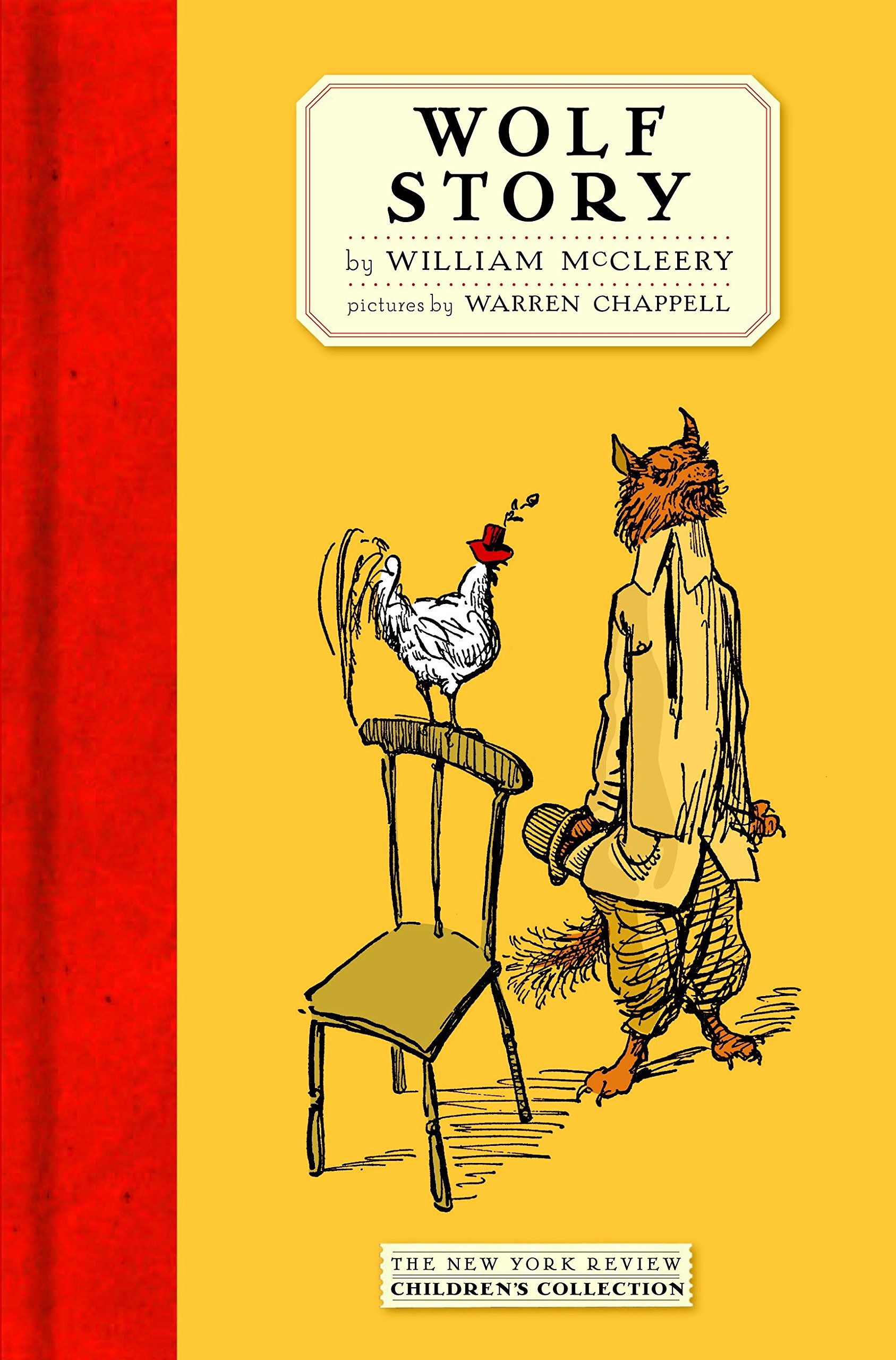
Wolf Story – William McCleery

A mildly meta curio spoiled by an ill-thought moral at the end. Not recommended.

https://images-na.ssl-images-amazon.com/images/I/81JS1tk45RL.jpgTitle: Wolf Story
Author: William McCleery (1911-2000)
Illustrator: Warren Chappell (1904-1991)
Original Publication Date: 1947
Edition: NYRB Children’s Collection (2012), 82 pages
Genre: Humor.
Ages: 4-6
First Sentence: Once upon a time a man was putting his five-year-old son Michael to bed and the boy asked for a story.

A father tucks his son into bed and the son naturally wants a story. After rejecting Goldilocks, Michael requests a new story and is soon “helping” his father make it more exciting by adding a fierce wolf called Waldo to the mix. On subsequent outings with Michael and his best friend Stefan the wolf story continues, despite the father’s boredom, until they reach a mutually satisfying conclusion.

Okay, so this book is nowhere near as meta as it probably sounds. The first two chapters do work quite well in that regard, as the story is constructed while the father and son’s relationship is being sketched out – mostly through the use of dialogue. It’s cozy and endearing, while also forming a humorous commentary on storytelling conventions:

And the man continued: “Once upon a time there was a hen. She was called Rainbow because her feathers were of many different colors: red and pink and purple and lavender and magenta–” The boy yawned. “–and violet and yellow and orange…”
“That will be enough colors,” said the boy.
“And green and dark green and light green…”
“Daddy! Stop!” cried the boy. “Stop saying so many colors. You’re putting me to sleep!”
“Why not?” said the man. “This is bed-time.”
“But I want some story first!” said the boy. “Not just colors.”
“All right, all right,” said the man. “Well, Rainbow lived with many other hens in a house on a farm at the edge of a deep dark forest and in the deep dark forest lived a guess what.”
“A wolf,” said the boy, sitting up in bed.
“No, sir!” cried the man.
“Make it that a wolf lived in the deep dark forest,” said the boy.
“Please,” said the man. “Anything but a wolf. A weasel, a ferret, a lion, an elephant…”
“A wolf,” said the boy.

wolfs hen and boy
Jimmy Tractorwheel the farmer’s son, and Rainbow the hen.

The rapport between father and son creates a pleasantly homey vibe, so nostalgic that it seems pulled directly from McCleery’s own experiences telling bedtime stories to his son. However, the novel proceeds to take on a slightly different tone, as subsequent chapters take place on various Sunday outings, accompanied by Michael’s best friend Stefan – from then on it’s two against one as the boys hijack and control the story, reducing the early delightful tug of war. The wolf story is then continuously interrupted by forays into the wider world of 1940s New York:

“Do you mind if we have lunch in the park?” said the boy’s father to the boy’s mother. “Would you mind not having to fix lunch for us?”
“Oh, that would be terrible,” said the boy’s mother. “If I don’t have to fix lunch for you I will be forced to go back to bed and read the Sunday paper!”
Soon the man and the two boys were driving along the West Side Highway toward Fort Tryon Park. The boys could see freighters, tankers, ferry boats and other craft in the Hudson River. “Enemy battleships!” the boys cried, and raked them with fire from their wooden rifles. Sometimes the man had to speak sternly to the boys, saying, “Boys! Sit down! Stop waving those rifles around. Do you want to knock my front teeth out?”
The boys were very well behaved, and every time the man spoke sternly to them they would stop waving the rifles around, for a few seconds anyway.

As you can tell, McCleery has a fairly repetitive style and prefers to avoid using names or descriptions for his characters. The story is completely trivial and its lack of suspense probably works in favor of a young audience – the wolf story is constantly being treated as a game by the boys, cutting any build-up of suspense with interruptions. It’s packed with dialogue, onomatopoeia and exclamation points, and supposedly makes an enjoyable read-aloud (although I have some caveats in the Parental Guide). McCleery wrote plays for television and Broadway, which explains a lot about his style.

wolf bestiary
Cute.

I would say that Wolf Story‘s greatest asset is its illustrator, Warren Chappell. Leaving the family wholly anonymous, he only illustrates the tale within the tale. Chappell takes McCleery’s dim-witted wolf and makes him hulking and villainous, yet absurd, while Rainbow the hen looks like she wandered in from Greenwich Village, sporting a debonair hat. Most charming of all are his medieval letters at the start of every chapter, with the wolf lurking behind them (it’s a pity the 10 chapters only opened with 5 individual letters).

Wolf Story is a very short book. It’s nicely packaged by NYRB and it seems to be well-received by modern parents – however, it doesn’t strike me as a lost children’s classic and I’m a little surprised it was chosen out of the sea of out-of-print stories waiting for a new lease on life. The plot is slight and gains little development, characters are thinly sketched, the glimpses of 1940s New York are all too brief and the writing is on the flat side. Also, the ending is a huge problem – the wolf story is based around a folktale motif, but if you enjoy the hard-headed sensibilities of classic folktales (where evil, selfishness and stupidity are punished in the end), you will probably find Wolf Story as much a letdown as I did. It looks good at the start but it wouldn’t make my list of vintage gems.

See Also: Stuart Little, another evocation of New York in the 40s, directed to the same basic age group (though the writing has way more style) and with eccentricities all its own…

And now a long Parental Guide for a short novel. Big spoilers for how the book ends.

Language: Quick heads up that there is one appearance of the word “damn,” which the father tries to dissuade his son from using, offering “darn” as a substitute – this book gets called a perfect read-aloud a lot, but I know there are parents who would prefer curse-free books for their six year olds.

wolf attacked
Big five year old or small wolf?

Violence: It’s about as serious as a Road Runner cartoon. Five year old Jimmy Tractorwheel, the farmer’s son, wallops Waldo the Wolf with a baseball bat and all that’s missing from the scene are the circling birdies. Lots of threats of eating the hen or shooting the wolf but no one actually dies, leading to…

Values: …the father inserting an asinine moral when the farmer’s family finally capture Waldo. Jimmy Tractorwheel decides to try and reform Waldo after the wolf whines about how: “I never had no opportunities. I ain’t even been to school.” He’s still a wolf, but that’s forgotten about and social experimentation follows, which the father insists is absolutely successful: “So Waldo was locked up and every day Jimmy would come and ask him questions about how a wolf is treated by his parents and what makes him so fierce. The more Waldo talked about his fierceness the gentler he grew, until finally he was allowed out of the cage on a leash. Jimmy and Waldo wrote a book about wolves which was read by the farmers and the wolves in that part of the country and helped them to understand each other. They all became quite friendly and some wolves even worked on the farms, as sheepdogs.” 

Michael actually tries to have Waldo revert to type and repay the farmer by stealing Rainbow again, but the father won’t have it and ends the story, which put me in mind of the quote by G.K. Chesterton: “For children are innocent and love justice, while most of us are wicked and naturally prefer mercy.”

wolf in prison
Hmm.

Role Models: The father clearly intends Jimmy to be such. Since both the father and Jimmy literally advocate letting a fox wolf guard the hen house, they obviously aren’t very smart. The wolf himself has no redeeming qualities – he is murderous, doltish and cowardly – yet he gets off scot-free.

Educational Properties: Since this is a static novel about the joys of telling a dynamic  story out of thin air, it could be used as an example of meta fiction for the young. You might also discuss the ending and explain that A: wolves are not tameable and B: pop psychology is not a panacea (and that’s just for starters). There are already too many people out there who think they live in a Disney movie. This is not helpful.

End of Guide.

This was William McCleery’s only work for young people, which means I have now completed his bibliography and I’m honestly relieved. Imagine what he’d have done with The Little Red Hen…

Up Next: Back to the story of Anne Shirley.

Stormy, Misty’s Foal – Marguerite Henry

This second sequel is a great improvement on Sea Star and makes so little reference to the events of that book that it could even be read as the first sequel to Misty – which nine year old me believed it to be, thanks to the Aladdin boxset.

stormyTitle: Stormy, Misty’s Foal (Misty #3)
Author: Marguerite Henry
Illustrator: Wesley Dennis
Original Publication Date: 1963
Edition: Aladdin Paperbacks (1991), 223 pages
Genre: Animal Stories. Survival stories.
Ages: 8-12
First Line: In the gigantic Atlantic Ocean, just off the coast of Virginia, a sliver of land lies exposed to the smile of the sun and the fury of wind and tide.

Misty has been home with the Beebes for an indeterminate amount of time and is now ready to have her first foal. Paul and Maureen are excited and impatient, but a violent storm strikes the islands, causing massive tidal flooding and forcing the locals to evacuate. Animals can’t come on the helicopters, so the Beebes have to move Misty into their kitchen and hope for the best. Will Misty and her colt survive? Will the Beebes have a home to return to? And how can the islands ever recover from such terrible devastation?

Stormy, Misty’s Foal is a much darker novel than Misty or Sea Star, death-riddled from the sixth chapter (when a neighbor reports on two thousand drowned baby chicks), onward through the storm and into its aftermath, in which Paul and Grandpa Beebe are enlisted to scour the islands and place markers wherever dead ponies are found. It’s a sequel meant for older kids, with a greater suspense and dread, and it stands on its own identity rather than the laurels of what came before.

cat and dog, wesley dennis
Happy dog, less happy cat.

Being considerably longer than the first two Beebe books, Marguerite Henry is able to place more focus on the location, with Pony Ranch clearly defined as a going concern. There are more details surrounding such things as church visits and the contents of the Beebe’s smokehouse, along with a family cat and dog. Misty is referred to as a “movie star,” and she’s obviously made the family prosperous, but there’s no indication in the text that she was ever gone, which makes it feel like Sea Star never happened.

Again, Henry contradicts a passage in her earlier work, preventing the three books from coming together as an integral whole. From Sea Star: “Look at me, Sea Star,” [Paul] said. “When Misty comes back home, you and she can be a team. Misty and Star. Sound pretty to you? And you can run like birds together and you can raise up foals of your own, and Maureen and I can race you both and we won’t care which wins.” It’s a pretty passage and was a high point of that book, yet Sea Star doesn’t appear or get mentioned here. The reason is probably that the true story had an unhappy ending – orphan foals are hard to keep alive, and the Beebe’s efforts were in vain – but after writing such a positive tale, Henry disappoints any children hoping to see Misty and Star together by silently sticking to the facts.

Grandpa Beebe, wesley dennis
Grandpa Beebe worries over his life’s work.

There are a host of positives that come with this third story, though. Chiefly among them is a real sense of the Beebe family as an ensemble cast. Therefore, Paul is no longer the only really proactive character; everyone has a job to do when the disaster strikes, and they each have their own fears to quell. Grandpa Beebe is particularly changed by this process into a man in his own right rather than the wise authority figure of previous books.

Misty spends much of her time separated from the Beebes, as their symbol of home, history and everything they wish to return to (with Stormy embodying hope for the future). Given this is based off of the Ash Wednesday storm of 1962, it’s clear that Henry is again playing loose with the facts – the real Clarence and Paul Beebe had both sadly died in the intervening decade and a different branch of the family was living at Pony Ranch and caring for Misty during this time. However, the extensive credits at the end of the book make it clear that Henry was determined to do right by the islanders and what they endured. She consulted everyone from the family to the mayor to the coast guard, giving Stormy‘s evacuation and cleanup scenes clarity and definition.

A street sign veered by, narrowly missing the horses’ knees. 98th Street, it said. Grandpa turned around to make sure he had read it aright. “My soul and body!” he boomed. “It scun clear down from Ocean City! That’s thirty mile away!”

In front of Barrett’s Grocery two red gas pumps were being used as mooring posts for skiffs and smacks and trawlers. A Coast Guard DUKW, called a “duck,” and looking like a cross between a jeep and a boat, came churning up alongside Grandpa and Paul.

As they turned onto Main Street, which runs along the very shore of the bay, Paul was stunned. Yesterday the wide street with its white houses and stores and oyster-shucking sheds had been neat and prime, like a Grandma Moses picture. Today boats were on the loose, bashing into houses. A forty-footer had rammed right through one house, its bow sticking out the back door, its stern out the front.
Nothing was sacred to the sea. It swept into the cemetery, lifted up coffins, cast them into peoples’ front yards.

flood destruction, wesley dennis
Flood destruction.

Stormy works just as well as the earlier volumes for reading aloud, and in this case parents might actually find the plot more gripping than their children, who would most likely focus on the ponies and the missing dog while parents would immediately grasp the larger nature of the disaster.

Of course, it isn’t all grim – there’s a great deal of focus on the community supporting one another and on the brave men in the Coast Guard and local volunteers setting forth into the floodlands, by boat and helicopter, providing aid and rescue. Also, the various book covers don’t exactly keep you in suspense about whether Misty safely delivers her foal or not.

Spoilers for the final chapters below.

Misty and Stormy end up on tour, raising money to restore the depleted herds of Assateague. Because we’ve seen the devastation close up, this tour to help the ecology and economy of Chincoteague comes across as truly heartwarming (unlike the previous college-for-Clarence plot), and it does help a lot that the Beebes don’t sell her off this time.

End of Spoilers.

One bit of advice I’d give is that no matter how many of the Misty books you decide to add to your library, avoid the Aladdin editions pictured at the top of these reviews. The Aladdin books are clearly cheap reprints and Wesley Dennis’s marvelous illustrations lose a great deal of definition in the process.

See Also: Misty of Chincoteague and Sea Star.

Parental Guide!

surviving ponies, wesley dennis
Surviving ponies.

Violence: A great deal. Many animals die in the flood, either drowned or exposed to the elements. Much of the time this is only mentioned in passing, but when Paul and Grandpa finally make it out to their ponies’ winter pasture they find an entire herd dead, and proceed to make a grim search for survivors. The heart-breaking work went on. They came upon snakes floating, and rabbits and rats. And they found more stallions dead, with their mares and colts nearby. And they found lone stragglers caught and tethered fast by twining vines. Grandpa is hit especially hard by this loss.

However, none of the main animal characters die and there are no human casualties at all, so depending on what your own child has already read, this might be very easy to handle. I remember finding it extremely disturbing when I first read it, but a year or so later this became my favorite Misty book.

Values: Faith, hope and charity all get their due, along with love of home and family, some grassroots philanthropy and community pulling together in hard times. The civic emphasis of the previous volumes (obey your elders and sacrifice for college) is replaced by civil disobedience. The Mayor has trouble with the mainland government after the storm:

“The government has approved sending ‘copters to take fresh water to the ponies still alive on Assateague, but they have no orders yet to take out the dead ones.”
Grandpa exploded. “Mayor! The live ones has got water. There’s allus water in the high-up pools in the White Hills. Them ponies know it.”
“You and I know it too, Clarence. But sometimes outside people get sentimental in the wrong places.”

This theme continues when the government refuses to allow women and children to return to Chincoteague, with Grandpa deciding to just smuggle his family home.

Perception of government isn’t the only thing that changed between the 40s and 60s. The role of women had too, and Grandma, a positive and respected figure before, is now singled out for pity at various points for having to always be at home or supporting the Ladies’ Auxiliary. As for Maureen…

Role Models: Maureen is now actively complaining about being a girl. As Maureen and Grandma heaped the trays and carried them back, Maureen’s lip quivered. “Oh, Grandma, Paul didn’t even ask what I did today. He doesn’t even know I was at Doctor Finney’s, riding a famous trotter. Oh, Grandma, why was I born a girl?” This is right after Paul and Grandpa come back from scouting for dead ponies, both so stricken by the sight that they can’t even talk about it, and she’s whining because she was spared all that and got to play with living ponies instead. She spends much of this book bursting into tears. “Oh, Grandma, being a girl is horrible. Paul always gets to have the most excitement.”

She’s acting as if trawling the death-choked waters is fun and games, and that’s not to mention that Paul only gets to accompany his grandfather on these forays back to the islands because he’s getting near full-grown, and the Coast Guard needs able-bodied men to do these jobs. Maureen is a pre-teen girl. She comes off far worse here than she ever did back in the 40s, precisely because Henry is trying to make her more outspoken – chafing at restrictions while ignoring that those restrictions are perfectly logical in this situation. The author never has any of her characters sit down and talk to Maureen about her attitude, and the girl is now a terrible role model, even though the others all remain admirable.

Educational Properties: Storms and flooding are serious concerns in coastal communities, and Stormy covers many aspects of such crises, from the creation of tidal storms to which citizens are most vulnerable when the power goes out (there’s a subplot involving a man who lives in an “electric cradle”). The details of evacuation, clean up and recovery mean that a lot of research and discussion could take place around this book, whether or not such a scenario could happen where you live. Obviously, massive amounts of natural science could also be tied in with Stormy, and there are also some random bonuses – like the reference to Grandma Moses and a world news report on the radio which is a time capsule in and of itself.

End of Guide.

I highly recommend Stormy, Misty’s Foal. It could foster some great conversations, and it’s full of drama without feeling lopsided the way Sea Star did. At this point, it seemed that Marguerite Henry had said all she needed to about Misty’s life, but Misty had three foals in all and Henry kept tabs on the descendants of her former pet and muse, eventually resulting in one final book about an especially gifted descendant: Misty’s Twilight. Expect my review next month.

Up Next: An odd little book by William McCleery, brought back in print by the NYRB Children’s Collection.

Junonia – Kevin Henkes

Diagnostic.

https://kevinhenkes.com/wp-content/uploads/Junonia.jpgTitle: Junonia
Author: Kevin Henkes
Illustrator: Kevin Henkes
Original Publication Date: 2011
Edition: Greenwillow Books/HarperCollins (2011), 176 pages
Genre: Realistic Fiction.
Ages: 8-10
First Line: When Alice Rice and her parents were halfway across the bridge, Alice felt strange.

Alice is an only child. She has no grandparents, aunts, uncles or cousins. Every year she and her parents go on a seaside vacation to Sanibel Island in Florida, where Alice celebrates her birthday and hunts for seashells, including the rare junonia – which she hopes to finally find this year, for her tenth birthday. Alice has created an extended family out of the other yearly vacationers who share neighboring cottages, but this year several of them aren’t coming and her “aunt” Kate is bringing a new boyfriend and his six year old daughter Mallory, who is in anguish over her mother leaving her to go live in France. Alice watches her make-believe family turn into strangers while her birthday is overshadowed by Mallory’s misery and subsequent bad behaviour. Will everything still turn out alright?

Junonia bird, Kevin Henkes
One of Junonia’s seaside vignettes.

Junonia has an eye catching cover and pretty blue ink illustrations heading every chapter, giving it an endearing appearance of vintage charm. It’s written by Caldecott winner (and 2020 recipient of the Award Formerly Known as the Laura Ingalls Wilder Award) Kevin Henkes, a beloved author/illustrator of picture books. He has also won Newbery Honors for two of his middle grade novels. Junonia has an idyllic setting, thoughtful pace and great perception, giving voice to the emotional life of a lonely and imaginative little girl. It suffers from none of the grittiness and gimmickry that bog down many modern books for pre-teens, and its retro vibe will appeal to cautious parents – but in spite of the sweetly vintage packaging, Junonia carries a hefty dose of spiritual malaise which seeps into every corner of this melancholic little book.

Let’s start with Alice, who is about to turn ten and is depressed. I’m really not sure what else to call this: Being low in the kayak made the water seem so vast and deep, the sky so far and wide. Alice felt like a dust mite compared to all of it. She whispered, “It’s so big.”
Her mother turned her head partway and nodded.
Alice wanted to ask her: Do you ever feel too small to matter? But she didn’t.

Junonia flower
Gladiolus.

Her previous summer vacations were always magical, but this year isn’t and she senses that right from the moment they arrive. Although plenty of nice things do happen this year, the happiness she’d felt was as thin as an eggshell, and as easily broken. She feels resentment toward even the smallest changes, she struggles with body image and awkwardness, and she’s waiting for something wonderful to happen (symbolized by the junonia) which fails to materialize. She is incredibly lonely: Kate was the closest thing Alice had to a relative. It would be different this year. Every other year, Kate had stayed with Alice’s family in their pink cottage, sleeping on the sofa in the living room. Every other year, Alice had had Kate to herself; she hadn’t had to share her with anyone except her parents. Her parents are older, non-religious, they don’t appear to have any pets waiting back home, Alice had given up wanting a brother or sister, and it’s nearly the end of the book before a best friend Libby is even mentioned. She’s never been allowed to walk down to the beach alone. Her parents are financially well off, however, and so she has everything that she really needs – like a Florida vacation and stacks of birthday presents.

Alice is a well-drawn and believable character whose constantly fluctuating inner life is related very clearly. Henkes is renowned for his ability to convey the inner life of children and several GoodReads reviewers referred to this book as Mrs. Dalloway for ten year olds. Aside from the question of whether ten year olds really need their own Mrs. Dalloway, I had no trouble believing in Alice as a real person and I felt great sympathy for her immediately. Henkes uses small details which accumulate into a portrait – not only for Alice, but also the smaller role of Mallory.

Mallory introduces herself by introducing her doll and we (and Alice) can immediately tell that something has gone wrong in the little girl’s life. “Munchkey’s mother went to sea in a pot, and she’s been missing for weeks,” Mallory said, her voice high and thin. “She might never come back.” The little girl proceeds to annoy and trouble Alice, and they never quite become friends. Alice doesn’t seem to have much experience with younger kids (wonder why) and she struggles not to be resentful, while Mallory grasps at any little thing that makes her happy, whether it belongs to her or not. Alice is capable of being patient and compassionate but finds it difficult, especially as Mallory has several breakdowns that spoil everyone’s vacation fun. Many reviewers have expressed annoyance towards both girls for being sullen, but in all honesty they were the only two characters in Junonia that I could stand. Why should they be expected to cavort through their summer vacation like the Bobbsey Twins when the adults in their lives have utterly failed to provide them any of the things those children could rely on?

https://i0.wp.com/i.ebayimg.com/images/i/110723678806-0-1/s-l1000.jpg

Henkes depicts the pain, confusion and despondency these girls are dealing with expertly, informing every small moment (and Junonia is nothing but a book of small moments). However, in contrast to books from even the 80s and 90s, neither he nor any of his characters treat the divorce of Mallory’s parents as something unusual – because these days it isn’t. It’s simply a part of life, and of course it hurts kids but they just don’t realize how complicated the situation is. Alice felt as if she had only a dim understanding of adult life. That’s all we are given of her inner thoughts when “aunt” Kate decides to bail. Kate, who chose to start a relationship with a single father, acts sensitive about it but in the end she blames Mallory for ruining everyone’s day. “Next year,” said Kate. “Next year will be better.” She came forward for hugs. “Maybe I’ll be alone.” No accountability.

All of this is incredibly realistic. It’s not uplifting or pretty, but it can’t be said that Henkes puts a foot wrong in depicting this world. His prose is simple and efficient, filled with small details that ring true; however, I did not find it to be as graceful or poetic as I’d heard it described. In fact, I was driven slightly insane by Henkes’s love of similes, which seem to be his go-to literary flourish:

Within minutes Alice was asleep … her hands curled at her chin like unusual, smooth pink seashells.

Banks of clouds sat on the western horizon like great cottony hedgerows with deep lilac shadows.

At the horizon, clouds crammed the sky like rolls of cotton smashed against glass. But up above, the sky was a bright blue bowl.

Seconds earlier, Alice had been thinking that the surface of the water was like glossy, peaked blue-green icing sprinkled with truckloads of sugar.

She watched the endless procession of long waves rolling toward the shore. The crests were white and foamy. The hollows between the crests were deep, like trenches scooped out by a huge shovel. After a while, she saw the crests as strips of lace laid out on folds of steel blue cloth.

Junonia seascape, Henkes
These similes are less effective than his art.

Junonia is a sad little book. This effect owes much to the realism of the story, as Henkes never cheats, never offers a scenario that is even remotely unlikely – everything here can happen, does happen. There’s a subtle and omnipresent depression going on. Lonely and introspective preteen girls might have an easier time relating to Alice than to the Railway Children or the Melendys, but maybe those older books would introduce or inspire a different value system, something more sustaining than Junonia, which simply reflects back to its young readers, honestly and accurately, the rising tide of pre-teen depression, for which “adopting” a sea turtle just isn’t much of a consolation prize.

See Also: The Hundred Dresses, another melancholy realistic story, only with better writing and a greater degree of hope.

Parental Guide.

Violence: None. Not even any bad language outside of one use of “bloody hell.”

Values: Life is disappointing and its best to accept that with grace. Loneliness and disillusionment are a part of life. Change is inevitable. It’s good to be understanding of others. It’s important to see yourself in a positive light, because everyone is pretty in their own way.

Junonia is almost aggressively secular at points, with Alice inventing a sea goddess called Junonia after deciding out of the blue that God wasn’t an old man in flowing robes with a white beard and a temper to beware of. An old man who didn’t come to the rescue during wars or when kids got picked on at school. Her new and improved perfect, personal god is then discarded like a disappointing toy when things go wrong. …it was a silly waste of time to think about a god named Junonia. Obviously she, Junonia, didn’t exist. She hadn’t saved Alice’s party from being spoiled, and she hadn’t stopped Mallory from becoming a thief. When it turns out that Mallory didn’t steal anything, Alice doesn’t reflect back on this dismissal.

Also of note is the final passage of the book, which put me so much in mind of the ending of Little House in the Big Woods that I immediately got out my copy and compared, only to notice a significant difference.

Little House: She thought to herself, “This is now.”
She was glad that the cosy house, and Pa and Ma and the firelight and the music, were now. They could not be forgotten, she thought, because now is now. It can never be a long time ago.

Henkes: Suddenly she felt as if she were the center of everything, like the sun. She was thinking: Here I am. I have my parents. We’re alone together. I will never be old. I will never die. It’s right now. I’m ten.

Laura falls into the stillness of the present because she cannot believe it will ever be forgotten. Alice falls into the stillness of the present because she’s gone from looking forward to turning ten, to no longer wanting to grow up. What’s the opposite of coming-of-age?

Role Models: Alice is a good kid trying to navigate life with few resources at her disposal. The same goes for Mallory times ten. The ghost of an ideal family is still felt, but it’s treated as something unreasonable to expect. The entire cast of vacationers and absentees are well-off, and small families are an unquestioned norm. Alice’s parents are well-meaning and still together, but their idea of a fun birthday surprise is to “give” their daughter a sea turtle, so they can show how much they love the environment together or something.

Junonia shells

Educational Properties: There’s a lot of talk throughout the book of sea shells and Henkes provides a hand drawn chart of them that was very helpful and appreciated. The text includes almost no scientific info on the local flora and fauna though, because Alice just isn’t much of a nerd. This is also reflected in the sea goddess subplot; Alice could have chosen to invest in any of a dozen mythological sea gods and goddesses, which would at least have offered her some cultural backbone, yet she conjured up a New Age alternative. In fact, the phrase Alice got books pretty much sums up what you won’t find here, as Henkes puts all his investment in Alice’s emotions rather than her interests.

Junonia is a successful example of a book that actually could be used to teach some empathy, due to its absolute commitment to realism. Lonely middle-class white kids whose parents take them on vacation and shower them with creature comforts are not high on the prescribed list of “people to feel sorry for,” yet a girl with siblings might take them less for granted after reading about Alice’s imaginary family. It might make a reasonable mother/daughter book choice, although there are many better options out there.

End of Guide.

Fans of modern realistic fiction would undoubtedly be the best fit for Junonia. Those who prefer a real vintage style and outlook will be disappointed. I don’t see much harm in the book when taken by itself, but if Junonia is indicative of the themes in modern middle-grade stories – loneliness, depression, dysfunction, disillusion – then well-adjusted children are really being left out in the cold.

I wasn’t a fan of Henkes’s writing in this book, but I admired his honesty and maintain a policy of never judging authors by just one work – especially when, like Junonia, it’s one of their minor endeavors. Henkes won two Newbery Honors and I won’t make any further pronouncements on his writing style until I’ve tried them both out.

Up Next: The vintage equivalent with a novel by Betsy Byars.

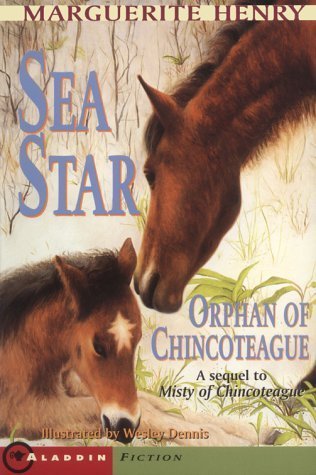
Sea Star: Orphan of Chincoteague – Marguerite Henry

Way to betray the entire premise of your original classic, Ms. Henry.

https://i.gr-assets.com/images/S/compressed.photo.goodreads.com/books/1452289973l/1351766.jpgTitle: Sea Star: Orphan of Chincoteague
Author: Marguerite Henry
Illustrator: Wesley Dennis
Original Publication Date: 1949
Edition: Aladdin Paperbacks (1991), 172 pages
Genre: Animal Stories.
Ages: 8-11
First Line: Paul was separating each silver hair in Misty’s tail.

I’ll begin with a quote from Misty of Chincoteague to explain my frustration with this book: Now when a buyer came to look at the colts, Maureen did not run to her room as she used to do, pressing her face in the feather bed to stifle her sobs. Nor did Paul swing up on one of Grandpa’s ponies and gallop down the hard point of land to keep from crying. Now they actually led the colts out to the buyers to show how gentle they were. They even helped load them onto waiting trucks. All the while they kept thinking that soon they would have a pony of their own, never to be sold. Not for any price.

Well, that didn’t age well.

It’s a bright July day when a silver airplane lands at Pony Ranch. Movie men have come to film the annual Pony Penning, and they want to purchase Misty for the film and subsequent tour. Paul and Maureen are guilt-tripped into selling Misty in order to put their uncle through college, and are afterwards thankful to discover an orphaned colt on Assateague. Little Sea Star helps to distract them from their loss but the colt is frail and refuses to eat – it’s up to the whole Beebe family to find some way to save the poor thing.

https://missmollys-inn.com/wp-content/uploads//2012/12/Marguerite-Henry-misty-of-chincoteague.jpeg
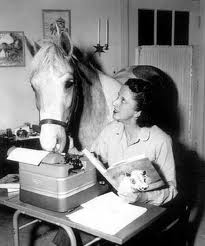
Marguerite and Misty.

Marguerite Henry had no plans to write a sequel to Misty of Chincoteague – having taken great liberties with the true story, she thought it stood well enough on its own, at least until she heard about little Sea Star. In this follow-up novel she tried to bring the plot more in line with reality. The real Misty had actually been sold to Marguerite Henry herself, and she did bring Misty to book signings to delight children. One important difference is that the real Misty was purchased before she’d even been weaned – while Clarence Beebe had not been planning to sell her, the little foal was not a beloved family pet, hard won from the wilds of Assateague and saved up for over a hard summer’s work by the Beebe children. Misty of Chincoteague was pure poetic license, delivered in gratitude to the Beebes for agreeing to sell such a wonderful pony. The characters by the end of the book were in a different place than they’d ever been in the real world, so the follow-up act of selling Misty was impossible to replicate naturally – instead, Marguerite Henry had to devote a portion of Sea Star‘s dialogue to a series of justifications for the decision. Unfortunately, none of them are very convincing.

Now it’s worth pointing out that the novel’s dialogues are only the connective tissue between the A and B plots. With the exception of the scene where Misty is crated for the plane trip, all of the horse material is entertaining for kids – the first half details the excitement of Pony Penning Day and the last third is all about saving Sea Star. Any child who loved Misty will easily pick this sequel out in a bookstore and they will probably like most of it – while it was my least favorite of the original trilogy as a kid, I still read it multiple times. Children might not agree with the decision to sell Misty, but it’s not likely to be a total deal-breaker and they certainly aren’t going to care about the mathematics of commerce or possible communistic overtones. That being said…

So the two men from New York arrive and, upon learning that the Beebe grandparents are both out, immediately start horse-trading with the kids. First they offer the tempting good news – a movie! how exciting! – and afterwards explain that they’d have to purchase Misty to make the film happen. They also want to take her to schools, libraries and movie theaters, and start guilting Paul and Maureen:

Mr. Van Meter said, “We had a feeling you might want to share Misty with boys and girls everywhere.”
“Boys and girls who have never seen a real pony,” Mr. Jacobs continued.
It was Mr. Van Meter’s turn now. “Sometimes when I hear children in New York talk about Misty, it seems she no longer belongs to a boy and girl on an island, but to boys and girls everywhere.”
The words kept flying, back and forth, higher and higher. “Misty has grown bigger than you know,” Mr. Jacobs said. “She isn’t just a pony. She’s a heroine in a book!”

Apart from the interesting metafictional element going on here (Misty of Chincoteague is a book within the sequel to the book) this is some appalling behaviour by two grown men, and Grandpa Beebe is rightly disgusted on his return. Also, no, Misty does not “belong” to all children everywhere, the book does. But the kids fall in line and even parrot some of this back at Grandma to shore up their decision to sell. “When they told how much Misty meant to poor little city children,” says Maureen. Well, as a former “poor little city child” who dreamt of riding lessons which my parents could never afford, I would not have wanted a girl in the countryside to give up her pony so that I could spend five minutes petting it. Not to mention the cold business decision to make thousands of children momentarily happy at the expense of making two extremely sad. As Grandpa says, “livin’ out here on this lonely marshland, why, Misty’s the nighest to a friend these childern got.” Are they undeserving of the pony they worked so hard for, just because she’s famous now?

Misty sold
Wesley Dennis does a great job with a sad scene.

The picture men’s arguments fail to entirely sway the family and Grandpa gladly sends them packing. However, shortly afterwards Grandma Beebe shows up with the woeful news that Clarence Lee, Paul and Maureen’s young uncle, can’t afford the college tuition of 300 dollars to study for the ministry. The children must now nobly sacrifice their beloved pony for the greater good of the family… No, hang on, that argument is also flawed.

First of all, it hinges on a character we never get to meet. Saintly Clarence Lee does not feature in a single scene in any of the three Misty books, so it is very difficult to care about his hopes and dreams. This is a failure in terms of dramatic impact, but it would still be an understandable decision for the characters in an era when college could have a great positive impact on an entire family’s prospects – until you do the math and realise that Grandpa Beebe is being taken for a fool.

The movie men explain that their company was young and struggling and could afford to pay only two hundred and fifty dollars for Misty. So she’s a famous pony and they’re trying to get her on the cheap. Grandpa agrees to this arrangement because, after a sale he was making fell through, he’s only got 50 dollars to his name. Combined, that makes up the entire tuition fee in one fell swoop. Problem is, the deal Grandpa had lost involved selling a “whole flock” of ponies – the buyer he had lined up decided to buy used trucks instead. So Grandpa has a “whole flock” of unsold ponies, and the going rate of wild ponies back in Misty of Chincoteague was 100 dollars. In that novel it was also made clear that gentled ponies could be sold for higher price. They’re sitting on a number of ponies that could easily turn a profit and instead they sell their famous Misty for beneath her value? How has Pony Ranch stayed in business?

Also, since when is college a one-time deal? Why can’t Clarence Lee wait a year and reapply? Grandma even says he’s recovering from pneumonia, which is why he can’t be expected to earn the money for himself. If he’s that physically frail, maybe it’s not the best time to embark on a grueling course of study? Selling out a beloved family pet to be hauled from place to place (which is bound to be stressful for a pony who has never traveled before), and giving her into the care of people who see a financial meal ticket decades before the film industry enforced an animal welfare code, all because college is worth any price? This has not aged well. Attempts to parallel them putting Misty in a sale crate with Paul releasing the Phantom back into the wilds also miss the mark because the Phantom was not happy at Pony Ranch while Misty clearly is.

happy misty
Behold happy Misty.

And so Misty is sold. They don’t even write up a formal contract, just a vague promise that Misty will be sent home after the tour is over. Luckily, Henry was inspired to write a third book in the series in the 1960s, assuring new generations of children that Misty did indeed come back to Paul and Maureen – unless those children got the Aladdin Horseshoe Library box set, which went ahead and listed the books in the wrong order so that Sea Star appeared to be the conclusion to the series after all.

https://d20eq91zdmkqd.cloudfront.net/assets/images/book/large/9780/6897/9780689716249.jpg
No, I’m not bitter.
Sea Star rescued, wesley dennis
Sea Star rescued.

Within hours of Misty’s departure, Paul and Maureen find little Sea Star in a cove on Assateague, and the whole family is delighted and relieved. Once this plot is finally under way, the novel does a 180 and becomes classic Marguerite Henry – the story of an orphaned colt wasting away in sorrow, and of an injured mare pining for her own lost foal and how they are brought together to grow strong and heal the sorrows of an entire family with the help of a lot of myrtle leaves. Sea Star, with his toothpick legs and wondering expression, is adorable and Wesley Dennis’s illustrations are a wonderful accompaniment once more. There are no dubious motivations amongst the native Chincoteaguers – nope, real salt of the earth types one and all. Scrumptious food descriptions are back and there’s even some humour. The first half of the book is all but forgotten, and yet…

I don’t like giving a negative review of a Marguerite Henry book. However, since Misty worked perfectly well as a standalone, I have to say that Henry’s first instinct was right. I will say in its favour that, while I can nitpick its value system, Sea Star would actually make a tremendous vehicle for discussion with even a young child and the writing remains on the same strong read-aloud level of Misty. It’s not essential, but as I said at the start, children will still enjoy the majority of the story.

See Also: Misty of Chincoteague.

Parental Guide, with mild spoilers.

Violence: Sea Star is found beside his mother’s body, but that is hardly described. Both Sea Star and the injured mare are implied to be well on the road to recovery by the end of the book.

Values: College is worth any price. If you love something, let it go. Share your greatest treasure with the impoverished world. Love is a healing force that helps us overcome our sorrows.

Role Models: Obviously the whole plot is meant to make the Beebes look virtuous and self-sacrificing, and it’s obvious what I think about that.

Educational Properties: If it’s used as a read aloud, it could spark some strong feelings and interesting discussion. Always a good thing.

End of Guide.

I’m now halfway through the series, with one more sequel and a final spinoff volume to go.

Up Next: Back to the Anne novels.

The Magic Snow Bird and Other Stories – Enid Blyton

Charlotte Mason would have called this twaddle, and she’d have been right. However, twaddle is a necessary step on the road to literacy and Blyton’s contributions, seen in this sampling of her posthumous Popular Rewards short story anthologies, are so clean you can practically hear the squeak. These days, that’s refreshing.

https://www.enidblytonsociety.co.uk/author/covers/the-magic-snow-bird-award.jpgTitle: The Magic Snow Bird and Other Stories
Author: Enid Blyton (1897-1968)
Illustrator: Dorothy Hamilton (1906-)
Original Publication Date: 1989
Edition: Award Publications (1990), 192 pages
Genre: Short stories. Fantasy. Anthropomorphic fantasy. Realistic fiction.
Ages: 4-7
First Line: Once upon a time, Derry the dormouse hid a nice little store of cherry-stones in the hole of a hollow tree.

If you happened upon this particular volume out of a Blyton bibliography consisting of hundreds of books, you would find 19 stories inside of a durable hardback printed in the German Democratic Republic, with large type, plentiful illustrations and what appears to be surprisingly low-acid paper. The stories are taken in part from a 1951 collection with the same name while the rest possibly date from the same era. Of the stories, 13 are fantasy tales, 4 are realistic tales of little British children at play and 2 are anthropomorphic stories of field and farm animals. The shortest selections are 4 pages long, while the longest, ‘Bobbo’s Magic Stocking,’ runs to 50. There is a slight Christmas theme at work, in that the title story and ‘Bobbo’ both involve trips to the North Pole to visit Santa’s Workshop – however, the rest of the material lacks a proper winter theme and appears to be selected mostly for variety.

The book is trite, just as one would suspect given the cover art. The writing is simple and fond of exclamation points: How all the others laughed! Funny old Thomas–wouldn’t go out into the water with his brothers and sisters, but didn’t think twice about going up to his chin for his boat! The illustrations are not exactly subtle. The pixies sport names like Littlefeet and Scatterbrain. And yet, none of that matters because The Magic Snow Bird (and I suspect many other Blyton works) are absolutely perfect for early readers.

The stories each stand alone and are equipped with simple plots, light comedy and wholesome messages. Three basic topics are covered:

snow bird, blyton, hamilton
Snow bird and cargo.

1. Stories meant purely to delight. Fairy treats such as the titular snow bird, which takes two children to visit Santa, or a magic blackberry which grows into a whole pie. Others ignore magic and involve simple visits from wildlife, such as the story of a dormouse who decides to hibernate in a little girl’s dollhouse. These are all low-stakes adventures based on ideas that children would enjoy.

2. “Just so stories.” Blyton’s whimsical answers to questions like how holly got its spines and why the blackbird’s beak is yellow. “A pixie did it” appears to be a favorite answer.

3. Cautionary tales. Stories of foolish or naughty children learning the error of their ways, such as Bobbo, the greedy materialist who sneaks aboard the annual good children’s trip to the North Pole because elves don’t know how to do head counts. Blyton changes up the standard Santa mythology regarding such questions as how the reindeer fly:

Bobbo looked, and he saw a most enormous hill stretching up in front of the sleigh. It was very, very steep, but the reindeer leapt up it as easily as if it was level ground. The sleigh tilted backwards, and the children held on more tightly than ever. Up and up went the sleigh, right to the very, very top, and then, on the summit, drenched in moonlight, it stopped.
‘We’ve come to a little inn!’ cried one of the children, leaning out. ‘Oh, and here come six little gnomes, carrying something! What are they going to do?’
All the children leaned out to watch. They saw the gnomes come hurrying up, carrying pairs of lovely green wings. There were six pairs of these, and the gnomes knew just what to do with them.
Four of the gnomes went to the reindeer, and fastened a pair of wings on to their backs. The other two bent down by the sleigh, and the children saw that they had fastened two pairs of wings on to the sides of the sleigh as well!

cat, blyton, hamilton
Dormouse and interested neighbour.

For all that the writing is simplistic, I actually enjoyed Blyton’s imagery quite a bit. Her stories are of the halcyon 1950s and utterly reject anything approaching relevance even for the time period. Her children play hide and seek, sail toy boats and have dollhouses. Her families are automatically intact and her reference pool consists of pixies, brownies and gnomes alongside classic British plants like holly and primroses. It’s simple escapism, something for the child graduating from I Can Read books to chapter books, completely clean-cut and cuddly. I suspect Blyton was consistent in this regard – series like Malory Towers might be aimed at an older group of kids than these anthologies, but I highly doubt the content takes any darker shifts.

Now here’s where things get interesting, as librarians and educators have been waging a war against Enid Blyton for the past 50 years. It’s almost funny, given how innocuous a target she appears, and I suspect a large part of their continued bitterness against Blyton stems from the fact that she won. Her books are still massively popular, such that British publisher Hachette’s attempt to doctor the Famous Five books hurt sales so badly that they actually returned to their earlier edition in 2016. Educators and librarians fume but Blyton remains standing. Used bookstores in Britain feature whole shelves stuffed with her books (which I’ve seen firsthand) and there she stays, not on the strength of one canonized classic so much as her whole output.

Normally I would be inclined to sympathize with critics taking a stand against poor prose – however, these critics sit mute over much of the modern dross saturating the markets while insisting that bad old Blyton should be quashed. As such I suspect the “literary standards” argument was simply a handy cudgel in this instance, with the real objection being Blyton’s perpetual popularity. These heartlessly conservative and blindingly white books are still widely read today, while successive Carnegie winners and acclaimed intersectional efforts lapse into obscurity. The so-called experts have failed to turn public opinion against her for over 50 years. That’s gotta sting.

https://d.gr-assets.com/books/1320495328l/7095563.jpg
The bait-and-switch winner of 2010, perhaps?

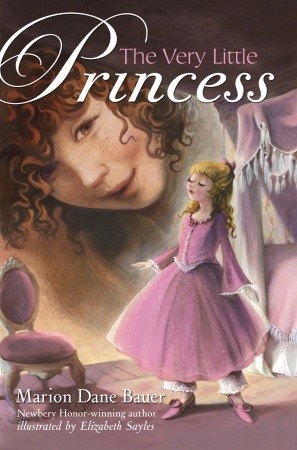
To best illustrate why I so warmly recommend Blyton, have a quick look at the GoodReads reviews for The Very Little Princess, a Stepping Stones chapter book by Newbery Honor author Marion Dane Bauer. With its quaint title, sweet pink cover and Blytonian premise of a doll coming to life, what could possibly go wrong? Surely any parent could gift this to their daughter in full confidence and leave it at that! Yet this book ends with its young heroine being abandoned by her bipolar mother at her grandmother’s house – a grandmother she’d never met before. The packaging thus appears deeply subversive – bypassing parents and cutting them out of the conversation they should be having (and deciding when to have) with their children about such topics. And it’s not the first, the worst or the last of this trend.

For a cautious parent, researching every book you pick up for your child is an overwhelming task, which leads us back to Blyton. With her, you’re off the hook. Children love her and parents can relax around her. Oh, the horror!

Check out the Parental Guide and see what I mean.

Violence: In one story, a duckling is angry at the mean ducks on the farm and so he goes to the farmer demanding that all the ducks be killed. Mr. Farmer laughs and tells him to come back in eight weeks, since he might change his mind by then – a bit of folktaleish cynicism on display here, though it’s obvious the farmer does not intend to follow through with the duckling’s idea. The duckling is ridiculed as a fool for wishing harm on his own while seeing himself as exempt.

No other stories go near the concept of death. There are some references to scary goblins, but they never actually appear.

Values: Blyton likes to tell her audience not to be idiots. Don’t be greedy. Don’t make assumptions. Don’t lose your temper. Don’t bite your nails. Don’t be like that duckling. Meanwhile, her good children are always helpful, generous and provide shelter for local wildlife.

Role Models: Naughty children learn the error of their ways. Good children visit Santa.

Educational Properties: A fine option for reading practice.

https://www.egmont.co.uk/wp-content/uploads/2018/08/enid-blyton.jpg
Enid Blyton and dog.

As I said, this book is being recommended on faith as a stand-in for much of Blyton’s work, as the odds of finding specific titles here in America seem small. She’s not great literature – and she doesn’t have to be. She gave children stories they loved.

Up Next: A wintry children’s classic and Dutch travelogue all rolled up in one for the Christmas season: Mary Mapes Dodge.

Flower Fairies of the Spring – Cicely Mary Barker

Given that the Flower Fairy books are A: standalone, B: poetry and C: have no plot between them, I will be reviewing this series in whatever order and at whatever speed I am able to acquire them. Nothing like a dream of spring in the depths of winter…

https://i.gr-assets.com/images/S/compressed.photo.goodreads.com/books/1309213072l/245680.jpgTitle: Flower Fairies of the Spring
Author: Cicely Mary Barker (1895-1973)
Illustrator: Cicely Mary Barker
Original Publication Date: 1923
Edition: Frederick Warne (2002), 42 pages
Genre: Poetry. Fantasy.
Ages: 3-8
First Line: The World is very old;
But year by year
It groweth new again
When buds appear.

Nursery rhymes are a tremendous learning tool for small children, conveying obvious skills such as memorization and predictive language, along with the specialized knowledge of how to read poetry in the first place – something of a lost art among today’s schoolchildren. Articles about the declining interest in poetry and what to do about it are a dime a dozen, and librarians are forever extolling the virtues of the trendiest middle-grade novels in verse, when the simplest remedy would be to avoid letting a child’s natural proficiency and enthusiasm for Mother Goose atrophy in the first place, via a fairly straightforward progression of English poets.

By providing the natural stepping-stones of Milne, Lear, Kipling and Stevenson, a gradual link would then be made to the classic narrative verse of Browning’s ‘Pied Piper of Hamelin,’ Rossetti’s ‘Goblin Market‘ and Tennyson’s ‘The Lady of Shalott,’ which are themselves not so far removed from romantics like Coleridge and Keats (and once a young person can read those poets, they would be able to progress both forwards and backwards in time from there with no real difficulty). Aside from the Classical Christian website, I couldn’t find a single educator advising this obvious curriculum to get kids reading poetry, probably because it would be way too white for today’s classrooms – thus they deny heritage to some children while offering mediocrity to all. In fact, educators love these new novels in verse specifically because the word count is lower and therefore they can be used to encourage “reluctant readers.” Now picture someone saying that Paradise Lost is simpler than Moll Flanders or that The Waste Land is an easier read for students than The Great Gatsby and you can imagine how topsy-turvy this whole educational trend really is.

https://thewesterncornerofthecastle.home.blog/wp-content/uploads/2019/12/52f10-05windflower.jpg
The Windflower Fairy.

This leads me to the Flower Fairy books of Cicely Mary Barker, which could easily fit on a young child’s poetry curriculum. Barker was an artistic invalid who took correspondence courses to become a painter while her older sister supported the family by opening a kindergarten in their house. Taking inspiration from Kate Greenaway and the Pre-Raphaelites, Barker began a series of children’s poetry books, most famously on the subject of fairies. Fairies were all the rage in the 1920s, enjoying heightened publicity thanks in part to the Cottingley Fairy photographs – and of course the Pre-Raphaelites hadn’t been immune to the lure of fairies either, which made it a natural subject for a book of botanical children’s poems. Queen Mary herself admired the results. At some point I will find a complete set of the little books, but for now this first one will have to suffice.


Every open page of this pocket-sized book contains a portrait of a fairy child with the flower he or she represents and on the facing page an ode to the flower in question. Her fairies were modeled by interested children from the household kindergarten, giving each character an individual appearance which combine over the book into a harmonious image of the English schoolchild of the 1920s. They are bright and happy, yet shy. They are impudent and proud and pleasant. They are beautiful, they are the generation who would grow up to endure the Second World War, and they are captured here fancifully and forever.

https://www.bing.com/th?id=OIP.A29LuxycpoD6TG5w_0VL8AHaLa&pid=Api&rs=1
The Dandelion Fairy.

Each costume for the fairies was based around the flower to be illustrated, which Barker would faithfully paint from real specimens. The costumes were where true flights of fancy would occur, and Barker created physical costumes and wing miniatures to paint, drawn from the different parts of the plant with rewarding detail. As an American, the flower I was most familiar with in this book was the dauntless dandelion and so it was his costume I most closely examined, discovering botanical inspiration from cuffs to shoes to the very shades of green and gold. Every portrait has this level of care, and the result really does have the feel of Pre-Raphaelites for toddlers.


Barker’s artwork is only half the volume, and the accompanying poems are every bit as enjoyable, particularly for parents who are big fans of Victorian poets. I could read this book aloud dozens of times and the poems would only become more engaging due to their mellifluous and leisurely rhythm. This is a book that rewards repetition.

https://www.bing.com/th/id/OIP.V2EcwpaQ-aaJhRwq0VgdDQHaLS?pid=Api&rs=1
The Daffodil Fairy.

I’m everyone’s darling; the blackbird and
    starling
Are shouting about me from blossoming
    boughs;
For I, the Lent Lily, the Daffy-down-dilly,
Have heard through the country the call to
    arouse.
The orchards are ringing with voices
    a-singing
The praise of my petticoat, praise of my
    gown;
The children are playing, and hark! they are
    saying
That Daffy-down-dilly is come up to town!


This collection is best suited for nature-oriented families, those with English gardens or wildflowers of their own to hunt and observe, for the poems are not narrative, meaning Barker will always be more niche than someone like Beatrix Potter. Nevertheless, these pages cover a variety of imaginative ground, some simply descriptive of the flowers themselves while others take to their viewpoint, like that of the cheerful daffodil. ‘The Song of the Lords-and-Ladies Fairy’ ends with a fierce warning likely to stick in its young audience’s mind and keep them from getting poisoned:
And my berries are a glory in September.
(BUT BEWARE!)

Meanwhile the Willow-Catkin admonishes:

To keep a Holy Feast, they say,
They take my pretty boughs away.
I should be glad– I should not mind–
If only people weren’t unkind.

Oh, you may pick a piece, you may
(So dear and silky, soft and grey);
But if you’re rough and greedy, why
You’ll make the little fairies cry.

There’s star imagery in the Windflower Song, there’s a little Mother Goose to Sing a song of Larch trees and the shortest poem in the lot is the humble ode to the Lesser Celandine. Over it all hang the twin centerpiece of the King and Queen of Spring, who are unfortunately not placed side by side in the middle of the book as they should be by rights. The Primrose has a simple charm and grace while the Bluebell (Wild Hyacinth in this case, not Scottish Harebell) is proud and superb.

https://i.pinimg.com/originals/ae/f8/55/aef8556c9c149bfe6be2ed6bb6947708.jpg
The Bluebell Fairy.

My hundred thousand bells of blue,
    The splendour of the Spring,
They carpet all the woods anew
With royalty of sapphire hue;
The Primrose is the Queen, ’tis true.
    But surely I am King!
            Ah yes,
    The peerless Woodland King!


Loud, loud the thrushes sing their song;
    The bluebell woods are wide;
My stems are tall and straight and strong;
From ugly streets the children throng,
They gather armfuls, great and long,
    Then home they troop in pride–
             Ah yes,
    With laughter and with pride!

https://i.pinimg.com/originals/3b/5b/6f/3b5b6f3b615843f9645c70f0e0933333.jpgOut of curiosity I made a list of the poems to see how often the rhyme schemes and templates repeated, to find that there were no exact replicas. When Barker reused a rhyme scheme she would change the number of stanzas, ensuring that every rhyme had its own face. I expect some repetitiveness would start to appear in the seven companion volumes but for now everything is very fresh, and in truth I would be very surprised if the artistic quality of subsequent installments ever dropped. Highly recommended to all English and Anglophile families.

Parental Guide, with no spoilers for once.

Violence: Completely inapplicable.

Values: English country flowers, landscape, children and folkways. Pre-Raphaelite influences.

Role Models: The children depicted are idealized, which is one of the chief purposes of art that has now been forgotten – to inspire.

Educational Properties: Memorization, recitation and elocution. Use for inspiration to plant and tend an English garden or to take a nature walk (in the right parts of the world) to hunt for the flowers – I’ve seen a number of them here in New England. Families who make their own doll costumes or other textile or artistic crafts might want a copy even if they hate poetry.

End of Guide.

I hope to acquire a complete set of the Flower Fairy books sometime soon, at which point I will make a full review series. I’m very happy to have stumbled upon this English gem I missed in my Anglophile childhood.

Up Next: Staying British with Enid Blyton.

Misty of Chincoteague – Marguerite Henry

Remember when you could buy a pony for 100 dollars? Me neither.

Related imageTitle: Misty of Chincoteague (Misty #1)
Author: Marguerite Henry (1902-1997)
Illustrator: Wesley Dennis (1903-1966)
Original Publication Date: 1947
Edition: Aladdin Paperbacks (1991), 174 pages
Genre: Animal Stories. Adventure.
Ages: 5-11
First Line: A wild, ringing neigh shrilled up from the hold of the Spanish galleon.

Paul and Maureen Beebe are growing up on their grandparent’s horse farm in the isolated commuity of Chincoteague Island. Tired of bonding with colts that always get sold, the siblings set out to earn 100 dollars to spend at the annual Pony Penning Day, when the wild herds on Assateague Island are rounded up and the colts auctioned. Paul and Maureen have their hearts set on an elusive mare called the Phantom, who has avoided capture two years in a row. Faced with the challenges of earning enough money, capturing and gentling her, an added complication is thrown into the mix when Pony Penning Day arrives and reveals that this year the Phantom has a colt of her own…

The Newbery list is certainly hit-and-miss but (with a few notable exceptions like The Phantom Tollbooth and Little House on the Prairie) they have historically been quite good at recognising children’s classics when they appear on the American stage and that’s exactly what the 1948 Honor Book Misty of Chincoteague is. A horse story that can appeal to a broad age range, full of action and purpose as the protagonists dedicate themselves to a series of goals, yet devoid of the emotional punches that are found in other famous horse books like Black Beauty. The ending is memorable and wistful, but without tragedy, and the story as a whole is sunny, lacking any villains beyond circumstances that must be overcome. With Paul and Maureen sharing viewpoints, it even has equal appeal to boys as well as girls, something that has become unusual in the genre.

Wesley Dennis
Paul heading off to work.

Marguerite Henry instills her book with a strong sense of place right from the start, not only with the wild herds on Assateague but also the fishing community of Chincoteague, whose independence forms a parallel to the ponies, for these men and women are also making do with less, cut off from the larger nation yet thriving. There’s a real American ethos within the book and it captures a place in time with its own culture and cuisine (there’s a small pile of food descriptions with oysters, cornbread, clam fritters, dumplings and wild blackberry jam). Henry spent a great deal of time on Chincoteague, and even though she changed the larger “true story” drastically, I have no reason to distrust her eye for detail, which even renders the old-timers’ accent through Grandpa and Grandma Beebe:

Maureen: “…if you came here to Pony Ranch to buy a colt, would you choose one that was gentled or would you choose a wild one?”
Grandpa chuckled. “Can’t you jes’ see yer Grandma crow-hoppin’ along on a wild colt!”
“Thar’s yer answer,” laughed Grandma, as she cut golden squares of cornbread. “I’d take the mannerly colt.”

The real draw are the horses, of course, and Henry supplies two perfect equine characters in the Phantom and Misty. The Phantom has a map of the United States on her withers – a clear cut case of symbolism in a patriotic novel. “Lad,” [Grandpa] said, “the Phantom don’t wear that white map on her withers for nothing. It stands for Liberty, and ain’t no human being going to take her liberty away from her. … The Phantom ain’t a hoss. She ain’t even a lady. She’s just a piece of wind and sky.”

https://78.media.tumblr.com/a995b367ed67762425a704e360e5c91e/tumblr_oigdbozsVX1tedwcmo7_500.jpg
Paul’s first glimpse of the Phantom and Misty.

The only thing that really tames the Phantom is her “colt” (islanders in this book refer to every young horse as a colt, which I thought only referred to males), whom Paul names Misty. Misty drives none of the plot – she is the counterweight to the Phantom’s wildness, playful and domestic by nature, belonging to Chincoteague from the moment her hooves land on the shore. Slowly and dejectedly the wild ponies paraded through the main streets of Chincoteague. Only the Phantom’s colt seemed happy with her lot.

I would be remiss not to single out Wesley Dennis as a large part of Misty of Chncoteague‘s charm, as he always supplies the perfect image for every scene. The personalities of every character, horse and human, shine through and equal the best of Garth Williams’ work. Dennis draws comic characters without caricaturing and his equines emote without crossing the line and losing their realism. His dramatic talents also enhance the impact of what is a fairly short and low-stakes adventure tale, making the risks feel bigger and the triumphs sweeter. Nicely done.

https://thehaynesblog.files.wordpress.com/2015/08/il_fullxfull-291177439.jpg
Maureen surrounded by wild ponies – a brief line of text given epic treatment.

I have no complaints to make. Misty of Chincoteague was quite nearly as enjoyable today as it was when I was a child. It makes a lovely addition to the family bookshelf and would make a good read-aloud for high summer, maybe even for 4th of July week given how civic minded the story is. For more on the 1940s value system this is steeped in, check out the Parental Guide below.

Violence: The book opens with a Spanish shipwreck in which the original Assateague ponies, destined for the mines of Peru, successfully swim to shore. All hands perish in the storm, with Henry softening that blow by depicting the Captain as gold-hungry and indifferent to the ponies’ welfare. In the present day, there’s a high ratio of distressed ponies, due to their captivity on Pony Penning Day and the auction. None are injured or die.

Values: Hard work and responsibility as Paul and Maureen seize any type of summer employment they can find to earn money for the Phantom – and then do it all over again to pay for Misty. They have a whole series of chores round the Ranch and almost every time the grandparents are depicted they are in the middle of work, whether that be feeding chickens, preparing food, maintaining the horses or doing laundry.

Misty is very patriotic in tone – Pony Penning revenue goes toward maintaining the island’s fire department, school is “what me and Grandma pays taxes for,” every roundup man is well-known by his day job and the island is a well oiled machine with every man, woman and child doing their part to keep it running. The kids have a great deal of independence and are allowed their own goals and their own time to tell about them, but once Paul is picked for the roundup crew he is expected to obey his leader’s orders (and is promptly rewarded when following instructions leads him to the Phantom). There’s even material about fair play, as Paul and Maureen pull a wishbone to decide who gets to race the Phantom, and liberty, when Paul makes a hard decision about the Phantom’s future.

Role Models: Paul has a keen head for business but also a romantic streak, and he’s the one most attuned to the Phantom. Maureen is given less to do, which disappointed me growing up, and a friend of mine found several disparaging remarks (such as “Quit acting like a girl, Maureen!”) concerning as a parent. As such, I paid close attention to the topic and found the only source of the quotes to be Paul, which could easily be attributed to big brother posturing. Such occasional put-downs never stop him from treating her as an equal partner in their plan to buy and gentle the Phantom and the actual text never devalues Maureen’s (or Grandma Beebe’s) contributions. It’s certainly true that she doesn’t get any action scenes, but it’s also true that not everything has to be about girls. There are thousands of horse and pony books catering to the pre-teen girl demographic, books which I devoured indiscriminately and which rarely ever give equal time or weight to male characters – such that when I first read Misty I assumed that Maureen should naturally have a greater bond with the Phantom just because she was a girl. No one ever labels that a cause for concern, so a mix of recent and vintage horse books would balance out nicely.

https://upload.wikimedia.org/wikipedia/en/thumb/c/cf/Marguerite_Henry.jpg/220px-Marguerite_Henry.jpg
Marguerite Henry was owner of the real Misty.

Aside from that, not a lot to say. Every character is trustworthy and fair and probably most kids would wish they had grandparents like the Beebes. Oddly, Paul and Maureen’s parents are absent due to being in China (I guess Henry thought orphaning them would be too predictable).

Educational Properties: I would normally advise researching the true story behind the fiction, but in this case there is no historical sweep that would prove schoolworthy and Misty is meant for such young readers that there’s no point digging for disillusion here.

On the other hand, the wild ponies have been observed for decades, which offers quite a lot of information and data for a bit of natural science. Theories on how the ponies arrived on Assateague are also well worth researching. Those in nearby states might want to take a trip to the islands as well.

End of Guide.

I have copies of all three sequels to Misty, which I will be posting in the next few months. I can then embark on her larger bibliography, which consists mostly of other horse stories (one of which won the Newbery Medal), many of which were also illustrated by Wesley Dennis.

Up Next: A springtime poetry collection by Cicely Mary Barker.

Anthropomorphic Fantasy: The Trumpet of the Swan

Well, that was odd.

https://i0.wp.com/pics.cdn.librarything.com/picsizes/38/57/3857e41d0383d9e597966675a67444341587343.jpgTitle: The Trumpet of the Swan
Author: E.B. White (1899-1985)
Illustrator: Edward Frascino (????-)
Original Publication Date: 1970
Edition: Harper and Row (1973), 210 pages.
Genre: Anthropomorphic fantasy.
Ages: 5-8
First Sentence: Walking back to camp through the swamp, Sam wondered whether to tell his father what he had seen.

https://thewesterncornerofthecastle.home.blog/wp-content/uploads/2019/09/4db91-17b.trumpeter-swan_2199.jpg
The gorgeous trumpeter swan (Cygnus buccinator).

The scene opens on a pond in the vast Canadian wilderness. Two swans have settled there to build a nest and raise their young. Sam Beaver, a boy from Montana, quietly observes them before returning to his father’s camp. The cygnets hatch and a peaceful, thoughtful nature documentary on the life cycle of a trumpeter swan seems about to unfold – except that one of the new cygnets is mute. So Louis, as the unfortunate is called (and that should be given the French pronunciation like Armstrong, or a later joke will fall flat), goes looking for Sam Beaver in Montana, finds him surprisingly quickly, and requests his assistance. Sam takes him to school, where he learns to write, but since swans can’t read, a full-grown Louis must learn to play trumpet to win the beautiful swan of his dreams. His father, the old cob, has to steal a trumpet to secure his son’s future (swans having no purchasing power), and Louis must then go forth across America and seek employment as everything from camp bugler to nightclub musician, all in quest of enough money to pay damages to the music shop in Billings and restore his father’s honour.

E.B. White took a break of nearly two decades between Charlotte’s Web and this, his longest novel, in which he lets loose all restraint and delivers a tale so wholly absurd that it makes Stuart Little look positively staid in comparison – in fact, had there been a cameo from Stuart, all the way to Montana and still looking for his bird, it would have fit the general tone rather perfectly. Many people say this is White’s funniest book and I suppose it is, although I found the constant unremarked absurdity and crazyquilt plotting to be a trifle wearying after a while.

https://i0.wp.com/www.mrslittle.com/wp-content/uploads/2014/06/Trumpet_steal.jpeg
The old cob’s daring heist.

The Trumpet of the Swan is best described as a peculiar mix of ingredients. First there is the riotous comedy of a swan playing trumpet, overnighting at the Ritz and attacking zookeepers. This is tempered by an obsession with “realistic” detail, such as swans being unable to read because they don’t go to school (of course that would be the case) and Louis needing an operation on his webbed foot to be able to use the valves on his new trumpet. Then there is the nature program aspect, detailing nesting habits, natural predators and man-made hazards in the life of the trumpeter swan. Meanwhile, the serious subtext of the novel is that of disability overcome and the final effect is (somehow) of a sweeping fairy tale romance – this in spite of the fact that Louis’s true love, Serena, is barely a character at all. Your individual enjoyment of the book will depend a lot on how successfully you think these elements are handled and how willing you are to see them meshed together in the first place.

What I actually found most refreshing about this novel had to do with the change in illustrator: Edward Frascino won the commission to illustrate because he could allegedly work faster than Garth Williams, and White insisted upon a spring publication date for financial reasons. Williams’ illustrations would undoubtedly have been warm and endearing as always, but I actually found Frascino’s style a far better match to the novel: As White muses on the subjects of freedom, romance and nature conservation, Frascino supplies regal swans and landscapes that are sweeping and full of wonder. There’s a grace implicit to even the silliest images that shows the New Yorker cartoonist had hidden depths. Unlike with Williams, Frascino has never been enshrined as integral to White’s work, and the special 2000 edition of The Trumpet of the Swan replaced his illustrations with those of Fred Marcellino. I have not had a chance to compare them yet other than to note that Marcellino’s swans are far more anthropomorphized than Frascino’s.

https://thewesterncornerofthecastle.home.blog/wp-content/uploads/2019/09/ce877-trumpet-swan-marcellino.jpg
Marcellino’s sad Louis, rejected by an illiterate Serena…
https://i.pinimg.com/originals/81/98/e4/8198e462e65db17bf899d590f6e75059.jpg
…and Frascino’s triumphant Louis, serenading Serena.


As for the actual text, the biggest disappointment to be found this time around is actually in White’s writing style, which has become a good deal plainer than it was before – perhaps because he was hurrying himself as well as his illustrator. The sentences are shorter on average and less suited to reading aloud, as in this scene where Louis rescues a drowning boy at summer camp: Cheers came from the people on the shore and in the boats. Applegate clung to Louis’s neck. He had been saved in the nick of time. Another minute and he would have gone to the bottom. Water would have filled his lungs. He would have been a goner.

https://www.abandonedspaces.com/wp-content/uploads/2018/08/564px-sheldon_church_2.jpg
The South Carolina town of Yemassee is famous for the Old Sheldon Church Ruins, dating from the 1700s. Lots of cool pictures and history in the link to the right.

While this loss of underlying melody is certainly sad, such stiff passages are broken up by measured lines of classic White, with delicate sensibility and a love for the North American landscape (including a shout out to Yemassee, SC, which led me to this cool page). They flew south across Maryland and Virginia. They flew south across the Carolinas. They spent a night in Yemassee and saw huge oak trees with moss hanging from their branches. They visited the great swamps of Georgia and saw the alligator and listened to the mockingbird. They flew across Florida and spent a few days in a bayou where doves moaned in the cedars and little lizards crawled in the sun. They turned west into Louisiana. Then they turned north toward their home in Upper Red Rock Lake.

Louis has wings, allowing him to be a far greater traveller than tiny Stuart in his automobile or sedentary Wilbur, and thus White has him traverse the country, from Canada to Montana to Boston and Philadelphia. This freedom is tremendously important to Louis – it’s truly the classic American saga of the young man going out into the world to make a name for himself, bring prestige to the family, earn a living and win his true love… the archetypal young man is just a swan in this case. With no overhead. So it lacks real drama, making it quite perfect for little kids. Worth noting that Louis is on his own a lot of the time, meaning that one of White’s greatest skills – that of the ensemble cast which made Charlotte’s Web and the first half of Stuart Little so engaging – is almost completely absent last time around.

https://i.pinimg.com/236x/de/7c/66/de7c66672d7559eed92cf1ab3ab4e95c.jpg
From the title page.

The most memorable character here is not even Louis; it’s his father, the old cob, who is prone to long speeches on his own gracefulness and his duty to uphold the swan image of elegance at all times. Yet he is willing to sacrifice that honour so that his mute son will have a future. He is at once both comic and noble, a figure of fun for being overly dignified, rather than a bumbling dad. In these moments The Trumpet of the Swan becomes a true companion for Charlotte’s Web – a story of a father’s love that is quite moving for a parent and comforting to a small child:

“I have robbed a store”, he said to himself. “I have become a thief. What a miserable fate for a bird of my excellent character and high ideals! Why did I do this? What led me to commit this awful crime? My past life has been blameless–a model of good behavior and correct conduct. I am by nature law-abiding. Why, oh, why did I do this?”
Then the answer came to him, as he flew steadily on through the evening sky. “I did it to help my son. I did it for love of my son Louis.”

In spite of my own preference for a less whimsical White, The Trumpet of the Swan is extremely easy to quote from and ends on a truly graceful note. While I never quite warmed to it, it does share the unique charms of Stuart Little and Charlotte’s Web and has its own moments of beauty alongside its wilder eccentricities.

See Also: The other two E.B. White books, Stuart Little and Charlotte’s Web.

Parental Guide up next, with spoilers.

Violence: Male swans have powerful wings and are accustomed to beating up those who cross them, with Louis attacking two zookeepers attempting to corner Serena, and cuffing a little duck who stole his trumpet. The old cob is shot trying to repay the music store he’d previously burgled, but any sense of danger is soon negated as the old cob continues his elegant monologue regardless of the pain, saying “I must die gracefully, as only a swan can” before fainting. He’s soon patched up and on his way again.

Values: In addition to a love for the American landscape and an encouragement for nature preservation, White also writes an ode to freedom, with Louis and Serena choosing to take their chances in the wild rather than remain in the zoo forever. However, in a twist that weirds a lot of people out, they barter for their freedom by promising the zoo an occasional cygnet of theirs in exchange. Louis keeps this promise, as Sam Beaver points out that there’s always a runt in any brood that could benefit from mankind’s protection.

Louis is a swan navigating human society and White does bring up the problem of prejudice, primarily to spoof it. While Louis works as camp bugler, he meets a boy called Applegate who insists he doesn’t like birds. The camp leader says he is “entitled to his likes and dislikes and to his prejudices” but must still treat Louis with the respect accorded a camp bugler. After Louis saves the boy from a watery grave, the camp leader then puts Applegate on the spot, coaxing him toward a “and what have we learned today?” life lesson. Applegate thought hard for a moment. “Well,” he said, “I’m grateful to Louis for saving my life. But I still don’t like birds.” The camp leader is nonplussed and has to leave it at that.

Role Models: Everyone in this book is quite nice and fairly high-minded. Louis works hard, pays his father’s debt and always tips the waiter. His original sense of self-pity is overcome alongside his disability. The old cob does as he promised, and risks life and limb first to steal and then to pay back for the crime. Sam Beaver is kind to animals and is willing to cross the country to help his friend out of a jam. Only Serena lacks positive attributes, seeming to fall for Louis just because he carries so many material goods around and serenades her on the water.

https://i0.wp.com/jasonrobertbrown.com/wp-content/uploads/2012/05/51cdkBfwoZL._SS500_.jpgEducational Properties: Easy tie-in to a music appreciation lesson if you have similar taste as White, who supplies a mixture of American standards (‘Summertime,’ ‘There’s a Small Hotel’ and ‘Beautiful Dreamer’ among those featured) and classical pieces (Brahms’ ‘Cradle Song’ mentioned by name, also Bach, Beethoven and Mozart) for Louis’s set list. A playlist drawn from and inspired by the book could very easily be created. The Trumpet of the Swan was also adapted for symphony in 2011 by Marsha Norman and received very positive reviews – if I ever expand into adaptations, that is certainly one I would like to try.
End of Guide.

With The Trumpet of the Swan I conclude the youth bibliography of Elwyn Brooks White. There is nowhere to go from here and that’s a very satisfying feeling all by itself, the more so given how effortless and enjoyable I found these three short, strange children’s classics to be. My advice for parents would be to gather up all three, start with Charlotte’s Web and see what order your own family would rank them in. I consider The Trumpet of the Swan as the weakest of the three but I also understand why so many other readers are completely charmed by it.

Up Next: Please note that I am changing the posting schedule from Saturday to Monday, owing to recent changes in my life. So next Monday expect a fantasy novel from two-time Carnegie winner Geraldine McCaughrean – finally a British author!

Adventure Novels: Adventures of Huckleberry Finn

If you loved The Adventures of Tom Sawyer for its prose or its characters or even its brand of humour, then I have some bad news for you. Adventures of Huckleberry Finn (whose loss of the definite article has always been a pet peeve of mine) is not a true sequel or even a companion volume to that first installment – rather, it is a wholly separate entity piggybacking on The Adventures of Tom Sawyer to that novel’s and its own detriment. Bear with me as I wrestle my sprawling notes into form, as this will be almost twice as long as my regular reviews…

https://images-na.ssl-images-amazon.com/images/I/517SX7S197L._SY291_BO1,204,203,200_QL40_.jpgTitle: Adventures of Huckleberry Finn
Author: Mark Twain (1835-1910)
Illustrator: Edward Winsor Kemble (1861-1933)
Original Publication Date: 1884
Edition: New Riverside Editions (2000), pages 69 to 320 of 392 pages.
Genre: Adventure. Humour. Historical Fiction.
Ages: 14-17
First Sentence: You don’t know about me, without you have read a book by the name of “The Adventures of Tom Sawyer,” but that ain’t no matter.

I owe a great deal of the following information to the contextual material included in the New Riverside Edition, specifically ‘The Composition of Adventures of Huckleberry Finn‘ by Victor A. Doyno and ‘Introduction to Adventures of Huckleberry Finn (1958)’ by Henry Nash Smith. Smith incidentally cautions against what I am about to do when he says “a book so clearly great, yet with such evident defects, poses a difficult critical problem. There is little profit in making a mere checklist of faults and beauties. We must try to see the book integrally.” There are apparently rules to reading Huckleberry Finn. I didn’t know this and it is now considerably too late for me to start playing by them.

https://thewesterncornerofthecastle.home.blog/wp-content/uploads/2019/08/057bb-mark-twain-.jpg
Mark Twain.

So to really understand the artistic debacle that is this novel, we have to start with a recap not of the plot, but of its very creation. Mark Twain began work on it in 1876, upon completing Tom Sawyer and got the plot well underway before losing steam and setting the manuscript aside for several years. In the meantime he went to Europe, got irritated at the aristocracy and wrote The Prince and the Pauper. Between 1879 and 1880 he returned to Huckleberry Finn and wrote the middle portion of the work, filled with feuds, charlatans and angry mobs. He also added a ‘Snicket Warning Label’ to the front of the book (more on that in a moment), presumably not willing to spend the extra time reworking part one to match up with his new interests and themes in part two. Then he lost interest and put the manuscript aside for another three years. Twain finally finished it up from 1883 to 1885, tagging on the ending – which is famously reviled even by those who in the same breath call Adventures of Huckleberry Finn the Great American Novel. To be fair, he also went back into the early portion and added the eerie sequence set on the wreck of the Walter Scott, which provides a window into what the whole book could have been had he pursued further revisions. Instead, he sent it to print and made some quick cash.

Now, about that warning label. NOTICE: Persons attempting to find a motive in this narrative will be prosecuted; persons attempting to find a moral in it will be banished; persons attempting to find a plot in it will be shot. Does ironic self-criticism ward off or negate external criticism? It certainly seems to have worked for Twain, at least as far as the plot warning goes.

The plot I’m not supposed to look for begins in a very straightforward manner: Huck flees from his abusive father, runs into escaped slave Jim and they decide to drift down the Mississippi on a raft to the mouth of the Ohio River. Jim will then be able to make his way north to freedom, Huck will be safe from his father finding him and there’s just one problem: Mark Twain didn’t know about the Ohio, he knew about the lower Mississippi and that’s what he wanted to write about. His solution to this problem of plot versus intention was for Huck and Jim to travel in a fog, overshoot the Ohio and have to find a canoe to get back up the river. Fair enough, but Twain then ceased to care about his original story at all. For a large portion of the book they have acquired a canoe and yet they just keep drifting down the Mississippi against all logic because Twain was unwilling to go back and rework his early material to fit his new direction. He had also conceived an antipathy to The Adventures of Tom Sawyer at some point in all this, which perhaps explains his slow work on the follow-up and certainly explains the new and improved Tom Sawyer we get in the finished product.

https://www.raptisrarebooks.com/images/52070/adventures-of-tom-sawyer-mark-twain-first-edition-signed-1876-rare.jpg
Tom Sawyer from the first edition frontispiece.

If you really loved Tom in his book, there is pretty much nothing for you here. The clever and admirable boy is completely gone and his superstitions and make-believe have now transformed into an inability to tell the difference between fantasy and reality. The problem is very obvious if you read the two novels close together: Tom explains quite cogently what “ransom” means at the end of The Adventures of Tom Sawyer, while in the opening chapters of Huckleberry Finn he is suddenly clueless about the word, saying “per’aps if we keep them till they’re ransomed, it means that we keep them till they’re dead.” I read the scene carefully to see if maybe Tom was pranking his friends in some way, but no, it’s just a lengthy and not terribly funny joke on Twain’s part. Tom is now just as ignorant as his peers and can’t even comprehend the stories he so avidly devours. His pranks are cruel and actively dangerous. The boy who testified to save an innocent man from execution, delaying to the last moment from fear, now makes revelations for “dramatic effect.” His code, his better qualities, are all gone.

On the other hand, if you really thought Tom was just a brat in his book, but loved The Adventures of Tom Sawyer for the writing, there is still little for you here. Twain trades in the larger-than-life narration that was a big part of Tom Sawyer‘s charm and turns to the first-person American vernacular. This is a historic moment in American literature and I’m certainly not saying it’s a bad decision or the wrong choice to make – it just further distances the two volumes from each other. Many people read Huckleberry Finn first, or never get around to Tom Sawyer because “it’s just a kid’s book,” and I suppose doing so would negate several of my criticisms. Huckleberry Finn breaks so thoroughly away from its predecessor in form, character and content that being a sequel actually does it a disservice. Here’s a taste of Twain’s excellent use of the vernacular, from Huck’s time spent abducted and living up in the woods with his father:

He kept me with him all the time, and I never got a chance to run off. We lived in that old cabin, and he always locked the door and put the key under his head, nights. He had a gun which he had stole, I reckon, and we fished and hunted, and that was what we lived on. Every little while he locked me in and went down to the store, three miles, to the ferry, and traded fish and game for whiskey and fetched it home and got drunk and had a good time, and licked me. The widow she found out where I was, by-and-by, and she sent a man over to try to get hold of me, but pap drove him off with the gun, and it warn’t long after that till I was used to being where I was, and liked it, all but the cowhide part.
It was kind of lazy and jolly, laying off comfortable all day, smoking and fishing, and no books nor study. Two months or more run along, and my clothes got to be all rags and dirt, and I didn’t see how I’d ever got to like it so well at the widow’s, where you had to wash, and eat on a plate, and comb up, and go to bed and get up regular, and be forever bothering over a book and have old Miss Watson pecking at you all the time. I didn’t want to go back no more. … It was pretty good times up in the woods there, take it all around.

https://flaglerlive.com/wp-content/uploads/huck-solid-comfort.jpg
Huck having a good time, E.W. Kemble illustration.

After Huck escapes down the river with Jim he revels in his new freedom – a freedom that looks almost identical to the above passage, the ability to loll about and do nothing all day rather than build a new life for himself. Always moving but never going anywhere, and that’s before the raft gets hijacked by the so-called King and the Duke, a pair of charlatans that Huck and Jim put up with while they go from town to town playing a variety of con games. At this point in the novel, Huck and Jim have a canoe, they could easily give the charlatans the slip and make a getaway and they don’t because it’s too much trouble. If I never learnt nothing else out of pap, I learnt that the best way to get along with his kind of people is to let them have their own way. So they continue to clock in the miles down to Arkansas.

My opinion of this novel would actually be fairly high if I could believe that this was the point. After all, being worthlessly free on a raft and going south to go north have merit for satire, but none of this seems to have been Twain’s intention. I can’t find any critics taking up the idea that Huck and Jim are meant to be comic figures of incompetent fun. Twain doesn’t spend very much of his time mocking the two of them – they are the good guys in this story, society’s outcasts, and Twain clearly despises society. His Mississippi feels more like the River Styx a lot of the time. Twain’s disgust is very genuine – this is the man who expressed approval for both French and nascent Russian revolutions in the last years of his life – and this explains his treatment of Tom Sawyer as well. Tom can get along with society and succeed in it, which seemingly makes him part of the problem in Twain’s eyes.

The moral conviction of the book does have the desired effect at points. The Grangerford-Shepherdson feud is one of the best portions, with Huck arriving amongst the well-to-do Grangerford family and, with sincere admiration in his heart, accidentally ridiculing their lifestyle, including the Mortuary School of poetry, in the obituary verse and paintings left behind by a deceased daughter of the family. Huck pores over them and concludes: Everybody was sorry she died, because she had laid out a lot more of these pictures to do, and a body could see by what she had done what they had lost. But I reckoned, that with her disposition, she was having a better time in the graveyard. When the Grangerfords are wiped out in a day, Huck watching in horror from a nearby tree, it matters to the reader because it mattered to Huck. I ain’t agoing to tell all that happened–it would make me sick again if I was to do that. I wished I hadn’t ever come ashore that night, to see such things. Emotional impact is similarly gained during the charlatans’ lengthy con of the Wilks’ daughters, because Huck cares for virtuous Mary Jane Wilks and hates to watch the game go down. This adds some tension to the tale, especially when he becomes proactive for her sake. There are things that are good about this book, but they are overshadowed more and more heavily by flaws as the plot progresses to its insane conclusion.

https://flaglerlive.com/wp-content/uploads/twain-huck-finn-kemble-28a.jpg
Poor Mary Jane gets put through the wringer.

Regarding the King and the Duke, Twain’s wholehearted commitment to satire on this outing damages one of the most successful features of Tom Sawyer, namely a credible villain. Injun Joe was a terrifying psychopath and far scarier than anything Twain serves up in this technically darker work, because now every evil is dished up with a load of vaudeville humour alongside. Pap is one of the worst fathers in literature, and Huck’s situation with him is grim and alarming, but pap is not that frightening because Twain is clearly showing him up as a slack-jawed moron the whole time. The charlatans are even worse, one introducing himself as “the rightful Duke of Bridgewater” and the other following up with saying he’s the “rightful King of France” and then he said it often made him feel easier and better for a while if people treated him according to his rights, and got down on one knee to speak to him, and always called him “Your Majesty,” and waited on him first at meals, and didn’t set down in his presence till he asked them. So Jim and me set to majestying him, and doing this and that and t’other for him, and standing up till he told us we might set down. This done him heaps of good, and so he got cheerful and comfortable. Twain’s humour in the previous volume relied mostly on verbal wit which was sophisticated enough to sail over kids’ heads much of the time. Huckleberry Finn features far more broad comedy, both backwoods humour and slapstick. If you like that better, you’re in luck, but from my point of view it’s not an improvement.

https://a4.pbase.com/g9/09/268309/3/160638773.xDDv4MGd.jpg
Huck and Jim asleep after a hard night’s drifting.

There is one single element of Adventures of Huckleberry Finn that works perfectly: the evolving friendship of Huck and Jim, and Huck’s changed attitude regarding Jim’s status as a slave. Yes, Huck’s battle with his conscience is riveting and tremendously realistic. His famous decision to “go to hell” and commit to the crime of stealing a slave is a great moment in American literature. It’s also only two pages long. Alas, alack, the Huck and Jim relationship is a subplot. Everyone talks about it and I was going to pitch in with my praise but since I’ve broken the other rules of reading Huck Finn I might as well break this one too.

However, at least reading the book has finally cleared up one mystery for me. It is now very clear why the ALA continues to defend Adventures of Huckleberry Finn with such energy, when no other old children’s book qualifies; no, I do not consider a negative defense a real one. The story of Huck Finn is a blueprint for many of the young adult (and now middle grade) themes the ALA loves to champion: Huck is from a broken home, he must make his own way and pointedly not learn from his elders who are all morally compromised and/or bankrupt. Instead, he joins forces with an outsider in society, who is a far better role model in every way. Huck’s most important character trait is compassion (I would have said lying, but if the Jim story is the most important part of the book, Huck’s lies are incidental to his changed view of Jim) and being caring is today’s cardinal virtue, rather than being courageous, strong, intelligent, honest, hard-working or decisive. Meanwhile, white society is a rotten structure with racism just the cherry on top – unlike Tom Sawyer or Little House or other old books the ALA mostly ignores these days, where an independently reading child might not even notice the racism and prefer to admire the good qualities being shown instead. This is indeed remarkably modern.

Last things last, we come to the artist’s solution to his problem of plot. Keep in mind it took him eight years to come up with this. Spoilers beyond.

https://flaglerlive.com/wp-content/uploads/c34-293.jpg
The shed Jim gets stuck in for roughly a quarter of the novel.

Huck and Jim have drifted eleven hundred miles away from St. Petersburg, Missouri when the charlatans have a streak of bad luck and do the natural thing: hand over Jim for the “reward money” from an invented flybill. Huck has his final crisis of conscience and commits to saving Jim, tracking him to a little one-horse cotton plantation owned by one Silas Phelps. Then, in the most outrageous Dickensian twist I think I’ve ever read, this man turns out to be Tom Sawyer’s uncle and Huck gets mistaken for Tom, who just so happens to be expected down for a visit. Huck ropes in Tom to help free Jim and the infamously stupid jailbreak plot ensues – basically, to reenact the great escapes from The Count of Monte Cristo and the like. This is justly criticized; however, nobody ever gives Tom’s plan credit for at least being lightyears ahead of Huck’s proposal. The following paragraph is legitimately the funniest part of this whole book and I’ve bolded the important bits:

“My plan is this,” I says. “We can easy find out if it’s Jim in there. Then get up my canoe to-morrow night, and fetch my raft over from the island. Then the first dark night that comes, steal the key out of the old man’s britches, after he goes to bed, and shove off down the river on the raft, with Jim, hiding daytimes and running nights, the way me and Jim used to do before. Wouldn’t that plan work?

I almost laughed till I cried. To think I complained about Tom’s drop in intelligence when Huckleberry Finn now has the collective I.Q. of a ham sandwich and a jar of mayonnaise.

https://i0.wp.com/huckleberry.pbworks.com/f/thinking_it_over.jpg
Please stop.

It would have been so, so easy for Mark Twain to fix this if he even pretended to care. JUST GET RID OF THE CANOE. Seriously, this book is supposed to be loaded with metaphorical significance, and what better than for the one thing that should be common along the river, the key to the north and freedom, to be so elusive that they are forced to drift south, sustained by the hope that today there’ll be an unguarded or drifting canoe that will turn everything around for them. This is the laziest fix possible – I can see why he might not have wanted to overhaul the whole thing by having Jim part with Huck at the Ohio, or turn the whole book on its head by starting down at Phelps’s plantation and going up the river, but he could have done something. Why are you asking me to accept this plot as the work of a genius? Oh right, because I’m not supposed to talk about the plot, I’m supposed to talk about Jim.

https://flaglerlive.com/wp-content/uploads/c42-355.jpg
Golly gee, the little sociopath sure knows how to enjoy himself.

Anyway, Twain wasn’t done with his masterpiece yet. After Tom’s ludicrous escape plan is ruined, he gets shot in the leg and Jim gets recaptured. Tom then reveals that Jim’s been freed this whole time – his owner had a crisis of conscience on her deathbed – and Tom set the whole escape plan up just to have some fun.

Well, at least someone is.

But why limit yourself to one twist, or even just two, when you could really knock em down with a third whole plot twist? On the last actual page of this lunatic book, Jim reveals to Huck that his evil pap is dead – the body they found in an early night on the river, which Jim didn’t let Huck get a look at, was pap all along, and Huck could have gone home anytime after that. Who cares if the likelihood of stumbling over Huck’s dead dad was fairly minute? I mean, does probability even matter after the convergence of Tom, Huck, Jim and Uncle Silas on a patch of land in Arkansas? Who cares if this reduces Huck’s entire journey and the traumas he’s endured to a shaggy dog story? Who cares if this turns Jim, previously a caring father-figure to Huck, into a selfish manipulator of a poor child? Or maybe this was just Twain’s way of saying that there truly is nothing good in American society after all? What a twist!

End Spoilers.

It’s possible I would have a more favorable opinion of Adventures of Huckleberry Finn if I hadn’t already read Pudd’nhead Wilson, another of his late works where he did the exact same thing – started one story, lost interest, switched focus (this time completely) and instead of going back and starting over, he rushed his comedy-turned-tragedy-turned-detective-story to print for fast revenue. I am well aware that Mark Twain had financial difficulties. So did a lot of great writers, yet they somehow stuck to their artistry – often at the expense of family and friends, though some of them even had day jobs. Twain’s talent and innovation are here placed at the service of rank commercialism, for why else would he persist in a sequel to a work he had lost interest in? Because The Adventures of Tom Sawyer had become a popular novel, so much that he later knocked out two more short sequels starring these beloved characters, sequels which everyone agrees were pure commercial product.

https://i.pinimg.com/736x/17/93/19/17931907345bc34062dafffd88db9567--huckleberry-finn-classic-books.jpg
The iconic first edition.

My personal response to this novel was so strongly negative that I find it impossible to fairly judge it as part of the Castle Project. I do not know what kind of a reaction it would get from young readers, beyond pointing out that many, many people do love this book and seem to find it a gripping story. The only thing I can state for certain is that it is a superfluous sequel in that outside of Huck himself, the second book offers no real continuation of the material in the first and is not necessary to complete the experience. If you stick to The Adventures of Tom Sawyer as a stand-alone, it’s not going to hurt anything.

Parental Guide, which I will keep brief.

Violence: Drunken abuse from pap, a family feud ending in massacre, a ghost story about a dead baby, a man shot down in the street, a couple of angry mobs forming, an incident of tarring and feathering, gold being hidden with a corpse in a coffin, casual references made to animal cruelty, murder, drownings, cruel pranks and crueller cons, much talk of slavery and copious quantities of the word “nigger.” I might be forgetting something. All is told in a tone of mixed humour and disgust not generally associated with youth literature until fairly recently.

Values: Black people are human beings and should no more be slaves than anyone else. Society is a disease. Human beings can be awful cruel to one another, as Huck thinks late in the book.

Role Models: Huck lies, steals and passively watches the King and the Duke rip off town after town before becoming proactive for the sake of Mary Jane. Jim briefly becomes the best character in the book right after the charlatans sell him, when he quite logically pays them back by spreading word about their con game, leading to them finally getting the tar and feathering they so richly deserve. Given that they betrayed a guy who could squeal on them and didn’t even have sense to blow town afterward, it’s extra satisfying. And yes, Huck and Jim together on the raft in harmony is truly a lesson to us all – though given how things literally go south for them I’m not sure I want to unpack that metaphor.

Educational Properties: Most people use this to discuss race relations in America but I expect you know by now what I’d suggest: a structural autopsy.

End of Guide.

There are two more (thankfully short) books in the Tom Sawyer series and I do already own them. Since the third volume, Tom Sawyer Abroad, gives me some Jules Verne vibes, I’m scheduling Around the World in Eighty Days for next month. This will hopefully give me some time to recover myself and gain some at least morbid curiosity for the remainder. I am genuinely shocked by just how much I hated this book, given how rewarding I found Tom Sawyer.

Up Next: I’m leapfrogging right over the 20th Century and into the 21st at last, with a work of historical fiction by Janet Taylor Lisle.