
This second sequel is a great improvement on Sea Star and makes so little reference to the events of that book that it could even be read as the first sequel to Misty – which nine year old me believed it to be, thanks to the Aladdin boxset.
 Title: Stormy, Misty’s Foal (Misty #3)
Author: Marguerite Henry
Illustrator: Wesley Dennis
Original Publication Date: 1963
Edition: Aladdin Paperbacks (1991), 223 pages
Genre: Animal Stories. Survival stories.
Ages: 8-12
First Line: In the gigantic Atlantic Ocean, just off the coast of Virginia, a sliver of land lies exposed to the smile of the sun and the fury of wind and tide.
Misty has been home with the Beebes for an indeterminate amount of time and is now ready to have her first foal. Paul and Maureen are excited and impatient, but a violent storm strikes the islands, causing massive tidal flooding and forcing the locals to evacuate. Animals can’t come on the helicopters, so the Beebes have to move Misty into their kitchen and hope for the best. Will Misty and her colt survive? Will the Beebes have a home to return to? And how can the islands ever recover from such terrible devastation?
Stormy, Misty’s Foal is a much darker novel than Misty or Sea Star, death-riddled from the sixth chapter (when a neighbor reports on two thousand drowned baby chicks), onward through the storm and into its aftermath, in which Paul and Grandpa Beebe are enlisted to scour the islands and place markers wherever dead ponies are found. It’s a sequel meant for older kids, with a greater suspense and dread, and it stands on its own identity rather than the laurels of what came before.

Being considerably longer than the first two Beebe books, Marguerite Henry is able to place more focus on the location, with Pony Ranch clearly defined as a going concern. There are more details surrounding such things as church visits and the contents of the Beebe’s smokehouse, along with a family cat and dog. Misty is referred to as a “movie star,” and she’s obviously made the family prosperous, but there’s no indication in the text that she was ever gone, which makes it feel like Sea Star never happened.
Again, Henry contradicts a passage in her earlier work, preventing the three books from coming together as an integral whole. From Sea Star: “Look at me, Sea Star,” [Paul] said. “When Misty comes back home, you and she can be a team. Misty and Star. Sound pretty to you? And you can run like birds together and you can raise up foals of your own, and Maureen and I can race you both and we won’t care which wins.” It’s a pretty passage and was a high point of that book, yet Sea Star doesn’t appear or get mentioned here. The reason is probably that the true story had an unhappy ending – orphan foals are hard to keep alive, and the Beebe’s efforts were in vain – but after writing such a positive tale, Henry disappoints any children hoping to see Misty and Star together by silently sticking to the facts.

There are a host of positives that come with this third story, though. Chiefly among them is a real sense of the Beebe family as an ensemble cast. Therefore, Paul is no longer the only really proactive character; everyone has a job to do when the disaster strikes, and they each have their own fears to quell. Grandpa Beebe is particularly changed by this process into a man in his own right rather than the wise authority figure of previous books.
Misty spends much of her time separated from the Beebes, as their symbol of home, history and everything they wish to return to (with Stormy embodying hope for the future). Given this is based off of the Ash Wednesday storm of 1962, it’s clear that Henry is again playing loose with the facts – the real Clarence and Paul Beebe had both sadly died in the intervening decade and a different branch of the family was living at Pony Ranch and caring for Misty during this time. However, the extensive credits at the end of the book make it clear that Henry was determined to do right by the islanders and what they endured. She consulted everyone from the family to the mayor to the coast guard, giving Stormy‘s evacuation and cleanup scenes clarity and definition.
A street sign veered by, narrowly missing the horses’ knees. 98th Street, it said. Grandpa turned around to make sure he had read it aright. “My soul and body!” he boomed. “It scun clear down from Ocean City! That’s thirty mile away!”
…
In front of Barrett’s Grocery two red gas pumps were being used as mooring posts for skiffs and smacks and trawlers. A Coast Guard DUKW, called a “duck,” and looking like a cross between a jeep and a boat, came churning up alongside Grandpa and Paul.
…
As they turned onto Main Street, which runs along the very shore of the bay, Paul was stunned. Yesterday the wide street with its white houses and stores and oyster-shucking sheds had been neat and prime, like a Grandma Moses picture. Today boats were on the loose, bashing into houses. A forty-footer had rammed right through one house, its bow sticking out the back door, its stern out the front.
Nothing was sacred to the sea. It swept into the cemetery, lifted up coffins, cast them into peoples’ front yards.

Stormy works just as well as the earlier volumes for reading aloud, and in this case parents might actually find the plot more gripping than their children, who would most likely focus on the ponies and the missing dog while parents would immediately grasp the larger nature of the disaster.
Of course, it isn’t all grim – there’s a great deal of focus on the community supporting one another and on the brave men in the Coast Guard and local volunteers setting forth into the floodlands, by boat and helicopter, providing aid and rescue. Also, the various book covers don’t exactly keep you in suspense about whether Misty safely delivers her foal or not.
Spoilers for the final chapters below.
Misty and Stormy end up on tour, raising money to restore the depleted herds of Assateague. Because we’ve seen the devastation close up, this tour to help the ecology and economy of Chincoteague comes across as truly heartwarming (unlike the previous college-for-Clarence plot), and it does help a lot that the Beebes don’t sell her off this time.
End of Spoilers.
One bit of advice I’d give is that no matter how many of the Misty books you decide to add to your library, avoid the Aladdin editions pictured at the top of these reviews. The Aladdin books are clearly cheap reprints and Wesley Dennis’s marvelous illustrations lose a great deal of definition in the process.
See Also: Misty of Chincoteague and Sea Star.
Parental Guide!

Violence: A great deal. Many animals die in the flood, either drowned or exposed to the elements. Much of the time this is only mentioned in passing, but when Paul and Grandpa finally make it out to their ponies’ winter pasture they find an entire herd dead, and proceed to make a grim search for survivors. The heart-breaking work went on. They came upon snakes floating, and rabbits and rats. And they found more stallions dead, with their mares and colts nearby. And they found lone stragglers caught and tethered fast by twining vines. Grandpa is hit especially hard by this loss.
However, none of the main animal characters die and there are no human casualties at all, so depending on what your own child has already read, this might be very easy to handle. I remember finding it extremely disturbing when I first read it, but a year or so later this became my favorite Misty book.
Values: Faith, hope and charity all get their due, along with love of home and family, some grassroots philanthropy and community pulling together in hard times. The civic emphasis of the previous volumes (obey your elders and sacrifice for college) is replaced by civil disobedience. The Mayor has trouble with the mainland government after the storm:
“The government has approved sending ‘copters to take fresh water to the ponies still alive on Assateague, but they have no orders yet to take out the dead ones.”
Grandpa exploded. “Mayor! The live ones has got water. There’s allus water in the high-up pools in the White Hills. Them ponies know it.”
“You and I know it too, Clarence. But sometimes outside people get sentimental in the wrong places.”
This theme continues when the government refuses to allow women and children to return to Chincoteague, with Grandpa deciding to just smuggle his family home.
Perception of government isn’t the only thing that changed between the 40s and 60s. The role of women had too, and Grandma, a positive and respected figure before, is now singled out for pity at various points for having to always be at home or supporting the Ladies’ Auxiliary. As for Maureen…
Role Models: Maureen is now actively complaining about being a girl. As Maureen and Grandma heaped the trays and carried them back, Maureen’s lip quivered. “Oh, Grandma, Paul didn’t even ask what I did today. He doesn’t even know I was at Doctor Finney’s, riding a famous trotter. Oh, Grandma, why was I born a girl?” This is right after Paul and Grandpa come back from scouting for dead ponies, both so stricken by the sight that they can’t even talk about it, and she’s whining because she was spared all that and got to play with living ponies instead. She spends much of this book bursting into tears. “Oh, Grandma, being a girl is horrible. Paul always gets to have the most excitement.”
She’s acting as if trawling the death-choked waters is fun and games, and that’s not to mention that Paul only gets to accompany his grandfather on these forays back to the islands because he’s getting near full-grown, and the Coast Guard needs able-bodied men to do these jobs. Maureen is a pre-teen girl. She comes off far worse here than she ever did back in the 40s, precisely because Henry is trying to make her more outspoken – chafing at restrictions while ignoring that those restrictions are perfectly logical in this situation. The author never has any of her characters sit down and talk to Maureen about her attitude, and the girl is now a terrible role model, even though the others all remain admirable.
Educational Properties: Storms and flooding are serious concerns in coastal communities, and Stormy covers many aspects of such crises, from the creation of tidal storms to which citizens are most vulnerable when the power goes out (there’s a subplot involving a man who lives in an “electric cradle”). The details of evacuation, clean up and recovery mean that a lot of research and discussion could take place around this book, whether or not such a scenario could happen where you live. Obviously, massive amounts of natural science could also be tied in with Stormy, and there are also some random bonuses – like the reference to Grandma Moses and a world news report on the radio which is a time capsule in and of itself.
End of Guide.
I highly recommend Stormy, Misty’s Foal. It could foster some great conversations, and it’s full of drama without feeling lopsided the way Sea Star did. At this point, it seemed that Marguerite Henry had said all she needed to about Misty’s life, but Misty had three foals in all and Henry kept tabs on the descendants of her former pet and muse, eventually resulting in one final book about an especially gifted descendant: Misty’s Twilight. Expect my review next month.
Up Next: An odd little book by William McCleery, brought back in print by the NYRB Children’s Collection.
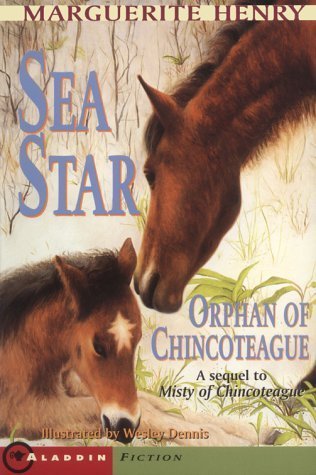 Title: Sea Star: Orphan of Chincoteague


 The Western Corner of the Castle